.webp)
How AI Recruitment Tools Improve Candidate Experience in 2026
Ever apply for a job, hear nothing for two weeks, and just... give up? You're not alone. Slow hiring, radio-silence communication, and endless manual busywork don't just annoy candidates they chase your best ones straight into a competitor's inbox. The result: frustrated applicants, rising hiring costs, and a talent pool that keeps getting smaller for all the wrong reasons.
Here's the twist: the fix isn't more effort it's less. AI recruitment tools handle the instant replies, automated interview scheduling, and faster candidate matching that keep people engaged instead of ghosted. In this guide, we break it down into a simple four-step approach to help your team boost application completion rates, keep candidates happy, and actually speed up hiring without working harder to do it.

 Updated: June 05, 2026 | 9 min read
 AI-Powered Candidate Experience Automation Workflow
| Workflow Stage | AI Automation Process |
| Step 1: Engage Candidates Instantly | Deploy Paradox (Olivia) to answer candidate questions, conduct conversational pre-screening, and automatically schedule interviews, eliminating communication delays from the first interaction. |
| Step 2: Provide 24/7 Candidate Support | Use Leena AI to deliver instant answers about company policies, benefits, hiring stages, and workplace information, reducing recruiter workload while improving responsiveness. |
| Step 3: Enable Self-Service Recruitment | Implement Personio to automate document collection, application tracking, onboarding tasks, and candidate self-service through a centralized portal. |
| Step 4: Continuously Improve the Experience | Use Lattice to automate post-interview surveys, analyze candidate sentiment, and identify recruitment bottlenecks for continuous process optimization. |
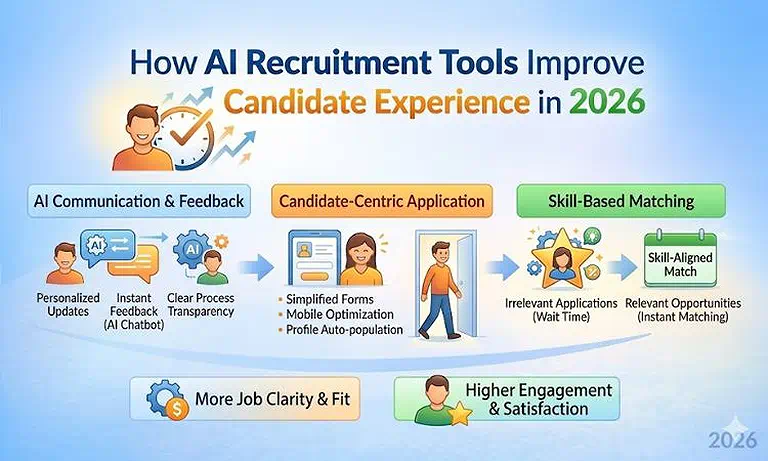
Cover Photo How AI Recruitment Tools Improve Candidate Experience in 2026
Who Should Read This Guide?
This guide is designed for organizations looking to improve every stage of the candidate journey through AI-powered recruitment automation. It is particularly valuable for:
- Talent Acquisition Leaders aiming to reduce candidate drop-off, improve hiring efficiency, and deliver a more engaging recruitment experience.
- HR Managers responsible for modernizing recruitment workflows, automating repetitive hiring tasks, and enhancing candidate satisfaction.
- Recruiters and Hiring Teams seeking to automate communication, interview scheduling, and applicant support while spending more time evaluating top talent.
- Growing Businesses and Enterprises scaling recruitment across multiple locations or high-volume hiring campaigns without increasing administrative workload.
- People Operations and HR Technology Teams evaluating AI recruitment platforms to build a faster, more consistent, and candidate-centric hiring process.
If your goal is to create a seamless candidate experience while reducing manual recruitment effort, this guide provides a practical AI implementation framework to help you achieve it.
The Hidden Problems Behind Poor Candidate Experience
Relying on manual applicant engagement creates hidden operational costs and weak candidate experience. When applicants receive no updates, they assume rejection and drop out. This increases abandonment, wastes sourcing budgets, and slows hiring. Prolonged vacancies also delay projects, reduce productivity, and place additional pressure on already stretched internal teams.
Many organizations still depend on spreadsheets and manual tracking for candidate communication. Fragmented systems and long application forms force repeated data entry and slow responses. These disconnected processes create delays, reduce efficiency, and frustrate top candidates, ultimately weakening the hiring pipeline and making it harder to secure high-quality talent quickly.
The Strategic Solution: The following structured, four-step framework resolves these scaling challenges permanently by weaving intuitive conversational intelligence into your core hiring workflow.
Step 1: Automated Communication via Paradox
Deploy conversational AI assistants directly onto your career portals to field candidate inquiries instantly.
These automated assistants guide applicants through conversational screening flows, answering natural language questions day or night.
This eliminates upfront form friction, ensuring candidates remain fully engaged from their very first interaction.
Step 2: Instant Employee and Candidate Support via Leena AI
Integrate context-aware support bots to handle complex candidate queries regarding company culture, benefits, and local operational policies.
By resolving localized, specific workspace inquiries automatically, you relieve core recruitment teams from repetitive, transactional ticketing loops.
Real-World Scenario: An engineering applicant queries an enterprise portal about hybrid work stipends at midnight. The autonomous assistant references the updated corporate policy repository and provides a definitive, accurate breakdown within five seconds.
Step 3: Candidate Self-Service Workflows via Personio
Transition your backend data flows into unified, automated self-service workspaces that empower candidates directly.
Automated pipelines push verified profiles forward, instantly triggering secure portals where candidates upload documentation and track their own background checks.
This transparent visibility removes operational ambiguity and drastically reduces inbound status-check emails to your team.
Step 4: Continuous Experience Feedback Loops via Lattice
Embed pulse sentiment checks directly after milestone recruitment actions to capture candidate impressions dynamically.
Automating short, post-interview feedback loops ensures you catch processing bottlenecks, communication gaps, or interviewer friction points in real-time.
TA leaders can quickly analyse these experience data points to refine system behaviours and maintain an agile, elite hiring standard.
Expected Results Timeline
| Timeline | Expected Outcome |
First 30 Days | Core conversational assistants go live, leading to an immediate reduction in early application drop-off rates. |
60 Days | Self-service candidate portals decrease administrative support requests and accelerate interview progression. |
90 Days | Measurable improvement in Candidate NPS, with significantly reduced time-to-hire across active recruitment pipelines. |
The Best Specialized AI Tools to Automate This Framework
Scaling a premium application journey requires a robust, specialized software infrastructure rather than fragmented manual tracking.
Paradox (Olivia)
Paradox utilizes its core AI persona, Olivia, to eliminate upfront application friction through ultra-responsive conversational engagement. This specialized system addresses Step 1 by automating continuous applicant communication, initial candidate pre-screening, and instant calendar synchronisation for interviews over SMS or web chat. Its high-speed interaction loop prevents top-tier candidate drop-off before profiles ever reach review stages. Read our comprehensive Paradox (Olivia) review to explore its capabilities.
Leena AI
Leena AI serves as an advanced autonomous support engine that unifies candidate and employee experience inquiries under a single, context-aware interface. The platform maps directly to Step 2 of our framework by delivering conversational answers to complex, policy-driven applicant questions while simultaneously automating backend HR workflow triggers. Its predictive intent matching ensures that prospective hires receive accurate corporate details without taxing human resources. Check out our in-depth Leena AI review for a full analysis.
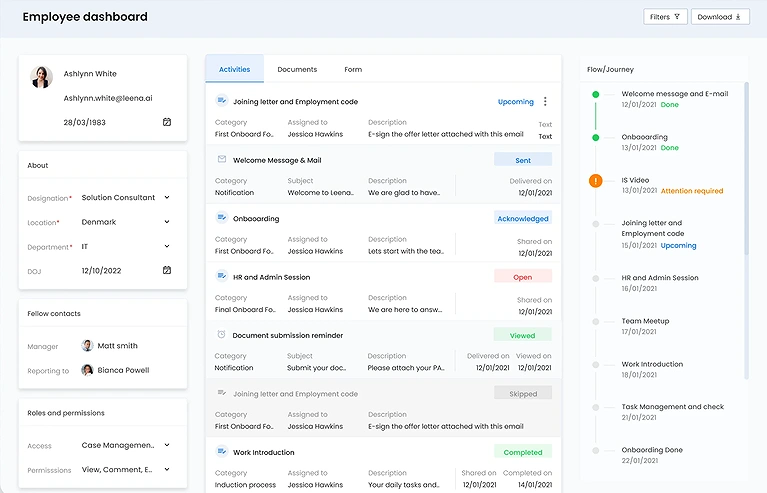
The Leena AI employee portal, displaying conversational workspace option, activities, and HR workflows.
Personio
Personio delivers an all-in-one HRIS and applicant tracking architecture built to scale automated self-service operations for growing companies. Moving applicants naively into Step 3, the platform digitises documentation handling, secure background check portals, and electronic offer signatures within a single repository. This structured data orchestration ensures that once a candidate is screened, their transition into onboarding requires zero manual data entry. Read our comprehensive Personio review to explore its capabilities.
Lattice
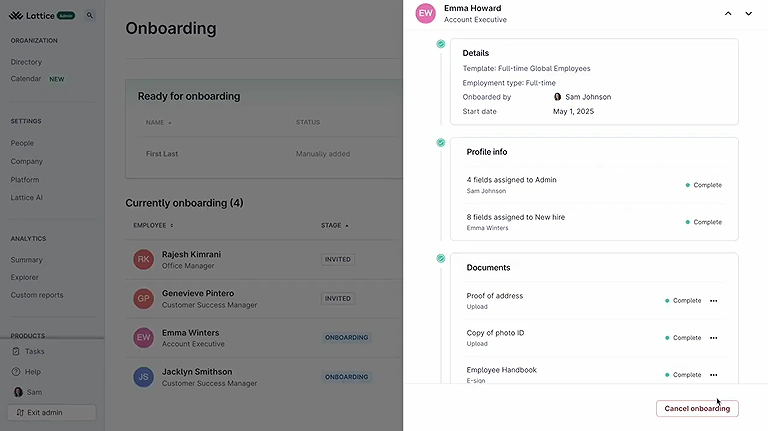
Lattice acts as the vital experience-tracking layer that closes the implementation framework for Step 4. By deploying automated post-interview pulse surveys and structured sentiment analysis, the software translates qualitative candidate experiences into hard, executive-level metrics. This gives talent acquisition teams immediate clarity on where interviewers or legacy process hurdles are disrupting closing rates. Check out our in-depth Lattice review for a full analysis.
Implementation Mistakes to Avoid
Over-Automation of Complex Rejection Touchpoints: Organizations frequently automate candidate rejections via cold, generic templates sent instantly upon algorithmic scoring. This alienates talent and tanks candidate Net Promoter Scores.
Prevention: Configure your workflow rules to include a natural temporal delay, and ensure executive or final-round rejections always receive human oversight with tailored development feedback.
Algorithmic Bias in Initial Conversational Screening: Blindly setting keyword-matching parameters within conversational chat triggers can inadvertently filter out non-traditional or highly diverse candidates. This occurs when underlying criteria value rigid background phrases over core competencies.
Prevention: Establish strict algorithmic governance; audit screening filters monthly and base conversational criteria entirely on verifiable, skills-based performance markers.
Recruitment Analytics Dashboard: Key Metrics to Monitor
| Metric | What It Measures | Why It Matters |
| Time-to-Hire | Days from application to accepted offer | Measures hiring speed |
| Candidate NPS | Candidate satisfaction | Evaluates recruitment experience |
| Screening Throughput | Time spent in screening | Identifies bottlenecks |
| Application Completion Rate | Completed applications | Measures engagement |
| Offer Acceptance Rate | Accepted offers | Indicates recruitment quality |
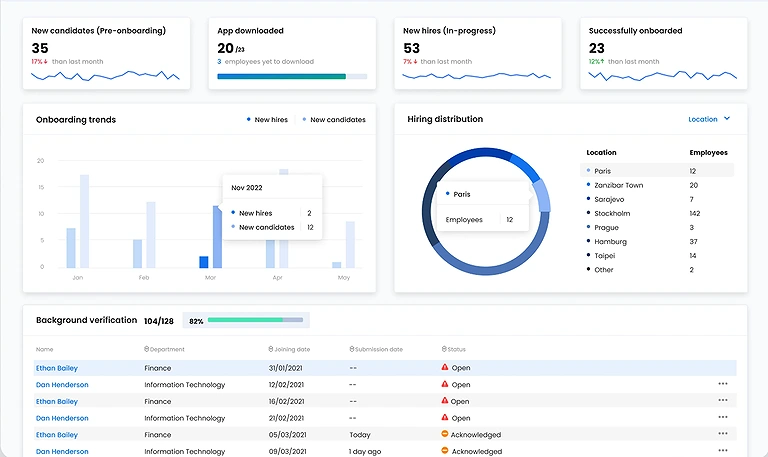
Most modern AI recruitment platforms provide real-time analytics dashboards that track these KPIs automatically. HR leaders should review these metrics regularly to identify bottlenecks, improve candidate engagement, and continuously optimize the recruitment process.
FAQs
What is the difference between a traditional recruiting chatbot and a conversational AI agent?
Conversational AI agents understand complex candidate intent and context to hold natural, fluid dialogues. Traditional chatbots rely entirely on rigid, pre-programmed script menus that break down and frustrate applicants when questions stray from a set path. Although this comparison focuses on recruitment technology, readers interested in how AI is transforming other industries can also explore AI vs Traditional Video Creation for a broader perspective on AI-driven automation.
How does conversational screening prevent top-tier applicant drop-off?
Conversational screening qualifies candidates instantly via mobile chat, removing long application forms that demand manual data re-entry. Replacing pipeline silence with real-time feedback keeps elite applicants fully engaged before they abandon the hiring track.
What should an organization do if an applicant objects to an AI-driven interview process?
Organizations must maintain human-led fallback paths within their compliance frameworks to accommodate applicants requesting alternative processing. Providing data transparency and clear opt-out mechanisms is essential to protecting the overall candidate experience.
How do autonomous recruitment platforms coordinate multi-person interview schedules instantly?
Autonomous platforms sync directly with internal hiring manager calendars to cross-reference multi-zone availability rules. The system texts the applicant a self-service scheduling link, instantly booking rooms and generating calendar invites globally without manual recruiter intervention.
Can conversational AI evaluate qualitative candidate sentiment during the application cycle?
Yes, modern engagement systems analyze phrasing and tone shifts when candidates submit feedback or inquiries through support portals. If an applicant expresses growing frustration regarding pipeline delays, the system flags the profile for human intervention.
How frequently should AI screening logic be audited to protect the candidate experience?
Hiring governance frameworks require automated screening audits at least every three months to ensure operational criteria remain fair. Regular checks evaluate historical outcomes against diverse datasets to verify filters prioritize verifiable, skills-based performance markers.
7. Can AI recruitment tools personalize the candidate experience for different roles?
Yes. Modern AI recruitment platforms tailor communication, interview scheduling, onboarding instructions, and job-related content based on the candidate's role, location, skills, and stage in the hiring process. This personalized approach improves engagement while ensuring every applicant receives relevant information without increasing recruiter workload.
8. How do AI recruitment platforms protect candidate data and privacy?
Enterprise AI recruitment tools support security standards such as role-based access controls, data encryption, audit logs, and compliance with regulations like GDPR and other regional privacy laws. Organizations should also establish data retention policies and regularly review access permissions to maintain candidate trust and regulatory compliance.
9. Can AI recruitment tools support multilingual and global hiring?
Yes. Many AI recruitment platforms provide multilingual conversations, localized communication, time zone awareness, and automated scheduling for candidates across different countries. This enables organizations to deliver a consistent recruitment experience while reducing language and geographical barriers.
10. How can organizations measure whether AI has improved the candidate experience?
Organizations should monitor metrics such as application completion rate, candidate satisfaction (Candidate NPS), interview scheduling time, response time to candidate inquiries, offer acceptance rate, and candidate drop-off rate. Tracking these KPIs before and after AI implementation provides a clear picture of improvements in both candidate experience and recruitment efficiency.
Streamlining Your Process Next
Audit your current candidate drop-off points immediately to identify exactly where talent exits your hiring funnel. Prioritize deploying a responsive conversational assistant to capture, engage, and screen incoming applicants without friction. Automating the initial touchpoints prevents candidates from leaving due to communication gaps or delayed responses. If you are looking to build out this automated ecosystem, mapping your technology stack through our guide to leading intelligent tools for elevating candidate engagement can help identify conversational AI solutions that keep candidates engaged 24/7. Once communication workflows are stabilized, integrate policy support modules and automated interview coordination systems to create a more efficient, consistent, and high-converting candidate journey.