.webp)
AI vs Traditional Video Creation: Critical Differences, Feature Comparisons, and Long-Term ROI Analysis
The choice between AI video creation and traditional video production is no longer just a discussion about human creativity versus automation. It has become a practical business decision focused on budget, production speed, and content scalability. For digital content teams, marketing agencies, and media companies aiming to build strong search visibility, understanding where these two production approaches overlap—and where they differ significantly—is essential.
As video continues to dominate search engines, social media platforms, advertising
channels, and online learning systems, organizations must determine how to use their resources effectively. This detailed comparison examines both production methods across important performance factors, technical capabilities, and long-term return on investment, helping businesses create an efficient and future-ready content production system.

 Updated: June 08, 2026 | 10 min read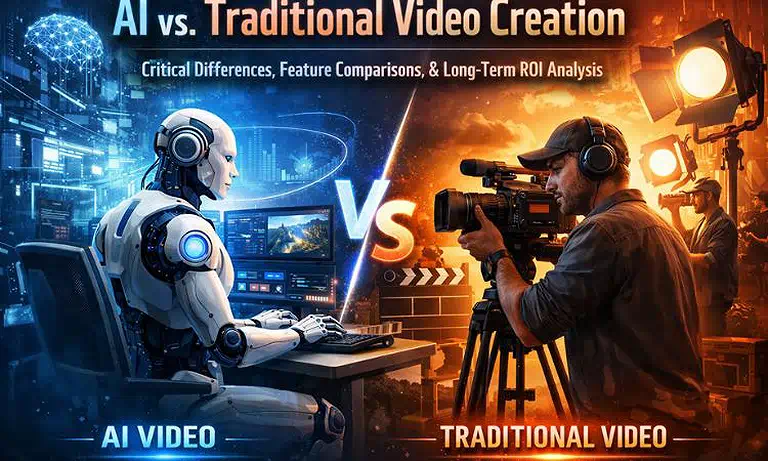
Cover Photo AI vs Traditional Video Creation: Critical Differences, Feature Comparisons, and Long-Term ROI Analysis
AI vs Traditional Video Creation: Quick Comparison
| If Your Goal Is | Best Production Approach |
| Premium brand commercials | Traditional video production |
| Documentary filmmaking | Traditional video production |
| Daily social media content | AI video creation |
| Multi-language training videos | AI video creation |
| Large-scale ad testing | AI video creation |
| Long-term brand growth | Hybrid production strategy |
What Is Traditional Video Creation?
Traditional video creation relies on physical equipment, production crews, actors, locations, and editing professionals to capture and refine footage. Cameras record real-world events, while editors assemble scenes, sound, graphics, and effects into a finished product through a largely linear workflow. This approach offers exceptional realism, creative control, and emotional authenticity. However, it is fundamentally resource-dependent, requiring significant investments in time, labor, equipment, and logistics.
What Is AI Video Creation?
AI video creation uses machine learning models to generate, edit, enhance, or localise video content through software-driven workflows. Instead of filming every scene, users create videos from text prompts, images, scripts, voice recordings, or existing footage. Software predicts and synthesizes imagery based on learned mathematical patterns from training data and user instructions. As a result, AI production is completely compute-dependent, bypassing physical staging to enable instant iteration and massive content variance.
The Core Difference Between AI and Traditional Production
1 Visual Content Creation
Traditional Video Production
Traditional video production creates visual content by capturing real-world scenes using physical cameras and human actors. Each shot is carefully planned, filmed, and then edited in a structured, step-by-step workflow. This process is linear and heavily dependent on physical resources, time, and production teams.
AI Video Creation
AI video creation generates or modifies visuals using computational systems instead of filming real events. It produces content by analyzing training data and responding to user prompts to synthesize new imagery. As a result, this method relies more on computing power and software capability rather than physical production resources.
2 Production Speed and Workflow Efficiency
One of the most significant advantages of shifting to an AI-assisted framework is the elimination of traditional post-production bottlenecks.
Traditional Workflow
A typical promotional video may require several stages:
- Planning and scripting
- Storyboarding
- Talent coordination
- Equipment setup
- Filming
- Editing
- Revisions
- Final delivery
Depending on project complexity, this process can take days or weeks.
AI Workflow
AI-powered platforms streamline these disjointed tasks into a unified environment. Teams can generate visuals, build voiceovers, translate content, edit scenes, and export final assets in a fraction of the time. For example, a content team can generate, edit, voice-over, and export a high-fidelity 2-minute video in under 15 minutes. This unprecedented turnaround time makes AI an essential asset for organizations producing large volumes of media.
3 Scalability Comparison
Scalability is where the financial and operational divergence between the two models becomes most apparent.
Traditional Production
Scaling production usually requires:
- More crew members
- Additional filming days
- Larger budgets
- More editing resources
- Increased operational complexity
As output grows, costs generally increase at a similar rate.
AI Production
AI systems decouple asset volume from human hours. Once a prompt framework or seed asset is built, generating multiple versions of the same content requires minimal additional effort. Teams can produce dozens of ad variations, separate language tracks, or vertical social media clips without repeating the production process. This capability enables rapid experimentation, continuous A/B testing, and broader audience targeting.
4 Visual Quality and Creative Control
Despite rapid software advancements, quality and technical control remain critical differentiators when evaluating your pipeline.
Traditional Video Quality
Traditional video production continues to provide:
- Authentic human performances
- Consistent visual continuity
- Real-world physics
- Precise cinematography
- Natural emotional expression
For premium storytelling and high-end branding, traditional production remains the industry benchmark.
AI Video Quality
Modern AI video tools can generate highly realistic visuals and cinematic effects. However, limitations still exist. Common challenges include:
- Keeping characters consistent across long scenes
- Rendering accurate hand movements and interactions
- Handling complex, physics-based motion sequences
- Maintaining fine facial details during long or extended actions
Although these limitations continue to improve, organizations should evaluate quality requirements before relying entirely on AI-generated content.
Technical Feature Matchup
| Feature / Metric | Traditional Video Production | AI-Driven Video Production |
| Production Speed | Days to weeks | Minutes to hours |
| Equipment Requirements | High (cameras, lighting, audio gear) | Minimal (browser and internet connection) |
| Language Localization | Manual (voice actors and dubbing) | Automated (voice cloning and lip-syncing) |
| Content Scaling | Limited by human effort and time | Highly scalable through computing power |
| Iteration Speed | Slow (requires reshoots or re-editing) | Fast (instant prompt-based changes) |
| Human Authenticity | Highly natural and emotionally precise | Improving, but may show minor visual artifacts |
Long-Term ROI Analysis
When building a long-term media strategy, calculating the Return on Investment (ROI) requires evaluating upfront capital expenditures against the life cycle value of the assets produced.
Traditional Video ROI: The Premium Anchor Model
Traditional production requires high upfront capital expenditures, typically ranging from $1,500 to upwards of $10,000 per finished minute. Because these expenses are tied to real-world infrastructure and labor hours, the unit cost remains stagnant.
However, traditional workflows yield high long-term ROI for premium, evergreen anchor assets—such as core brand films, executive communications, or cinematic hero commercials. These assets build foundational brand equity, convert high-value clients, and carry an emotional resonance that purely synthetic workflows cannot yet reliably emulate.
AI Video ROI: The High-Volume Velocity Model
AI-driven video models offer incredibly low, predictable operational expenses driven by SaaS subscription tiers. The cost per generated minute drops drastically, hovering between $0.50 and $5.00 depending on platform selection.
For high-volume content strategies—such as dynamic social ads, faceless YouTube channels, personalized email marketing videos, and enterprise learning management systems (LMS)—AI video delivers an exponential ROI curve. It allows teams to test hundreds of creative variables simultaneously, optimizing ad spend and audience retention algorithms in real time without blowing out production budgets.
Critical Traps to Avoid
The "Professional Mode" Tax: Many platforms advertise cheap per-clip rates based on low-quality standard settings. For instance, Kling AI's high-quality Professional Mode costs 3.5x more credits per second than its standard mode, rapidly draining starter plans.
The Trial-and-Error Buffer: Because AI video rarely gives you the perfect shot on the first prompt, creators should budget a 25% to 30% credit waste buffer for failed generations or visual anomalies.
The Rollover Trap: Standard subscription credits for Runway and Kling do not roll over at the end of the billing cycle. If you don't use them, you lose them.
How AI Video Tools Solve Common Production Challenges?
Cinematic B-Roll & Visual Assets: Traditional crews spend hours traveling or chasing golden-hour lighting. Creators can bypass this by using Runway or Luma Dream Machine to generate hyper-realistic, multi-axis camera pan footage instantly from an image or phrase.
Short-Form Distribution Scaling: Manually scrubbing through an hour-long traditional webinar to find viral clips takes an editor hours. Opus Clip automates this completely, scrubbing long-form footage with one click to isolate high-retention hooks and auto-generate styled captions for TikTok and YouTube Shorts.
Corporate Training & Localization: Traditional corporate training updates require rehiring actors and re-booking sound booths for multi-language dubbing. Platforms like HeyGen and Synthesia bypass this entirely, providing teams with digital avatars capable of speaking over 40 languages with flawless vocal cloning and lip-sync.
When Traditional Video Production Still Wins
Despite rapid AI advancement, several categories continue to favor traditional production.
Documentary Storytelling: Authentic footage and real-world events remain critical for documentaries and journalism.
Luxury Branding: Premium brands often require complete control over every production element, including talent, lighting, cinematography, and location selection.
Live Events: Conferences, sports events, interviews, and live experiences rely heavily on real-world capture.
Emotional Narrative Content: Complex storytelling and nuanced human performances still benefit significantly from traditional film making techniques.
Building a Hybrid Video Production Strategy
For most organizations, the most effective video production strategy is not choosing between AI and traditional workflows. Instead, it is combining both approaches to maximize quality, efficiency, and scalability.
Traditional production excels at creating high-value foundational content, while AI tools accelerate editing, localization, repurposing, and distribution. Together, they form a hybrid production framework capable of supporting both premium brand storytelling and high-volume content marketing.
The Hybrid Production Framework
A successful hybrid workflow typically operates in two stages:
1. Foundational Asset Creation (Traditional Production)
The process begins with creating a flagship content asset using traditional production methods. This may include a brand film, an executive interview, a product demonstration, a webinar, a keynote presentation, or a customer success story.
By capturing real-world footage, authentic human interactions, and professional cinematography, organizations establish a high-quality source asset that serves as the foundation for future content initiatives.
2. Content Scaling and Distribution (AI Automation)
Once the core asset is complete, AI-powered tools help transform a single piece of content into multiple formats tailored for different audiences and platforms.
a) Short-Form Content Repurposing: AI editing platforms can automatically identify key moments, generate captions, and reformat long-form videos into vertical content optimized for YouTube Shorts, TikTok, Instagram Reels, and other social platforms.
b) Multi-Language Localization: AI translation and avatar platforms enable organizations to adapt content for global audiences by generating localized voiceovers, subtitles, and presenter-led videos without requiring extensive re-recording.
c) Creative Testing and Ad Variations: AI video tools can rapidly generate alternative visuals, aspect ratios, and creative variations, allowing marketing teams to test multiple campaign concepts more efficiently.
Why the Hybrid Model Works
The hybrid approach combines the authenticity and production quality of traditional video creation with the speed and scalability of AI-driven workflows. Instead of repeatedly investing resources into new productions, organizations can extend the value of a single flagship asset across multiple channels, formats, and markets. As a result, teams can increase content output, improve distribution efficiency, and support long-term audience growth without sacrificing quality where it matters most.
FAQs
Can AI completely replace traditional video production?
No. AI excels at scalability, automation, localisation, and rapid content creation. Traditional production remains essential for premium storytelling, documentary work, live events, and high-end luxury branding projects where complete control over real-world elements is non-negotiable.
Is AI-generated video suitable for commercial use?
Yes, but it depends on your plan and platform selection. Most major AI platforms grant full commercial licensing options exclusively on their paid subscription tiers. Organisations must verify training data policies and intellectual property terms before deployment to ensure commercial compliance.
Which approach is more cost-effective?
For high-volume content production, localized training portfolios, and short-form social media assets, AI video creation provides vastly superior operational efficiency. For flagship brand assets and long-term credibility, traditional production generates stronger long-term value.
What is the best strategy for businesses in 2026?
Most organizations benefit from a hybrid approach that combines traditional production for core assets with AI workflows for scaling, distribution, localization, and continuous optimization of variation.
How does AI video production improve content marketing performance?
AI video production improves marketing performance by enabling faster content creation, rapid A/B testing, and large-scale personalization. It allows businesses to generate multiple variations of ads and tailor content for different audiences, which increases engagement and conversion rates.
What are the main risks of relying only on AI-generated video?
Relying only on AI-generated video can lead to limitations in emotional depth, visual accuracy, and brand uniqueness. There may also be concerns around intellectual property, content authenticity, and occasional visual artifacts that reduce overall production quality.
Conclusion
AI video creation and traditional video production are used for different business goals. Traditional workflows still offer unmatched realness, creative accuracy, and strong storytelling quality. AI systems provide speed, scalability, and operational efficiency that were not possible before at large scale. Instead of seeing both as rivals, companies should use them as supporting tools in a modern content system. Businesses that mix traditional production with AI workflows can produce more content, reach wider audiences, and improve long-term return on investment in a video-first digital world.