.webp)
Lattice Review 2026: Features, Pricing & Performance Analysis
Quick question: when was the last time your "annual performance review" told an employee something they didn't already know? If you're drawing a blank, you're not alone most performance systems are elaborate paperwork generators dressed up as insight engines. Managers burn hours writing evaluations nobody rereads, feedback arrives so late it's basically archaeology, and "measurable growth" is nowhere to be found. Fragmented reviews, disconnected feedback loops, manual tracking less a system, more an expensive filing exercise.
The HCM market has noticed, and it's racing toward AI-driven, unified talent ecosystems that turn real-time employee data into decisions you can act on. Enter
Lattice a platform betting it can fix performance, engagement, calibration, and culture in one place instead of five disconnected tools pretending to talk to each other. This review is built for CPOs, HR Ops leaders, and enterprise buyers asking one question: does Lattice actually scale, or is it just really good marketing? Let's find out.

 Updated: May 25, 2026 | 21 min read
 Key Takeaways
- Lattice is built around continuous performance management rather than annual employee evaluations.
- One-on-one meetings, goals, feedback, performance reviews, and engagement surveys are closely connected instead of operating as isolated modules.
- Managers receive structured tools to support coaching and employee development throughout the year.
- HR teams gain visibility into engagement, performance trends, and organizational development through centralized reporting.
- The platform is particularly valuable for companies investing in employee growth, leadership development, and retention.
- Organizations that only require basic HR administration may find Lattice more comprehensive than necessary.
- Its long-term value depends on consistent adoption by both managers and employees not simply deploying the software.
Cover Photo Lattice Review 2026: Features, Pricing & Performance Analysis
Quick Review Table
| Review Factor | Review Result |
Core Strength | Combines performance reviews, OKRs, 1:1s, feedback, and engagement tools in a single AI-assisted workflow platform. |
Primary Limitation | Lacks payroll, benefits, and full HRIS depth; best used alongside Workday or BambooHR, not as a system of record. |
Target Scale | Best suited for mid-market and enterprise organizations running structured performance cycles and manager workflows. |
Pricing Model | Starts around $6–$11 per employee/month with ~$4,000 annual minimum contract requirement. |
Top Compliance | Meets enterprise-grade security standards suitable for global workforce data protection and compliance needs. |
Deployment Channel | Fully web-based with deep integrations into Slack, Teams, Workday, BambooHR, and other HR tools. |
Overall Score | Strong best-in-class performance management platform, but limited by cost floor and lack of HRIS capabilities. |
We Used the Evaluation Criteria
To provide a balanced and practical review, we evaluated Lattice using the same methodology applied across our software reviews. Rather than focusing only on its feature list, we assessed how well the platform performs throughout the entire employee lifecycle from implementation and day-to-day usability to AI capabilities, integrations, scalability, pricing, and long-term business value. Our goal was to determine not only what Lattice offers, but how effectively it supports real-world HR and people management workflows.
Our Evaluation Criteria
- Core Features – Evaluated the depth and usability of performance reviews, continuous feedback, goal management (OKRs), employee engagement, career development, compensation planning, one-on-one meetings, and people analytics.
- Setup & Implementation – Assessed onboarding experience, HRIS integration, implementation complexity, administrator configuration, and the time required to deploy the platform successfully.
- User Experience – Reviewed dashboard design, navigation, workflow efficiency, role-based experiences, accessibility, and overall ease of use for employees, managers, and HR administrators.
- AI Capabilities – Analyzed AI-powered review summaries, writing assistance, goal recommendations, workforce insights, and how effectively AI reduces administrative effort.
- Customization & Flexibility – Examined how easily organizations can customize review cycles, competencies, workflows, permissions, surveys, and organizational structures to match their HR processes.
- Integration Ecosystem – Evaluated compatibility with HRIS platforms, applicant tracking systems (ATS), payroll software, identity providers, collaboration tools, and third-party business applications.
- Reporting & People Analytics – Reviewed the quality of workforce analytics, engagement reporting, performance dashboards, executive insights, and decision-support capabilities.
- Scalability – Assessed how well Lattice supports growing organizations, distributed teams, enterprise governance, and increasing operational complexity.
- Security & Administration – Considered enterprise security features, role-based access controls, Single Sign-On (SSO), user management, and administrative controls.
- Pricing & Overall Value – Evaluated pricing structure, modular licensing, expected return on investment, suitability for different organization sizes, and overall value compared with similar people management platforms.
What Is Lattice Review ?
Lattice is an AI-powered people management and performance platform designed to help organizations improve employee performance, engagement, career development, and compensation planning from a single workspace. Instead of relying on disconnected HR tools, Lattice combines performance reviews, employee feedback, goal tracking, analytics, and HR workflows into one unified system that supports managers, HR teams, and employees throughout the entire employee lifecycle.
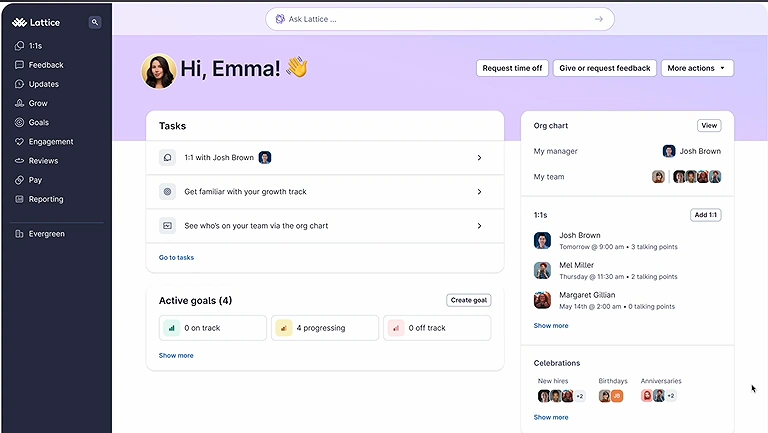
Overview of the Lattice platform user homepage interface for Emma Howard.
Company Snapshot
| Category | Details |
| Company | Lattice |
| Founded | 2015 |
| Headquarters | San Francisco, California, USA |
| Primary Category | People Management & HR Software |
| Best For | Mid-sized businesses and enterprise organizations |
| Core Users | HR teams, People Operations, Managers, Executives |
| Deployment | Cloud-based (SaaS) |
| AI Capabilities | AI-assisted reviews, feedback summaries, goal writing, HR insights, employee analytics |
| Integrations | Workday, BambooHR, ADP, Slack, Microsoft Teams, Okta, Greenhouse, Rippling, and 100+ business tools |
What Problem Does It Solve?
As organizations grow, managing employee performance, engagement, and career development across spreadsheets and disconnected HR systems becomes inefficient. Lattice centralizes these processes into one platform, helping HR teams and managers run structured performance reviews, collect continuous feedback, align employee goals with business objectives, measure engagement, and make data-driven people decisions.
Lattice helps organizations:
- Eliminate manual performance review processes
- Align company, team, and individual goals
- Collect continuous employee feedback throughout the year
- Measure engagement using surveys and analytics
- Support employee growth with career development plans
- Improve manager effectiveness through actionable insights
- Simplify compensation and talent review cycles
- Generate AI-powered summaries and recommendations to reduce administrative work
How Lattice Works ?
Lattice acts as a centralized employee experience platform where HR teams configure performance cycles, engagement surveys, goals, career frameworks, and compensation workflows. Employees update goals, request feedback, complete reviews, participate in surveys, and track career development within the platform, while managers receive AI-assisted summaries, coaching suggestions, and performance insights. Leadership gains access to workforce analytics dashboards that highlight engagement trends, performance distributions, retention risks, and organizational health metrics, enabling more informed talent decisions. Integrations with HRIS, communication, and productivity platforms keep employee data synchronized while reducing manual administration.
Why Enterprises Choose Lattice ?
- Centralizes multiple people management functions in one platform
- AI-powered performance review assistance reduces administrative workload
- Supports continuous feedback instead of annual-only evaluations
- Strong goal-setting (OKRs) and employee development capabilities
- Advanced people analytics for HR and executive leadership
- Customizable review cycles and competency frameworks
- Enterprise-grade security, permissions, and compliance features
- Extensive integrations with leading HRIS, payroll, ATS, and collaboration platforms
- Scales effectively from growing companies to large global organizations
- Helps improve employee engagement, retention, and performance through data-driven insights
Setup, Deployment & User Experience
Onboarding
Lattice offers a guided onboarding process designed for HR teams and administrators. Organizations typically begin by connecting their HRIS, importing employee records, configuring organizational structures, and customizing performance review cycles, goals, competencies, and engagement surveys. Built-in templates, implementation specialists, and knowledge resources help reduce setup complexity, allowing teams to adopt the platform without extensive technical expertise while ensuring a consistent employee experience.
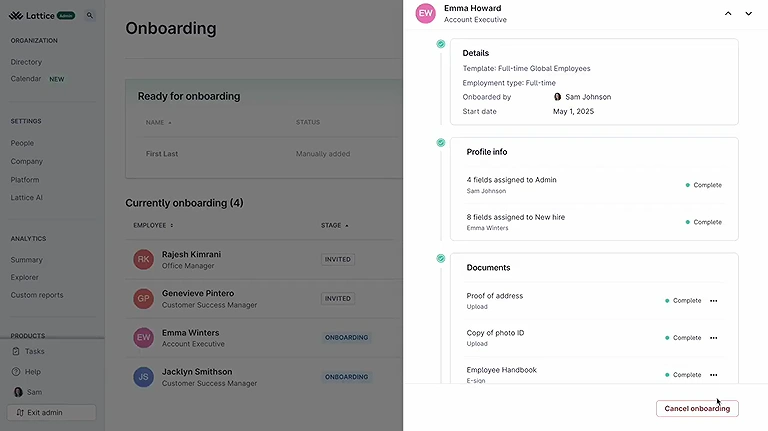
Lattice AI tool interface demonstrating automated new hire onboarding workflows and task tracking.
Implementation Timeline
While agile startups can go live with basic feedback modules in 2 to 3 weeks, enterprise deployments require a more realistic 6 to 10 weeks. This timeline accounts for structural setup parameters, calibration group configuration, historical review data ingestion, and custom SSO/SCIM provisioning.
| Organization Size | Estimated Implementation Time | Typical Activities |
| Small Business (50–200 employees) | 1–2 weeks | HRIS integration, employee import, review setup, manager training |
| Mid-Market (200–1,000 employees) | 2–6 weeks | Performance frameworks, goals, surveys, permissions, workflow customization |
| Enterprise (1,000+ employees) | 6–12+ weeks | Multi-region configuration, SSO, advanced integrations, security reviews, change management, administrator training |
Dashboard & UX
Lattice provides a clean, role-based dashboard that adapts to employees, managers, HR administrators, and executives. Employees can manage goals, feedback, career development, and review tasks from a single interface, while managers gain visibility into team performance, engagement, and one-on-one meetings. HR leaders access organization-wide analytics, participation metrics, talent insights, and AI-generated summaries that simplify workforce management and decision-making without navigating multiple systems.
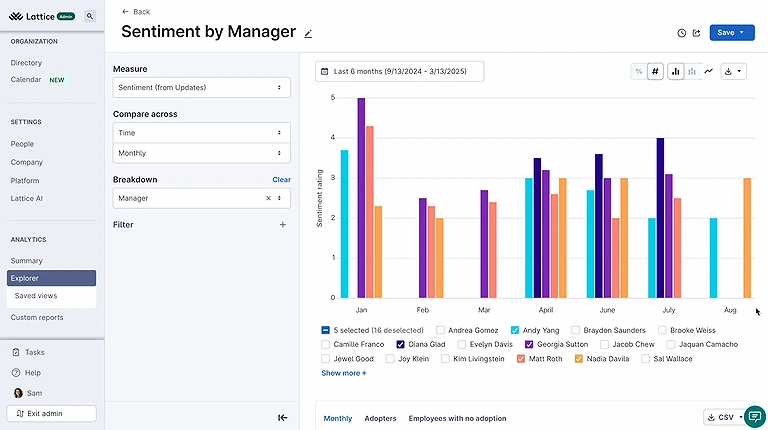
: The Lattice analytics dashboard illustrating employee sentiment analysis and manager effectiveness drivers
Deployment Requirements
- Cloud-based SaaS platform with no on-premises infrastructure required
- Modern web browser (Chrome, Edge, Firefox, or Safari)
- Stable internet connection
- HRIS integration for employee data synchronization (optional but recommended)
- Single Sign-On (SSO) support through providers like Okta, Microsoft Entra ID (Azure AD), or Google Workspace
- Administrator permissions for workspace configuration and user provisioning
- Email access for notifications, review reminders, and workflow approvals
- Optional integrations with Slack, Microsoft Teams, payroll, ATS, and productivity platforms
- Role-based access controls for secure employee and HR data management
- Initial administrator and manager training to maximize platform adoption
Core Features Granular Breakdown
Feature 1: Performance Management & Talent Calibration
Lattice excels at structured 360-degree reviews, peer feedback, manager evaluations, and calibration workflows through its flexible rules-based performance engine. However, the platform is less effective for highly fluid freelance or project-based teams because its architecture is optimized around stable organizational hierarchies and enterprise reporting structures.
Feature 2: The Lattice AI Agent & Contextual Synthesis
Lattice uses HR-focused AI agents powered by advanced LLMs to generate evidence-based performance reviews using data from 1:1 meetings, feedback logs, and status updates. By transforming year-long employee activity into objective summaries, the platform reduces managerial workload, improves review consistency, and minimizes recency bias in evaluations.
Feature 3: Grow & Succession Planning
Lattice aligns employee development with long-term leadership pipelines using integrated skill mapping. By mapping sentiment data against performance metrics, the platform builds predictive retention risk profiles for team leads. This granular focus places it among the top AI talent management solutions currently optimising internal mobility, tracking attrition, and securing business-critical succession coverage.
Feature 4: Platform Security, Compliance & Signatures
Lattice manages sensitive employee data with enterprise-grade security and compliance controls, including SOC 2 Type II, ISO 27001, GDPR, and CCPA adherence. It supports SAML SSO, SCIM provisioning, and role-based access control, while providing audit able employee signatures with timestamped review acknowledgements for secure and compliant performance documentation.
Integration Ecosystem
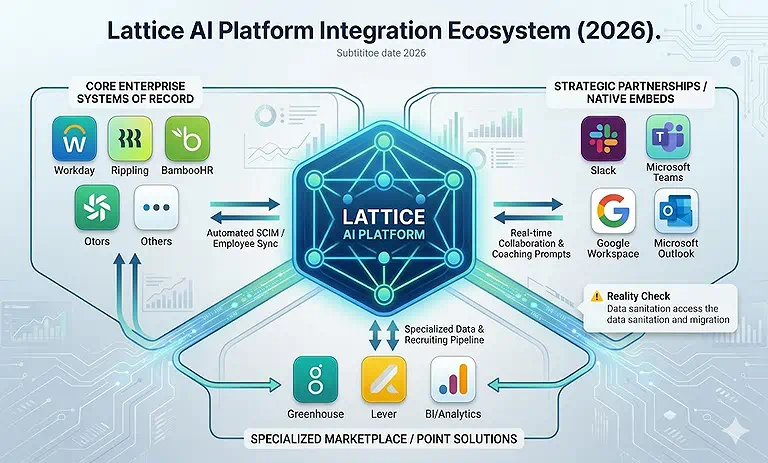
The Lattice framework connects directly to an enterprise tech stack, pulling core identity records from systems of record and pushing real-time coaching prompts out to everyday communication platforms.
Workday / Rippling: Native, bidirectional API integrations that keep employee records and organizational charts dynamically aligned.
BambooHR / HiBob / SAP SuccessFactors: Automated daily directory syncing to ensure mid-market records transfer seamlessly without manual entry.
Slack / Microsoft Teams: Deeply integrated operational portals that allow employees to submit weekly updates, write praise, and track 1:1 goals directly inside chat channels.
Google Workspace / Microsoft Outlook: Direct calendar integrations that automatically generate and attach shared 1:1 agendas to active meeting invitations.
undefined
Key Integrations
| Integration | Supported | Primary Use |
| Workday | ✔ | Employee data synchronization |
| SAP SuccessFactors | ✔ | HRIS and workforce management |
| BambooHR | ✔ | Employee records and onboarding |
| ADP Workforce Now | ✔ | Payroll and HR data sync |
| Rippling | ✔ | HRIS and employee lifecycle management |
| Greenhouse | ✔ | Applicant tracking and hiring workflows |
| Lever | ✔ | Recruitment and candidate management |
| Slack | ✔ | Notifications, feedback, and reminders |
| Microsoft Teams | ✔ | Collaboration and workflow notifications |
| Microsoft Entra ID (Azure AD) | ✔ | Single Sign-On (SSO) and user provisioning |
| Okta | ✔ | Identity management and secure authentication |
| Google Workspace | ✔ | Authentication and user management |
| Jira | ✔ | Goal alignment and project visibility (selected workflows) |
Implementation Reality Check
While Lattice offers a strong integration ecosystem, some enterprise integrations and advanced workflow automations may require higher-tier plans, API configuration, or implementation assistance. Organizations with highly customized HR processes should verify connector capabilities and licensing requirements before deployment.
Real-World Use Cases
Typical Workflow
| Stage | What Happens |
| Employee Data Sync | HR imports employees from the HRIS and configures teams, reporting structures, and permissions. |
| Configure Performance Programs | HR creates review cycles, competencies, goals (OKRs), engagement surveys, and development plans. |
| Set Individual & Team Goals | Managers and employees establish measurable objectives aligned with company priorities. |
| Continuous Feedback | Employees and managers exchange real-time feedback, recognition, and coaching throughout the review period. |
| One-on-One Meetings | Managers conduct regular check-ins, document discussions, and monitor employee progress. |
| Performance Reviews | Self, peer, manager, and upward reviews are completed using customizable workflows and AI-assisted summaries. |
| Talent & Compensation Planning | HR and leadership evaluate performance, identify high-potential employees, and plan promotions or compensation adjustments. |
| Analytics & Action Planning | Leadership reviews engagement trends, performance insights, and workforce analytics to improve organizational effectiveness. |
Business Scenarios
Continuous Performance Management
Best For: Technology companies, SaaS businesses, consulting firms, HR teams, department managers
Organizations use Lattice to replace annual performance reviews with continuous feedback and structured check-ins. Managers can monitor employee progress, provide coaching throughout the year, and identify performance issues earlier, creating a more consistent and transparent evaluation process for growing teams.
Goal Alignment Across Departments
Best For: Mid-market companies, enterprise organizations, executive leadership, operations teams
Lattice helps organizations connect company objectives with department and individual goals. Leaders gain visibility into organizational progress while managers ensure employees understand how their work contributes to broader business priorities, reducing misalignment across teams.
Employee Engagement Programs
Best For: HR departments, People Operations teams, hybrid and remote organizations
Companies use engagement surveys and sentiment analytics to understand employee satisfaction, identify workplace challenges, and measure organizational health. HR teams can prioritize improvements using real participation data instead of relying on assumptions or informal feedback.
Career Development & Growth Planning
Best For: Knowledge-based businesses, professional services, software companies, corporate HR
Managers create structured development plans, competency frameworks, and career conversations that help employees understand growth opportunities. This supports long-term retention by providing clearer career paths and measurable development goals.
Talent Review & Succession Planning
Best For: Enterprise HR teams, leadership groups, multinational organizations
Organizations use performance data, feedback history, and talent assessments to identify future leaders and high-performing employees. Structured talent reviews improve promotion decisions while helping leadership plan for key business roles.
Compensation Review Cycles
Best For: HR leaders, finance teams, executive management
Lattice centralizes compensation planning alongside performance data, making salary reviews, promotions, and merit increases more consistent. Decision-makers can compare employee contributions using standardized performance information rather than isolated spreadsheets.
Manager Coaching & Team Development
Best For: Department managers, team leads, people managers
Managers use one-on-one meeting templates, coaching notes, and continuous feedback tools to improve communication with employees. This creates regular development conversations instead of limiting discussions to formal review periods.
Multi-Location Workforce Management
Best For: Global enterprises, distributed teams, international organizations
Organizations with employees across multiple offices use Lattice to standardize performance reviews, engagement programs, and development processes while maintaining consistent HR practices across regions and departments.
HR Analytics & Executive Reporting
Best For: CHROs, HR analysts, executive leadership
Leadership teams rely on Lattice dashboards to monitor engagement, review completion, performance trends, retention indicators, and workforce health. These insights support strategic planning with measurable people data rather than manual reporting.
Mergers, Growth & Organizational Scaling
Best For: Fast-growing companies, scale-ups, expanding enterprises
Rapidly growing organizations use Lattice to standardize performance management as headcount increases. Centralized workflows, automation, and integrations reduce administrative effort while maintaining consistency during hiring, restructuring, or expansion.
Best Organization Size
| Organization Size | Recommendation | Why? |
| Startup | ⚠ Depends on Needs | Suitable for people-focused startups, but pricing and advanced features may exceed the needs of very small teams. |
| Small Business | ✔ Recommended | Provides structured performance management and engagement tools without requiring enterprise-scale HR infrastructure. |
| Mid-Market | ✔ Highly Recommended | Offers an excellent balance of automation, integrations, analytics, and scalability for growing organizations. |
| Enterprise | ✔ Highly Recommended | Built to support complex organizational structures, advanced HR workflows, enterprise security, and large-scale workforce management. |
Financial Breakdown
Pricing Structure
Lattice utilizes a Per-Employee Per-Month (PEPM) SaaS model, billed strictly on upfront annual contracts. The software is modular, requiring buyers to purchase a primary package before layering on advanced culture and career modules.
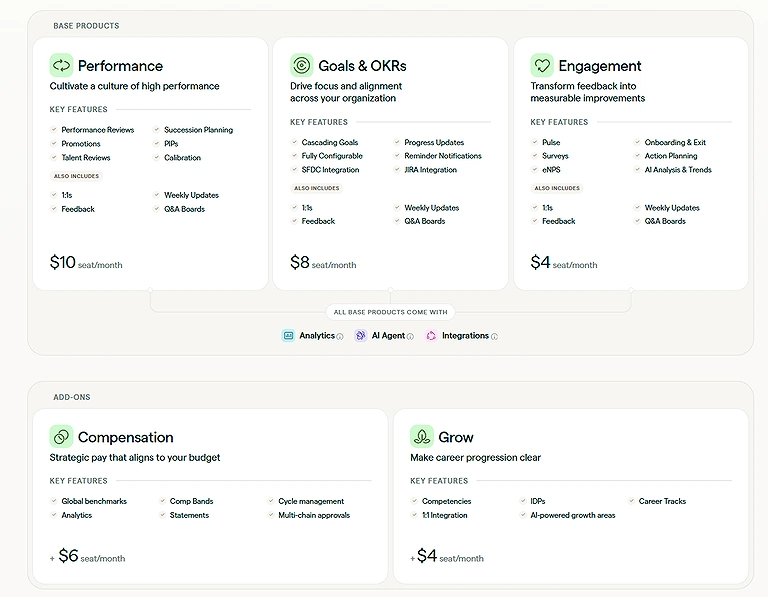
Lattice platform pricing plans displaying modular tiers for talent management, engagement, compensation, and add-on suites.
Cost Benchmarks
| Module / Package Layer | Price per User / Month | Key Features Included |
| Talent Management (Base Core) | $11.00 | Performance reviews, 360s, OKRs, 1:1s, foundational AI. |
| Engagement (Add-on) | $4.00 | Pulse surveys, eNPS tracking, onboarding/exit analytics. |
| Grow (Add-on) | $4.00 | Competency matrices, career pathing models, personal IDPs. |
| Compensation (Add-on) | $6.00 | Merit cycle management, budget analytics, pay bands. |
| Lattice Core AI (Premium Layer) | $6.00 | Full Agentic workflow synthesis, coaching prompts, draft generators. |
Crucial Enterprise Minimum Spending Requirement: Lattice enforces a rigid minimum annual commitment floor of $4,000/year. For small teams or boutique firms whose seat counts mathematically fall short of this limit, the true per-seat pricing will scale up to match the $4,000 minimum contract requirement.
Hidden Costs & Resource Drags
System Setup & Implementation Fees: Mid-sized teams should anticipate between $2,000 and $7,000 for structured deployment, data mapping, and custom training sessions led by Lattice implementation consultants.
Data Pipeline Upkeep: Because Lattice discontinued its native HRIS and payroll products, engineering teams must dedicate internal technical resources to manage and monitor external API connections, ensuring data stays consistent across tools.
Deep-Dive Strengths and Trade-Offs
Strengths
Elite Multi-Source Data Synthesis: The Lattice AI Agent contextualizes employee evaluations by accurately synthesizing a year's worth of multi-source feedback data, eliminating personal bias.
Seamless Collaborative Flow: Integrates directly with Slack and Microsoft Teams, allowing users to capture feedback and complete updates within their existing daily workflows.
Highly Advanced Calibration Tooling: Provides enterprise administrators with powerful visual calibration matrices to ensure fair performance evaluations across large, distributed divisions.
Excellent Compliance Frameworks: Delivers premium data security via auditable signature tracking, SOC 2 Type II standards, and advanced enterprise permission settings.
Trade-Offs
Significant Total Cost Escalation: Because of its modular pricing structure, adding essential layers like Engagement, Grow, and Compensation can quickly double the baseline subscription rate.
Uncompromising Contract Minimums: The mandatory $4,000 annual spending floor makes the platform highly cost-prohibitive for smaller businesses or early-stage startups.
Integration Dependencies: Following the sunset of its native HRIS and payroll modules, users must rely entirely on third-party connections to handle core employee database changes.
Significant Initial Training Curve: Fully leveraging the platform’s advanced competency matrices and succession tools requires a focused, multi-week internal rollout and manager training initiative.
Market Positioning: Where Lattice Fits in the People Management Market
Modern HR technology has evolved far beyond digital employee records. Organizations now expect software that not only manages HR processes but also improves employee performance, engagement, development, and retention through data-driven insights. As a result, the market has split into several specialized categories, each solving different workforce challenges. Understanding these categories helps buyers avoid investing in software that excels in one area but lacks capabilities they need elsewhere. Lattice positions itself as a People Success Platform, combining performance management, employee engagement, career development, and people analytics into a unified solution rather than focusing solely on HR administration or payroll.
Category Analysis
People Success Platforms
People Success Platforms focus on improving employee performance, engagement, growth, and retention throughout the employee lifecycle. Rather than acting as a traditional HR database, these platforms provide continuous feedback, performance reviews, goal management, engagement surveys, career development, and workforce analytics in a single environment. They are designed for organizations that want to build stronger management practices and make people decisions using measurable data instead of annual reviews and spreadsheets.
Best Suited For
- Mid-sized businesses
- Enterprise organizations
- HR and People Operations teams
- Knowledge-based companies
- Hybrid and remote workforces
- Organizations prioritizing employee development
Typical Capabilities
- Continuous performance management
- Goal and OKR tracking
- Employee engagement surveys
- Career development planning
- AI-assisted review summaries
- Workforce analytics and reporting
- Manager coaching workflows
Example Products
Lattice , Culture Amp , Leapsome , Betterworks ,15Five
Human Resource Information Systems (HRIS)
HRIS platforms serve as the operational foundation for employee data management. Their primary responsibility is maintaining employee records, payroll information, benefits administration, attendance, compliance, onboarding, and workforce administration. While many HRIS solutions include basic performance review modules, they generally prioritize operational efficiency over employee development and engagement. Organizations often pair an HRIS with a dedicated performance management platform when they need more advanced people management capabilities.
Best Suited For
- Businesses of all sizes
- HR administration teams
- Payroll departments
- Compliance-focused organizations
- Companies managing employee records
- Multi-location businesses
Typical Capabilities
- Employee database management
- Payroll integration
- Benefits administration
- Time and attendance tracking
- Compliance reporting
- Employee onboarding
- Organizational structure management
Example Products
Workday , BambooHR ,Rippling , ADP Workforce Now ,SAP SuccessFactors
Employee Engagement Platforms
Employee engagement platforms primarily measure workplace sentiment and organizational health through surveys, feedback collection, pulse checks, and employee listening programs. Their objective is helping organizations understand employee satisfaction, identify engagement risks, and improve workplace culture. While some include lightweight performance tools, they generally do not provide the comprehensive performance management and career development workflows found in broader People Success Platforms.
Best Suited For
- HR teams
- Employee experience leaders
- Remote organizations
- Corporate communications teams
- Large enterprises
- Culture-focused organizations
Typical Capabilities
- Pulse surveys
- Employee sentiment analysis
- Anonymous feedback
- Engagement reporting
- Benchmarking
- Action planning
- Organizational health dashboards
Example Products
Culture Amp ,Peakon (Workday) ,Glint ,Qualtrics EmployeeXM ,Workleap
OKR & Goal Management Platforms
These platforms specialize in aligning organizational strategy with measurable objectives. They help leadership define company goals, cascade objectives across departments, monitor progress, and improve execution. Although some products include employee check-ins and collaboration features, they usually lack comprehensive performance reviews, engagement measurement, compensation planning, and career development workflows.
Best Suited For
- Executive leadership
- Operations teams
- Fast-growing companies
- Product organizations
- Strategy teams
- Goal-driven businesses
Typical Capabilities
- OKR management
- Goal tracking
- Progress dashboards
- Strategic planning
- Team alignment
- Executive reporting
- Performance metrics
Example Products
Betterworks ,Quantive ,WorkBoard ,Perdoo ,Ally.io (legacy Microsoft solution)
Strategic Buying Table
| Primary Organizational Goal | Preferred Architectural Approach | Ideal Software Solutions |
| Continuous employee feedback, goal management tracking, and active review loops. | Specialized Continuous Performance Layer | Lattice (Current Review) |
| Deep workforce sentiment benchmarking, people-science analytics, and broad culture diagnostics. | People-Science Driven Engagement Platform | Culture Amp (Alternative Architecture) |
If you are selecting an alignment and growth suite for your corporate ecosystem, see which engine leads the space in our side-by-side analysis, Lattice vs Culture Amp.
Our Team Experience Using Lattice
What we found as immediately distinguishes Lattice from many HR platforms is that it rarely feels like software employees only open when HR sends a reminder. Instead, much of the platform revolves around regular interactions between managers and their teams.
Another area that leaves a positive impression is how performance reviews connect with ongoing feedback instead of existing as completely separate events. Managers can reference previous conversations, achievements, and goals when completing evaluations, creating a more complete picture of employee performance than relying solely on end-of-year assessments.
Observations from the evaluation
- The platform encourages continuous manager-employee communication instead of periodic performance reviews.
- Goals, one-on-ones, feedback, and reviews work together as parts of a single performance management process.
- Navigation remains intuitive even as multiple performance cycles and employee conversations accumulate.
- HR dashboards provide meaningful visibility into engagement and development trends without overwhelming administrators with unnecessary metrics.
Areas worth considering
- Organizations without an established feedback culture may need time before employees and managers fully adopt continuous performance practices.
- The platform delivers greater value when managers consistently document one-on-one discussions and employee development plans.
- Smaller businesses looking only for annual appraisal software may not utilize many of Lattice's broader people development capabilities.
Ultimately, Lattice feels less like a tool for conducting performance reviews and more like a platform for building an ongoing performance culture. Organizations that already view coaching, feedback, and employee growth as continuous responsibilities are likely to gain considerably more value than those treating performance management as a once-a-year HR exercise.
Alternatives
| Alternative | Best For |
| Culture Amp | Organizations prioritizing employee engagement, experience, and people analytics alongside performance management. |
| Leapsome | Businesses seeking an all-in-one platform for performance reviews, learning, engagement, and career development. |
| 15Five | Small to mid-sized companies focused on continuous feedback, manager coaching, and employee development. |
| Betterworks | Enterprises requiring advanced OKR management combined with performance and talent management workflows. |
| Workday Performance Management | Large organizations already using Workday HRIS and wanting tightly integrated performance management. |
| Microsoft Viva Glint | Enterprises focused primarily on employee engagement, workplace sentiment, and organizational health insights. |
| Quantum Workplace | HR teams looking for flexible employee engagement surveys and performance management tools. |
| PerformYard | Small and mid-sized businesses needing customizable performance review processes with simpler implementation. |
What's New in 2026?
- Expanded AI assistance with smarter review summaries, writing suggestions, and actionable recommendations to reduce administrative work for managers and HR teams.
- More intelligent people analytics that surface workforce trends, engagement patterns, and performance insights for faster decision-making.
- Enhanced compensation planning with improved workflows for merit reviews, promotion planning, and pay decisions linked to performance data.
- Stronger career development tools featuring richer competency frameworks, growth plans, and employee development tracking.
- Improved manager experience through streamlined one-on-one meeting workflows, coaching guidance, and centralized action items.
- Deeper HR ecosystem integrations with continued support for leading HRIS, collaboration, and identity management platforms to simplify data synchronization.
- Workflow customization enhancements allowing organizations to tailor review cycles, approval processes, and feedback programs to their internal policies.
- Performance and scalability improvements focused on faster reporting, smoother navigation, and a more responsive experience for large organizations managing thousands of employees.
Final Verdict & Rating
Best For
- Organizations with 100+ employees that use a primary HRIS (like Workday or Rippling) and want to supercharge their performance culture.
- People teams looking to run unbiased, data-backed talent calibration reviews using advanced contextual AI tools.
- Leadership teams that want clear visibility into organizational goals, career paths, and internal succession pipelines.
Skip If
- Your team has fewer than 35 employees, meaning the $4,000 mandatory spending floor will heavily inflate your per-user operational costs.
- You need an all-in-one software tool to run core HR administration, local payroll operations, and hourly time tracking out of a single box.
- You are using multiple detached performance suites that overlap with your current software stack. To cut operational waste, read our strategy on how to optimize your TA budget by consolidating tech stacks with AI
Overall Score:
8.7 / 10
Frequently Asked Questions (FAQs)
1. What is Lattice primarily used for?
Lattice is a people management platform that helps organizations manage employee performance, engagement, career development, compensation planning, goals (OKRs), and workforce analytics from a single cloud-based platform.
2. Does Lattice function as an HRIS or payroll system?
No. Lattice is not a full Human Resource Information System (HRIS) or payroll platform. It focuses on performance management, employee engagement, development, and compensation planning while integrating with HRIS solutions such as Workday, BambooHR, ADP, and Rippling.
3. Which businesses benefit most from Lattice?
Lattice is best suited for growing mid-market and enterprise organizations that want structured performance reviews, continuous feedback, employee engagement programs, and data-driven people analytics. Very small businesses may find its pricing and capabilities more extensive than required.
4. Can Lattice be used by remote and hybrid teams?
Yes. Lattice supports distributed workforces by providing continuous feedback, one-on-one meeting management, goal tracking, engagement surveys, and performance reviews that employees and managers can access from anywhere.
5. Can we purchase the Performance module without buying Grow or Engagement?
Yes. Lattice offers modular pricing, allowing organizations to start with its core Talent Management platform and add modules such as Grow, Engagement, or Compensation as business needs evolve.
6. Which HR software integrates with Lattice?
Lattice integrates with many leading business applications, including Workday, BambooHR, SAP SuccessFactors, ADP, Rippling, Greenhouse, Slack, Microsoft Teams, Okta, Google Workspace, and Microsoft Entra ID, helping organizations synchronize employee data and automate workflows.
7. How secure is Lattice for handling employee performance and feedback data?
Lattice uses enterprise-grade security features, including role-based access controls, encryption, Single Sign-On (SSO), and secure cloud infrastructure. Its AI capabilities are designed to protect sensitive employee information while supporting organizational security and compliance requirements.
8. Does Lattice use AI throughout the platform?
Yes. Lattice incorporates AI to assist with performance review summaries, writing feedback, goal creation, workforce insights, and manager recommendations. These features help reduce manual effort while improving consistency across HR workflows.
9. Is Lattice suitable for startups and small businesses?
It depends on organizational needs. Companies with mature people operations may benefit from Lattice early, but very small startups often choose simpler or lower-cost performance management solutions until their HR processes become more structured.
10. Does Lattice require an annual contract?
Yes. Lattice primarily sells annual subscriptions rather than month-to-month plans. Pricing is typically customized based on organization size, selected modules, and contract terms.
11. Can Lattice replace spreadsheets for performance reviews?
Yes. Lattice centralizes performance reviews, feedback, goal tracking, one-on-one meetings, and development plans, eliminating many manual spreadsheets while providing standardized workflows, reporting, and analytics.
12. What are the biggest strengths of Lattice compared to general HR software?
Lattice stands out by combining performance management, employee engagement, career development, compensation planning, AI-assisted workflows, and workforce analytics in a unified platform. Organizations looking to improve employee growth and manager effectiveness often find it more comprehensive than basic HR administration tools.
Conclusion
Lattice has established itself as a mature People Success Platform for organizations that want to improve performance management, employee engagement, career development, and workforce analytics rather than simply manage HR administration. Throughout this review, we examined its features, pricing, implementation experience, integrations, real-world use cases, and market positioning to understand where it delivers the most value. While it requires an external HRIS and may represent a significant investment for smaller teams, its scalable architecture, AI-assisted workflows, strong analytics, and enterprise-ready integrations make it a compelling choice for mid-market and enterprise organizations building data-driven people strategies. Businesses seeking structured talent development, continuous feedback, and measurable workforce insights will find Lattice a well-rounded long-term solution.