.webp)
How to Optimize Your TA Budget by Consolidating Tech Stacks with AI
Quick gut-check: how many different logins does your recruiting team juggle before a single candidate gets hired? If you're at a typical enterprise, the answer might shock you — Aptitude Research found hiring teams often rely on 7–12 separate platforms just to run one hiring process. That's not a tech stack. That's a tech maze.
And mazes are expensive. Every extra tool means another subscription, another admin task, another system that doesn't talk to the others — which means recruiters spend more time hunting for data than actually recruiting. The irony? Companies buy more tools to move faster, then end up slower than when they started.
Here's the twist: the fix isn't adding another platform to the pile — it's subtracting. A single AI-powered HR system can absorb workforce planning, screening, compliance, and performance tracking into one place, cutting duplicate costs and finally giving your team one system to master instead of a dozen to survive.

 Updated: June 05, 2026 | 10 min read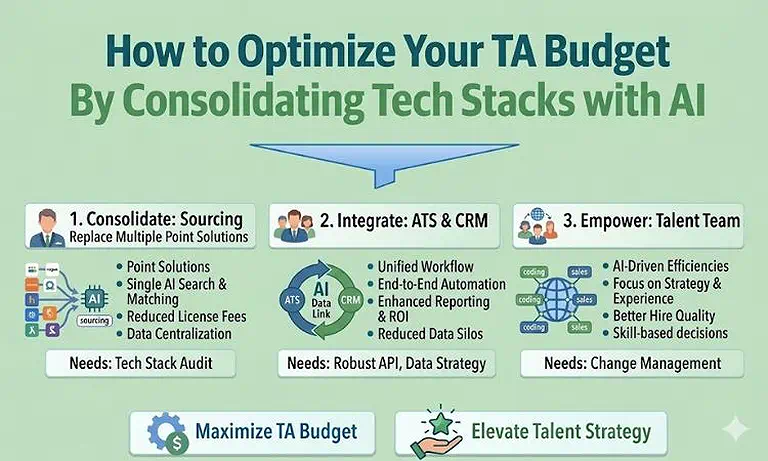
Cover Photo How to Optimise Your TA Budget by Consolidating Tech Stacks with AI
Workflow Table
| Workflow Stage | AI Tools Discussed |
| Audit the Existing Recruitment Tech Stack | ChatGPT, Glean |
| Identify Redundant Software and Manual Processes | Glean, Notion AI |
| Consolidate Recruitment Workflows into Unified Platforms | Workday, SAP SuccessFactors, Oracle Fusion Cloud HCM, Eightfold AI |
| Automate Candidate Sourcing and Matching | Eightfold AI, LinkedIn Recruiter AI |
| Streamline Candidate Communication | Paradox, Phenom |
| Automate Interview Scheduling | GoodTime, Paradox |
| Improve Hiring Analytics and Budget Reporting | Visier, Workday Analytics, Tableau AI |
| Continuously Monitor Technology ROI and Optimise Spending | Visier, Tableau AI, Power BI Copilot |
Who Should Read This Guide?
This guide is designed for organisations looking to reduce recruitment technology costs while improving hiring efficiency through AI-powered consolidation. It is especially valuable for teams managing multiple recruiting tools or planning to modernise their talent acquisition technology.
- Chief Human Resources Officers (CHROs)
- Talent Acquisition Directors
- Recruitment Operations Managers
- HR Technology Managers
- People Operations Leaders
- Talent Acquisition Specialists
- Procurement and Finance Teams overseeing HR technology budgets
- Enterprise Digital Transformation Leaders
The Hidden Costs of a Fragmented Recruitment System
A fragmented recruiting system increases costs in ways that are often difficult to notice. Besides paying for multiple software subscriptions, teams spend extra time moving data between platforms, which slows hiring and creates a poor candidate experience. Scattered data also makes reporting less accurate, making it harder to track hiring performance and cost-per-hire. Organisations routinely compound these financial losses by making critical operational mistakes:
Relying on Manual Spreadsheets: Teams build fragile tracking processes on manual spreadsheets to bridge data gaps between disconnected applications, wasting hours on data re-entry.
Deploying Point Solutions Reactively: Hiring teams purchase narrow, specialized software products to solve isolated, short-term issues without evaluating the broader tech stack architecture.
Tolerating System Redundancy: Companies pay for multi-functional suites while simultaneously running overlapping standalone platforms for screening, communication, or analytics.
The Strategic Solution: The structured four-step framework detailed below provides a clear technical roadmap to permanently remove software redundancies, reduce operational waste, and establish a consolidated AI recruitment ecosystem.
Step 1: Audit and Map Your Current TA Software Ecosystem
To achieve true cost optimization, you must first build a comprehensive inventory of every software platform, application, and subscription currently paid for across your recruitment departments. Document every platform's exact user count, monthly API fees, internal adoption metrics, and contract renewal schedule.
Map out the precise data journey of a candidate across your company to discover hidden areas of platform friction. Identify overlapping platform modules where separate software systems are handling the same administrative tasks.
Categorize each software tool into a functional quadrant: core platform, secondary asset, underutilized product, or immediate cancellation candidate.
Step 2: Establish a Centralized AI Planning and Tracking Foundation
Replace brittle manual spreadsheets with a single, intelligent data layer designed to manage global workforce forecasting and live budgeting. A centralized AI data layer automatically extracts operational metrics from your disparate software applications to provide a single source of truth.
This software layer helps you proactively forecast organizational design changes, assess team capacity limits, and build dynamic headcount models.
For instance, when a global enterprise opens a new technical branch, an automated planning layer calculates localized compensation models, evaluates current team capacity, and pushes hiring demands straight to recruiters without requiring separate standalone analytics tools.
Step 3: Streamline Core HR Operations and Applicant Databases
Consolidate your point solutions into a centralized HR Information System (HRIS) and Applicant Tracking System (ATS) platform that embeds native AI workflows. Point solutions dedicated solely to basic resume parsing, interview scheduling, or candidate messaging should be removed entirely.
Configure automated candidate sorting paths that evaluate applicants based on structural skill sets rather than static resumes.
Using an integrated platform ensures that candidate communication data, onboarding documentation, and regional tax paperwork flow smoothly through your single core database, removing the need for custom external integrations.
Step 4: Automate Global Administration and Performance Loops
Complete your optimization framework by connecting global employment logistics, regional compliance guardrails, and post-hire performance tracking into a seamless loop. Managing distributed teams typically requires multiple country-specific legal and payroll vendors, driving up overhead.
Consolidate these workflows into a unified international workforce platform that automates dynamic contract generation, independent contractor compliance, and global payroll processing.
Link these onboarding paths directly to continuous performance feedback software. Tracking performance metrics alongside initial hiring profiles creates a closed data loop that helps you optimize long-term quality-of-hire and retention.
Expected Results Timeline
| Timeline | Expected Outcome |
First 30 Days | Complete a full recruitment technology audit, identify overlapping platforms, eliminate unused software licenses, and establish a centralized workforce planning strategy. |
60 Days | Consolidate duplicate recruiting tools, automate candidate workflows across a unified platform, reduce manual administrative work, and improve data visibility. |
90 Days | Achieve organization-wide adoption, retire unnecessary point solutions, reduce technology spend, improve recruiter productivity, and generate measurable cost-per-hire savings. |
The Best Specialized AI Tools to Automate This FrameworkManual tech stack consolidation becomes difficult to maintain at scale and requires a foundational software architecture designed to handle diverse operational tasks smoothly.
Agentnoon
Agentnoon is an intelligent workforce planning and organizational charting platform designed to optimise workforce spend and headcount tracking. It maps directly to Step 1 and Step 2 of this framework by giving executives real-time visibility into organisational structures, salary data, open requisitions, and workforce planning insights. Its interactive organisational maps replace disconnected spreadsheets and simplify technology audits, making it easier to identify redundant systems before consolidation.
Best for: Mid-sized and enterprise organisations modernising workforce planning while reducing operational complexity.
Read our comprehensive Agentnoon review to explore its capabilities and software integration modules.
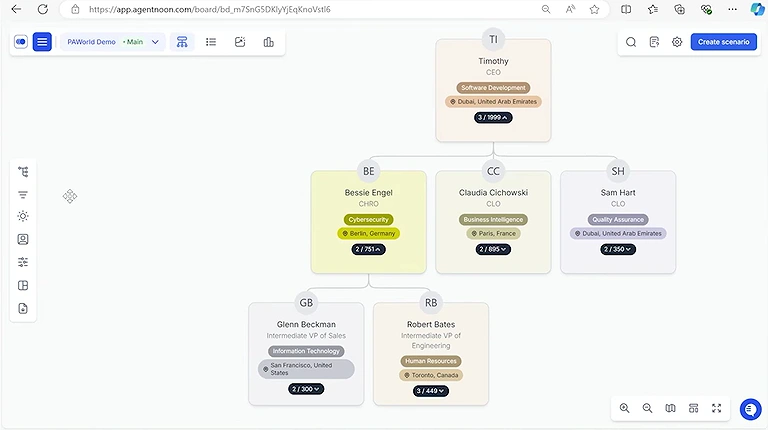
Agentnoon transforms imported HR and people data into visual charts for faster, smarter decision-making.
Deel
Deel provides a comprehensive global payroll, compliance, and international workforce management platform that unifies fragmented HR operations across multiple countries. It aligns with Step 3 and Step 4 of this framework by centralising employment contracts, employer-of-record (EOR) services, payroll, tax compliance, onboarding, and cross-border payments within a single platform. This enables organisations to replace multiple regional HR and compliance solutions with one integrated system, reducing administrative overhead while improving governance.
Best for: Companies hiring and managing distributed or international teams that need scalable global HR infrastructure.
Check out our in-depth Deel review for a full analysis of its international workforce capabilities.
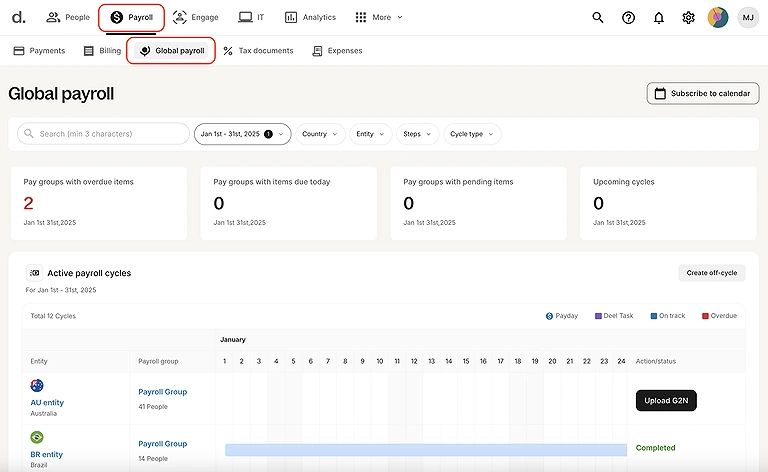
Running payroll in multiple currencies with zero manual work—Deel does it all.
Implementation Mistakes to Avoid
Over-Automating Sensitive Relationships: Organizations often make the mistake of removing human intervention entirely from candidate interactions, using raw bots to handle complex hiring steps. This results in candidate abandonment, lower application completion rates, and a cold employer brand. To prevent this, retain human checkpoints for final technical screening and offer negotiations.
Failing to Standardize System Governance: Tech stack consolidation fails when individual department leads quietly purchase unauthorized, minor SaaS applications outside IT oversight. This shadow IT behavior recreates software bloat and introduces compliance vulnerabilities. Prevent this by enforcing a strict, centralized software procurement policy that requires explicit CIO or VP of HR validation.
Recruitment Analytics Dashboard: Key Metrics to Monitor
Monitoring recruitment analytics after consolidating your talent acquisition (TA) tech stack helps validate whether AI-driven optimisation is delivering measurable business value. These metrics provide visibility into hiring speed, recruitment costs, candidate experience, and overall hiring quality. Regularly reviewing them enables HR leaders to identify process improvements, eliminate inefficiencies, and ensure that technology investments continue to support long-term recruitment performance and budget optimisation.
| Metric | Why It Matters |
| Time-to-Hire / Time-to-Fill | Tracks the average time from opening a job requisition to offer acceptance, helping organisations verify that removing disconnected point solutions has accelerated hiring workflows. |
| Cost-per-Hire / Sourcing Channel ROI | Measures total recruitment expenditure per successful hire while evaluating sourcing channel performance to demonstrate software savings and improved operational efficiency. |
| Candidate Net Promoter Score (NPS) | Assesses candidate satisfaction after the recruitment process to confirm that a consolidated AI-powered hiring experience has improved the overall applicant journey. |
| Screening Throughput Time | Measures how quickly AI processes and screens candidate applications, indicating whether recruiters can review more qualified candidates within the same timeframe. |
| Interview-to-Offer Ratio | Evaluates the percentage of interviews that result in job offers, helping determine whether unified screening processes are delivering higher-quality candidates to hiring managers. |
| Quality-of-Hire | Compares first-year employee performance with original hiring assessments to verify that the consolidated recruitment technology supports stronger long-term hiring outcomes. |
Frequently Asked Questions
How do I know if my talent acquisition tech stack is overcomplicated?
Your tech stack may be overly complex if recruiters regularly switch between multiple applications to complete a single hiring task, maintain manual spreadsheets to transfer data, or pay for tools with overlapping functionality. Frequent integration issues, inconsistent candidate data, and low software adoption are also strong indicators that it's time to consolidate.
What are the first steps to consolidating a recruitment tech stack?
Begin by auditing every recruitment tool your organisation uses, including applicant tracking systems, sourcing platforms, interview scheduling tools, assessment software, analytics platforms, and communication tools. Document each tool's purpose, users, annual cost, integrations, and feature overlap before deciding which platforms should be retained or replaced.
How does tech stack consolidation lower talent acquisition costs?
Consolidation reduces costs by eliminating duplicate software subscriptions, decreasing integration maintenance, and reducing manual administrative work. Instead of paying for multiple point solutions, organisations can centralise key recruitment functions into fewer AI-powered platforms, improving operational efficiency while lowering total technology spend.
What is shadow IT in talent acquisition?
Shadow IT refers to recruitment teams purchasing or using software without approval from IT or procurement departments. These unauthorised tools often duplicate existing capabilities, increase subscription costs, create fragmented candidate data, and introduce compliance and cybersecurity risks that complicate long-term technology management.
Can AI replace multiple recruitment tools?
In many cases, yes. Modern AI recruitment platforms combine capabilities such as candidate sourcing, resume screening, interview scheduling, candidate relationship management (CRM), analytics, and workflow automation within a single ecosystem. While specialised software may still be required for unique business needs, many organisations can significantly reduce the number of standalone applications they manage.
Can consolidation help reduce software security risks?
Yes. Every additional recruitment application creates another potential entry point for sensitive candidate information. Consolidating your technology stack reduces the number of integrations, user accounts, APIs, and third-party vendors that require security oversight, simplifying governance while strengthening data protection and compliance.
Does tech stack consolidation lower employee training costs?
Yes. Recruiters, hiring managers, and HR administrators only need to learn one primary platform instead of several disconnected applications. This shortens onboarding time, improves user adoption, reduces support requests, and helps teams become productive much faster.
How do I identify redundant software in my recruiting stack?
Review every recruitment tool alongside the capabilities already available within your primary ATS or HR platform. If two or more systems perform the same function—such as interview scheduling, candidate communication, reporting, or assessments—one of them is likely redundant. A comprehensive software audit helps identify these overlaps and prioritise consolidation opportunities.
How long does a talent acquisition tech stack consolidation project usually take?
The timeline depends on the size and complexity of the organisation. Smaller businesses may complete consolidation within a few weeks, while enterprises with multiple HR systems, international operations, and complex integrations often require several months for planning, data migration, workflow testing, user training, and full deployment.
Which recruitment processes benefit the most from AI automation?
The highest-impact areas include candidate sourcing, CV screening, interview scheduling, recruiter communications, talent pipeline management, reporting, workforce planning, and compliance monitoring. Automating these repetitive processes allows recruiters to spend more time building relationships with qualified candidates and making strategic hiring decisions.
How can I measure the success of a consolidated recruitment technology stack?
Monitor key recruitment KPIs before and after consolidation, including time-to-hire, cost-per-hire, quality-of-hire, recruiter productivity, candidate Net Promoter Score (NPS), interview-to-offer ratio, software utilisation, and overall recruitment technology spending. Improvements across these metrics demonstrate whether the consolidation strategy is delivering measurable business value.
Should small businesses consolidate their recruitment software?
Yes. Small and growing organisations often benefit significantly because consolidation reduces subscription costs, simplifies hiring workflows, minimises administrative work, and provides better visibility into recruitment performance. Adopting an integrated AI-powered platform also creates a scalable foundation that supports future hiring growth without continually adding new software.
Conclusion
Audit your current SaaS licenses and software expenses to identify hidden feature overlaps, low-adoption tools, and unnecessary platform costs. Work with IT security and talent acquisition leaders to assess your data infrastructure and replace isolated applications with unified AI platforms that combine applicant screening, workforce tracking, and compliance management. Explore native AI capabilities from existing vendors, enforce procurement controls against shadow software, and review our analysis of the best all-in-one HR tech stacks for budget optimization to identify consolidated solutions that streamline operations, reduce costs, and support a leaner recruitment technology ecosystem.