.webp)
Lattice vs Culture Amp: Which Platform Is Better for Enterprise Performance in 2026?
Two platforms dominate the enterprise performance conversation in 2026 — yet they were built to solve completely different problems. Pick the wrong one, and you'll spend the next fiscal year patching the gap.
Here's the tension most HR Ops and Talent Acquisition leaders run into: performance cycles grind to a halt the moment culture data and compensation decisions live in separate systems. Engagement scores tell you how people feel. Calibration and promotion workflows decide what happens next. When those two threads don't talk to each other, every review cycle becomes a manual reconciliation exercise — and at enterprise scale, that's not a minor inconvenience, it's a systemic bottleneck.
So which platform actually closes that gap?
If you need performance management natively fused with HR infrastructure — compensation bands, structured reviews, and workflow automation baked in — Lattice is built for that operational backbone. But if your priority is science-backed employee listening, advanced DEI analytics, and best-in-class benchmarking, Culture Amp still leads the pack.The real answer depends on what your organization is optimizing for — and that's exactly what we're breaking down below.

 Updated: May 28, 2026 | 15 min read
 Key Takeaways
- Best For: Lattice is best for organizations prioritizing performance management, employee engagement, and continuous development. Culture Amp is ideal for enterprises focused on employee feedback, engagement insights, and organizational culture improvement.
- Biggest Strength: Lattice combines performance reviews, goals, career development, and analytics in a unified platform. Culture Amp delivers industry-leading employee engagement surveys with powerful benchmarking and action planning.
- Biggest Limitation: Lattice offers fewer workforce planning capabilities than dedicated HR suites. Culture Amp is less comprehensive for end-to-end performance management workflows.
- AI Capability: Both platforms use AI for survey analysis, review summaries, feedback insights, and manager recommendations, though neither is designed as a fully autonomous HR AI platform.
- Ease of Implementation: Lattice is generally faster to deploy for organizations adopting modern performance management. Culture Amp requires more planning when rolling out enterprise-wide engagement programs.
- Enterprise Readiness: Both platforms scale well for large organizations with enterprise-grade security, integrations, role-based permissions, and global deployment support.
- Internal Mobility: Lattice provides stronger career development, growth planning, and competency tracking. Culture Amp supports employee development but places less emphasis on internal mobility.
- Candidate CRM: Neither platform includes a native Candidate CRM, requiring integration with external ATS or recruitment platforms.
- Workforce Planning: Lattice offers limited workforce planning features through talent and performance insights. Culture Amp focuses on people analytics rather than strategic workforce planning.
- Overall Recommendation: Choose Lattice if your priority is improving performance, career growth, and manager effectiveness. Choose Culture Amp if your primary goal is measuring employee engagement, strengthening workplace culture, and turning feedback into organizational action.
Cover Photo Lattice vs Culture Amp: Which Platform Is Better for Enterprise Performance in 2026?
Quick Comparison: Lattice vs Culture Amp at a Glance
| Evaluation Category | Lattice | Culture Amp |
| Core Focus | Performance management suite centered on goals, 1:1s, feedback, and performance reviews. | Employee experience platform focused on engagement, surveys, and people analytics. |
| Workflow Flexibility | Structured performance cycles with customizable review templates and OKR tracking. | Survey-driven workflows with strong flexibility in engagement, sentiment, and feedback programs. |
| Platform Intelligence | AI-assisted performance insights, growth coaching, and manager enablement features. | Advanced people analytics engine analyzing engagement trends, sentiment signals, and organizational health. |
| Cost Predictability | Per-user pricing with modular add-ons for engagement, goals, and compensation features. | Tiered enterprise pricing based on employee count and selected analytics/engagement modules. |
| Deployment & Sync | Quick rollout for performance cycles; integrates well with HRIS and collaboration tools. | Requires survey configuration and data alignment across HR systems for full analytics depth. |
| Enterprise Scale | Strong fit for mid-market and scaling organizations focused on performance culture. | Built for large enterprises needing deep behavioral insights across global workforces. |
| Engagement Depth | Secondary focus on engagement, primarily tied to performance workflows. | Core strength is continuous listening, engagement benchmarking, and culture diagnostics. |
| Overall Weighted Score | 9.1 / 10 | 9.3 / 10 |
Overall Rating Source: Derived from recent G2 crowdsourced feedback and people-ops software evaluation forums, both solutions consistently show high enterprise user satisfaction, verifiable through the Lattice G2 Profile and Culture Amp G2 Profile.
What is Lattice?
Lattice is a premium enterprise HR infrastructure platform that centralises performance management, goal tracking (OKRs), compensation cycles, and employee growth tracks. It started as a performance management tool and has grown into an all-in-one suite with native HRIS capabilities and salary review tools. Its Ideal Customer Profile (ICP) consists of fast-growing tech enterprises and mid-market organizations seeking a highly structured, workflow-driven ecosystem. To see how its core platform handles high volume, read our comprehensive Lattice Review 2026 for a complete feature breakdown.
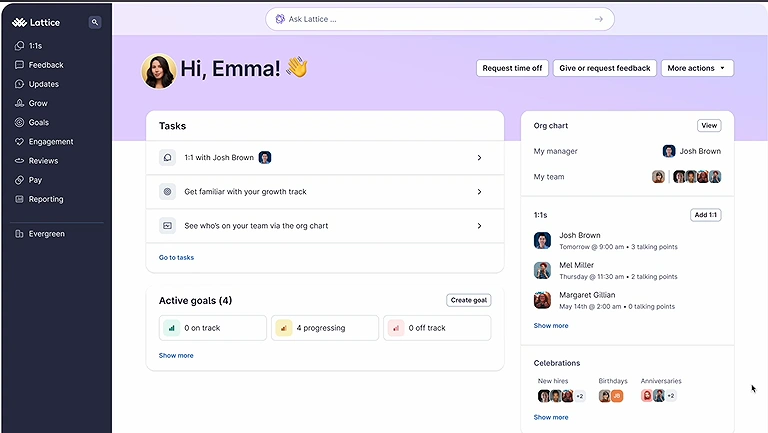
Overview of the Lattice platform user homepage interface for Emma Howard.
What is Culture Amp?
Culture Amp is an industry-leading employee experience and people analytics platform built on more than 15 years of organizational behavioral science. It's a powerful listening engine that uses robust demographic slicing, diversity analytics, and extensive global benchmarks across thousands of organizations. It's ICP centers on large global enterprises that prioritise culture, employee retention, and evidence-based workplace strategies.
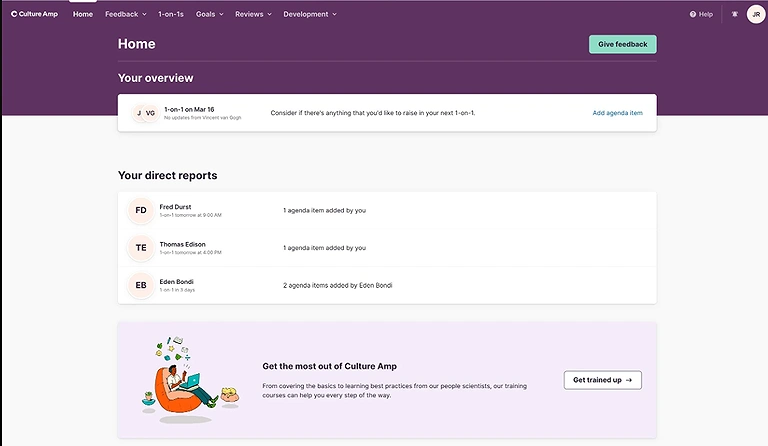
First look of Culture Amp Home Page. Excited to finally have a single source of truth for employee feedback and development.
Platform Architecture & Approach
Selecting between Lattice and Culture Amp involves more than comparing feature lists. Their underlying architecture reflects different philosophies about how organizations improve workforce performance. Lattice is built around continuous performance management and employee development, while Culture Amp is designed to transform employee feedback into measurable organizational improvements. These architectural differences influence implementation priorities, administrative workflows, long-term scalability, and how HR teams interact with each platform on a daily basis.
Platform Foundation Comparison
| Area | Lattice | Culture Amp |
| Overall Architecture | Built as a unified talent management platform where performance, goals, feedback, growth, and engagement operate within a connected ecosystem. | Built around an employee experience architecture that connects engagement surveys, performance, development, and people analytics through a feedback-first framework. |
| Product Philosophy | Focuses on improving individual performance, manager effectiveness, and career progression through continuous development cycles. | Prioritizes understanding employee sentiment, identifying organizational trends, and driving cultural improvement through data-driven decision-making. |
| AI Architecture | AI supports review summaries, goal recommendations, feedback analysis, and manager guidance to streamline performance workflows. | AI is primarily designed to analyze employee feedback, identify themes, surface organizational insights, and recommend actions from survey data. |
| Data Model | Organizes data around employees, goals, competencies, reviews, and development plans, creating a structured talent record. | Centers data around employee feedback, engagement metrics, survey responses, and organizational benchmarks to monitor workforce health over time. |
| Workflow Design | Encourages continuous performance conversations through recurring check-ins, reviews, and development planning integrated into everyday management. | Follows a cyclical workflow where organizations collect feedback, analyze results, build action plans, and measure improvements across future survey cycles. |
Enterprise Administration & Adoption Comparison
| Area | Lattice | Culture Amp |
| User Experience | Provides a manager-focused workspace with centralized access to goals, reviews, feedback, and employee development activities. | Offers dashboards designed for HR leaders and executives, with employees primarily interacting during surveys, feedback requests, and development activities. |
| Interface Complexity | Moderate complexity due to multiple interconnected talent management modules that require structured configuration. | Generally simpler for end users, although administrators managing multiple survey programs and analytics may encounter greater operational complexity. |
| Learning Curve | Managers and HR teams typically require onboarding to establish effective review cycles, goal frameworks, and development processes. | Employees adapt quickly, while HR teams invest more time learning survey methodology, analytics interpretation, and organizational action planning. |
| Enterprise Scalability | Scales effectively across large organizations with configurable workflows, permissions, and standardized performance processes. | Supports global enterprises through scalable survey distribution, benchmarking, multilingual capabilities, and organization-wide analytics. |
| Deployment Methodology | Usually implemented by configuring performance frameworks, review cycles, competency models, and organizational goals before company-wide adoption. | Typically begins with engagement surveys and feedback programs before expanding into broader employee development and performance initiatives. |
Migration Considerations
Migrating to Lattice
Migration to Lattice is generally straightforward for organizations already using modern HRIS and performance management systems. Historical review data, goals, competencies, and employee records can typically be imported, although custom workflows may require reconfiguration. Managers and employees usually need training to adapt to Lattice's continuous performance and development processes.
Migrating to Culture Amp
Moving to Culture Amp is often easier for organizations focused on employee engagement and survey programs. Historical survey results and employee data can be transferred where supported, but maintaining long-term benchmarking consistency may require careful planning. HR teams typically need additional training on survey design, analytics, and action planning methodologies.
Better Choice: Tie
Why: Both platforms provide enterprise migration support and integrate with major HR systems, but the complexity depends more on the organization's existing HR technology stack and whether it is migrating performance management workflows or employee engagement programs.
The Core Feature Showdown
1. Employee Engagement & Surveys
Lattice:
Lattice includes engagement surveys, pulse surveys, and sentiment tracking, allowing organizations to measure employee satisfaction alongside performance data. Its engagement capabilities are well integrated but not the platform's primary differentiator.
Culture Amp:
Culture Amp is widely recognized for enterprise-grade engagement surveys, scientifically validated question frameworks, benchmarking, and actionable insights that help organizations understand workforce sentiment at scale.
Better Choice: Culture Amp
Why: Employee engagement is Culture Amp's core strength, offering deeper survey methodology, richer benchmarking, and more advanced organizational insights.
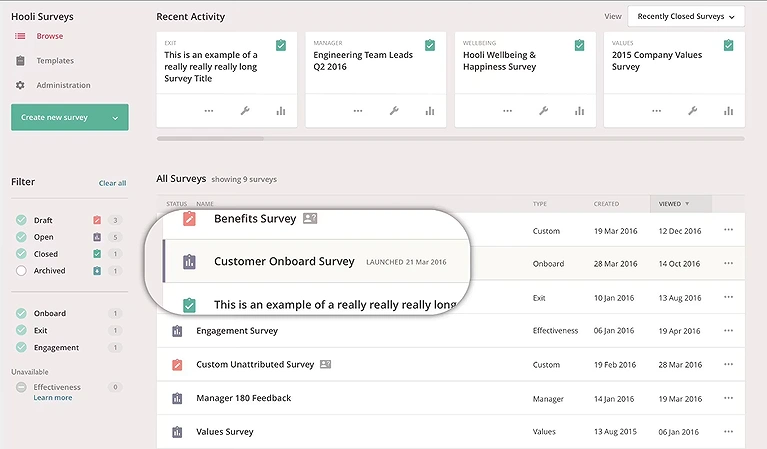
Here's a look at our Culture Amp Surveys section, where Employee Engagement data and multiple survey insights come together in one view
2. Performance Management
Lattice:
Lattice is built around continuous performance management, offering structured review cycles, one-on-one meetings, goals (OKRs), feedback, and career development in a single workflow. It encourages regular manager-employee conversations instead of annual evaluations.
Culture Amp:
Culture Amp includes performance management with reviews, feedback, and development planning, but the experience is designed to complement its broader employee experience platform rather than serve as the primary focus.
Better Choice: Lattice
Why: Lattice provides a more mature and comprehensive performance management framework with stronger support for continuous coaching, goal alignment, and employee growth.
3. People Analytics & Insights
Lattice:
Lattice combines performance, engagement, goals, and development data into unified dashboards that help managers monitor employee progress and identify coaching opportunities.
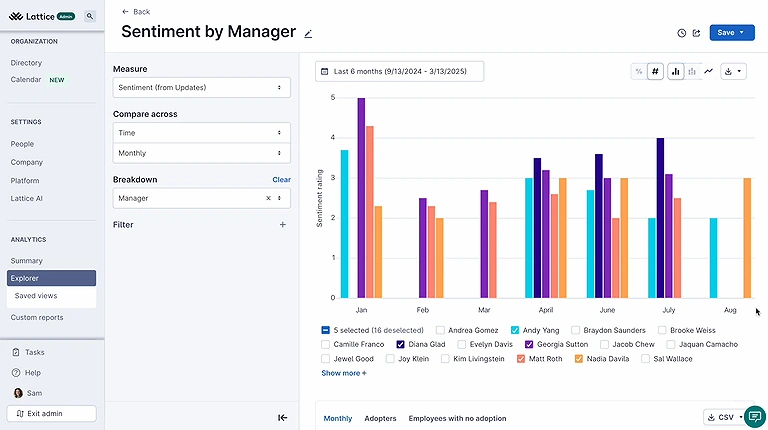
The Lattice analytics dashboard illustrating employee sentiment analysis and manager effectiveness drivers
Culture Amp:
Culture Amp delivers advanced people analytics focused on engagement trends, organizational health, leadership effectiveness, and workforce sentiment, helping HR leaders identify patterns across teams and business units.
Better Choice: Culture Amp
Why: Culture Amp provides more sophisticated workforce analytics and deeper organizational insights for strategic HR decision-making.
4. Goal Setting & Employee Development
Lattice:
Goal management is deeply integrated into Lattice, allowing organizations to connect OKRs, competencies, career paths, development plans, and performance reviews within one continuous workflow.
Culture Amp:
Culture Amp supports goal setting and development conversations, but these capabilities are designed to reinforce employee feedback rather than serve as a complete performance development system.
Better Choice: Lattice
Why: Lattice offers stronger alignment between organizational goals, employee growth, and ongoing performance management.
5. Manager Enablement & Coaching
Lattice:
Lattice equips managers with one-on-one meeting tools, coaching prompts, AI-assisted feedback, performance insights, and structured development workflows that encourage regular employee coaching.
Culture Amp:
Culture Amp helps managers interpret employee feedback and recommends actions to improve engagement, but its coaching tools are primarily centered around survey outcomes rather than continuous performance conversations.
Better Choice: Lattice
Why: Lattice places greater emphasis on helping managers coach employees throughout the year, making it better suited for organizations building a continuous feedback and development culture.
Integration Ecosystem
Lattice and Culture Amp both integrate with modern enterprise HR ecosystems, supporting leading HRIS platforms, identity providers, and collaboration tools. Neither platform aims to replace existing HR technology; instead, both are designed to fit into enterprise environments through APIs, SSO, and third-party integrations. The key difference is that Lattice places greater emphasis on operational talent workflows, while Culture Amp focuses on securely connecting employee feedback and people analytics across existing HR systems.
| Integration Area | Lattice | Culture Amp | Better Choice |
| HRIS Integrations | Strong integrations with major HRIS platforms for employee data synchronization. | Robust HRIS integrations supporting employee lifecycle and engagement data. | Tie |
| ATS Integrations | Integrates with leading ATS platforms primarily for employee onboarding and talent data continuity. | Supports ATS integrations where needed but places less emphasis on recruiting workflows. | Lattice |
| CRM Integrations | Limited native CRM connectivity; relies on third-party automation where required. | Similar approach with minimal focus on CRM platforms. | Tie |
| API | Well-documented APIs enable integration with enterprise HR and business systems. | Comprehensive APIs support data synchronization and custom reporting workflows. | Tie |
| Webhooks | Supports webhooks for workflow automation and event-driven integrations. | Provides webhook support for enterprise integration scenarios. | Tie |
| Marketplace | Offers a growing marketplace covering HR, communication, productivity, and learning tools. | Provides a curated integration ecosystem focused on HR and employee experience technologies. | Lattice |
| Authentication | Supports secure authentication standards for enterprise deployments. | Enterprise-grade authentication with modern identity management support. | Tie |
| Single Sign-On (SSO) | Supports SAML-based SSO with major identity providers. | Supports enterprise SSO through common identity platforms. | Tie |
| Security | Enterprise security controls, role-based permissions, and compliance-focused architecture. | Comparable enterprise security with strong governance and access controls. | Tie |
| Developer Experience | Flexible APIs and implementation resources make custom integrations relatively straightforward. | Developer tools are robust but more focused on extending people analytics and survey workflows. | Lattice |
| Third-Party Integrations | Broad ecosystem spanning HRIS, productivity, communication, learning, and business applications. | Extensive HR-focused integration network with strong people analytics connectivity. | Lattice |
Which Organization Should Choose Which Platform?
| Business Scenario | Better Choice | Why |
| Startup | Lattice | Provides an easy-to-adopt performance management framework that helps growing teams establish structured goals, feedback, and career development without excessive complexity. |
| SMB | Lattice | Offers a balanced combination of performance reviews, engagement, and employee development, making it well suited for organizations building scalable HR processes. |
| Mid-market | Lattice | Supports standardized performance management, manager coaching, and goal alignment as organizations expand across departments and locations. |
| Enterprise | Tie | Lattice excels in performance management, while Culture Amp provides deeper employee engagement and organizational insights. The better fit depends on strategic HR priorities. |
| Global Enterprise | Culture Amp | Strong benchmarking, multilingual survey capabilities, and enterprise-scale people analytics make it well suited for managing employee experience across global workforces. |
| Healthcare | Culture Amp | Employee engagement and workforce sentiment are critical in healthcare, where continuous feedback helps improve retention and employee well-being. |
| Manufacturing | Culture Amp | Enables organizations to measure workforce engagement across distributed and frontline teams while identifying organization-wide improvement opportunities. |
| Technology | Lattice | Technology companies often prioritize continuous feedback, OKRs, career growth, and manager coaching—all areas where Lattice performs particularly well. |
| Retail | Culture Amp | Helps organizations monitor employee sentiment across large, distributed workforces and improve engagement through data-driven action plans. |
| Financial Services | Tie | Both platforms meet enterprise governance requirements. Lattice is stronger for structured performance management, while Culture Amp offers richer workforce insights. |
| Government | Culture Amp | Organizations focused on employee engagement, organizational culture, and workforce feedback initiatives may benefit more from Culture Amp's analytical capabilities. |
| Education | Culture Amp | Institutions seeking to strengthen employee engagement and organizational culture can leverage Culture Amp's survey methodology and benchmarking tools. |
| Internal Mobility | Lattice | Career development plans, competency frameworks, goal alignment, and continuous performance tracking provide stronger support for internal talent growth. |
| High-volume Hiring | Neither | Neither platform is designed as a recruitment or applicant tracking solution. Organizations typically integrate with dedicated ATS platforms for large-scale hiring. |
| Executive Hiring | Neither | Executive recruitment requires specialized recruiting platforms or executive search solutions, as both products focus primarily on employee performance and experience after hiring. |
Real-World Use Cases
| Business Situation | Recommended Platform | Business Justification |
| An organization wants to replace annual performance reviews with continuous feedback and structured coaching. | Lattice | Lattice is designed around continuous performance management, enabling regular one-on-ones, goal tracking, feedback, and employee development throughout the year. |
| A global enterprise needs to measure employee engagement across multiple regions and identify trends affecting retention. | Culture Amp | Culture Amp's advanced engagement surveys, benchmarking, and people analytics help HR leaders understand workforce sentiment at enterprise scale. |
| A fast-growing technology company wants to align individual goals with company objectives while improving manager effectiveness. | Lattice | The platform integrates OKRs, performance reviews, coaching, and career development into a single workflow that supports rapid organizational growth. |
| An HR team needs actionable insights from employee feedback to improve workplace culture and leadership effectiveness. | Culture Amp | Culture Amp specializes in transforming employee feedback into measurable organizational actions through advanced analytics and recommended improvement plans. |
| A mid-sized business wants to introduce structured career development and competency-based growth without adopting a full HCM suite. | Lattice | Lattice combines career growth, competency frameworks, development plans, and performance management within one platform. |
| A multinational organization wants leadership teams to monitor employee sentiment after organizational change, restructuring, or mergers. | Culture Amp | Continuous engagement surveys and organizational analytics help leadership understand change impact and respond with data-driven initiatives. |
| A company is investing heavily in manager development and wants consistent coaching practices across departments. | Lattice | Built-in one-on-one management tools, performance insights, and AI-assisted feedback help managers deliver more effective coaching consistently. |
| An enterprise wants to improve employee retention by identifying engagement risks before they affect productivity and turnover. | Culture Amp | Its engagement analytics and workforce sentiment tracking enable HR teams to detect emerging issues early and prioritize targeted interventions. |
Pricing Comparison: Which Offers Better ROI
Subscription Architecture:
Lattice operates on a modular, transparent per-employee-per-month (PEPM) pricing structure, starting at $11 for its base Talent Management plan, with add-on modules (Engagement, Grow, Compensation) costing $4 to $6 extra.
Culture Amp uses custom, tier-based annual enterprise contracts that require direct interaction with sales teams to scale alongside headcount.
Hidden Costs & Add-ons:
Lattice enforces an absolute minimum annual contract floor of $4,000, meaning smaller or modular accounts face flat minimum costs.
Culture Amp frequently charges premium implementation and onboarding fees, and tier renewals often carry annual price escalators ranging between 3% and 7%.
Pros and Cons
Lattice Pros
- Provides one of the most comprehensive continuous performance management platforms in the market.
- Combines performance reviews, one-on-ones, OKRs, feedback, and career development within a unified workflow.
- Strong manager enablement tools encourage regular coaching and employee development.
- AI-assisted review summaries and feedback recommendations reduce administrative effort.
- Flexible review cycles and customizable competency frameworks adapt to different organizational structures.
- Integrates well with leading HRIS, identity providers, and workplace collaboration tools.
- Scales effectively for growing mid-market and enterprise organizations with configurable permissions and workflows.
- Offers actionable performance analytics that connect employee growth with business objectives.
Lattice Cons
- Organizations seeking deep employee engagement research may find its survey capabilities less advanced than specialist platforms.
- Initial implementation requires thoughtful configuration of goals, competencies, and review processes.
- Workforce planning functionality is limited compared with comprehensive HCM platforms.
- Native recruiting and applicant tracking capabilities are minimal, requiring external ATS integration.
- HR teams may need ongoing administration to maintain review cycles and performance frameworks.
- Smaller organizations with simple review requirements may find some functionality more extensive than necessary.
- Advanced customization can increase implementation complexity for large enterprises.
- Reporting outside performance and talent management may require additional BI tools.
Culture Amp Pros
- Industry-leading employee engagement surveys supported by proven research methodologies.
- Powerful people analytics help organizations identify engagement trends and workforce risks.
- Extensive benchmarking enables enterprises to compare results against industry peers.
- Strong action planning capabilities help HR teams translate employee feedback into measurable improvements.
- Pulse surveys make it easier to monitor organizational sentiment throughout the year.
- Supports global organizations with multilingual surveys and enterprise-scale deployment.
- Integrates well with major HRIS platforms and enterprise identity providers.
- AI-powered insight generation helps HR leaders quickly identify recurring workforce themes.
Culture Amp Cons
- Performance management capabilities are less comprehensive than platforms built primarily for continuous performance.
- Goal management and career development are not as deeply integrated into everyday manager workflows.
- Organizations focused primarily on manager coaching may require additional tools or processes.
- Survey design and analytics require HR teams to understand engagement methodology for maximum value.
- Native recruiting, applicant tracking, and talent acquisition features are limited.
- Workforce planning is not a primary capability and often requires complementary HR platforms.
- Organizations seeking an all-in-one talent management suite may need additional software alongside Culture Amp.
- Benchmarking and analytics deliver the most value when employee participation rates remain consistently high.
Final Recommendations
Choose Lattice if...
- Your organization wants to establish a continuous performance management culture instead of relying on annual reviews.
- Manager effectiveness and employee development are strategic priorities for your HR team.
- You need a platform that aligns employee goals with broader business objectives.
- Career growth, internal promotions, and structured development programs are central to your talent strategy.
- You want to standardize performance processes across multiple departments or business units.
- Your HR technology strategy favors consolidating performance, feedback, and development into a single platform.
- You're scaling rapidly and need repeatable talent management processes that can grow with the business.
- Success will be measured by improvements in employee performance, manager quality, and career progression.
Choose Culture Amp if...
- Your primary objective is improving employee engagement and strengthening organizational culture.
- Leadership wants data-driven insights to guide workforce and people decisions.
- You regularly run engagement surveys, pulse surveys, or organizational listening programs.
- Your organization is undergoing transformation, restructuring, or rapid change and needs to monitor employee sentiment.
- Benchmarking your employee experience against industry peers is an important part of your HR strategy.
- You want HR teams to identify workforce risks early through people analytics and actionable insights.
- Retention, employee experience, and organizational health are higher priorities than expanding performance management processes.
- Success will be measured by higher engagement scores, stronger workplace culture, and informed leadership decisions.
Alternative Platforms to Consider
| Alternative Platform | Core Best For |
| Leapsome | Balanced mid-market agility and learning modules |
| PerformYard | Highly customizable, low-overhead review processes |
You can also evaluate platforms like Quantum Workplace to manage employee feedback. For matching growth with proper top-of-funnel systems, explore our full review of 10 Best AI Tools for Smarter & Faster Talent Acquisition.
Future Roadmap / Innovation Direction
Lattice
- Vendor Innovation Pace: Continues releasing regular enhancements focused on performance management, manager enablement, and employee development rather than expanding into a broad HCM suite.
- AI Investment: Increasing investment in AI-assisted performance reviews, feedback summarization, coaching recommendations, and productivity features for managers and HR teams.
- Product Vision: Building an integrated talent management platform where performance, goals, career development, and employee growth operate as a connected system.
- Ecosystem Expansion: Expanding integrations with HRIS, collaboration platforms, learning systems, and enterprise productivity tools to strengthen interoperability.
Culture Amp
- Vendor Innovation Pace: Maintains a steady innovation cycle centered on employee experience, organizational analytics, and evidence-based HR decision-making.
- AI Investment: Expanding AI capabilities for employee sentiment analysis, survey interpretation, thematic insights, and actionable recommendations for HR leaders.
- Product Vision: Evolving into a comprehensive employee experience platform that combines engagement, performance, development, and people analytics to support strategic workforce decisions.
- Ecosystem Expansion: Continuing to strengthen its integration ecosystem with enterprise HR platforms, identity providers, and workplace collaboration tools while improving data connectivity across the HR technology stack.
Frequently Asked Questions
Is Lattice better than Culture Amp for continuous performance management?
Lattice is the stronger choice for continuous performance management because it combines goals, one-on-one meetings, performance reviews, feedback, and career development into a unified workflow. Culture Amp includes performance management but places greater emphasis on employee engagement and organizational insights.
Is Culture Amp better than Lattice for employee engagement surveys?
Yes. Culture Amp is widely recognized for its advanced employee engagement surveys, industry benchmarking, and people analytics, making it the stronger option for organizations focused on measuring and improving workplace culture.
Can Lattice and Culture Amp integrate with existing HRIS platforms?
Yes. Both platforms integrate with leading HRIS solutions, enabling employee data synchronization, automated user provisioning, and streamlined HR workflows without replacing an organization's existing HR system.
Which platform provides better people analytics?
Culture Amp generally offers more comprehensive people analytics by combining employee feedback, engagement trends, benchmarking, and workforce insights. Lattice focuses its analytics primarily on performance, goals, and employee development.
Does either platform include built-in workforce planning capabilities?
Neither platform is a dedicated workforce planning solution. However, Culture Amp provides broader organizational insights that can support workforce planning decisions, while Lattice focuses more on performance and talent development.
Which platform is easier for managers to adopt?
Lattice is often easier for managers who regularly conduct performance reviews, one-on-one meetings, and coaching sessions because these workflows are integrated into daily management activities. Culture Amp requires managers to engage more with survey insights and action planning.
Is either platform suitable for small and mid-sized businesses?
Yes. Both platforms support SMBs, but Lattice is often preferred by growing companies building structured performance management processes, while Culture Amp is a strong fit for businesses prioritizing employee engagement and workplace culture.
Do Lattice and Culture Amp support global enterprise organizations?
Yes. Both platforms are designed for enterprise-scale deployments, offering robust security, role-based access controls, multilingual capabilities, and integrations that support distributed and multinational workforces.
Which platform offers stronger internal mobility and career development?
Lattice provides stronger support for internal mobility through competency frameworks, career development plans, goal management, and continuous performance tracking, helping organizations develop and retain internal talent.
Can either platform replace a Human Capital Management (HCM) system?
No. Lattice and Culture Amp are designed to complement—not replace—a core HCM or HRIS. Most enterprises use them alongside existing HR platforms for employee records, payroll, benefits, and workforce administration.
How do the AI capabilities differ between Lattice and Culture Amp?
Lattice uses AI primarily to streamline performance management through review summaries, feedback generation, and manager coaching assistance. Culture Amp applies AI to employee sentiment analysis, survey interpretation, and identifying workforce trends from engagement data.
Which platform offers better long-term value for enterprise organizations?
The answer depends on business priorities. Lattice delivers greater value for organizations investing in performance management, manager effectiveness, and employee development, while Culture Amp provides stronger long-term value for enterprises focused on employee engagement, organizational culture, and strategic people analytics.
Conclusion
Lattice and Culture Amp are both enterprise-grade people platforms, but they solve different HR challenges. Lattice is the stronger choice for organizations looking to modernize performance management, strengthen manager effectiveness, and support continuous employee development. Culture Amp stands out for enterprises that prioritize employee engagement, organizational culture, and data-driven people insights. Neither platform is objectively better in every scenario—the right decision depends on your HR strategy, workforce priorities, and existing technology ecosystem. Before making a final investment, identify whether your primary goal is improving employee performance or strengthening employee experience, then choose the platform that best aligns with your long-term business objectives.