.webp)
Personio HR Software Review 2026: Features, Pricing & Verdict
If your HR team's day still looks like copy-pasting numbers between five spreadsheets and silently hoping nothing breaks — congratulations, you're running on legacy software, and you're not alone. Studies suggest HR teams burn nearly 70% of their operational time just reconciling data that shouldn't need reconciling in the first place. That's not "process," that's a part-time job nobody signed up for.
The good news? Enterprise software has quietly leveled up. We've moved past clunky UI automation into something smarter — contextual, permission-aware AI that actually reads documents, spots trends, and thinks a little like a colleague instead of a filing cabinet.
This review is built for HR leaders at European SMEs (50–2,000 employees) ready to trade spreadsheet chaos for something that actually digitises core personnel processes. Running a large enterprise and need serious, high-volume sourcing firepower instead? You'll want our comparative breakdown of
HR software with AI features before you commit to anything. Personio, for its part, is practically tailor-made for regulated European HR — though if global payroll flexibility is non-negotiable for you, keep that in mind as you read on.

 Updated: May 24, 2026 | 21 min read
 Key Takeaways
- Personio combines core HR administration, recruiting, onboarding, performance management, and workforce reporting into a unified platform.
- Employee information is organized through a centralized database, helping HR teams reduce manual record management across multiple systems.
- Built-in applicant tracking and onboarding features create a smoother transition from candidate to employee within the same platform.
- Workflow automation for leave requests, approvals, reminders, and HR tasks can significantly reduce repetitive administrative work.
- Reporting and analytics provide better visibility into workforce trends and HR performance metrics.
- Personio is designed primarily for small and medium-sized businesses looking to modernize HR operations rather than large enterprises requiring extensive customization.
- The platform offers the greatest value when organizations adopt multiple HR modules instead of using it solely for employee record management.
Cover Photo Personio HR Software Review 2026: Features, Pricing & Verdict
Quick Review Table
| Review Factor | Rating & Details | Review Result |
Core Strength | Unified HRIS Platform | Combines employee records, payroll, time tracking, and HR workflows within a single centralized system. |
Primary Limitation | European-Centric Focus | Strongest value for European organizations; some global enterprises may require additional integrations. |
Target Scale | 50–5,000+ Employees | Ideal for small and mid-sized businesses seeking a scalable HR management platform. |
Pricing Model | Custom Subscription Pricing | Modular pricing based on company size, features, and workforce requirements. |
Top Compliance | GDPR, ISO 27001, SOC 2 | Strong data protection and security standards designed for modern HR operations. |
Deployment Channel | Cloud-Based SaaS | Accessible through web and mobile applications with self-service tools for employees and managers. |
Overall Score | 8.7 / 10 | Comprehensive HR software that delivers excellent workforce management and HR automation for growing organizations. |
Evaluation Criteria
Personio HR Software review, our evaluation focused on how effectively the platform supports the day-to-day responsibilities of modern HR teams rather than simply listing its available features. The assessment examined whether Personio can reduce administrative workload, improve employee lifecycle management, and provide a centralized HR system for growing organizations.
Our review considered the following areas:
- Ease of implementation and initial system configuration
- Employee record management and centralized HR data
- Recruitment and applicant tracking capabilities
- Onboarding and offboarding workflows
- Time tracking, attendance, and leave management
- Payroll preparation and compensation management
- Performance reviews and employee development tools
- Workflow automation and approval processes
- Reporting, workforce analytics, and HR insights
- Integration options with payroll, recruiting, and business applications
- Overall usability for HR administrators, managers, and employees
What Is Personio ?
Personio is an all-in-one Human Resources (HR) software platform designed primarily for small and medium-sized businesses (SMBs). It centralizes core HR operations—including employee records, recruitment, onboarding, time tracking, payroll preparation, performance management, and workforce analytics—into a single cloud-based system. By replacing disconnected spreadsheets and standalone HR tools, Personio helps HR teams automate repetitive administrative work while improving compliance, employee experience, and operational efficiency.
Company Snapshot
| Category | Details |
| Company | Personio |
| Founded | 2015 |
| Headquarters | Munich, Germany |
| Primary Focus | Human Resource Management (HRMS/HRIS) |
| Best For | Small and medium-sized businesses (typically 10–2,000 employees) |
| Deployment | Cloud-based (SaaS) |
| Core Modules | Core HR, Recruiting, Time Tracking, Performance, Payroll Preparation, Compensation, Surveys, Workforce Analytics |
| Supported Platforms | Web, iOS, Android |
| Target Markets | Europe, UK, and expanding international businesses |
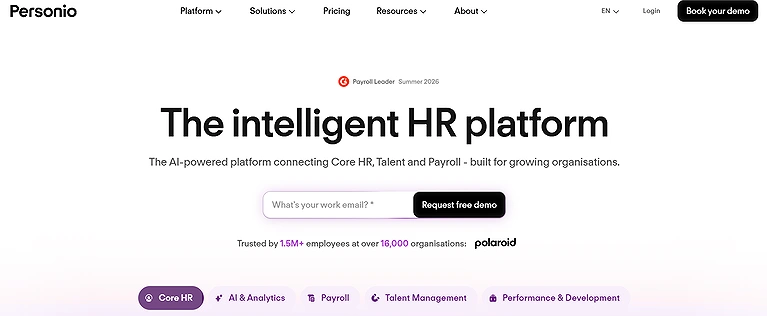
Official source interface: Personio HR Management platform.
What Problem Does It Solve?
Managing HR through spreadsheets and disconnected software often results in duplicate data, manual processes, delayed hiring, payroll errors, compliance risks, and limited workforce visibility. Personio consolidates the entire employee lifecycle into one centralized platform, enabling HR teams, managers, and employees to manage people operations more efficiently while reducing administrative overhead and improving data accuracy.
It helps organizations solve:
- Centralizing employee records in a single HR database
- Automating recruitment and candidate management
- Simplifying employee onboarding and offboarding
- Managing leave requests, attendance, and time tracking
- Preparing accurate payroll with fewer manual errors
- Streamlining performance reviews and employee development
- Improving HR reporting and workforce analytics
- Reducing repetitive administrative work through automation
- Helping organizations stay compliant with labor regulations
- Giving employees self-service access to HR information
How Personio Works ?
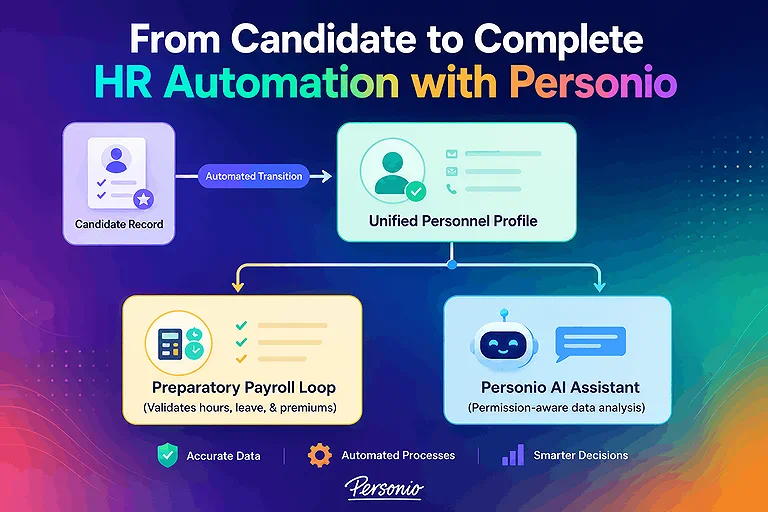
Personio acts as a centralized HR hub where employee information is stored once and shared across every HR workflow. HR teams can recruit candidates, convert successful applicants into employee profiles, automate onboarding tasks, manage attendance and leave, prepare payroll data, conduct performance reviews, and generate workforce reports from the same platform. Employees and managers access self-service portals to update personal information, submit requests, approve workflows, complete reviews, and track HR activities, while configurable automation rules minimize manual intervention throughout the employee lifecycle.
Why Enterprises Choose It
- Centralizes HR operations in a single cloud platform
- Reduces manual administrative work through workflow automation
- Improves hiring efficiency with integrated applicant tracking
- Provides a consistent employee self-service experience
- Supports structured onboarding and offboarding processes
- Simplifies attendance, leave, and payroll preparation
- Offers customizable workflows and approval processes
- Delivers workforce analytics for data-driven HR decisions
- Integrates with payroll, communication, identity, and productivity tools
- Scales as organizations grow without requiring multiple disconnected HR systems
- Helps maintain accurate employee records and audit trails
- Enables HR teams to focus more on strategic initiatives instead of repetitive administration
Operational Interface & Deployment
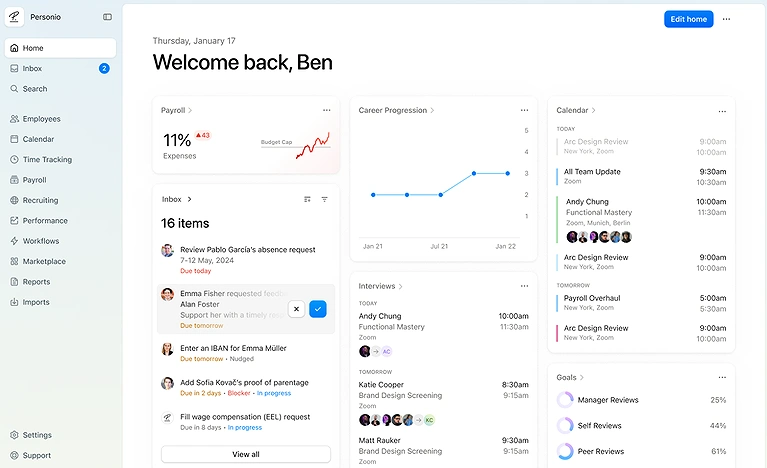
Personio employee portal interface, showing an active user profile analytics
Onboarding Experience
Personio provides a structured onboarding process that begins with configuring the organization's HR structure, importing employee data, assigning user roles, and customizing workflows. Administrators can connect recruiting pipelines, leave policies, approval chains, and payroll settings before inviting employees. The platform also includes implementation guidance, onboarding checklists, a knowledge base, and customer success resources to help organizations adopt the system with minimal disruption.
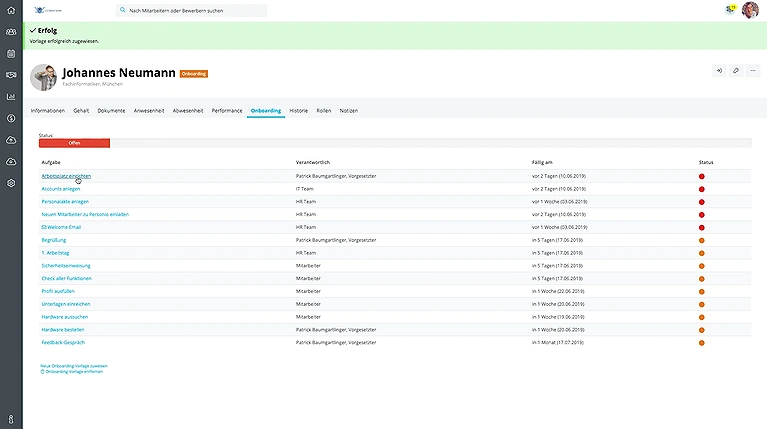
A look inside the Personio platform, showcasing a structured, step-by-step digital onboarding workflow for new employees.
Implementation Timeline
| Organization Size | Typical Timeline | Primary Activities |
| Small Business (10–50 employees) | 2–4 weeks | Employee import, company setup, leave policies, user permissions, onboarding |
| Medium Business (50–250 employees) | 4–8 weeks | Workflow configuration, ATS setup, payroll preparation, integrations, manager training |
| Growing Organization (250–1,000 employees) | 8–12 weeks | Data migration, process customization, automation, reporting, integration rollout |
| Enterprise Rollout (1,000+ employees) | 3–6 months | Multi-team deployment, advanced workflows, change management, phased implementation, system integrations |
Dashboard & UX
Personio's dashboard is modern, intuitive, and role-based, displaying different information for HR administrators, managers, and employees. HR teams receive quick access to hiring progress, employee records, pending approvals, workforce analytics, and compliance tasks, while employees can easily request leave, update personal information, complete onboarding tasks, and access company documents through a clean self-service interface. Navigation is straightforward, making daily HR operations easier for both technical and non-technical users.
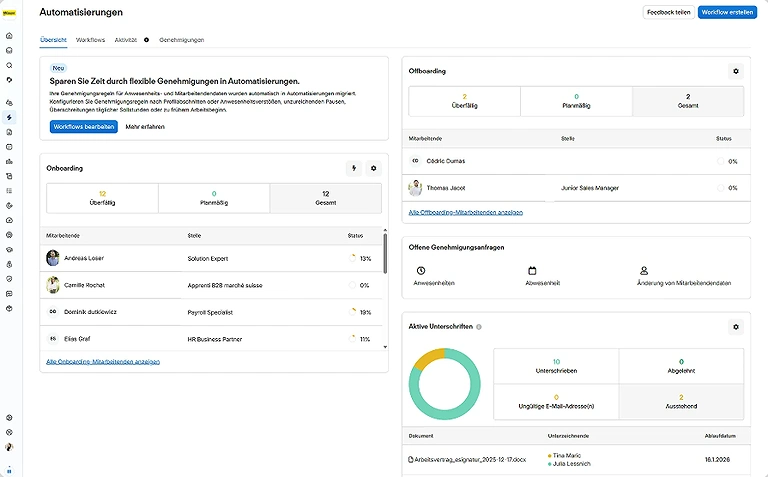
Overview of Personio’s human resources data analytics and reporting interface.
Deployment Requirements
- Cloud-based SaaS platform with no on-premise server installation
- Modern web browser (Chrome, Edge, Firefox, or Safari)
- Stable internet connection
- Employee data available for migration (CSV or supported import formats)
- Company organizational structure and user hierarchy
- Administrator account for initial system configuration
- Defined HR policies (leave, attendance, approvals, etc.)
- Optional integrations with payroll, identity management, calendars, communication, and productivity tools
- Supported mobile apps for iOS and Android for employee self-service
- User training for HR administrators, managers, and employees to maximize platform adoption
Core Features — Granular Breakdown
People & Organization Management + Automated Workflows
This core module acts as the primary system of record for employee profiles, files, and organizational charts using a secure relational database. In 2026, a code-free workflow builder enables triggers like signed contracts to automate onboarding tasks, IT requests, and mentoring assignments. It follows EU data protection rules with e-signatures and audit trails but struggles with complex matrix reporting structures.
Attendance, Leave, & Overnight Time Tracking
This module manages employee schedules, holiday requests, and shift validation rules using a localized time-tracking engine that processes data in real time. Its overnight tracking feature records shifts crossing midnight as continuous entries while automatically calculating overtime, night premiums, and mandatory rest periods. It also ensures compliance with EU working time directives and laws like Germany’s GoBD, reducing non-compliance risks.
Contextual AI: The Personio Assistant
Personio Assistant is a context-aware AI engine that reduces manual HR analysis by integrating directly into the core database as a permission-aware layer. Employees can ask simple questions like vacation balance and get instant, secure answers, while HR managers generate reports such as attrition trends. It enforces strict role-based access control and cites sources when connected to external systems.
Macro-Level People Analytics & Compliance
This feature tracks operational trends and generates predictive insights for headcount, salaries, and absenteeism using a built-in report builder that allows non-technical users to create dashboards and visualisations. It meets enterprise-grade security standards, including ISO 27001, SOC 2 Type II, and EU GDPR compliance, with encrypted data in transit and at rest stored on European servers for data sovereignty.
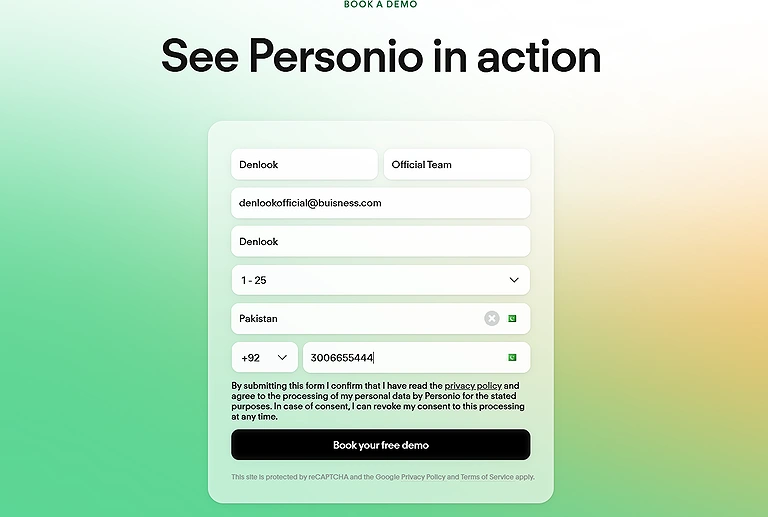
The initial step for Personio onboarding: Registering to request a platform demo account.
Processes We Used in Personio Testing
To evaluate Personio's effectiveness as an end-to-end HR management platform, during review we examined how the system supports everyday HR operations from recruitment through ongoing employee administration.
Our evaluation process included:
- Reviewing account setup and organizational configuration.
- Creating employee profiles and managing centralized personnel records.
- Testing recruitment workflows, job postings, and applicant tracking functionality.
- Evaluating onboarding task management for newly hired employees.
- Reviewing attendance tracking, leave requests, and approval workflows.
- Assessing payroll preparation features and employee compensation management.
- Examining performance review workflows and employee feedback capabilities.
- Testing document management and digital employee file organization.
- Reviewing reporting dashboards, workforce analytics, and HR insights.
- Evaluating integration capabilities with payroll providers, productivity tools, and third-party HR applications.
Overall our objective was to determine whether Personio meaningfully simplifies routine HR administration while providing sufficient flexibility for growing organizations with evolving workforce management needs or not.
Integration Ecosystem
Personio offers a broad integration ecosystem that connects HR workflows with payroll, recruiting, communication, identity management, productivity, and business applications. Organizations can synchronize employee data, automate repetitive tasks, and reduce manual data entry by integrating Personio with popular third-party platforms. For businesses with custom requirements, Personio also provides APIs and integration capabilities that enable secure data exchange between internal systems and external applications.
undefined
Integration Support
| Integration | Supported |
| Workday | ✔ |
| SAP | ✔ |
| Greenhouse | ✔ |
| Slack | ✔ |
| Microsoft Teams | ✔ |
| Microsoft Entra ID (Azure AD) | ✔ |
| Google Workspace | ✔ |
| Microsoft 365 | ✔ |
| DATEV | ✔ |
| ✔ | |
| Indeed | ✔ |
| Personio Payroll (where available) | ✔ |
| Zapier | ✔ |
| REST API | ✔ |
| Webhooks | ✔ |
Implementation Reality Check
While Personio supports a strong ecosystem of integrations, not every connector offers the same level of functionality. Some integrations provide full two-way synchronization, whereas others only support data import, export, or workflow automation. Certain payroll connectors, regional integrations, and advanced capabilities are also available only in specific countries or subscription plans. Organizations should verify the exact integration features and regional availability before deployment, especially if they rely on complex HR or payroll workflows.
Real-World Use Cases
Growing European startups rely heavily on centralized automation to streamline manual personnel tasks, track local attendance, and manage documents. Discover how it stacks up against alternative startup platforms in our comprehensive review of the Best AI HR Tools for Small Businesses and Growing Startups.
1 .Typical Workflow
| Stage | What Happens |
| HR Workspace Setup | HR administrators configure company structure, departments, roles, approval workflows, and leave policies. |
| Employee Data Import | Existing employee records are imported or new employee profiles are created in the centralized HR database. |
| Recruitment Begins | Job openings are published, applications are collected, and candidates move through the hiring pipeline. |
| Hiring & Onboarding | Successful candidates are converted into employee profiles, while onboarding tasks and required documents are assigned automatically. |
| Daily HR Operations | Employees submit leave requests, update personal information, and managers review approvals through self-service workflows. |
| Performance & Development | Managers conduct performance reviews, document feedback, and monitor employee development activities. |
| Payroll Preparation | Attendance, leave balances, and employee data are consolidated to prepare payroll information for payroll systems. |
| Workforce Reporting | HR teams monitor workforce metrics, hiring progress, employee trends, and operational reports to support business decisions. |
2. Business Scenarios
Growing SMBs Building Their First HR System
Best For: Small businesses, startups, expanding companies, HR generalists
Organizations replacing spreadsheets with a centralized HR platform can standardize employee records, automate approvals, and improve hiring processes. Personio helps growing businesses establish consistent HR workflows without managing multiple disconnected tools, making everyday administration more organized as headcount increases.
Multi-Location Businesses
Best For: Retail chains, restaurant groups, healthcare providers, service businesses
Companies operating across multiple offices or branches can maintain standardized HR policies while giving managers localized access to employee information. Centralized workflows simplify leave management, onboarding, and reporting across distributed teams without relying on separate HR systems.
Recruitment-Driven Organizations
Best For: Internal recruiting teams, HR departments, professional services firms
Businesses hiring frequently benefit from connecting recruitment directly with employee management. Once candidates are hired, their information transitions into the employee database, reducing duplicate data entry and creating a smoother hiring-to-onboarding process.
HR Teams Replacing Manual Processes
Best For: HR administrators, people operations teams, administrative departments
Organizations moving away from spreadsheets and email-based approvals can automate routine HR tasks such as leave requests, onboarding checklists, and employee record updates. This reduces repetitive administrative work while improving consistency across HR operations.
Companies Focused on Employee Self-Service
Best For: Knowledge-based businesses, technology companies, consulting firms
Businesses looking to reduce routine HR inquiries can provide employees with self-service access for leave requests, personal information updates, and company documents. This allows HR teams to spend less time handling administrative requests and more time on strategic initiatives.
Fast-Scaling Organizations
Best For: Scale-ups, venture-backed startups, expanding SMBs
As employee numbers increase, maintaining consistent HR processes becomes more challenging. Personio helps standardize approvals, employee records, and onboarding workflows, allowing HR operations to scale without significantly increasing administrative workload.
Organizations Seeking Better Workforce Visibility
Best For: HR leaders, executives, department managers
Companies that rely on workforce insights for planning can use centralized reporting to monitor hiring progress, employee growth, attendance patterns, and other HR metrics. Consolidated data supports more informed operational and workforce decisions.
Businesses Using Multiple Business Systems
Best For: Companies with payroll providers, productivity suites, recruiting platforms
Organizations already using payroll, communication, and productivity software can connect Personio with existing tools to reduce duplicate data entry and improve workflow continuity. Integration capabilities help HR information move more efficiently between business systems.
Compliance-Focused HR Operations
Best For: Regulated industries, financial services, healthcare organizations
Businesses with formal HR policies benefit from structured employee records, documented approval workflows, and centralized personnel information. Organized processes make internal HR administration more consistent while supporting documentation requirements.
3. Best Organization Size
| Organization Size | Recommendation | Why? |
| Startup | ✔ Recommended | A good fit for startups building structured HR processes, although very small teams may not require its full feature set. |
| Small Business | ✔ Highly Recommended | Offers a strong balance of automation, usability, and scalability for growing HR teams with limited administrative resources. |
| Mid-Market | ✔ Highly Recommended | Comprehensive HR workflows, reporting, integrations, and employee management capabilities align well with mid-sized organizations. |
| Enterprise | ⚠ Depends on Needs | Suitable for many enterprise HR operations, but organizations with highly complex global requirements should carefully evaluate customization, regional support, and integration needs before adoption. |
Our Experience Using Personio
We experienced navigating between employee profiles, recruitment activities, and HR administration felt structured and consistent. Employee information is easy to locate, while common HR tasks—such as approving leave requests, updating personnel records, or monitoring onboarding progress—are organized through straightforward workflows that reduce unnecessary administrative effort. We covered below as where the stood out and where its limitations appeared.
What stood out
- Well-organized employee lifecycle management from recruitment through ongoing HR administration
- Centralized employee database that reduces duplicate record keeping
- Automated workflows for leave approvals, onboarding, and recurring HR tasks
- Integrated recruiting functionality that connects directly with employee management
- Clean reporting dashboards that improve workforce visibility for HR teams
Potential limitations
- Organizations with highly specialized enterprise HR requirements may require additional customization beyond the standard platform.
- Initial implementation benefits from careful planning of HR policies, approval structures, and employee data migration.
- Some integrations and advanced functionality may require additional configuration depending on existing business systems.
- Teams transitioning from manual HR processes should expect a short adjustment period while standardizing new workflows.
Overall, Our observations as Personio's primary strength lies in simplifying everyday HR operations through connected workflows rather than isolated feature sets. For growing businesses that want greater consistency across recruitment, employee administration, leave management, and workforce reporting, the platform provides a practical foundation for building more efficient HR processes.
Financial Breakdown
Personio uses a subscription-based PEPM pricing model with annual commitments. The platform is offered in tiered packages—Essential, Professional, and Enterprise—while additional modules like Recruitment, Performance, Surveys, and Compensation are available as optional add-ons for expanded HR functionality and scalability.
Cost Benchmarks
| Plan Tier | Estimated Price Range (PEPM) | Minimum Spend Threshold | Ideal Organizational Profile |
| Core Essential | From $2.95 – $3.50 | Contact Sales | Small teams requiring foundational data records and basic time off |
| Core Professional | From $4.50 – $6.00 | Contact Sales | Mid-sized companies requiring advanced custom workflows and API options |
| Core Enterprise | Custom Quote Only | Custom Annual Minimum | Complex organizations requiring advanced role permissions and strict compliance |
Note: Personio utilizes custom sales-led quoting for mid-market clients, meaning final contract costs vary based on chosen add-on modules and total user counts.
Hidden Costs & Resource Drags
API Maintenance: Custom connections utilising Personio’s public API require regular internal developer reviews when company data properties change.
Add-On Accumulation: Outfitting the platform with performance reviews, employee surveys, and compensation tools can increase initial cost estimates by 40% to 60%.
Internal Training Requirements: While the employee view is highly intuitive, training HR administrative teams to build advanced, multi-step workflows requires dedicated implementation hours.
Deep-Dive Strengths and Trade-Offs
Strengths
European Regulatory Advantage: Native architecture built around GDPR, GoBD, and European labor laws avoids the compliance gaps seen in US-centric platforms.
Unified Data Flow: Connecting attendance records directly to preparatory payroll eliminates manual copy-paste errors for payroll managers.
Secure AI Integration: Personio Assistant provides useful summaries without compromising internal company data access permissions.
Excellent Usability: High user adoption rates driven by a clean, consumer-grade mobile and desktop layout.
Trade-Offs
Sales-Led Pricing Friction: The absence of public, transparent pricing tiers requires teams to go through formal sales calls for contract adjustments.
Limited Complex Matrix Structures: The platform struggles to map complex corporate structures with multi-layered, non-traditional reporting lines.
Payroll Depth Boundaries: Outside of its core European target markets, payroll functionality relies heavily on external partners rather than native execution.
Configuration Guardrails: Companies requiring deep, infinite fields or custom structural modifications will find the platform's focus on standardisation restrictive.
Market Positions:Where Personio Fits in the HR Software Market
Human Resource software has evolved from basic employee record systems into comprehensive platforms that manage the entire employee lifecycle. Today, organizations can choose from several HR software categories depending on whether their priority is core HR administration, enterprise workforce management, recruiting, or payroll. Understanding these categories is important because no single platform is designed to excel at every HR function. Personio is positioned as an integrated HR management platform for small and medium-sized businesses, combining core HR, recruiting, employee management, and workflow automation into a unified solution rather than focusing exclusively on enterprise HR or specialized recruiting.
Category Analysis
Integrated HR Management Platforms
Integrated HR management platforms centralize the most important HR processes into a single system. Rather than purchasing separate tools for employee records, recruiting, onboarding, attendance, performance management, and reporting, organizations manage these activities from one platform. This category focuses on reducing administrative work, maintaining consistent employee data, and improving collaboration between HR teams, managers, and employees. These platforms are particularly valuable for organizations seeking operational efficiency without the complexity of large enterprise HR suites.
Best Suited For
- Small and medium-sized businesses
- Growing organizations
- HR departments modernizing manual processes
- Companies with limited HR resources
- Businesses seeking an all-in-one HR platform
Typical Capabilities
- Centralized employee database
- Recruiting and onboarding workflows
- Leave and attendance management
- Workflow automation
- Performance management
- HR reporting and analytics
- Third-party integrations
Example Products
Personio ,BambooHR ,HiBob ,Factorial ,CharlieHR
Enterprise Human Capital Management (HCM) Suites
Enterprise HCM platforms are designed for large organizations operating across multiple business units, countries, or regulatory environments. These solutions typically extend beyond traditional HR by supporting global payroll, workforce planning, compensation management, talent management, compliance, and advanced workforce analytics. While they offer extensive functionality and customization, they also require longer implementation projects, dedicated administration, and higher investment.
Best Suited For
- Large enterprises
- Multinational organizations
- Highly regulated industries
- Global HR teams
- Complex organizational structures
Typical Capabilities
- Global workforce management
- Advanced compliance controls
- Workforce planning
- Compensation management
- Talent management
- Enterprise reporting
- Extensive customization
Example Products
Workday ,SAP SuccessFactors ,Oracle Fusion Cloud HCM,UKG Pro ,ADP Workforce Now
Applicant Tracking & Recruitment Platforms
Recruitment platforms specialize in attracting, managing, and hiring candidates rather than overseeing the complete employee lifecycle. They provide advanced hiring workflows, candidate relationship management, interview scheduling, sourcing tools, and recruitment analytics. Organizations with dedicated talent acquisition teams often choose these platforms when recruiting is their primary business priority.
Best Suited For
- Talent acquisition teams
- High-volume hiring organizations
- Recruitment agencies
- Fast-growing companies
- Internal recruiting departments
Typical Capabilities
- Applicant tracking
- Candidate pipelines
- Interview scheduling
- Career site management
- Recruitment analytics
- Candidate communication
- Hiring collaboration
Example Products
Greenhouse ,Lever ,Ashby ,SmartRecruiters ,Recruitee
Payroll & Workforce Administration Platforms
Payroll-focused platforms primarily manage payroll processing, tax calculations, benefits administration, workforce compliance, and employee compensation. While many include basic HR functionality, their primary objective is ensuring accurate payroll operations rather than delivering comprehensive employee lifecycle management.
Best Suited For
- Payroll departments
- Finance teams
- Compliance-focused organizations
- Businesses with complex payroll requirements
- Companies outsourcing HR but managing payroll internally
Typical Capabilities
- Payroll processing
- Tax management
- Benefits administration
- Compensation management
- Compliance reporting
- Employee payments
- Payroll integrations
Example Products
ADP ,Paychex ,Gusto ,Deel ,Rippling
Where Personio Fits
Personio belongs primarily to the Integrated HR Management Platform category. Its strongest value comes from bringing recruitment, employee administration, onboarding, attendance, performance management, and reporting together within a unified HR workspace. This makes it particularly attractive for small and medium-sized businesses that want to replace spreadsheets or multiple disconnected HR applications with a single platform. Organizations requiring deep enterprise workforce planning, extensive multinational compliance capabilities, or highly specialized payroll operations may find enterprise HCM suites or dedicated payroll platforms better aligned with their needs. Likewise, businesses focused almost exclusively on talent acquisition may benefit from a specialized applicant tracking system with more advanced recruiting functionality.
Buyer Decision Summary
| Buyer Need | Best Category | Why |
| Replace spreadsheets with one HR system | Integrated HR Management Platforms | Centralizes core HR operations and reduces manual administration. |
| Manage the complete employee lifecycle | Integrated HR Management Platforms | Combines recruiting, employee management, onboarding, and reporting in one platform. |
| Support multinational enterprise HR operations | Enterprise HCM Suites | Offers deeper compliance, workforce planning, and global HR capabilities. |
| High-volume recruiting and talent acquisition | Applicant Tracking & Recruitment Platforms | Provides advanced recruiting workflows and candidate management tools. |
| Complex payroll processing | Payroll & Workforce Administration Platforms | Focuses on payroll accuracy, tax compliance, and compensation management. |
| Growing business scaling HR operations | Integrated HR Management Platforms | Balances automation, usability, and scalability without enterprise-level complexity. |
| Advanced workforce planning and analytics | Enterprise HCM Suites | Delivers broader strategic HR planning and enterprise reporting capabilities. |
Before finalizing your baseline database infrastructure, find out which operational model fits your team profile by checking out our deep dive, Deel vs Personio.
Alternatives
| Alternative | Best For |
| BambooHR | Small and medium-sized businesses looking for an intuitive HRIS focused on employee records, onboarding, and core HR management. |
| HiBob (Bob) | Mid-sized organizations that prioritize employee engagement, performance management, and modern people operations. |
| Rippling | Businesses that want to manage HR, payroll, IT, identity, and employee device provisioning from one platform. |
| Workday | Large enterprises requiring advanced Human Capital Management (HCM), global workforce planning, and enterprise analytics. |
| SAP SuccessFactors | Multinational organizations needing comprehensive talent management, compliance, localization, and enterprise HR capabilities. |
| Factorial | Growing SMBs seeking an affordable HR platform with time tracking, document management, and leave administration. |
| Gusto | Small businesses where payroll, tax filing, employee benefits, and compliance are the primary priorities. |
| Deel | Organizations hiring international employees or contractors that need global payroll and Employer of Record (EOR) services. |
| Greenhouse | Recruiting-focused companies that require a dedicated applicant tracking system with advanced hiring workflows. |
| Lever | High-growth recruiting teams looking for collaborative recruitment, CRM capabilities, and candidate pipeline management. |
What's New in 2026?
Note: Product roadmaps evolve throughout the year. The updates below reflect the platform's continued focus and capabilities available or expanding during 2026 rather than a complete release changelog.
- Expanded AI capabilities: Personio continues to enhance AI-assisted HR workflows, helping HR teams draft content, summarize information, and complete routine administrative tasks more efficiently.
- Improved workflow automation: Additional automation options make it easier to streamline approvals, onboarding tasks, and recurring HR processes with less manual intervention.
- Enhanced workforce insights: Reporting and analytics continue to evolve with more customizable dashboards and improved visibility into workforce trends and key HR metrics.
- Refined employee experience: Updates to the employee self-service experience simplify common actions such as managing leave, updating personal information, and completing assigned HR tasks.
- Broader integration ecosystem: Continued investment in integrations and APIs helps organizations connect Personio more effectively with payroll, productivity, identity management, and recruiting systems.
- Greater scalability for growing businesses: Platform enhancements continue to support organizations as they expand, with improvements to workflow flexibility, permissions, and organizational management.
- Ongoing usability improvements: Regular interface refinements and navigation enhancements aim to reduce administrative effort and make everyday HR operations more intuitive for HR teams, managers, and employees.
Final/ Verdict & Rating
Best For
- European and UK companies with 50 to 1,000 employees that need to transition away from messy, manual spreadsheet-based HR processes into a centralised system.
- Growing teams looking for a unified platform that seamlessly combines employee time-tracking, holiday bookings, and payroll preparation into a single, intuitive dashboard.
- Organizations prioritising strict regional compliance that require localised European data hosting, full GDPR alignment, and adherence to regional labour laws.
Skip If
- You operate a massive, global corporation with highly complex organizational charts, non-linear reporting structures, and deeply matrixed cross-functional team layouts.
- Your company is located outside of Europe and requires a dedicated platform optimised specifically for US, LATAM, or APAC employment compliance and local tax routing.
- You are a rapidly scaling business that requires a highly tailored procurement framework rather than a general HR suite—instead, evaluate your options through our guide on how to choose the right AI recruitment tool for your company size
Overall Score
8.4 / 10
Frequently Asked Questions (FAQs)
1. What is Personio primarily used for?
Personio is an all-in-one HR management platform that helps businesses manage the complete employee lifecycle, including recruitment, onboarding, employee records, leave management, attendance, performance reviews, payroll preparation, and HR reporting from a single cloud-based system.
2. Which businesses are the best fit for Personio?
Personio is best suited for small and medium-sized businesses (SMBs), particularly organizations with approximately 10–2,000 employees that want to replace spreadsheets or disconnected HR tools with a centralized HR platform.
3. Does Personio include payroll?
Personio prepares payroll by consolidating attendance, leave, bonuses, and employee data into payroll-ready exports. Depending on the country and payroll setup, organizations may also integrate with supported payroll providers or use Personio Payroll where available.
4. Can Personio support companies operating in multiple countries?
Yes. Personio supports organizations with multiple offices, locations, and country-specific policies. However, businesses with complex multinational payroll or compliance requirements should verify regional support and available integrations before implementation.
5. How secure is employee data in Personio?
Personio uses role-based access controls, allowing employees, managers, and HR administrators to access only the information relevant to their responsibilities. Security features, audit trails, and permission management help organizations protect sensitive HR data.
6. How long does it typically take to implement Personio?
Implementation varies depending on company size and process complexity. Small businesses may complete deployment within a few weeks, while larger organizations often require several months for data migration, workflow configuration, integrations, and user training.
7. Does Personio integrate with other business applications?
Yes. Personio integrates with a wide range of payroll, recruiting, communication, identity management, and productivity tools. It also offers APIs that enable organizations to connect the platform with existing business systems.
8. Is Personio suitable for enterprise organizations?
Personio can support larger organizations, but it is primarily designed for SMBs and mid-market businesses. Enterprises with highly customized HR processes, extensive global operations, or advanced workforce planning requirements may find dedicated enterprise HCM platforms more suitable.
9. Can employees and managers use Personio without HR assistance?
Yes. Personio includes self-service capabilities that allow employees to update personal information, submit leave requests, access documents, and complete onboarding tasks, while managers can approve requests and manage their teams without relying on HR for routine activities.
10. What are Personio's biggest strengths and limitations?
Personio's strengths include centralized HR management, workflow automation, employee self-service, and an intuitive user experience. Its limitations mainly relate to highly specialized enterprise requirements, regional payroll availability, and advanced functionality that may vary by subscription plan or integration.
Conclusion
Personio stands out as a well-rounded HR management platform that helps growing organizations centralize employee data, automate routine HR processes, and improve operational consistency across the employee lifecycle. Its combination of recruiting, onboarding, workforce management, reporting, and self-service capabilities makes it particularly attractive for small and mid-sized businesses seeking a unified HR solution. While enterprises with highly complex global HR or payroll requirements should carefully evaluate their needs, Personio offers an excellent balance of usability, scalability, and automation for its target market. For organizations looking to modernize HR operations without the complexity of enterprise HCM suites, it remains one of the strongest options to consider in 2026.