.webp)
How to Choose the Right AI Recruitment Tool for Your Company Size
Here's a mistake that costs companies months: buying the same AI recruitment tool as the enterprise down the street — the one with 10,000 employees and a hiring team the size of your entire company.
Manual screening, repetitive admin, hiring workflows that crawl instead of run — every recruitment team knows this pain, and AI tools genuinely fix it, automating candidate matching and resume evaluation so recruiters spend time on people instead of paperwork. But here's the part most guides skip: the "best" tool isn't universal. What works flawlessly for a 5,000-person enterprise can be complete
overkill — or worse, completely wrong — for a 50-person startup, and vice versa.
The right platform depends entirely on your size, your hiring volume, your actual bottlenecks. Get that match right, and recruiters move faster, delays disappear, and hiring scales with you instead of against you. This guide walks you through exactly how to find that match — no guesswork required.

 Updated: June 04, 2026 | 10 min read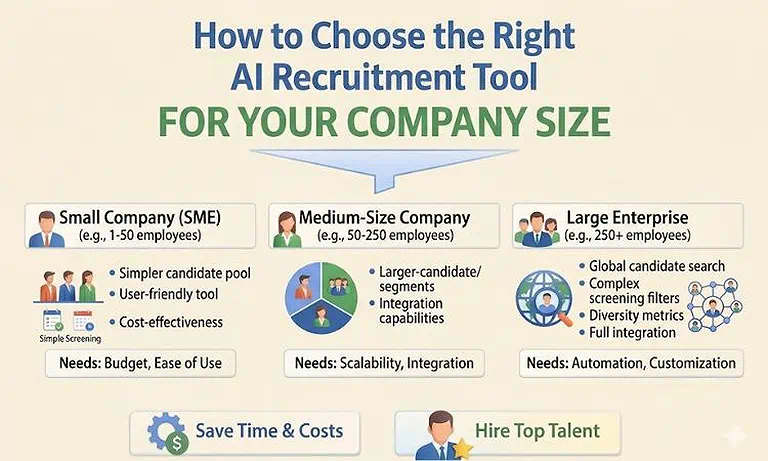
Cover Photo How to Choose the Right AI Recruitment Tool for Your Company Size
Workflow Table
| Business Need / Workflow Stage | What to Evaluate in an AI Recruitment Tool |
| Assess hiring volume | Determine whether you need a solution for occasional hiring, steady recruitment, or high-volume talent acquisition. |
| Define company size requirements | Match the platform to your organisation's size, number of recruiters, and expected hiring growth. |
| Identify recruitment challenges | Prioritise tools that solve your biggest issues, such as candidate sourcing, screening, scheduling, or interview management. |
| Evaluate automation capabilities | Compare AI features like resume screening, candidate matching, chatbot support, and workflow automation. |
| Check ATS and HR integrations | Ensure the platform integrates with your existing Applicant Tracking System (ATS), HRIS, calendars, and communication tools. |
| Review collaboration features | Verify support for hiring managers, recruiter collaboration, interview scorecards, and approval workflows. |
| Compare analytics and reporting | Look for dashboards that track hiring speed, quality of hire, recruiter performance, and diversity metrics. |
| Consider scalability | Choose software that can support future hiring expansion without requiring a platform migration. |
| Analyse pricing and ROI | Compare licensing models, implementation costs, and expected productivity improvements. |
| Request demos and pilot testing | Validate usability, implementation effort, vendor support, and business fit before making a final decision. |
Who Should Read This Guide?
Choosing the right AI recruitment tool depends on hiring volume, organisational complexity, available resources, and long-term growth plans. This guide helps decision-makers compare solutions objectively and select software that aligns with their recruitment strategy rather than simply choosing the most popular platform.
- HR managers evaluating AI recruitment software
- Talent acquisition teams improving hiring efficiency
- Recruitment leaders managing high-volume hiring
- Small businesses selecting their first recruiting platform
- Mid-sized companies planning recruitment automation
- Enterprise HR departments comparing scalable AI solutions
- Business owners looking to reduce hiring costs
- Operations leaders responsible for HR technology decisions
- Organisations replacing legacy recruitment systems
- Companies planning future workforce growth
The Hidden Problems Behind Slow Hiring
When hiring takes too long, the impact reaches far beyond the HR department. Open positions reduce team productivity, delay important projects, and can affect business growth. At the same time, overloaded employees face increased pressure, while highly qualified candidates often accept other opportunities before the hiring process is completed.
Many companies try to solve hiring delays with manual methods that create even more inefficiencies. Using spreadsheets to manage large numbers of applicants makes tracking and decision-making difficult. Disconnected recruitment tools also force recruiters to manually transfer information between platforms, increasing workload and slowing the hiring process.
The Strategic Solution: Right-sizing your procurement strategy prevents costly multi-year software churn while ensuring high team adoption rates. By filtering software ecosystems through our comprehensive matrix of the highest-rated AI solutions for scalable corporate sourcing, companies can isolate the exact platform tier that matches their current head-count scaling velocity.
Step 1: Audit Your Current Hiring Bottlenecks
Before looking at software, you must accurately pinpoint where your current talent pipeline stalls. Calculate your baseline time-to-hire and identify if the delay occurs during sourcing, screening, or scheduling.
Look closely at your application volumes to understand the operational pressure on your team. If your recruiters spend hours reading resumes, high-volume screening is your primary issue.
Choose a baseline focus area before purchasing any tech vendor licenses. Matching software capabilities to documented process gaps prevents wasting budget on unnecessary features.
Step 2: Define Infrastructure and Integration Requirements
Your chosen AI platform must easily connect with your existing core Applicant Tracking System (ATS) and HR database. Seamless data sharing prevents information silos and eliminates the need for manual data entry.
Growing companies and enterprises need systems that support secure data sharing and strict compliance standards. Ensure any vendor complies with local labor laws and data privacy regulations.
For example, a mid-sized tech company experiencing a hiring surge might integrate an AI tool into its core platform. Within days, candidate profiles sync automatically, allowing recruiters to view AI-vetted scores right inside their existing dashboard without switching tabs.
Step 3: Match AI Capabilities to Your Organisation's Scale
Small to mid-sized businesses (SMBs) should focus on automation that cuts down everyday administrative work, like automated scheduling and basic keyword screening. Large enterprises, however, require deep talent intelligence platforms built to manage massive, complex global talent pools.
Evaluate the underlying technology to ensure it matches your day-to-day hiring volume. High-volume hiring requires automated conversational screening tools to handle thousands of early applicants.
Enterprise hiring requires deep internal mobility matching and skill-gap analysis features. This helps your internal HR teams spot hidden talent already working inside your global company.
Step 4: Establish Governance and Human-in-the-Loop Safeguards
Never allow an AI algorithm to make final hiring or rejection decisions completely on its own. Human-in-the-loop safeguards ensure that recruiters review all automated recommendations to maintain absolute quality control.
Set up regular bias audits to check your machine learning models for unintended algorithmic discrimination. This practice keeps your hiring process fair, compliant, and legally sound.
Train your recruitment team to view AI tools as smart assistants rather than automated decision-makers. Recruiter intuition remains essential for assessing cultural alignment and final candidate quality.
Expected Results Timeline
Executing this selection framework yields predictable operational milestones over a standard 90-day cycle.
| Timeline | Expected Outcome |
| First 30 Days | Initial automation deployment, system integration, and workflow stabilization. |
| 60 Days | Noticeable improvement in operational efficiency and reduced administrative bottlenecks. |
| 90 Days | Significant performance gains, full team adoption, and measurable business ROI impact. |
The Best Specialized AI Tools to Automate This Framework
Manual tool selection becomes difficult to scale over time and quickly requires dedicated software infrastructure to keep up with your hiring needs.
Personio
Personio is an all-in-one HR and recruiting platform built specifically to streamline workflows for small to mid-sized organisations. It matches the requirements of Step 1 and Step 2 by combining applicant tracking, onboarding, and payroll within a single cohesive system. It eliminates fragmented spreadsheets and establishes consistent recruitment processes as teams expand.
Best suited for: Small businesses and growing mid-market organisations looking for an integrated HR and recruitment platform without enterprise-level complexity.
Read our comprehensive Personio Review to see how it fits mid-market recruitment workflows.
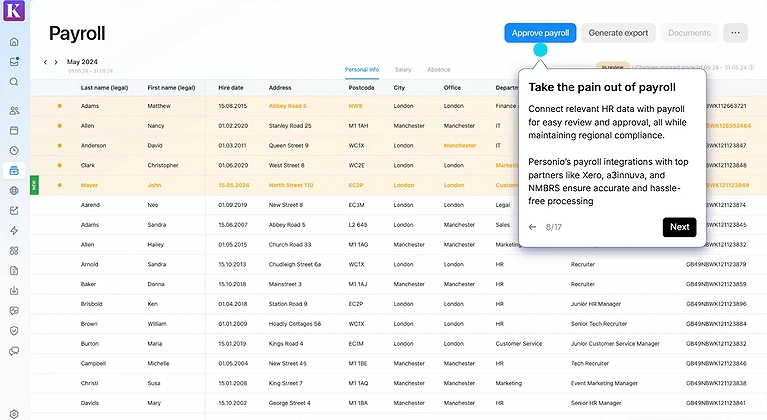
Streamlining payroll workflows from start to finish with Personio.
Paradox (Olivia)
Paradox is an enterprise-grade conversational AI assistant designed to automate high-volume recruitment screening and interview scheduling. It aligns with the scaling objectives in Step 3 by engaging applicants through conversational AI, qualifying candidates instantly, and automatically scheduling interviews. This significantly reduces recruiter workload during large hiring campaigns.
Best suited for: Large enterprises, retail, hospitality, healthcare, and organisations managing continuous or seasonal high-volume hiring.
Check out our in-depth Paradox (Olivia) Review to explore its conversational recruitment automation capabilities.
Eightfold AI
Eightfold AI is a talent intelligence platform built for organisations that require advanced AI-driven candidate matching, workforce planning, and internal mobility. It supports Step 3 by using predictive AI to identify qualified candidates from both external applicants and existing employees, making it particularly valuable for enterprises managing complex talent ecosystems.
Best suited for: Global enterprises focused on skills-based hiring, workforce planning, internal mobility, and long-term talent development.
Read our comprehensive Eightfold AI Review for a full analysis of its enterprise talent intelligence capabilities.
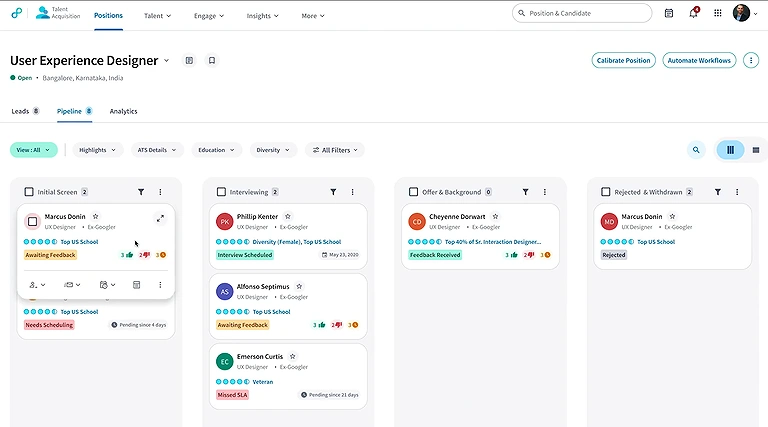
Eightfold candidate experience pipeline showing automated scheduling status, active applications, and milestone progression tracking.
HireVue
HireVue specialises in AI-assisted video interviewing, structured candidate assessments, and automated interview workflows. It complements Step 4 by helping organisations standardise candidate evaluations while supporting governance, documentation, and human oversight throughout the hiring process. This makes recruitment decisions more consistent and easier to audit.
Best suited for: Medium to large organisations that conduct high volumes of interviews or require structured, compliance-focused hiring processes.
Explore our detailed HireVue Review to learn more about its interview automation and assessment capabilities.
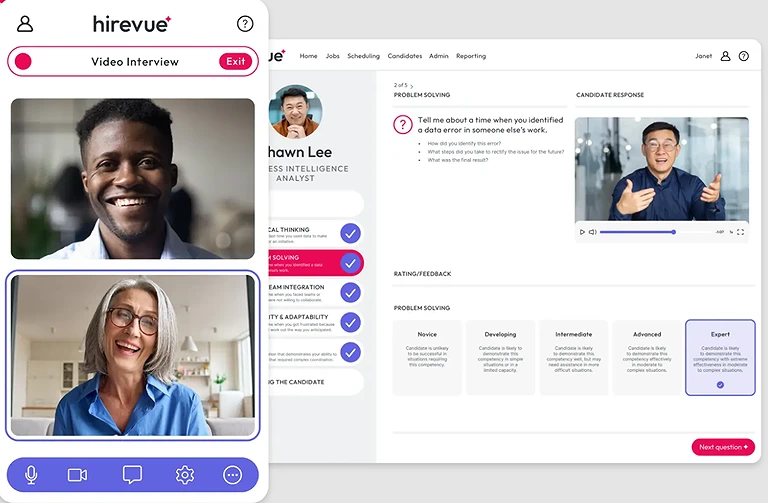
The HireVue candidate interface during a practice interview simulation for mobile and desktop.
Implementation Mistakes to Avoid
Over-Automation and Loss of the Human Touch: This mistake occurs when organizations automate every single candidate interaction, including offer calls and rejections. The consequence is a cold, robotic candidate experience that damages your employer brand. Prevent this by keeping human touch points active during the interview and offer stages.
Ignoring Algorithmic Bias and Lack of Governance: This issue happens when teams deploy AI screening models without checking the underlying training data. This can accidentally screen out qualified, diverse candidates based on biased historical hiring data. Prevent this risk by requiring vendors to provide transparent bias audit reports and keeping human recruiters in charge of final selections.
Recruitment Analytics Dashboard: Key Metrics to Monitor
Monitoring recruitment metrics helps organisations determine whether an AI recruitment tool is delivering measurable business value rather than simply automating manual tasks. By tracking hiring speed, recruitment costs, candidate experience, recruiter productivity, and long-term hiring outcomes, businesses can identify bottlenecks, optimise recruitment workflows, and justify their investment with data-driven insights. The following dashboard highlights the most important recruitment KPIs every organisation should monitor after implementing an AI-powered hiring solution.
| Recruitment Metric | Why It Matters |
| Time-to-Hire / Time-to-Fill | Measures the total number of days from publishing a job vacancy to the candidate accepting an offer. A shorter hiring cycle indicates that AI automation is reducing delays in sourcing, screening, scheduling, and decision-making. |
| Cost-per-Hire / Sourcing Channel ROI | Evaluates the overall recruitment cost for each successful hire while measuring the return on investment from different sourcing channels. This helps organisations reduce agency fees, optimise advertising spend, and invest in the highest-performing recruitment channels. |
| Candidate Net Promoter Score (NPS) | Tracks candidate satisfaction throughout the recruitment journey using post-application or interview surveys. High satisfaction scores indicate that automated communication, scheduling, and application processes remain clear, responsive, and candidate-friendly. |
| Screening Throughput Time / Recruiter Productivity | Measures how many applications each recruiter can review within a specific timeframe compared to previous manual processes. Higher productivity demonstrates that AI is successfully reducing repetitive administrative work while enabling recruiters to focus on strategic hiring activities. |
| Interview-to-Offer Ratio / Offer Acceptance Rate | Evaluates the quality of AI-recommended candidates by measuring how many shortlisted applicants progress through interviews and ultimately accept employment offers. Strong ratios suggest more accurate candidate matching and improved hiring efficiency. |
| Quality-of-Hire | Assesses the long-term success of new employees by monitoring first-year retention, performance evaluations, productivity, and manager feedback. This metric provides one of the clearest indicators of whether AI-assisted recruitment is improving workforce quality and delivering sustainable business value. |
Frequently Asked Questions
What should I consider when choosing an AI recruitment tool for my company size?
Start by evaluating your hiring volume, team size, budget, existing HR technology, and future growth plans. Small businesses often need simple, affordable solutions, while mid-sized and enterprise organisations typically require advanced automation, analytics, integrations, and scalability.
Which features are most important in an AI recruitment platform?
The most valuable features include AI resume screening, candidate matching, interview scheduling, chatbot support, ATS integration, recruitment analytics, collaborative hiring workflows, and automated candidate communication. Prioritise features that address your biggest hiring challenges rather than choosing the platform with the longest feature list.
How do I know if an AI recruitment tool integrates with my existing HR software?
Most leading vendors provide pre-built integrations with popular ATS, HRIS, calendar, email, and communication platforms. Before purchasing, confirm compatibility with your current technology stack and ask whether additional integration work or API access is required.
Is an enterprise AI recruitment platform always the best option?
No. Enterprise platforms often include advanced capabilities that smaller organisations may never use. Choosing software that aligns with your hiring needs, recruitment complexity, and available resources usually delivers better value and a faster return on investment.
What is the difference between an ATS and an AI recruitment tool?
An Applicant Tracking System (ATS) primarily manages job postings, applications, and candidate records. An AI recruitment tool enhances these processes with intelligent automation, such as resume ranking, candidate matching, interview scheduling, predictive analytics, and personalised candidate engagement.
How can I evaluate the ROI of an AI recruitment tool?
Measure improvements in key recruitment metrics such as time-to-hire, cost-per-hire, recruiter productivity, quality-of-hire, candidate satisfaction, and offer acceptance rates. Comparing these metrics before and after implementation provides a clear picture of business value.
Should I request a product demo before selecting recruitment software?
Yes. A live demonstration or pilot programme allows you to assess usability, workflow compatibility, reporting capabilities, integration quality, and vendor support. It also helps identify any limitations before committing to a long-term contract.
What common mistakes should companies avoid when selecting AI recruitment software?
Common mistakes include choosing software based solely on popularity, overlooking integration requirements, ignoring scalability, failing to involve recruiters in the evaluation process, and not defining clear hiring objectives before comparing vendors.
Can AI recruitment tools help reduce hiring bias?
They can help reduce certain forms of unconscious bias by applying consistent evaluation criteria to every applicant. However, the quality of results depends on responsible AI design, representative training data, ongoing monitoring, and human oversight throughout the hiring process.
How often should businesses review their AI recruitment software?
Review your recruitment platform at least once a year or whenever hiring volumes, organisational structure, or business goals change. Regular reviews ensure the software continues to meet operational requirements and delivers measurable value.
Are AI recruitment tools suitable for remote and global hiring?
Yes. Many modern AI recruitment platforms support remote recruitment through automated interview scheduling, multilingual communication, video interview integrations, global candidate sourcing, and collaboration features for distributed hiring teams.
Can AI recruitment software scale as my company grows?
Most leading platforms are designed to scale with business growth. As hiring demands increase, organisations can typically expand user access, automate additional workflows, integrate new HR systems, and manage larger candidate volumes without replacing their recruitment platform.
Conclusion
Choosing the right AI recruitment tool begins with understanding your organisation's hiring goals, current recruitment challenges, and future growth plans. Start by auditing your existing hiring process to identify bottlenecks such as lengthy time-to-hire, manual screening, or limited reporting capabilities. Next, define your essential requirements, including ATS integrations, compliance standards, budget, and scalability needs. With these priorities established, evaluate shortlisted vendors through live demonstrations or pilot programmes to determine which solution best aligns with your operational workflows and long-term talent acquisition strategy.