.webp)
Eightfold AI Review 2026: Is It the Best AI Talent Intelligence Platform for Enterprise Hiring?
Somewhere right now, a genuinely great internal candidate is being passed over — not because they weren't qualified, but because nobody knew they existed. That's the quiet problem with traditional ATS platforms: excellent filing cabinets, terrible fortune tellers. They store data beautifully but can't tell you who's about to quit, who's ready for promotion, or who 40 steps down the pipeline is your best hire.
Enter Eightfold AI — built less like a database and more like a talent crystal ball, using predictive modeling and agentic AI to surface workforce intelligence most ATS platforms don't attempt. In our comprehensive breakdown of modern AI recruitment platforms, we explore how predictive modeling scales industry-wide; here, we put Eightfold AI under the microscope to see if it earns its "enterprise powerhouse" reputation.

 Updated: May 22, 2026 | 20 min read
 Key Takeaways
- Eightfold AI is designed as a comprehensive talent intelligence platform rather than a traditional recruiting application.
- Its AI-powered skills intelligence enables organizations to evaluate candidates beyond keyword matching by identifying transferable skills and career potential.
- Internal mobility features help enterprises retain talent by recommending new roles and career opportunities for existing employees.
- AI-assisted sourcing and candidate rediscovery can reduce recruiter effort when filling difficult or high-volume positions.
- Workforce intelligence dashboards provide hiring leaders with broader visibility into organizational skills, talent gaps, and workforce planning.
- The platform is best suited for enterprises managing large-scale hiring and long-term talent development initiatives.
- Organizations already using enterprise ATS and HR systems are likely to gain the greatest value from Eightfold's integration capabilities.
Cover Photo Eightfold AI Review 2026: Is It the Best AI Talent Intelligence Platform for Enterprise Hiring?
Quick Overview
| Category | Details |
| Product Type | AI-powered Talent Intelligence Platform for recruiting, internal mobility, workforce planning, career development, skills intelligence, and talent management. |
| Best For | Large enterprises, global organizations, Fortune 1000 companies, government agencies, and businesses managing high-volume hiring and internal workforce mobility. |
| Deployment | Cloud-based (SaaS) with enterprise-grade implementation, web application, mobile access, API integrations, and support for multi-region global deployments. |
| Pricing | Custom enterprise pricing. Quotes are provided based on organization size, modules selected, employee count, and implementation requirements. |
| Overall Rating | **4.7/5** (Based on enterprise adoption, AI capabilities, scalability, integrations, customer feedback, and overall platform maturity.) |
| Industries | Technology, Healthcare, Financial Services, Manufacturing, Retail, Telecommunications, Energy, Government, Education, Professional Services, and Global Enterprises. |
| Alternatives | Workday Talent Management, SAP SuccessFactors, Oracle Fusion Cloud HCM, Beamery, Gloat, Phenom, iCIMS Talent Cloud, Avature, SmartRecruiters, and Eightfold's traditional ATS competitors such as Greenhouse and Lever (when paired with additional talent intelligence solutions). |
Evaluation Criteria
In the Eightfold AI review, our team evaluation focused on how its AI capabilities support recruiting, internal mobility, workforce planning, and employee retention across the entire talent lifecycle.The assessment considered both recruiter efficiency and the experience delivered to candidates and employees.
We focused on the following areas:
- AI Talent Intelligence – We assessed how effectively the platform uses AI to identify skills, recommend candidates, support internal mobility, and improve talent discovery beyond traditional keyword matching.
- Recruiting & Talent Acquisition – We evaluated recruiting workflows, candidate matching, sourcing capabilities, recruiter productivity, and hiring process support.
- Workforce Planning & Skills Intelligence – We examined workforce analytics, skills mapping, talent forecasting, succession planning, and strategic workforce planning capabilities.
- User Experience – We reviewed interface organization, role-based navigation, workflow consistency, dashboard usability, and overall ease of adoption for recruiters, HR teams, managers, and executives.
- Implementation & Deployment – We considered onboarding complexity, deployment timelines, enterprise readiness, configuration flexibility, and implementation requirements.
- Integration Ecosystem – We analyzed compatibility with leading ATS, HRIS, learning platforms, collaboration tools, identity providers, and API support.
- Reporting & Analytics – We evaluated executive dashboards, recruiting insights, workforce analytics, AI-generated recommendations, and decision-support reporting.
- Scalability & Enterprise Readiness – We assessed global deployment capabilities, security, governance, multi-region support, and suitability for large organizations managing complex hiring operations.
- Pricing & Overall Value – Because Eightfold AI follows custom enterprise pricing, we evaluated its value based on platform breadth, scalability, implementation requirements, and long-term strategic benefits rather than subscription cost alone.
What is Eightfold AI?
Company Snapshot
Eightfold AI is an enterprise Talent Intelligence Platform that uses deep-learning AI to help organizations recruit, retain, upskill, and plan their workforce through a unified skills-based approach. Rather than treating hiring, mobility, and workforce planning as separate functions, the platform connects them with a shared AI engine that continuously analyzes skills, experience, career potential, and organizational talent data.
| Category | Details |
| Founded | 2016 |
| Headquarters | Santa Clara, California, USA |
| Product Category | AI Talent Intelligence Platform |
| Core Focus | Recruiting, Talent Management, Internal Mobility, Workforce Planning |
| Deployment | Cloud-based (SaaS) |
| Primary Customers | Mid-market to Global Enterprises |
| AI Foundation | Deep Learning, Skills Intelligence, Talent Matching, Predictive Analytics |
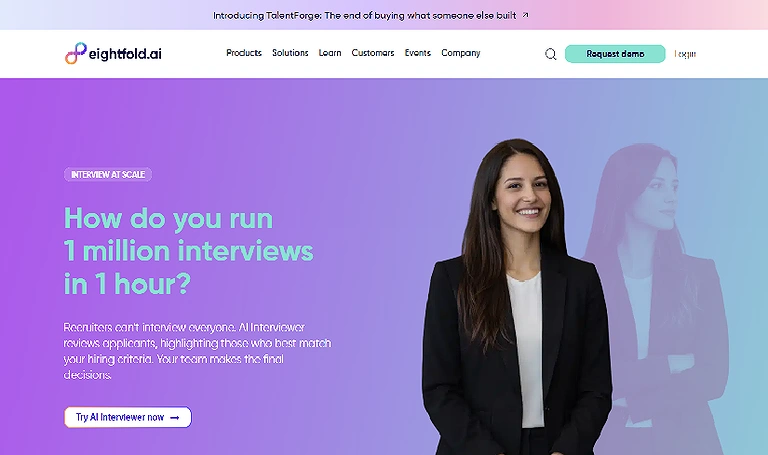
Eightfold AI Official source page
Eightfold AI Interface & Setup
Onboarding
Eightfold AI follows a structured enterprise onboarding process led by implementation consultants and customer success teams. The process typically begins with business requirement workshops, followed by system integration, AI model configuration, skills taxonomy mapping, administrator training, and pilot testing before production rollout. Because the platform supports multiple HR functions, organizations often deploy it in phases rather than enabling every module simultaneously.
Implementation Timeline
| Phase | Typical Timeline | Activities |
| Discovery & Planning | 1–2 weeks | Define business objectives, success metrics, implementation scope, and stakeholder alignment. |
| System Integration | 2–6 weeks | Connect ATS, HRIS, identity management, learning platforms, and enterprise data sources. |
| AI Configuration | 2–4 weeks | Configure skills framework, talent models, workflows, permissions, and business rules. |
| Testing & Validation | 1–3 weeks | Validate integrations, AI recommendations, user roles, security, and data quality. |
| Training & Go-Live | 1–2 weeks | Train recruiters, HR teams, managers, and administrators before full production deployment. |
| Typical Total Deployment | 6–12 weeks | Enterprise timelines vary based on implementation complexity, integrations, and global rollout requirements. |
Dashboard Experience
The dashboard is designed for enterprise HR teams, recruiters, managers, and executives, with role-based views tailored to each user. Navigation centers around recruiting, talent pipelines, internal mobility, workforce insights, skills intelligence, and analytics. AI recommendations are surfaced throughout the interface, helping users identify qualified candidates, uncover internal talent, monitor hiring progress, and access workforce insights without manually analyzing large datasets.
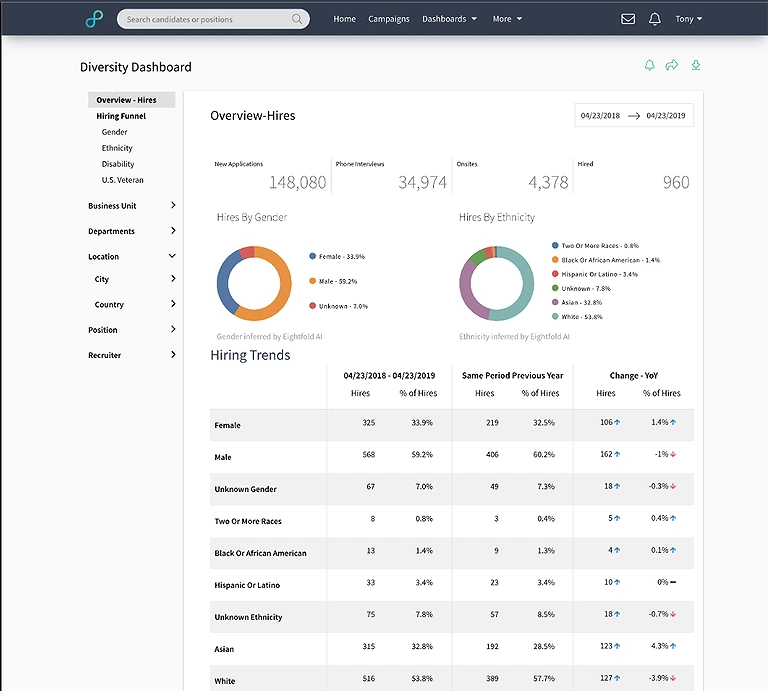
Eightfold analytics dashboard showcasing recruitment pipelines, application volume, and gender diversity distribution metrics.
Deployment Requirements
- Cloud-based deployment with no on-premise infrastructure required.
- Integration with existing ATS, HRIS, and identity management systems.
- Clean and well-structured employee and candidate data for optimal AI performance.
- Administrator access for configuring workflows, permissions, and security policies.
- Single Sign-On (SSO) support through enterprise identity providers.
- API access for integrating third-party HR, payroll, learning, and collaboration platforms.
- Cross-functional participation from HR, IT, security, and business stakeholders during implementation.
- User training for recruiters, hiring managers, HR administrators, and system owners.
- Ongoing monitoring and optimization to improve AI recommendations as organizational data evolves.
In-Depth Feature Analysis
1 Agentic Talent Sourcing & Matching
Eightfold AI uses deep-learning models to infer candidate capabilities and future career trajectory beyond exact resume keywords. It identifies transferable skills, experience patterns, and role similarity to improve matching accuracy. However, it is primarily an internal talent optimisation system, excelling at rediscovering existing ATS data rather than outbound sourcing from external candidate pools.
2 Autonomous AI Interviewers & Talent Agents
A defining shift for the platform is its transition into Agentic AI. Eightfold now deploys autonomous conversational agents that directly handle high-volume screening and the active interview cycle.
a) Eightfold AI Interviewer: Eightfold AI Interviewer conducts 24/7 multilingual first-round interviews, assessing skills, domain knowledge, and reasoning automatically.
b) Responsible Evaluation Metrics: The system is bias-audited for compliance and evaluates candidates only on response content, ignoring video, bio metrics, and vocal tone.
c) AI Interview Companion: The agent monitors human-led interviews in real time, ensuring consistent evaluations, guiding skill assessment, and automatically documenting structured feedback for hiring panels.
3 Internal Mobility & the "Eightfold Digital Twin"
Eightfold AI’s Digital Twin technology creates dynamic employee profiles by analysing enterprise systems like Slack, Microsoft Teams, email, and code repositories. This helps the Talent Marketplace recommend internal promotions, cross-functional opportunities, personalised learning paths, and skill development initiatives based on real-time workforce intelligence.
4 Workforce Planning & Public Sector Compliance
Eightfold AI provides predictive workforce analytics to identify future skill gaps, attrition risks, and long-term hiring needs. Its FedRAMP Moderate authorisation, SOC 2 compliance, and ISO 42001 certification also make it suitable for government agencies, healthcare organisations, financial institutions, and other highly regulated enterprises requiring strict data governance.
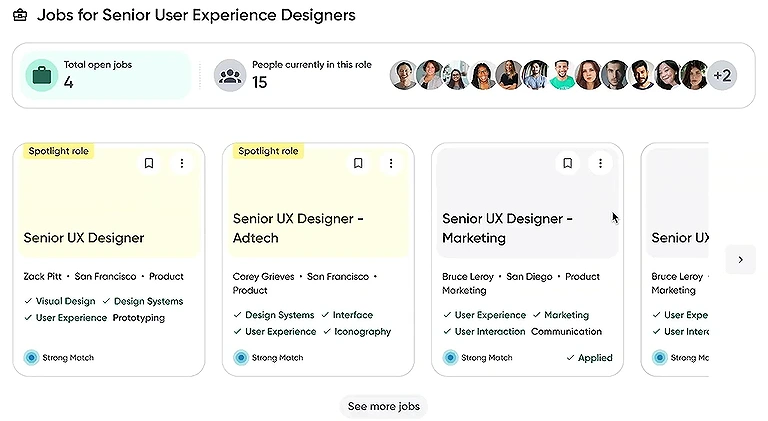
Eightfold AI interface illustrating recruitment workflows, sourcing trends, and talent rediscovery pools for UX design positions.
Integration Ecosystem: How Eightfold Connects
Eightfold AI acts as an intelligence layer, integrating with enterprise HR systems through native APIs and bi-directional data synchronisation.
Integration Support
| Integration | Supported |
| Workday | ✔ |
| SAP SuccessFactors | ✔ |
| Oracle HCM Cloud | ✔ |
| Greenhouse | ✔ |
| Lever | ✔ |
| iCIMS | ✔ |
| Microsoft Teams | ✔ |
| Slack | ✔ |
| LinkedIn Talent Solutions | ✔ |
| Microsoft Entra ID (Azure AD) / Okta (SSO) | ✔ |
| Learning Management Systems (LMS) | ✔ |
| REST APIs & Webhooks | ✔ |
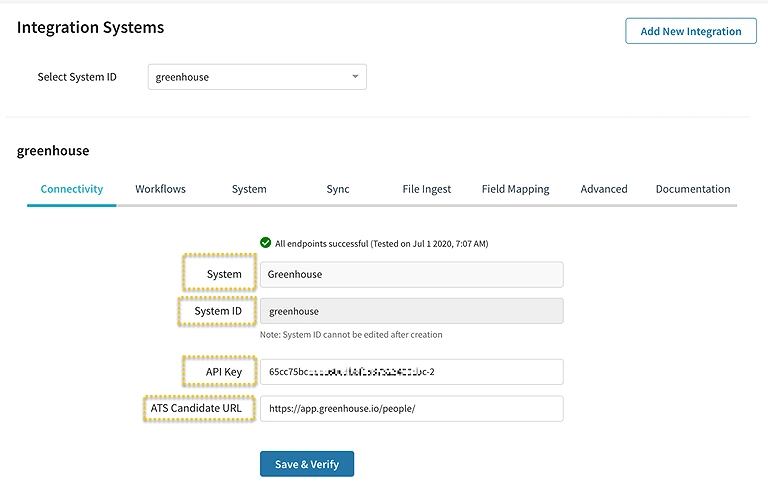
Seamless connectivity. Connecting our core tech stack to Eightfold AI using automated API integrations and ATS synchronization.
a) Core HCM & ATS Environments: Eightfold integrates with Workday, SAP SuccessFactors, Greenhouse, and iCIMS using bi-directional data synchronisation across enterprise HR systems.
b) The Oracle Agentic Partnership: Eightfold integrated its Autonomous AI Interviewer into Oracle Fusion Cloud, enabling native AI screening and coding interviews within Oracle workflows.
c) Specialised Talent Tech & Collaboration Hubs: Eightfold connects with tools like CodeSignal, HackerRank, Checkr, and First Advantage, and integrates with Teams, Slack, and Google Workspace for scheduling and Digital Twin features.
d) Implementation Reality Check: Enterprise deployment is not plug-and-play; legacy data must be cleaned and mapped to Eightfold’s skills ontology, often taking 4–9 months of engineering work.
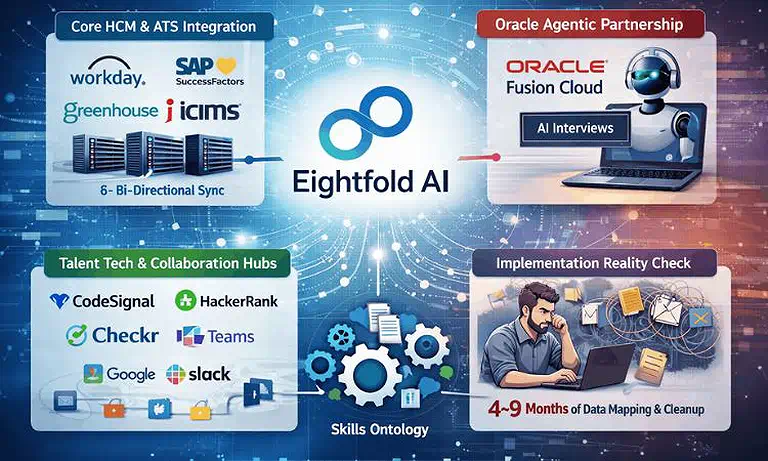
Eightfold AI Integration Ecosystem: How Eightfold Connects
Real Use Cases — Who Benefits Most?
Large enterprises handling thousands of applications monthly benefit significantly from Eightfold AI’s automation and agentic screening capabilities. To see how its high-capacity matching engine scales enterprise recruitment pipelines, read our review of the Best AI Recruitment Tools for High-Volume Hiring in 2026. The platform improves hiring scalability while reducing manual screening workloads for internal teams, shifting recruiters from manual task execution to high-level strategic orchestration.
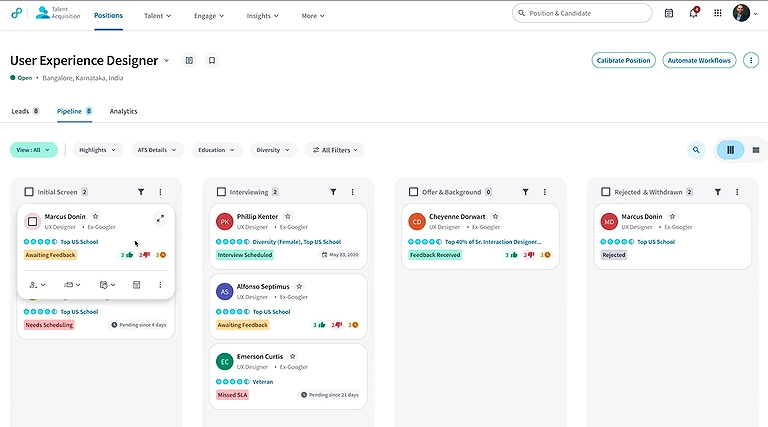
Eightfold candidate experience pipeline showing automated scheduling status, active applications, and milestone progression tracking.
1. Typical Workflow
| Stage | What Happens |
| Workforce Needs Identified | HR and business leaders define hiring demand, workforce gaps, or internal mobility objectives. |
| Job Requisition Created | Recruiters create or import open positions from the ATS or HCM system. |
| AI Matches Talent | Eightfold AI analyzes skills, experience, and career potential to rank internal and external candidates. |
| Recruiter Reviews Recommendations | Recruiters review AI-ranked talent pools, refine filters, and prioritize qualified candidates. |
| Candidate Engagement | Candidates are contacted, interviews are scheduled, and recruiting workflows continue through integrated ATS platforms. |
| Internal Mobility Evaluation | Employees are matched with open roles, projects, or career opportunities before external hiring begins. |
| Hiring Decisions | Hiring managers compare candidates, complete evaluations, and finalize offers using connected HR systems. |
| Learning & Skill Development | Employees receive personalized learning and career recommendations to close skill gaps. |
| Workforce Analytics | HR leaders monitor hiring efficiency, skill availability, diversity metrics, and workforce trends for future planning. |
2. Business Scenarios
Enterprise Talent Acquisition
Best For: Global enterprises, Fortune 1000 companies, enterprise recruiting teams, multinational organizations
Large organizations often manage thousands of applicants across multiple regions and business units. Eightfold AI centralizes talent intelligence, helping recruiters identify qualified candidates faster, reduce manual sourcing, and improve hiring consistency. The biggest benefit is a unified recruiting workflow supported by AI-driven candidate recommendations and enterprise-scale analytics.
Internal Mobility Programs
Best For: Enterprises focused on employee retention, HR business partners, talent management teams
Organizations with large workforces frequently struggle to fill open positions internally because employee skills are spread across disconnected systems. Eightfold AI identifies employees whose skills match new opportunities, making career progression more visible while reducing external hiring costs and improving retention.
Skills-Based Workforce Planning
Best For: Workforce planning teams, CHROs, enterprise strategy departments
Business leaders need visibility into future workforce capabilities rather than relying solely on current job titles. Eightfold AI maps organizational skills, identifies shortages, and supports long-term workforce planning, helping leadership prepare for expansion, digital transformation, or changing business priorities.
High-Volume Hiring
Best For: Retail, healthcare, telecommunications, manufacturing, customer service organizations
Companies hiring hundreds or thousands of employees each year benefit from automated candidate matching and prioritization. Recruiters spend less time reviewing resumes manually while maintaining hiring consistency across multiple locations and recruiting teams.
University & Early Career Recruiting
Best For: Graduate recruitment teams, campus hiring programs, enterprise internship initiatives
When candidates have limited professional experience, traditional resume screening provides less value. Eightfold AI emphasizes transferable skills, education, projects, and learning potential, helping recruiters identify promising early-career talent more efficiently.
Global Workforce Management
Best For: Multinational corporations, geographically distributed HR teams
Organizations operating across multiple countries often struggle to maintain consistent hiring and talent visibility. Eightfold AI provides a centralized view of workforce skills, internal opportunities, and recruiting activity, allowing regional HR teams to collaborate while supporting global talent strategies.
Employee Career Development
Best For: Learning & development teams, HR leaders, employee experience programs
Employees often lack visibility into potential career paths within their organization. Eightfold AI recommends suitable roles, learning opportunities, and skill-building activities based on each employee's profile, making career development more structured and personalized.
Diversity-Focused Hiring Initiatives
Best For: Diversity and inclusion teams, enterprise recruiting organizations
Organizations aiming to broaden talent pipelines can use skills-based matching to expand candidate discovery beyond traditional keyword searches. The platform helps recruiters evaluate candidates using broader talent signals while supporting more consistent recruiting processes across hiring teams.
Post-Merger Workforce Integration
Best For: Enterprises undergoing mergers, acquisitions, or organizational restructuring
Following mergers or restructures, HR teams need to understand available skills across newly combined workforces. Eightfold AI helps consolidate talent data, identify overlapping capabilities, uncover internal mobility opportunities, and support workforce redeployment during organizational change.
Strategic Executive Workforce Reporting
Best For: CHROs, HR executives, business leadership teams
Executive leadership requires data to support hiring investments and workforce decisions. Eightfold AI provides workforce analytics covering hiring trends, internal mobility, skill availability, and talent gaps, enabling leaders to make more informed strategic workforce decisions rather than relying solely on operational recruiting reports.
3. Best Organization Size
| Organization Size | Recommendation | Why? |
| Startup | ❌ Not Recommended | Enterprise pricing, implementation effort, and advanced capabilities typically exceed the needs of most startups. |
| Small Business | ⚠ Depends on Needs | Suitable only for businesses with aggressive hiring or complex talent management requirements that justify the investment. |
| Mid-Market | ✔ Recommended | Organizations with growing workforces and structured HR operations can benefit from AI-driven recruiting, internal mobility, and workforce planning. |
| Enterprise | ✔ Highly Recommended | The platform's scalability, enterprise integrations, skills intelligence, security, and advanced workforce planning capabilities are designed for large, complex organizations. |
Our Experience Using Eightfold AI
Our team expereinced that its internal mobility capabilities also stand out as a significant differentiator. Rather than limiting AI recommendations to external recruitment, the platform supports existing employees by identifying potential career opportunities, learning pathways, and internal role matches based on evolving skills and organizational needs.
What stood out
- Skills-based talent matching instead of simple keyword-driven searches
- AI recommendations that support both external recruiting and internal mobility
- Comprehensive workforce intelligence for enterprise talent planning
- Candidate rediscovery capabilities that help maximize existing talent databases
- Strong enterprise integrations supporting complex HR technology ecosystems
Potential limitations
- Organizations with relatively small recruiting teams may not require the platform's extensive enterprise functionality.
- AI recommendations should complement recruiter judgment rather than replace human hiring decisions.
- Successful implementation depends on well-maintained talent data and integration with existing HR systems.
- Enterprise deployment may require collaboration across HR, IT, talent acquisition, and workforce planning teams to fully utilize the platform's capabilities.
Its AI-powered recommendations, and workforce planning insights within a unified platform, it enables enterprise HR teams to make more strategic hiring and talent management decisions rather than simply accelerating resume screening.
Pricing — Complete Breakdown
Pricing Structure
Eightfold AI uses a closed enterprise subscription framework based on an organisation's scale. Because the software sits as an intelligence layer on top of your existing human capital management (HCM) platforms, you cannot purchase standard out-of-the-box licenses. Quotes are customised based on global headcount, hiring frequency, and specific modules deployed (e.g., matching vs. agentic interview tiers).
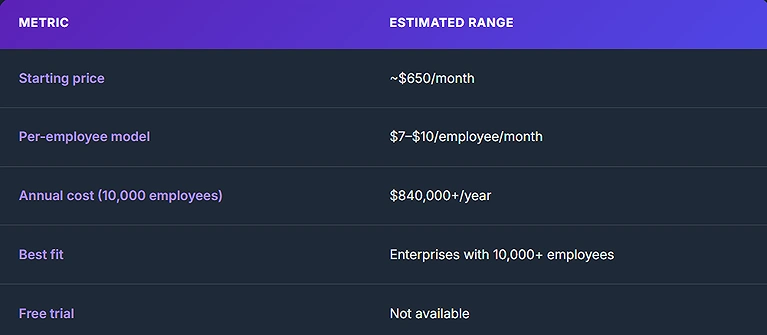
An overview of the Eightfold AI enterprise pricing architecture
Estimated Costs (2026 Benchmarks)
Enterprise Transparency Note: While exact contractual pricing remains private and requires a custom quote, industry analysis and enterprise buyer reports indicate the following cost structures
| Metric | Industry Estimate / Benchmark |
| Pricing Model | Per-Employee Per-Month (PEPM) subscription structure |
| Average Unit Rate | $7.00 to $10.00 per employee/month |
| Minimum Fit Threshold | Typically cost-prohibitive for organizations with under 2,000 employees |
| Enterprise Scaled Value | Large implementations (10,000+ employees) routinely reach $840,000+ annual contract value (ACV) |
Hidden Costs & Budgeting Factors
When presenting a business case to executive leadership, human resources teams should account for several supplementary implementation costs:
Bi-Directional ATS/HRIS Integrations: Complex custom data pipeline syncs frequently incur technical implementation charges, even when using native adapters.
Data Sanitation & Ingestion: Migrating legacy workforce data and unstructured resumes into Eightfold requires significant backend engineering and data preparation.
AI Governance Training: Deploying AI agents requires change management so HR teams can interpret, audit, and override AI scoring safely.
Eightfold AI Pros and Cons
Pros
Autonomous Agentic Screening: The AI Interviewer scales 24/7 multilingual first-round screening without increasing recruiter workload.
Continuous Skill Mapping via "Digital Twins": Instead of relying on static employee profiles, Digital Twin uses real-time signals from Slack and Microsoft Teams to identify promotions and upskilling opportunities.
Elite Public Sector Compliance: With FedRAMP Moderate Authorization and ISO 42001 certification, it meets strict governance and bias-auditing standards for government, defense, and regulated industries.
Unrivaled Predictive Dataset: Its deep-learning engine analyzes over 1.6 billion career trajectories to predict talent potential and long-term workforce skill gaps.
Cons
Prohibitive Enterprise Cost Framework: With pricing around $7–$10 per employee per month, annual contracts often exceed $800,000, making it unsuitable for small and mid-sized companies.
Inward-Facing Sourcing Limitations: The platform mines existing talent pools and internal data but lacks outbound web scraping, so teams often use tools like hireEZ or Findem.
Protracted Implementation Timelines: As an intelligent data layer over legacy systems, integrating with Workday or SAP SuccessFactors often requires months of cross-functional configuration.
Steep Management Learning Curve: Managing backend setup, profile calibration, and HR training for AI agents requires strong organisational change management.
Market Positioning: Where Eightfold AI Fits
The talent technology market has expanded beyond traditional applicant tracking systems into specialized platforms that support recruiting, workforce planning, employee development, and skills intelligence. As organizations face ongoing talent shortages and changing skill requirements, many are adopting solutions that address different stages of the employee lifecycle rather than relying on a single HR application. Understanding these categories helps buyers invest in software that aligns with their strategic priorities instead of selecting tools based solely on feature lists. Eightfold AI fits within the AI Talent Intelligence Platform category, where the focus is on connecting recruiting, internal mobility, workforce planning, and skills-based decision-making through a unified AI engine.
Category Analysis
AI Talent Intelligence Platforms
AI Talent Intelligence Platforms create a unified view of candidates and employees by analyzing skills, experience, career progression, and workforce data. Rather than focusing only on applicant tracking, these platforms help organizations recruit externally, promote internal mobility, identify future skill gaps, and support long-term workforce planning. They are typically deployed by enterprises with mature HR operations that want data-driven talent decisions across the entire employee lifecycle instead of isolated recruiting workflows.
Best Suited For
- Enterprise organizations
- Global HR teams
- Workforce planning departments
- Talent management leaders
- Organizations prioritizing internal mobility
- Businesses with complex hiring operations
Typical Capabilities
- Skills intelligence and talent matching
- Internal mobility recommendations
- Workforce planning analytics
- AI-assisted recruiting
- Career path recommendations
- Enterprise reporting and dashboards
- HR ecosystem integrations
Example Products
Eightfold AI ,Beamery ,Gloat ,Fuel50 ,Phenom Talent Experience Management
Enterprise Human Capital Management (HCM) Suites
Enterprise HCM platforms manage core HR operations, including employee records, payroll, benefits, performance management, compliance, and workforce administration. Recruiting and talent management are often included as modules within a broader HR ecosystem. These platforms are ideal for organizations seeking a single system of record that supports multiple HR functions rather than advanced AI-driven talent intelligence.
Best Suited For
- Large enterprises
- HR operations teams
- Global organizations
- Compliance-focused businesses
- Organizations standardizing HR processes
Typical Capabilities
- Core HR management
- Payroll administration
- Performance management
- Benefits administration
- Employee records
- Workforce compliance
- HR reporting
Example Products
Workday ,SAP SuccessFactors ,Oracle Fusion Cloud HCM ,UKG Pro ,Dayforce
Applicant Tracking Systems (ATS)
Applicant Tracking Systems are designed primarily to manage recruitment workflows from job posting through hiring. Their emphasis is on organizing candidates, interview scheduling, recruiter collaboration, and hiring pipelines rather than long-term workforce intelligence. Many organizations combine an ATS with additional AI or talent intelligence platforms to expand capabilities as hiring complexity increases.
Best Suited For
Small and mid-sized businesses
Recruiting agencies
HR departments
Growing organizations
Companies focused primarily on hiring
Typical Capabilities
- Job posting management
- Candidate pipeline tracking
- Interview scheduling
- Recruiter collaboration
- Offer management
- Resume database
- Hiring workflow automation
Example Products
Greenhouse ,Lever ,Ashby ,iCIMS ,SmartRecruiters
Recruitment Marketing & Candidate Experience Platforms
These platforms focus on attracting, engaging, and nurturing candidates before they formally apply. Their primary objective is improving employer branding, talent communities, career sites, and candidate communication throughout the recruitment process. They are particularly valuable for organizations competing for high-demand talent and maintaining long-term recruiting pipelines.
Best Suited For
- Talent acquisition teams
- Employer branding specialists
- High-volume recruiting organizations
- Global recruitment teams
- Organizations building talent communities
Typical Capabilities
- Career site management
- Candidate relationship management (CRM)
- Recruitment marketing campaigns
- Talent communities
- Employer branding tools
- Candidate engagement automation
- Analytics and campaign reporting
Example Products
Phenom ,Avature ,Radancy ,Symphony Talent ,Beamery (Recruitment Marketing modules)
Where Eightfold AI Fits
Eightfold AI belongs primarily to the AI Talent Intelligence Platform category. Its greatest strength lies in connecting recruiting, internal mobility, workforce planning, and skills intelligence into a unified decision-making platform rather than functioning solely as an applicant tracking system. Organizations with complex hiring operations, large employee populations, and long-term workforce planning initiatives are likely to gain the most value.
However, businesses seeking only basic recruiting workflows may find a traditional ATS sufficient, while organizations prioritizing payroll, compliance, and core HR administration may benefit more from a full HCM suite. Likewise, companies focused primarily on employer branding and candidate attraction may require a recruitment marketing platform alongside their recruiting infrastructure.
Buyer Decision Summary
| Buyer Need | Best Category | Why |
| Enterprise workforce planning | AI Talent Intelligence Platforms | Combines skills intelligence with strategic workforce analytics. |
| Internal mobility and employee retention | AI Talent Intelligence Platforms | Identifies internal talent and career opportunities. |
| Core HR, payroll, and compliance | Enterprise HCM Suites | Provides centralized HR administration beyond recruiting. |
| Structured recruiting workflows | Applicant Tracking Systems | Focuses on managing hiring pipelines efficiently. |
| Employer branding and talent attraction | Recruitment Marketing Platforms | Builds long-term candidate engagement before applications begin. |
| High-volume enterprise recruiting | AI Talent Intelligence Platforms | Uses AI to prioritize candidates and improve recruiter productivity. |
| Growing business with basic hiring needs | Applicant Tracking Systems | Offers simpler implementation and lower operational complexity. |
See How They Stack Up
If you are torn between prioritising deep AI skills, intelligence, or scaling marketing-led talent pipelines, read our detailed comparison guide, Eightfold AI vs Beamry.
Why This Matters for Buyers
Most enterprise HR stacks use multiple tools, with Eightfold AI sitting on top of HCM systems to enhance decision-making.
Alternatives
| Alternative | Best For |
| Leena AI | Enterprises looking to automate HR service delivery, employee support, and HR workflows with conversational AI rather than talent intelligence. |
| Personio | Small and mid-sized businesses needing an all-in-one HR platform with recruiting, employee management, and payroll support. |
| Lattice | Organizations focused on performance management, employee engagement, feedback, and career development after hiring. |
| Deel | Companies hiring international employees and contractors while managing global payroll, compliance, and workforce expansion. |
| Agentnoon | HR leaders and executives who need workforce planning, organizational design, and headcount modeling for strategic planning. |
| Degreed | Businesses prioritizing employee learning, upskilling, skill development, and talent growth through a learning experience platform. |
| HireVue | Enterprises conducting high-volume hiring with AI-assisted interviews, assessments, and candidate screening. |
| Paradox (Olivia) | Organizations that want conversational AI to automate candidate engagement, interview scheduling, and recruiting communication at scale. |
| Beamery | Enterprises seeking a talent intelligence platform with strong recruitment marketing and candidate relationship management. |
| Gloat | Organizations prioritizing internal talent marketplaces, workforce agility, and employee mobility. |
What's New in 2026?
- Expanded AI Talent Intelligence capabilities continue to improve skills inference, helping organizations identify qualified candidates and internal talent using broader career signals rather than relying only on resumes or job titles.
- Greater emphasis on skills-based hiring supports organizations shifting toward competency-driven recruitment, internal mobility, and workforce planning as traditional degree and title requirements become less central.
- Enhanced workforce planning insights provide HR leaders with deeper visibility into organizational skill gaps, future hiring needs, and talent supply to support long-term strategic planning.
- Improved internal mobility recommendations help employees discover relevant projects, open positions, and career paths based on evolving skills and business priorities.
- Broader enterprise integration capabilities strengthen connectivity with leading ATS, HRIS, learning platforms, and identity management systems, reducing data silos across HR technology stacks.
- More configurable AI governance and administrative controls allow organizations to align AI-driven recommendations with internal hiring policies, compliance requirements, and security standards.
- Continued investment in analytics and executive dashboards gives HR leaders richer insights into hiring efficiency, workforce trends, skills distribution, and talent movement across the organization.
- Ongoing platform enhancements focus on improving usability, scalability, and support for global enterprises managing complex recruiting and talent management operations.
Final Verdict — Should You Use Eightfold AI?
Eightfold AI is an advanced enterprise talent intelligence platform with AI agents, workforce analytics, and skills-based mobility for large organisations.
Best For
- Large enterprise HR departments managing massive workforces of 2,000 to 10,000+ employees.
- Global recruitment operations requiring robust, multilingual, and legally compliant AI screening.
- Forward-thinking companies are heavily focused on skills-based internal mobility and talent retention.
- Highly regulated organizations that strictly require end-to-end FedRAMP-compliant systems.
Skip If
- Your organization lacks a compliance framework—instead, study our guide on how to ensure compliance and prevent AI bias in recruitment.
- You run a small or mid-sized business that doesn't require high-volume enterprise automation features.
- You only need a lightweight setup rather than a deeply integrated, standalone applicant tracking system (ATS).
- Your primary sourcing priority centres almost exclusively around cold, outbound candidate web scraping.
Overall Rating
8.9 / 10
Frequently Asked Questions
1. What is Eightfold AI primarily used for?
Eightfold AI is an AI-powered talent intelligence platform that helps organizations recruit, retain, and develop talent using a skills-based approach. It supports recruiting, internal mobility, workforce planning, career development, and talent analytics within a single enterprise platform.
2. Is Eightfold AI an Applicant Tracking System (ATS)?
No. Eightfold AI is not a traditional ATS. Instead, it complements existing ATS platforms by adding AI-powered candidate matching, skills intelligence, internal mobility, and workforce planning. Many organizations integrate it with systems like Workday, Greenhouse, SAP SuccessFactors, and Oracle HCM.
3. Which organizations benefit most from Eightfold AI?
Eightfold AI is best suited for mid-market and enterprise organizations with complex hiring needs, large workforces, and long-term talent management strategies. Companies managing global recruitment, internal mobility, and workforce planning typically gain the most value from the platform.
4. How does Eightfold AI match candidates?
The platform uses AI to analyze skills, work history, certifications, education, projects, and career progression instead of relying only on keyword matching. This enables recruiters to discover qualified candidates who may be overlooked by traditional resume searches.
5. Can Eightfold AI support internal mobility?
Yes. One of Eightfold AI's core strengths is identifying employees who are suitable for internal roles, projects, mentorship opportunities, or career development paths. This helps organizations improve employee retention while reducing external hiring costs.
6. Does Eightfold AI integrate with existing HR systems?
Yes. Eightfold AI supports integrations with many enterprise HR technologies, including Workday, SAP SuccessFactors, Oracle HCM, Greenhouse, Lever, Microsoft Teams, Slack, learning platforms, identity providers, and other systems through APIs.
7. How long does it typically take to implement Eightfold AI?
Implementation timelines vary depending on organization size, existing HR systems, and deployment scope. Most enterprise implementations take approximately 6 to 12 weeks, although highly customized or global deployments may require additional planning and integration work.
8. Is Eightfold AI suitable for small businesses?
Generally, no. While technically capable of supporting smaller organizations, its enterprise-focused functionality, implementation requirements, and custom pricing make it a better fit for mid-sized and large organizations with dedicated HR teams and strategic talent initiatives.
9. How does Eightfold AI help with workforce planning?
Eightfold AI provides visibility into organizational skills, identifies talent gaps, forecasts workforce needs, and supports succession planning. These insights help HR leaders make informed decisions about hiring, reskilling, and future workforce investments.
10. How does Eightfold AI compare with HireVue and Paradox (Olivia)?
Although all three use AI in recruitment, they solve different problems. Eightfold AI focuses on talent intelligence, skills matching, and workforce planning. HireVue specializes in AI-assisted interviewing and assessments, while Paradox (Olivia) automates candidate communication, screening, and interview scheduling.
11. Does Eightfold AI use AI responsibly in hiring?
Eightfold AI provides governance controls, configurable workflows, and reporting features that help organizations monitor AI-assisted recommendations. However, hiring decisions remain the responsibility of employers, who should regularly review their processes to align with internal policies and applicable employment regulations.
12. Is Eightfold AI worth the investment?
For organizations with high-volume hiring, global workforces, or a strong focus on skills-based talent management, Eightfold AI can provide significant strategic value by improving recruiting efficiency, supporting internal mobility, and enabling data-driven workforce planning. Smaller businesses with straightforward hiring needs may find a traditional ATS or HR platform more cost-effective.
Conclusion
Eightfold AI stands out as one of the most comprehensive AI talent intelligence platforms for enterprises that want to modernize recruiting, internal mobility, and workforce planning through a skills-based approach. Rather than replacing core HR systems, it enhances them with AI-driven talent insights and enterprise analytics. Its implementation effort and custom pricing make it better suited to mid-market and large organizations than smaller businesses. If your priority is strategic talent management across the entire employee lifecycle, Eightfold AI is a strong choice. However, organizations with simpler hiring needs may achieve better value with a traditional ATS or a focused recruiting platform that matches their current scale and budget.