.webp)
How to Ensure Compliance and Prevent AI Bias in Recruitment
Your AI hiring tool could be quietly breaking the law right now — and the first time you'd find out is a regulator's letter, not a dashboard alert.
That's the uncomfortable twist about biased AI hiring systems: they don't announce themselves. No error message pops up saying "hey, this algorithm just filtered out qualified candidates based on a pattern nobody meant to teach it." It just... happens, quietly, until poor compliance turns into legal exposure, financial penalties, and a reputation hit that takes years to undo. And with hiring laws getting stricter by the year, "we didn't know" is quickly becoming the most expensive sentence in HR.
The good news? This isn't unfixable — it's just unmonitored. This guide breaks down practical strategies and technologies to catch bias, build fairness in, and create a skills-based process that actually holds up under audit.

 Updated: June 05, 2026 | 9 min read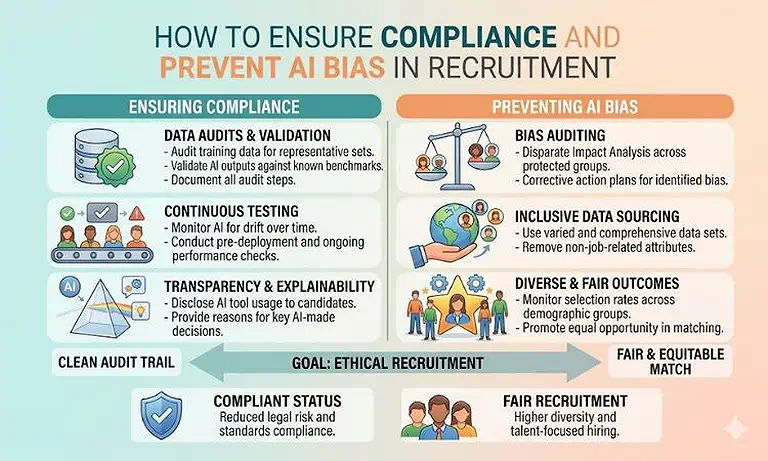
Cover photo How to Ensure Compliance and Prevent AI Bias in Recruitment
Workflow Table
| Recruitment Compliance Workflow Stage | AI Recruitment Tools That Support the Stage |
| Define fair hiring policies and competency frameworks | Degreed |
| Standardize candidate assessments and interview criteria | HireVue |
| Detect potential AI bias and improve talent matching consistency | Eightfold AI |
| Maintain compensation equity and compliant pay decisions | Aeqium |
| Monitor compliance data, audit records, and hiring outcomes | Eightfold AI, HireVue, Aeqium |
| Continuously update hiring practices based on workforce learning and regulatory changes | Degreed |
Who Read this Guide For?
This guide is designed for organizations that want to use AI in recruitment while maintaining compliance, reducing hiring bias, and meeting evolving employment regulations. It helps decision-makers understand which AI tools support fair, transparent, and auditable hiring processes.
- HR leaders implementing responsible AI recruitment.
- Talent acquisition teams improving hiring compliance.
- Compliance and legal professionals overseeing recruitment policies.
- Enterprise organizations managing high-volume hiring.
- People operations teams focused on reducing recruitment bias.
- Business leaders evaluating AI recruitment software for regulated industries.
The Hidden Costs of Manual Recruitment Compliance
Relying on manual compliance checks or unverified automated screening leads to extensive operational friction, skyrocketing cost-per-hire, and high candidate abandonment rates. When regulatory standards change, organizations using fragmented, spreadsheet-driven workflows struggle to track data provenance, resulting in delayed decision-making and prolonged vacancies.
A common organizational mistake is treating compliance as a reactive, manual review process rather than an active technical layer. Talent teams frequently attempt to patch system gaps by adding manual oversight checklists to broken, disjointed recruiting legacy tools, which slows down throughput without eliminating underlying algorithmic bias.
Step 1: Standardize Skills-Based Candidate Matching
Transition recruitment frameworks away from demographic markers and unstructured resume data by focusing exclusively on validated technical skills, capabilities, and past performance metrics.
Algorithmic models must be configured to mask applicant names, genders, zip codes, and graduation years to eliminate historical profiling and pedigree bias during the initial sourcing phase.
Step 2: Implement Structured, Masked Assessments
Deploy objective, standardised interviewing criteria across every department to ensure identical candidate evaluations and eliminate human interviewer subjectivity or accent-based bias.
A mid-market financial services firm recently automated its technical screening by masking candidate identities and using standardised evaluation rubrics, which increased minority hiring by 34% in 90 days.
Step 3: Audit and Calibrate Pay and Compensation Equity
Run algorithmic payroll and offer data validation cycles before releasing candidate proposals to maintain internal pay equity and eliminate demographic pay gaps at the point of offer.
Continuous compensation analysis ensures incoming talent offers strictly align with current internal benchmarks, market data, and job-specific complexities, completely mitigating manual negotiating biases.
Step 4: Validate Long-Term Skills Intelligence data
Continuously verify that your internal talent data libraries and external automated matching pools accurately reflect up-to-date professional credentials and technical certifications.
Establish a governance loop that audits candidate placement metrics quarterly against performance scores to ensure the AI engine identifies genuine high performers without developing proxy variables for protected classes.
Expected Results Timeline
| Timeline | Expected Outcome |
First 30 Days | Complete AI hiring audits, apply data masking, and introduce compliant skills-based assessments. |
60 Days | Standardize candidate screening across all hiring processes and reduce potential bias in evaluations. |
90 Days | Achieve full compliance with hiring regulations, lower bias risks, and improve hiring results with measurable ROI. |
The Best Specialized AI Tools to Automate This Framework
Manual compliance oversight becomes impossible to scale efficiently over large volumes of talent pipelines and requires dedicated software infrastructure.
Aeqium
Aeqium provides sophisticated compensation modeling software that systematically automates internal equity evaluations during the offer phase as highlighted in Step 3. By pulling real-time internal payroll metrics and contrasting them with proposed talent packages, it completely eliminates negotiation variances that perpetuate historic wage disparities. Check out our in-depth Aeqium review for a full analysis.
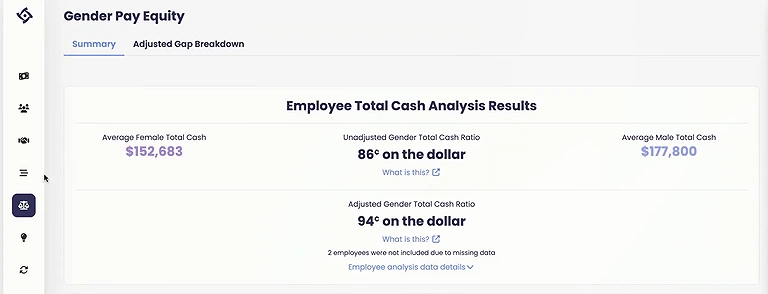
Image showing the gender pay equity of Aeqium features
Eightfold AI
Eightfold AI leverages an advanced skills intelligence platform to automate anonymous, objective candidate matching as outlined in Step 1. The platform maps deep professional capabilities rather than biographical histories, directly lowering adverse impact risks across high-volume pipelines while offering complete transparency logs for regular regulatory audits. Read our comprehensive Eightfold AI review to explore its capabilities.
HireVue
HireVue introduces highly structured, validated video assessments and conversational AI conversational frameworks to secure the interviewing phase detailed in Step 2. By replacing subjective human scoring with pre-calibrated evaluation rubrics that analyze job-relevant competencies, it actively eliminates human interviewer bias from early-stage screening. Check out our in-depth HireVue review for a full analysis.
Degreed
Degreed closes the optimization loop by validating long-term skills intelligence and post-hire credential data as structured in Step 4. The platform builds a dynamic "skill DNA" profile for hired candidates, allowing legal and TA teams to audit whether the AI's predictive hiring scores match actual on-the-job performance and skill growth over time. Read our comprehensive Degreed review to explore its capabilities.
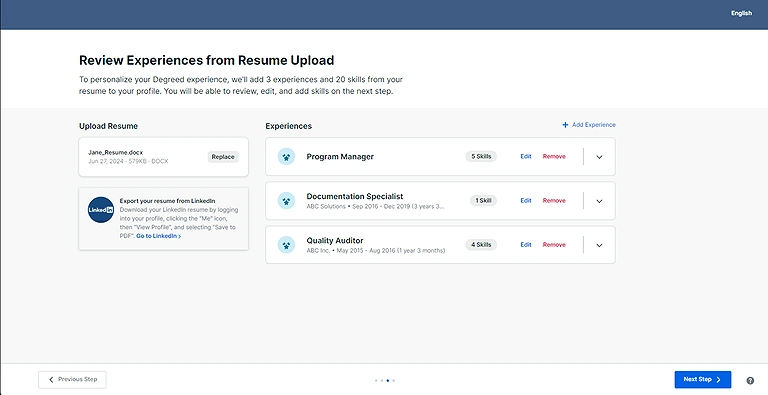
Tailoring Degreed experiences as automate the framework—just add the skills that matter to you.
Critical Pitfalls & Implementation Mistakes to Avoid
Algorithmic Bias: This risk occurs when AI systems train on historical data reflecting systemic human prejudices, leading to the automatic exclusion of diverse talent pools. Prevent this by conducting routine algorithmic audits and enforcing strict, demographic-blind screening protocols directly within your active hiring software.
Over-Automation and Lack of Oversight: This mistake happens when organizations eliminate human touchpoints completely, driving talent away with an impersonal experience. Instead of rushing to patch procedural inefficiencies with disjointed software, talent leaders must choose modern, cohesive tools. Evaluate top options using our curated guide on the most efficient AI platforms for accelerating the hiring process to balance structural speed with authentic human engagement.
Operational Metrics: How to Measure and Track Success
Adverse Impact Ratio: Track the selection rate of protected demographic groups against majority groups to ensure compliance with the 80% rule.
Screening Throughput Time: Measure the speed of anonymized automated screening stages compared to traditional manual resume sorting.
Quality-of-Hire and Retention: Monitor the 12-month performance and stay rates of candidates selected via skills-based AI matching.
Offer Acceptance Rate: Analyze if structured, equitable compensation modeling improves your final pipeline closing ratios.
FAQs
How can organizations ensure AI recruitment remains compliant over time?
AI recruitment compliance is an ongoing process rather than a one-time setup. Organizations should regularly review hiring outcomes, monitor adverse impact metrics, update models when regulations change, document decision-making processes, and perform independent bias audits. Combining AI with human oversight helps maintain fairness while meeting evolving legal requirements.
Can AI recruitment software comply with global hiring regulations?
Yes, many enterprise AI recruitment platforms are designed to support compliance across multiple regions. Features such as audit logs, consent management, configurable workflows, data retention controls, and explainable AI help organizations align with regulations like GDPR, EEOC guidance, and emerging AI governance frameworks. Final compliance, however, depends on how employers configure and use the software.
How often should AI hiring systems be audited for bias?
Best practice is to conduct bias audits at least annually and whenever significant changes are made to hiring models, job requirements, or recruitment workflows. High-volume employers may also monitor fairness metrics quarterly to identify performance changes before they affect hiring outcomes.
Can AI reduce hiring bias?
Yes. When properly configured with skills-based evaluation criteria, anonymized candidate data, and continuous fairness monitoring, AI can reduce many forms of unconscious human bias during candidate screening. However, organizations must regularly audit AI outputs because biased training data or poor implementation can introduce new forms of discrimination.
Is AI recruitment compliant with EEOC guidelines?
AI recruitment can support EEOC compliance when employers validate hiring assessments, monitor adverse impact, maintain documentation, and ensure hiring decisions are job-related and consistent with business necessity. Employers remain responsible for demonstrating that their recruitment practices are fair and non-discriminatory.
What is an algorithmic bias audit?
An algorithmic bias audit is an independent evaluation that examines how an AI hiring system makes decisions across different demographic groups. Auditors analyse selection rates, model behaviour, training data, and decision outcomes to identify potential discrimination, document risks, and recommend corrective actions before legal or compliance issues arise.
What is an Automated Employment Decision Tool (AEDT)?
An Automated Employment Decision Tool (AEDT) is software that uses AI, machine learning, statistical modelling, or automated scoring to assist or influence employment decisions such as screening, ranking, interviewing, or selecting candidates. Many jurisdictions have introduced specific transparency and auditing requirements for these systems.
Who is legally responsible if an AI hiring tool discriminates against candidates?
In most jurisdictions, the employer remains legally responsible for hiring decisions, even when third-party AI software is used. Software vendors may provide compliance features and documentation, but organizations must validate the system, monitor outcomes, investigate bias, and ensure employment decisions comply with applicable employment and anti-discrimination laws.
What is the four-fifths rule in AI recruitment compliance?
The four-fifths rule is a commonly used statistical guideline for identifying potential adverse impact. If the selection rate for one protected group is less than 80% of the selection rate for the highest-performing group, employers should investigate whether their hiring process or AI system is creating unintended discriminatory outcomes.
How do AI recruitment platforms improve transparency and explainability?
Modern AI recruitment platforms improve transparency by providing audit trails, explainable candidate scores, documented evaluation criteria, recruiter activity logs, and reporting dashboards. These capabilities help HR teams justify hiring decisions, respond to compliance reviews, and demonstrate that candidates were evaluated using consistent, job-related criteria.
Conclusion
Regularly review your recruitment platform to identify areas where demographic data, outdated workflows, or poorly configured AI screening may create compliance risks. Establish clear evaluation criteria, implement privacy-focused processes such as data masking, and adopt AI recruitment tools that support transparent, auditable hiring decisions. Partner with legal, HR, and technology teams to validate your hiring workflows on an ongoing basis, ensuring they remain fair, compliant, and aligned with evolving employment regulations while reducing bias and improving recruitment efficiency.