.webp)
Degreed Review 2026: Complete AI Learning Platform for Enterprise Workforce Training
Let's be honest: "mandatory training" is corporate code for clicking through slides while thinking about lunch. That's the legacy of old-school LMS platforms rigid courses, forgettable content, and zero proof it mattered. Low engagement, weak skill alignment, no measurable impact.
Thankfully, the enterprise learning world is growing up. Platforms like Degreed ditch the static course-library model for AI-powered, skill-first ecosystems that notice skill gaps, personalize learning, and connect growth to real internal mobility. This Degreed review is built for CHROs, CLOs, and L&D leaders done guessing whether training actually works.

 Updated: May 26, 2026 | 20 min read
 Key Takeaways
- Degreed is a skills-first Learning Experience Platform (LXP) built for enterprise workforce development.
- It works as an intelligence layer, not a traditional LMS or course hosting system.
- It connects multiple learning sources (internal + external) into one unified skill-based ecosystem.
- Best suited for large enterprises (5,000+ employees) focused on upskilling and internal mobility.
- Strong AI capabilities for skills mapping, learning recommendations, and workforce analytics.
- Requires structured HR data and strong implementation maturity to unlock full value.
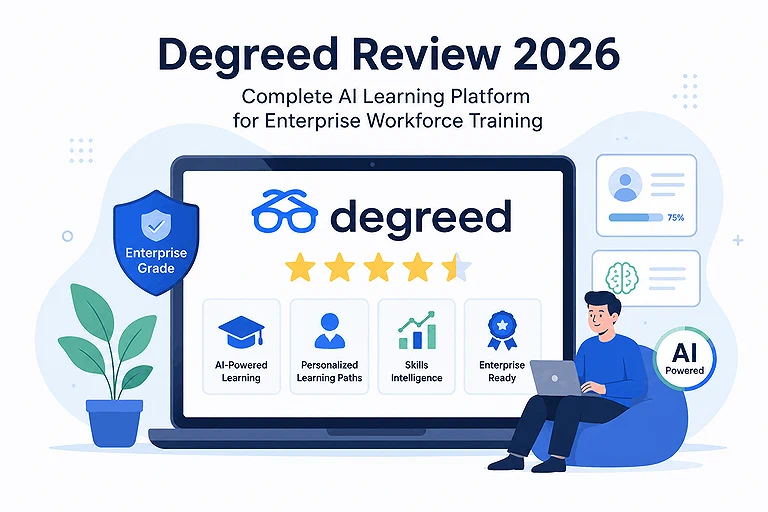
Degreed Software Cover Photo for Reviews
Evaluation Criteria
In this review we evaluates Degreed from the perspective of organizations looking to improve workforce learning, skills development, and internal talent growth rather than simply managing online training courses.
We considered the following criteria:
- Learning Experience – Assessed how effectively Degreed personalizes learning journeys, recommends relevant content, and encourages continuous employee development.
- Skills Intelligence – Evaluated the platform's ability to infer skills, identify capability gaps, support upskilling and reskilling initiatives, and align learning with business objectives.
- Administration & Deployment – Reviewed implementation complexity, platform configuration, user management, and scalability for enterprise environments.
- Integrations & Ecosystem – Examined support for HR systems, LMS platforms, collaboration tools, identity providers, APIs, and third-party learning content.
- Analytics & Reporting – Measured the depth of workforce insights, learning analytics, skills reporting, and executive dashboards available to administrators.
- User Experience – Considered navigation, interface consistency, accessibility, and the overall experience for both learners and administrators.
- Enterprise Readiness – Reviewed security, governance, scalability, compliance support, and suitability for large, distributed organizations.
- Pricing & Overall Value – Evaluated pricing transparency, expected return on investment, and the value delivered relative to enterprise learning and talent development goals.
What Makes Degreed Different?
Degreed is different because it is not a traditional LMS focused on course delivery. Instead, it works as a skills intelligence and learning orchestration layer that connects learning across the entire organization.
- Focuses on skills, not courses completed
- Builds a dynamic skills graph based on roles and activity
- Aggregates learning from multiple sources (internal tools, Coursera, LinkedIn Learning, YouTube, etc.)
- Does not host content it unifies external + internal learning ecosystems Sits above LMS/HCM systems like Workday and SAP SuccessFactors
In simple terms, Degreed turns scattered learning data into a single skills-driven intelligence system for the enterprise.
Quick Review Table
| Evaluation Area | Assessment |
| Product Category | AI-Powered Learning Experience Platform (LXP) |
| Primary Use Case | Enterprise learning, workforce upskilling, skills intelligence, and internal mobility |
| Best For | Mid-market and enterprise organizations with structured Learning & Development (L&D) strategies |
| Deployment Model | Cloud-based (SaaS) |
| Ease of Setup | Moderate – Requires planning, integrations, and learning architecture configuration |
| Learning Curve | Low for learners • Moderate for administrators |
| User Experience | Modern, intuitive, and designed around personalized learning journeys |
| AI Capabilities | AI-powered content recommendations, skills intelligence, personalized learning paths, and career development insights |
| Integration Support | Extensive – Supports HRIS, LMS, content providers, collaboration platforms, SSO, and enterprise APIs |
| Enterprise Readiness | Excellent – Built for large organizations with complex learning ecosystems |
| Pricing Transparency | Custom enterprise pricing (Sales consultation required) |
| Implementation Timeline | Typically varies based on organization size, integrations, and content migration requirements |
| Overall Value | High for organizations adopting a skills-first workforce development strategy |
| Overall Rating | ⭐ 9.7 / 10 |
What Is Degreed?
Company Snapshot
Degreed is an AI-powered enterprise learning experience platform (LXP) that helps organizations unify employee learning, skill development, career mobility, and workforce intelligence in one ecosystem. Instead of replacing existing learning systems, it connects internal and external content while using AI to personalize learning paths based on employee skills and business objectives.
| Category | Details |
| Company | Degreed |
| Founded | 2012 |
| Headquarters | Pleasanton, California, USA |
| Platform Type | AI Learning Experience Platform (LXP) |
| Primary Users | Mid-market and enterprise organizations |
| Deployment | Cloud-based (SaaS) |
| Best For | Workforce learning, upskilling, reskilling, and skills intelligence |
| AI Capabilities | Personalized learning recommendations, skills inference, learning pathways, analytics |
What Problem Does It Solve?
Many organizations struggle with fragmented learning systems, low employee engagement, inconsistent skill tracking, and limited visibility into workforce capabilities. Degreed centralizes learning from multiple providers, identifies skill gaps using AI, and recommends personalized development paths that align employee growth with business priorities.
It helps organizations by:
- Bringing learning content from multiple platforms into one experience
- Mapping employee skills and identifying capability gaps
- Delivering AI-powered personalized learning recommendations
- Supporting upskilling and reskilling initiatives at enterprise scale
- Connecting learning with career development and internal mobility
- Providing analytics for workforce planning and learning effectiveness
How Degreed Works
Degreed integrates with an organization's HR systems, learning management systems, content providers, and business applications to build a unified learning ecosystem. AI analyzes employee skills, roles, career goals, and completed learning activities to recommend relevant courses, learning pathways, and skill-building opportunities while providing leaders with workforce insights through centralized dashboards.
Why Enterprises Choose It
- AI-driven personalized learning recommendations
- Unified learning experience across multiple content providers
- Enterprise-scale skills intelligence and workforce analytics
- Strong support for upskilling and reskilling programs
- Extensive integrations with HR, LMS, and enterprise software
- Career mobility and internal talent development capabilities
- Centralized reporting for learning leaders and HR teams
- Scalable cloud platform suitable for global organizations
- Continuous skill tracking instead of one-time assessments
- Supports data-driven workforce planning and future skills strategies
Operational Interface & Deployment
First Impression
Degreed presents a modern enterprise interface that prioritizes personalized learning over traditional course administration. Instead of leading users directly into a catalog of mandatory training, the platform emphasizes skill development, recommended learning content, career growth, and individualized learning pathways. This approach creates an experience that feels closer to a professional development hub than a conventional LMS.
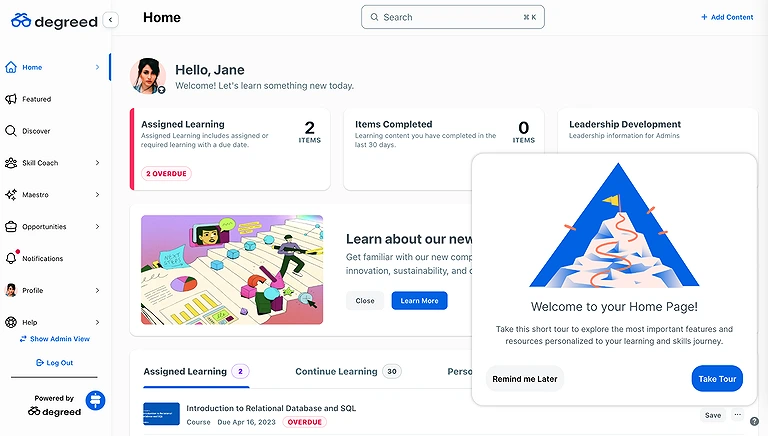
Overview of the modern, personalized user learning interface within the Degreed enterprise platform.
Dashboard & Navigation
The dashboard is organized around employee learning activities, skill profiles, curated content, and personalized recommendations. Navigation remains consistent across major modules, allowing users to move between learning pathways, skill tracking, career goals, and external content sources without excessive menu complexity. For administrators, dedicated management areas separate learner-facing experiences from configuration, reporting, and content administration, helping reduce unnecessary clutter during daily operations.
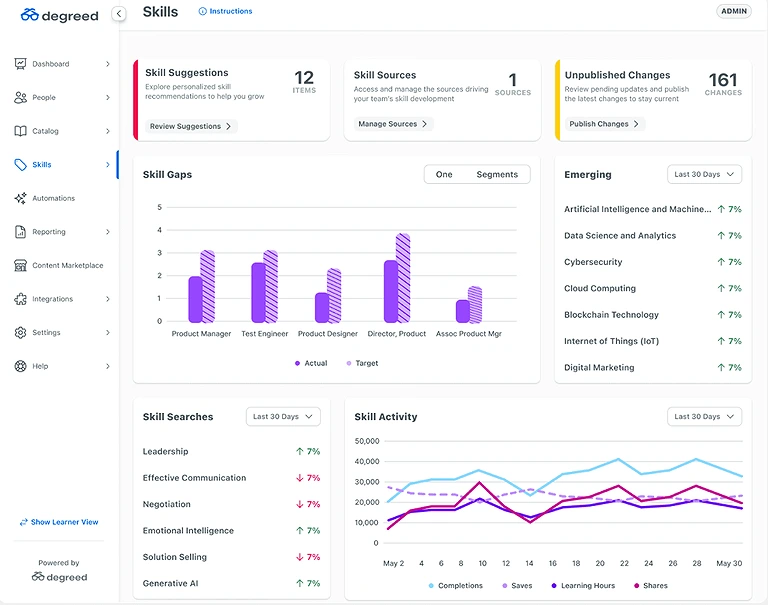
Degreed platform analytics dashboard displaying workforce skill telemetry and structural capability tracking.
Learner Onboarding Experience
Organizations can tailor onboarding experiences based on departments, roles, business units, or learning objectives. Once users gain access, personalized recommendations and structured learning paths help reduce the effort required to discover relevant content. Employees are encouraged to build learning habits through continuous recommendations rather than relying solely on assigned courses.
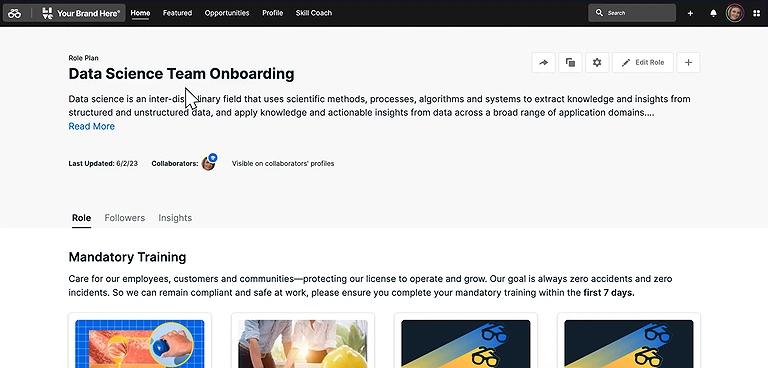
Overview of departmentally tailored onboarding tracks within the Degreed platform.
Administrative Experience
From an administrator's perspective, Degreed offers extensive configuration capabilities for managing learning pathways, skills frameworks, content providers, permissions, analytics, and user groups. While this flexibility supports complex enterprise environments, organizations should expect a moderate learning curve during the initial setup phase, particularly when designing skills taxonomies or integrating multiple external learning sources.
Deployment Observations
As a cloud-based enterprise platform, Degreed is designed to integrate with existing HR and learning technology ecosystems rather than operate as a standalone application. Successful deployments typically involve coordination between HR, Learning & Development, IT, and system administrators to configure integrations, user provisioning, authentication, and content synchronization. Although implementation requires careful planning, the platform is built to support large-scale organizations where long-term workforce development is a strategic priority rather than a one-time training initiative.
Core Features Granular Breakdown
1 Degreed Learning & Content Curation (Core Capability)
Degreed centralizes internal, public, and paid learning content into one searchable platform. It uses a skills graph to auto-tag content for better skill-based discovery and learning alignment.
Operational Limits: This curation model breaks down when enterprises use fully offline, air-gapped training systems that do not generate digital usage data or structured content for indexing.
Compliance & Security: All content pathways respect original source access controls, fully adhering to standard single sign-on (SSO) configurations and digital rights management policies.
2 Degreed Maestro Studio (Autonomous/Agentic AI)
Degreed Maestro Studio is an AI tool that creates personalized learning experiences and tutoring agents. It uses enterprise AI to build simulations, support coaching, and deliver role-play training for sales and customer service teams.
2026 Cutting-Edge Application: Maestro acts as an AI tutor inside learning paths. It asks reflection questions, answers policy-based queries, and adjusts difficulty based on learner interaction.
Compliance & Security: Maestro follows strict enterprise security rules. All training data stays inside the customer’s system, ensuring no private company data is shared with public AI models.
3 Degreed Skills+ & Dynamic Taxonomies (Internal Retention Capability)
Degreed Skills+ is a real-time skill tracking system that replaces manual updates with continuous monitoring of learning, feedback, and work outcomes.
2026 Cutting-Edge Application: The platform updates its talent marketplace in real time using multiple data sources. When employees complete learning milestones, their verified skills are instantly updated and shown to managers searching for those capabilities.
Compliance & Security: The skills engine strictly complies with localized labor regulations and European Works Council requirements regarding automated worker tracking and performance profiling.
4 Macro Reporting & Platform Trust Center (Reporting & Security)
Degreed provides skill dashboards that track proficiency growth, behavior changes, and skill gaps across teams instead of course completion metrics.
Security Certifications: Degreed maintains an enterprise-grade security posture, backing its operations with SOC 2 Type II, ISO 27001, and ISO 9001 certifications.
Compliance Standards: The platform follows GDPR and CCPA rules, using strong encryption to protect personal data during storage and transfer.
Integration Ecosystem
For enterprise learning platforms, integration capabilities often determine long-term success more than the number of built-in features. Degreed is designed to operate as a central learning and skills intelligence layer rather than an isolated application, allowing organizations to connect existing HR, learning, and productivity systems into a unified employee development ecosystem. This approach minimizes duplicate data, improves reporting accuracy, and enables employees to access learning resources without constantly switching between multiple platforms.
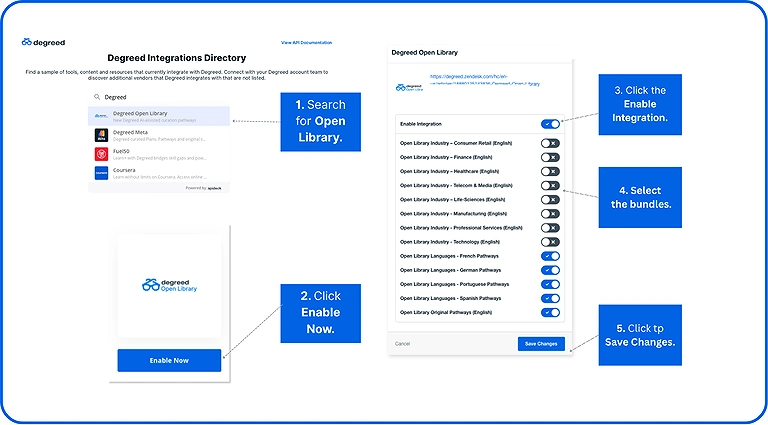
Enterprise technology dashboard displaying available native integrations and application marketplace options
The platform supports integrations across several enterprise technology categories:
| Integration Category | Business Value |
| HRIS & HCM Systems | Synchronizes employee profiles, organizational structures, departments, job roles, and reporting relationships to keep learning assignments aligned with workforce data. |
| Learning Management Systems (LMS) | Extends existing LMS investments by aggregating learning content, tracking development activities, and delivering a more personalized learning experience. |
| Single Sign-On (SSO) | Supports enterprise authentication providers, allowing employees to securely access the platform using existing corporate credentials while simplifying user management. |
| Content Providers | Connects with leading digital learning libraries and educational content partners, enabling organizations to deliver diverse learning resources through a single interface. |
| Collaboration Platforms | Integrates with workplace collaboration tools to make learning recommendations, notifications, and development activities more accessible within employees' daily workflows. |
| Open APIs & Enterprise Integrations | Provides API capabilities for integrating with internal business applications, custom workflows, analytics platforms, and broader enterprise technology ecosystems. |
Integration Support
| Integration | Supported |
| Workday | ✔ |
| SAP SuccessFactors | ✔ |
| Greenhouse | ✔ |
| Slack | ✔ |
| Microsoft Teams | ✔ |
| LinkedIn Learning | ✔ |
| Cornerstone | ✔ |
| Okta | ✔ |
| Microsoft Entra ID (Azure AD) | ✔ |
| SCORM/xAPI Content | ✔ |
Reality Check
Degreed's integration capabilities are one of its strongest enterprise advantages. Most major HR and learning platforms connect through pre-built integrations or APIs, but implementation complexity varies depending on the organization's existing systems, custom workflows, identity management, and data governance requirements. Large enterprise deployments typically require IT and HRIS teams to configure and validate integrations before rollout.
Real-World Use Cases
Enterprise Workforce Upskilling
Organizations undergoing digital transformation often struggle to keep employee skills aligned with rapidly evolving technologies. Degreed enables Learning & Development teams to deliver personalized learning journeys based on individual roles, existing competencies, and future business priorities. Instead of assigning identical training to every employee, the platform recommends targeted learning resources that help accelerate workforce reskilling while providing leadership with greater visibility into organizational skill development.
Internal Talent Mobility
Many enterprises are shifting from external recruitment toward internal talent development to reduce hiring costs and retain experienced employees. Degreed supports this strategy by helping HR teams identify transferable skills across the workforce, uncover employees who are ready for new responsibilities, and recommend learning pathways that prepare them for future roles. This skills-first approach encourages career growth while enabling organizations to fill critical positions using existing talent.
Global Compliance & Certification
For multinational organizations operating across multiple regions, maintaining consistent compliance training can be challenging. Degreed helps centralize mandatory learning programs, certification tracking, and continuous professional development while allowing organizations to adapt learning requirements for different business units or regulatory environments. This ensures employees remain current with evolving compliance standards without relying on fragmented learning systems.
Industry Applications
Degreed delivers the greatest value in organizations where continuous learning, workforce agility, and skills intelligence are strategic priorities. It is particularly well
suited for the following industries:
- Financial Services & FinTech: Supports large-scale workforce reskilling as financial institutions adopt AI, automation, and advanced analytics while maintaining compliance with evolving regulatory requirements.
- Healthcare & Life Sciences: Enables continuous professional development, certification tracking, and role-specific learning for clinical and administrative staff across hospitals, healthcare networks, and research organizations.
- Global Manufacturing & Automotive: Helps standardize technical training, product certification, and operational knowledge across geographically distributed production facilities while supporting evolving engineering and safety standards.
- Technology & Software: Assists rapidly growing technology companies in keeping engineering, product, and customer-facing teams up to date with emerging technologies, cloud platforms, cybersecurity practices, and evolving technical skill requirements.
- Retail & Consumer Goods: Delivers personalized learning programs for distributed frontline employees, store managers, and regional teams, ensuring consistent product knowledge, customer service standards, and leadership development across multiple locations.
Our Experience Using Degreed
Based on our evaluation of Degreed's official documentation, product walkthroughs, platform capabilities, and publicly available customer feedback, the platform presents a structured learning experience centered on skills development rather than traditional course management. The workflow is designed to guide employees from skill assessment to personalized learning recommendations, while administrators receive centralized oversight through analytics dashboards. Navigation appears intuitive for everyday learners, although configuring skills frameworks, integrations, and organizational taxonomies requires thoughtful planning before enterprise-wide adoption.
What Stood Out
- The learning experience is organized around skills and career development, making recommendations feel more relevant than static course catalogs.
- Navigation emphasizes discovery, allowing employees to find internal and external learning resources from a single interface instead of switching between multiple systems.
- Administrative workflows are structured to give learning teams visibility into workforce capabilities without relying on disconnected reporting tools.
- AI-driven recommendations appear designed to encourage continuous learning, helping employees build skills incrementally rather than completing isolated training events.
- Reporting focuses on measurable workforce development, enabling leaders to connect learning initiatives with organizational skill priorities.
- The platform scales well for large organizations by supporting diverse learning providers and enterprise-grade integrations within a unified ecosystem.
- Integration with HR, collaboration, and content platforms helps reduce duplicate data management and creates a more consistent employee experience across systems.
Potential Limitations
- Successful implementation depends on clearly defined skills frameworks and governance, which may require cross-functional planning between HR, IT, and learning teams.
- Organizations migrating from traditional LMS platforms may need time to adapt to a skills-first learning model.
- Enterprise integrations and identity management can increase implementation complexity, particularly in highly customized technology environments.
- Some advanced capabilities are most valuable when combined with existing HR and talent management systems, potentially limiting benefits for smaller organizations with simpler technology stacks.
- Pricing and deployment are geared toward enterprise customers, making the platform less practical for organizations with limited learning and development requirements.
Degreed delivers the greatest value for organizations building long-term workforce development strategies rather than simply distributing training content. Enterprises investing in upskilling, reskilling, and internal talent mobility are likely to benefit most from its skills-focused approach. Its strongest advantage is the ability to unify learning, skills intelligence, and workforce insights within a connected enterprise ecosystem, supporting more informed talent development decisions over time.
Financial Breakdown
Pricing Structure
Degreed uses a SaaS subscription model with per-employee or per-seat pricing, usually through multi-year enterprise contracts. Individual access is free, but full business features require a corporate subscription.
Cost Benchmarks
| Enterprise Segment Size | Estimated Price Range (PEPM) | Minimum Annual Spend | Typical Contract Length |
| Mid-Market Enterprise (2,500–5,000 Seats) | $12.00–$16.00 | $40,000 | 1–3 Years |
| Large Enterprise (5,000–20,000 Seats) | $8.00–$12.00 | $75,000 | 3 Years |
| Strategic Global Enterprise (20,000+ Seats) | Volume Custom Discounting | $150,000+ | 3–5 Years |
Hidden Costs & Resource Drags
Subscription Model: Beyond standard per-seat licensing, pricing may include additional enterprise costs.
System Integration Costs: Extra expenses arise from connecting Degreed with customized legacy LMS systems.
Data Maintenance: Ongoing costs are required for managing and maintaining internal data pipelines.
Professional Services: Fees may apply for custom taxonomy alignment and system configuration.
Staff Training: Organizations must invest in training L&D teams to use Degreed Maestro Studio effectively.
Strategic Strengths & Trade-offs
Strategic Strengths
Exceptional Consumer-Grade UX: Successfully drives voluntary, daily user adoption far beyond the typical baseline of rigid, legacy compliance systems.
Powerful Skills-Graph Translation: Automatically unifies highly fragmented global content libraries into a coherent, skill-indexed data taxonomy.
Secure, Domain-Isolated Agentic AI: Degreed Maestro Studio accelerates content development and provides scalable, context-aware coaching without exposing private enterprise data.
Robust Global Security Compliance: Backed by verified SOC 2 Type II and extensive ISO certifications, meeting the strict procurement standards of global financial and healthcare institutions.
Trade Offs
High Enterprise Cost Barriers: Pricing structures and multi-year commitments make it prohibitively expensive for small-to-midsize businesses.
Significant Implementation Drag: Requires dedicated internal resources and multiple weeks to sanitize historic data for proper skills-graph alignment.
Total Dependence on Content Quality: If your underlying, connected content libraries are outdated, Degreed's AI curation will merely deliver highly personalized paths to poor training materials.
Not a Standalone LMS Substitute: Does not feature native, heavy-duty operational transactional modules like payroll, complex direct physical asset scheduling, or foundational HRIS architecture.
Market Positions: Where Degreed Fits in the Learning Technology Market
To understand the enterprise landscape, software buyers must look past superficial, transient product features and categorize platforms by their core architectural philosophies.
AI Learning Experience Platforms (LXPs)
Learning Experience Platforms prioritize personalized, employee-driven learning instead of administrator-controlled course delivery. They aggregate learning from multiple internal and external sources while using AI to recommend content based on employee skills, interests, and career goals. Organizations focused on continuous learning, workforce agility, and talent development often adopt this category.
Best Suited For
- Large enterprises
- Learning and Development teams
- Organizations with continuous upskilling initiatives
- Companies investing in internal career mobility
- Global workforces
Typical Capabilities
- AI-powered learning recommendations
- Skills mapping and intelligence
- Personalized learning pathways
- Learning content aggregation
- Workforce analytics
- Career development support
- Enterprise integrations
Example Products
Degreed ,Cornerstone Learn ,EdCast (Cornerstone) ,Learning Pool LXP ,Valamis
Learning Management Systems (LMS)
Learning Management Systems are designed primarily to administer, deliver, and track mandatory training programs. They emphasize compliance, certifications, enrollments, and standardized course management rather than personalized employee learning. Industries with regulatory requirements often rely on LMS platforms to ensure workforce compliance.
Best Suited For
- Compliance-driven organizations
- Healthcare providers
- Financial institutions
- Government agencies
- Corporate training departments
Typical Capabilities
- Course administration
- Certification tracking
- Compliance reporting
- Instructor-led training management
- Assessments and quizzes
- Learning records
- Audit reporting
Example Products
Moodle ,Docebo ,TalentLMS ,Absorb LMS ,SAP SuccessFactors Learning
Talent Intelligence & Skills Platforms
These platforms focus on understanding workforce capabilities rather than delivering learning content. They analyze employee skills, identify capability gaps, support workforce planning, and improve internal talent mobility. Organizations building long-term workforce strategies frequently use this category alongside learning platforms.
Best Suited For
- Enterprise HR teams
- Workforce planning leaders
- Talent management departments
- Organizations with strategic skills initiatives
- Large global enterprises
Typical Capabilities
- Skills inference
- Workforce analytics
- Internal mobility insights
- Talent intelligence
- Succession planning
- Skill gap analysis
- AI-powered workforce planning
Example Products
Eightfold AI ,Gloat ,SkyHive ,TechWolf ,Fuel50
Corporate Learning Content Libraries
Content library providers focus on delivering professionally created training materials across technical, business, and leadership topics. Rather than replacing enterprise learning platforms, they typically integrate with LMS or LXP solutions to expand available learning resources.
Best Suited For
- Organizations expanding learning catalogs
- Technical teams
- Professional development programs
- Enterprise training departments
- Global learning initiatives
Typical Capabilities
- Extensive course libraries
- Professional certifications
- Technical skills training
- Leadership development
- Business skills content
- Content updates
- Third-party platform integrations
Example Products
LinkedIn Learning ,Coursera for Business ,Udemy Business ,Pluralsight ,Skillsoft
Where Degreed Fits
Degreed is best positioned as an AI Learning Experience Platform (LXP) with strong skills intelligence capabilities. It is designed for enterprises that want to centralize learning, personalize employee development, and align workforce skills with business objectives. Organizations seeking structured compliance training may require a traditional LMS, while businesses focused primarily on workforce planning or talent intelligence may benefit from dedicated skills platforms alongside Degreed. Organizations evaluating alternative enterprise LXPs should also review Degreed vs EdCast: The 2026 Enterprise Buyer's Guide before making a purchasing decision, as both platforms address personalized learning and skills development with different implementation approaches. Its greatest value comes from connecting learning, skills, and career development within a unified enterprise ecosystem.
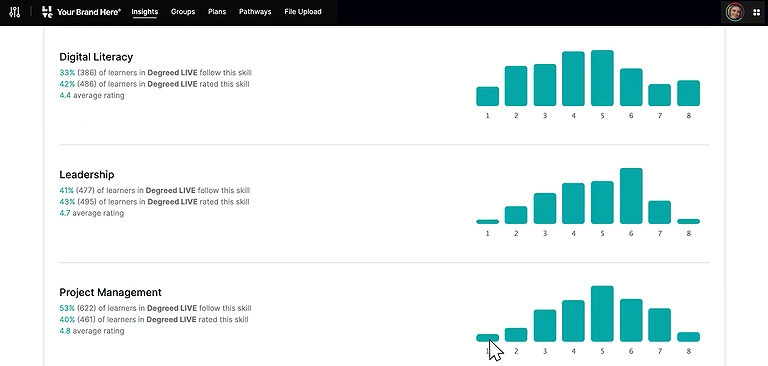
Overview of the Degreed analytics panel tracking leadership, digital literacy, and project management skills.
Strategic Buying Table
| If Your Primary Organizational Goal Is | Recommended Platform Category | Strategic Recommendation |
| Build a skills-first workforce and enable continuous employee development | Learning Experience Platform (LXP) | Choose Degreed to deliver AI-powered personalized learning, skills intelligence, and internal career mobility. |
| Deliver mandatory compliance training and track course completion | Traditional Learning Management System (LMS) | Consider platforms such as Workday Learning or SAP SuccessFactors Learning if compliance administration is the primary objective. |
| Improve internal talent mobility through verified employee skills | Skills Intelligence & Talent Development Platform | Degreed is well suited for organizations prioritizing internal mobility, career development, and workforce capability planning. |
| Aggregate learning content from multiple providers into a single learning experience | Enterprise Learning Experience Platform | Degreed excels at bringing together internal training, third-party content, and external learning resources within one platform. |
| Support global enterprise learning across multiple regions and business units | Enterprise Learning & Skills Platform | Degreed offers the scalability, governance, and integration capabilities required for complex multinational organizations. |
| Manage payroll, employee records, and core HR administration | Human Capital Management (HCM) Platform | Choose an HCM solution such as Workday or SAP SuccessFactors, then integrate Degreed to strengthen learning and workforce development. |
| Deliver employee performance reviews and continuous feedback | Performance Management Platform | Consider dedicated performance management solutions like Lattice or 15Five alongside Degreed if performance management is the primary requirement. |
| Develop a connected HR technology ecosystem | Integrated HR Technology Stack | Combine Degreed with HRIS, HCM, collaboration platforms, and enterprise content providers to create a unified employee development ecosystem. |
Degreed Alternatives
| Alternative | Best For |
| Eightfold AI | Enterprises prioritizing AI-powered talent intelligence, skills matching, internal mobility, and workforce planning beyond learning management. |
| Leena AI | Organizations looking to automate HR support, employee service delivery, and knowledge management through conversational AI rather than learning experiences. |
| Personio | Small and mid-sized businesses seeking an all-in-one HR platform with core HR, recruiting, and employee management capabilities. |
| Lattice | Companies focused on performance management, employee engagement, goal tracking, and career development alongside continuous feedback. |
| Deel | Global organizations managing international hiring, payroll, compliance, and contractor management across multiple countries. |
| Agentnoon | Enterprises requiring workforce planning, organizational design, and scenario modeling to optimize team structures and future headcount. |
| Cornerstone Learn | Businesses needing a combination of traditional LMS functionality, compliance training, and enterprise learning management. |
| LinkedIn Learning | Organizations primarily interested in expanding their learning content library with professionally developed business and technical courses. |
| HireVue | Companies focused on AI-assisted hiring, video interviewing, and candidate assessments instead of workforce learning. |
| Paradox (Olivia) | High-volume recruiting teams that want conversational AI to automate candidate engagement, interview scheduling, and hiring workflows. |
Common Implementation Challenges
- Skills taxonomy design is difficult
- Needs cross-department alignment
- Heavy integration dependency
- HRIS + LMS + identity systems required
- Long deployment cycles
- Not a plug-and-play SaaS setup
- Change management resistance
- Employees must shift from course-based → skill-based mindset
- Content overload risk
- Too many integrations can reduce clarity
- AI trust issues
- Poor governance leads to irrelevant skill recommendations
Organizational Fit
| Organization Size | Fit Rating | Assessment |
| Startups (1–50 Employees) | ⭐⭐☆☆☆ | The platform is generally more sophisticated than most startups require. Simpler and lower-cost learning solutions are often a better fit at this stage. |
| Small Businesses (51–250 Employees) | ⭐⭐⭐☆☆ | Suitable for organizations investing heavily in structured employee development, although implementation costs and administrative overhead should be carefully evaluated. |
| Mid-Market (251–1,000 Employees) | ⭐⭐⭐⭐☆ | A strong option for businesses formalizing learning strategies, building internal career pathways, and preparing for future workforce growth. |
| Enterprise (1,001–10,000 Employees) | ⭐⭐⭐⭐⭐ | Degreed performs exceptionally well in enterprise environments where personalized learning, skills intelligence, and integration with existing HR systems are strategic priorities. |
| Global Enterprise (10,000+ Employees) | ⭐⭐⭐⭐⭐ | One of Degreed's strongest use cases. Its scalability, governance capabilities, AI-powered recommendations, and enterprise integrations make it well suited for multinational organizations managing complex learning ecosystems across multiple regions. |
What's New in 2026?
- Expanded AI-powered skills intelligence with more accurate skill inference, helping organizations identify emerging capabilities and workforce gaps without relying solely on manual assessments.
- Improved personalized learning recommendations that better align employee development paths with business priorities, career goals, and role requirements.
- Enhanced workforce analytics dashboards providing learning leaders with deeper visibility into skill growth, learning engagement, and organizational readiness.
- Greater support for internal talent mobility, enabling organizations to connect learning achievements with career opportunities and succession planning.
- Broader integration capabilities across HRIS, LMS, collaboration, and enterprise productivity platforms to simplify data synchronization.
- Refined administrator experience with improved tools for managing learning pathways, skills frameworks, and reporting at enterprise scale.
- Continued investment in AI governance and responsible AI practices, giving enterprises more transparency over how AI-generated recommendations are produced.
- Ongoing expansion of partner content and ecosystem integrations, allowing organizations to deliver a more unified learning experience from multiple content providers.
Final Verdict
Best For
Global organizations managing more than 5,000 employees with highly diverse, rapidly changing technical skill requirements.
Enterprises that already possess multiple, fragmented content providers (e.g., Coursera, Harvard ManageMentor, internal files) and want to unify them under a single interface.
L&D leaders looking to shift their corporate culture from passive training completion to active, validated skill progression.
Skip If
Your company has fewer than 2,000 total employees, making the platform's heavy integration costs and subscription pricing difficult to justify.
You do not have an existing LMS or HCM infrastructure and need an all-in-one platform to handle core HR transactional processes like payroll and shift tracking.
Overall Score:
8.8 / 10
Context-Driven FAQs & Conclusion
1. What is Degreed primarily used for?
Degreed is an AI-powered Learning Experience Platform (LXP) that helps organizations centralize employee learning, develop workforce skills, identify skill gaps, and support career growth. It combines learning content, skills intelligence, and analytics into a single platform for enterprise talent development.
2. How is Degreed different from a traditional Learning Management System (LMS)?
A traditional LMS focuses on assigning courses, tracking completions, and managing compliance training. Degreed emphasizes personalized learning, AI-driven recommendations, skills development, and internal mobility while integrating with existing LMS platforms rather than replacing them.
3. How exactly does Degreed integrate with an existing legacy LMS like Cornerstone?
Degreed sits on top of legacy LMS platforms as an intelligent learning layer, bringing together internal and external learning content in one experience. It synchronizes course information and learning completions so organizations can continue using their LMS for compliance while providing employees with a more personalized learning environment.
4. Does Degreed replace our corporate HRIS or talent marketplace?
No. Degreed is not designed to replace HR systems such as Workday or SAP SuccessFactors. Instead, it complements existing HR technology by adding skills intelligence, personalized learning, and workforce development while exchanging relevant employee and skills data with connected enterprise systems.
5. Which organizations benefit most from Degreed?
Degreed is best suited for medium-sized and large enterprises that invest in continuous learning, workforce upskilling, reskilling, leadership development, and internal talent mobility. Organizations with global workforces and mature learning strategies typically gain the greatest value.
6. Can Degreed track offline learning, mentoring, and informal skill development?
Yes. Degreed supports a broad definition of learning by allowing employees to record activities such as mentoring, conferences, books, podcasts, and other informal development opportunities. This helps organizations build a more complete picture of workforce skills beyond formal training courses.
7. What are the main data privacy safeguards for Degreed's AI capabilities?
Degreed provides enterprise-grade security and governance controls designed for business environments. Organizations maintain control over their workforce data, and AI capabilities are governed by enterprise security policies to help support privacy, compliance, and responsible use of organizational information.
8. How much internal effort is required to maintain skills data over time?
While AI helps identify and update skills based on employee activities and learning records, organizations still benefit from governance by HR and Learning & Development teams. Periodic reviews ensure skill frameworks remain aligned with business priorities and evolving workforce requirements.
9. Does Degreed support external learning providers?
Yes. Degreed can aggregate learning content from numerous external providers alongside internal resources. This allows employees to access a wide range of learning materials through a single platform instead of navigating multiple systems independently.
10. Is Degreed suitable for compliance training?
It can support compliance initiatives, but organizations that rely heavily on mandatory certifications and regulatory training often use Degreed alongside a traditional Learning Management System. This approach combines structured compliance management with personalized learning experiences.
11. How does Degreed use AI to personalize learning?
Degreed analyzes factors such as employee skills, roles, learning history, career interests, and organizational priorities to recommend relevant learning content and development pathways. The goal is to make learning more targeted and aligned with both individual and business objectives.
12. What should organizations prepare before implementing Degreed?
Before deployment, organizations should define their skills framework, learning objectives, governance processes, and integration strategy. Planning these elements early helps ensure the platform delivers meaningful workforce insights, personalized learning experiences, and long-term adoption across the organization.
Conclusion
Degreed stands out as a strong enterprise Learning Experience Platform for organizations looking to move beyond traditional training and adopt a skills-first approach to workforce development. Its strengths lie in AI-driven learning personalization, skills intelligence, extensive integrations, and support for continuous upskilling and internal mobility. While implementation requires thoughtful planning and is best suited to medium and large enterprises, the platform delivers the most value when integrated into an existing HR and learning ecosystem. If your organization wants to align employee development with long-term business goals and build a future-ready workforce, Degreed is a compelling option to consider in 2026.