.webp)
Degreed vs EdCast: Which Platform Is Better for Enterprise Upskilling in 2026?
Every corporate learning team knows the feeling: content scattered across a dozen systems, skill gaps tracked in spreadsheets, and an LMS that fights you every time you try to integrate something new. It's not a training problem it's an infrastructure problem. And it's exactly what's slowing down modern corporate education today.
For Enterprise HR Ops leaders and Global Chief Learning Officers, the fix isn't another point solution. It's a central data layer one that pulls siloed content into a single system and delivers personalized development paths to thousands of employees worldwide, without adding more friction.
Two platforms have built their entire architecture around solving this: Degreed and EdCast (by Cornerstone). Both lead the skill-based talent mobility space, but they take very different roads to get there. If your priority is user-driven micro-learning and granular engagement metrics, Degreed is the stronger pick. If you're deeply embedded in broader HCM infrastructure or need specialized frontline compliance tools, EdCast is built to serve that need.
The right choice comes down to how your organization actually learns here's how to tell which one fits.

 Updated: May 30, 2026 | 15 min read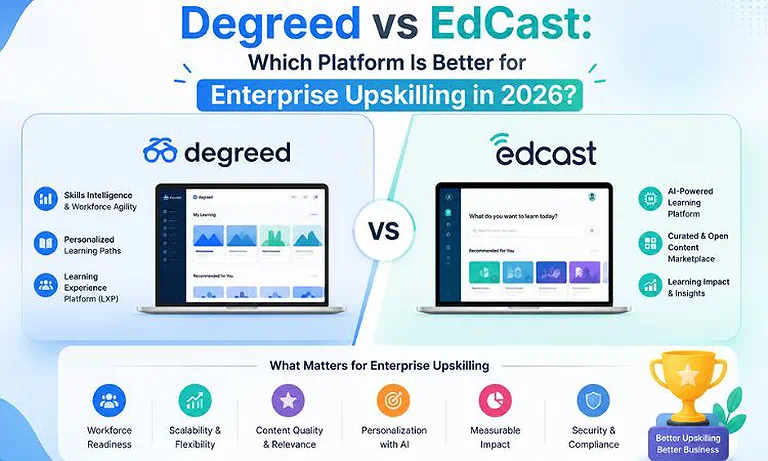
Cover Photo Degreed vs EdCast: Which Platform Is Better for Enterprise Upskilling in 2026?
Key Takeaways
- Best For: Degreed is best for organizations building a skills-first learning ecosystem, while EdCast is better for enterprises focused on AI-powered learning experience, knowledge discovery, and workforce development at scale.
- Biggest Strength: Degreed offers one of the most mature enterprise skill intelligence and learning ecosystems. EdCast excels at personalized learning recommendations and knowledge aggregation powered by AI.
- Biggest Limitation: Degreed typically requires more planning and governance to unlock its full value. EdCast can feel complex to configure because of its extensive content, AI, and knowledge management capabilities.
- AI Capability: Both platforms provide strong AI features. EdCast places greater emphasis on AI-driven content recommendations and knowledge experiences, while Degreed focuses more on AI-assisted skills intelligence and career development.
- Ease of Implementation: Degreed usually involves a structured enterprise rollout. EdCast implementations can also be resource-intensive, especially when integrating multiple enterprise systems.
- Enterprise Readiness: Both are highly enterprise-ready, supporting global organizations with robust security, integrations, governance, and scalability.
- Internal Mobility: Degreed has the advantage for skills-based career development, career pathways, and internal talent mobility initiatives.
- Candidate CRM: Neither platform is designed as a candidate CRM; enterprises typically integrate them with dedicated recruiting platforms.
- Workforce Planning: Degreed provides stronger support for skills-based workforce planning, while EdCast contributes through workforce insights and learning analytics rather than dedicated planning capabilities.
- Overall Recommendation: Choose Degreed if your priority is building a long-term skills architecture and internal mobility strategy. Choose EdCast if you want an AI-first learning experience platform that combines learning, knowledge management, and personalized content discovery.
Quick Comparison: Degreed vs EdCast at a Glance
| Evaluation Category | Degreed | EdCast |
| Core Focus | Skills-first learning experience platform focused on workforce upskilling, learning paths, and internal mobility. | AI-powered learning experience platform focused on content aggregation, employee upskilling, and enterprise learning delivery. |
| Workflow Flexibility | Highly flexible learning journeys built around skills graphs, personalized learning pathways, and employee-driven development. | Structured learning workflows combining content curation, personalized recommendations, and enterprise training programs. |
| Platform Intelligence | Strong skills intelligence engine mapping employee skills, gaps, and career progression opportunities. | AI-driven content recommendation system optimizing learning discovery and enterprise knowledge distribution. |
| Cost Predictability | Enterprise subscription pricing based on modules, user scale, and skills intelligence capabilities. | Tiered enterprise pricing integrated within broader Cornerstone ecosystem licensing models. |
| Deployment & Sync | Requires structured onboarding with HRIS/LMS integration for skills data mapping and learning workflows. | Faster deployment for content aggregation use cases with deeper integration in Cornerstone ecosystem. |
| Enterprise Scale | Built for global enterprises prioritizing skills transformation and internal mobility programs. | Strong enterprise adoption across large organizations focused on centralized learning delivery. |
| Content Ecosystem | Strong emphasis on curated internal + external learning content mapped to skills frameworks. | Broad content aggregation from multiple sources with AI-based curation and recommendations. |
| Overall Weighted Score | 9.2 / 10 | 8.9 / 10 |
Note: Overall scores and comparative satisfaction metrics are derived from aggregated public professional software evaluation registries, enterprise case study analysis, and corporate IT implementation logs which can be further verified through the Degreed G2 Profile and EdCast G2 Profile.
What is Degreed?
Degreed is an enterprise-grade Learning Experience Platform (LXP) built to decode, track, and amplify organizational skill health. Functioning as an independent, skill-agnostic intelligence layer, it consolidates internal resources, external courses, and peer-to-peer insights into a unified interface. It’s Ideal Customer Profile (ICP) centers on fast-moving global enterprises aiming to operationalize internal career mobility through skill diagnostics. To see how its core platform handles high-volume learning tracking, read our comprehensive Degreed Review 2026 for a complete feature breakdown.
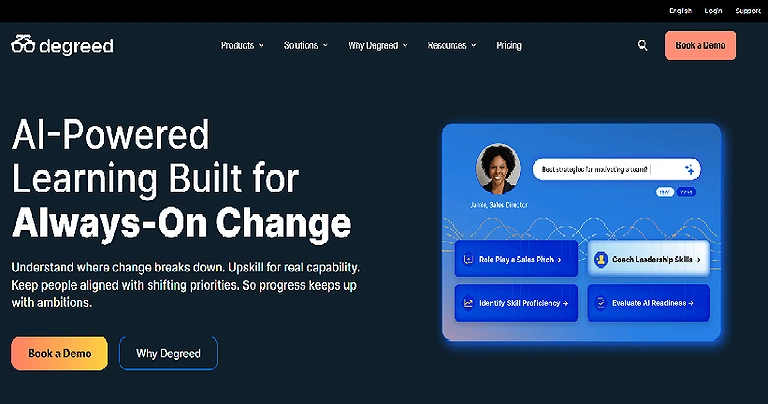
Degreed Official source image
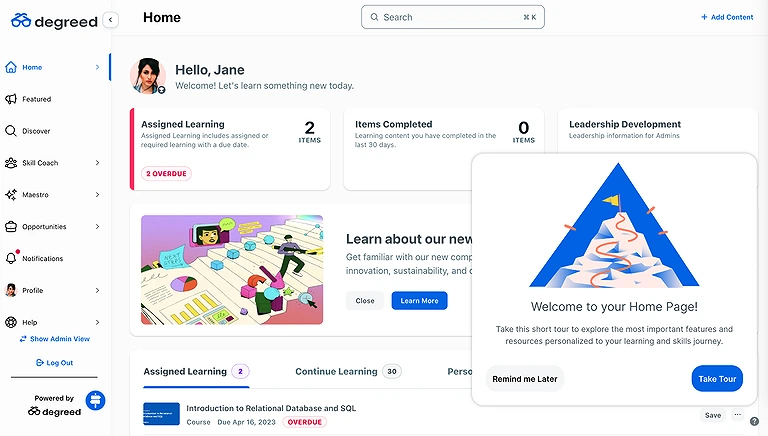
Overview of the modern, personalized user learning interface within the Degreed enterprise platform.
What is EdCast?
EdCast is an enterprise LXP designed to streamline knowledge management, training delivery, and regulatory compliance within unified digital workspaces. Following its acquisition by Cornerstone OnDemand, the software has evolved into a powerhouse for data-rich corporate education and multi-tenant content distribution. It’s Ideal Customer Profile (ICP) encompasses large-scale, highly regulated corporate entities demanding deep integration between structured LMS records and decentralized everyday learning.
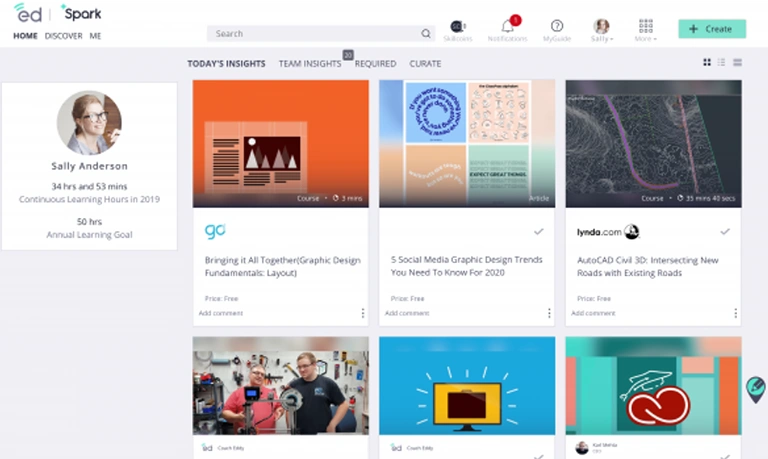
A view of the EdCast user homepage, showcasing the personalized learning dashboard and recommended content
Platform Design & Architectural Philosophy
Selecting an enterprise learning platform involves more than comparing features. The underlying architecture determines how easily the platform integrates into existing HR ecosystems, scales across global teams, and adapts to evolving workforce strategies. While Degreed and EdCast both support enterprise upskilling, they take noticeably different architectural approaches. Degreed is built around a skills-first operating model that connects learning to workforce capability, whereas EdCast emphasizes AI-driven learning experiences, knowledge discovery, and content orchestration across multiple systems.
| Area | Degreed | EdCast |
| Overall Architecture | Built as a centralized skills intelligence and learning platform where learning, skills, and career growth share a unified framework. | Designed as an AI-powered Learning Experience Platform (LXP) that aggregates learning content, enterprise knowledge, and productivity resources from numerous systems. |
| Product Philosophy | Prioritizes measurable skill development and long-term workforce capability over traditional course completion. | Focuses on delivering personalized learning and knowledge exactly when employees need it, regardless of where the content resides. |
| AI Architecture | AI primarily supports skills inference, personalized learning pathways, career recommendations, and capability analysis. | AI is deeply embedded in content discovery, recommendation engines, semantic search, knowledge surfacing, and learning personalization. |
| Data Model | Centers on employee skill profiles that continuously evolve through learning activities, assessments, certifications, and work experiences. | Uses a broader data model combining user behavior, content metadata, enterprise knowledge sources, and engagement signals to personalize experiences. |
| Workflow Design | Encourages structured learning journeys aligned with organizational skill frameworks and internal career progression. | Supports flexible, continuous learning workflows where employees consume learning and knowledge within their daily work environment rather than following rigid learning paths. |
Enterprise Experience & Operational Design
| Area | Degreed | EdCast |
| User Experience | Offers a structured experience focused on skill tracking, development plans, and career progression dashboards. | Provides a highly personalized interface centered around AI recommendations, knowledge feeds, and contextual learning experiences. |
| Interface Complexity | Relatively straightforward once governance is established, though administrators invest time configuring skill frameworks and learning structures. | Rich functionality creates a more feature-dense interface that may require additional administrator training and governance to maximize value. |
| Learning Curve | End users generally adapt quickly, while administrators spend more time designing skill taxonomies and organizational frameworks. | Employees benefit from intuitive recommendations, but administrators often face a steeper learning curve due to broader configuration options and content orchestration. |
| Enterprise Scalability | Scales effectively for multinational organizations managing enterprise-wide skills strategies, compliance, and career development programs. | Equally suited for large global enterprises, particularly those managing diverse learning ecosystems and extensive knowledge repositories. |
| Deployment Methodology | Implementation typically follows a phased rollout centered on defining skills architecture, governance, and HR ecosystem alignment. | Deployment often begins with integrating content providers, enterprise applications, and AI personalization before expanding into broader workforce initiatives. |
Migration Considerations
Enterprise migrations between Degreed and EdCast are feasible, but the effort depends more on how deeply each platform is embedded into existing learning, HR, and identity systems than on the platforms themselves. Organizations should plan for data mapping, integration validation, user adoption, and governance reviews before transitioning.
Migrating to Degreed:
Moving to Degreed is generally straightforward if the organization already maintains well-structured employee, learning, and skills data. Historical learning records can usually be imported, but rebuilding skill taxonomies, career pathways, and proficiency models often requires additional planning. Existing HRIS, LMS, and identity integrations typically need to be reconfigured and users trained on the platform's skills-first approach.
Migrating to EdCast:
Migration to EdCast is typically more involved when organizations rely on numerous learning content providers and enterprise knowledge repositories. Historical learning data is portable, but AI recommendations and personalized experiences improve over time as user engagement data accumulates. Integration work often focuses on connecting multiple content sources, while administrator training is important to manage AI configuration and content orchestration effectively.
Better Choice: Tie
Why: Neither platform offers a universally easier migration. Degreed usually requires more effort around skills architecture and governance, while EdCast often demands more integration and content ecosystem configuration. The smoother migration depends largely on the organization's existing technology landscape and workforce development strategy rather than the destination platform itself.
The Core Feature Showdown
1. Skills Intelligence & Skill Development
Degreed:
Degreed places skills intelligence at the center of the platform. It continuously builds employee skill profiles using learning activity, assessments, certifications, and work experience, helping organizations measure workforce capabilities and identify skill gaps.
EdCast:
EdCast also supports skills management, but its strength lies in enriching learning experiences with AI recommendations rather than making skills intelligence the primary operating model.
Better Choice: Degreed
Why:
Organizations building a long-term skills-first workforce strategy will generally find Degreed's skills architecture more mature and deeply embedded throughout the platform.
2. Learning Experience & Content Discovery
Degreed:
Degreed delivers personalized learning pathways by bringing together internal and external learning resources. Its recommendations are closely aligned with employee goals and skill development.
EdCast:
EdCast excels at AI-powered content discovery by aggregating learning materials, enterprise knowledge, videos, documents, and productivity resources into a highly personalized experience.
Better Choice: EdCast
Why:
Its recommendation engine and knowledge aggregation capabilities create a richer, more dynamic learning experience for employees working across multiple content ecosystems.
3. AI Personalization & Recommendation Engine
Degreed:
AI is primarily used to recommend learning based on skill gaps, career aspirations, and organizational capability requirements. Recommendations are closely linked to measurable workforce development.
EdCast:
AI is embedded across the platform to personalize learning feeds, recommend knowledge assets, surface relevant experts, and deliver contextual learning during daily work.
Better Choice: EdCast
Why:
EdCast applies AI more broadly across both learning and knowledge management, resulting in a more comprehensive personalization experience.
4. Career Development & Internal Mobility
Degreed:
Career pathways, skill progression, and internal mobility are tightly integrated into Degreed's skills framework, enabling employees to understand what capabilities they need for future roles.
EdCast:
EdCast supports career growth through personalized learning and skills development but places less emphasis on structured career progression frameworks.
Better Choice: Degreed
Why:
Organizations prioritizing internal talent mobility and skills-based career planning will typically benefit from Degreed's stronger alignment between skills, learning, and career advancement.
5. Enterprise Learning Ecosystem Management
Degreed:
Degreed integrates well with enterprise HR systems and learning providers while maintaining a relatively focused ecosystem centered on workforce capability development.
EdCast:
EdCast is designed to aggregate learning content, enterprise knowledge, collaboration resources, and multiple external content providers into a unified learning experience.
Better Choice: EdCast
Why:
Enterprises with diverse content sources and distributed knowledge repositories often gain greater value from EdCast's broader ecosystem management capabilities.
Tech Stack Integration & Ecosystem
Both Degreed and EdCast offer enterprise-grade integration capabilities designed for complex IT environments. They connect with leading HR platforms, identity providers, learning systems, and business applications. The main difference is that Degreed emphasizes integrating skills and workforce data across HR ecosystems, while EdCast provides broader connectivity for learning content, knowledge platforms, and enterprise productivity tools.
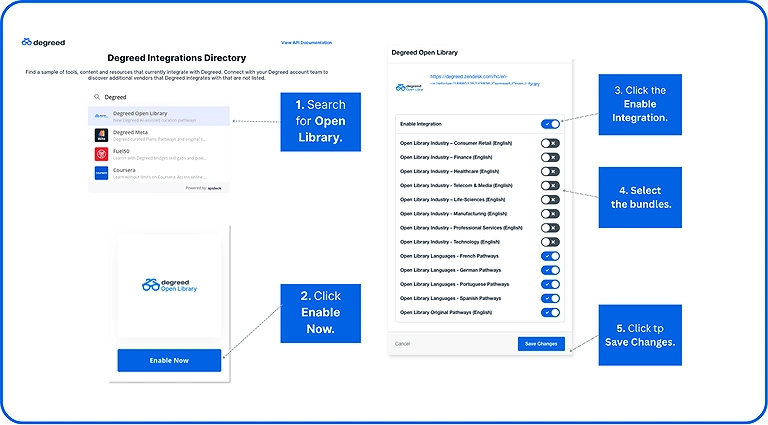
Enterprise technology dashboard displaying available native integrations and application marketplace options
| Integration Area | Degreed | EdCast | Better Choice |
| HRIS | Strong integrations with major HRIS platforms to synchronize employee profiles, organizational data, and skills information. | Integrates with leading HRIS platforms for workforce and learning data synchronization. | Tie |
| ATS | Connects with enterprise recruiting systems to support learning and talent development workflows, though ATS integration is not a primary focus. | Supports ATS integrations where required, but recruiting workflows are not a core platform capability. | Tie |
| CRM | Limited direct CRM focus; CRM connectivity is typically achieved through APIs or middleware. | Similar approach, with CRM integrations available through enterprise integration frameworks rather than native functionality. | Tie |
| API | Comprehensive REST APIs enable organizations to extend functionality and integrate with custom enterprise applications. | Offers robust APIs for integrating learning, content, knowledge, and workforce systems. | Tie |
| Webhooks | Supports event-based automation and workflow triggers for enterprise integrations. | Provides webhook support for real-time synchronization and automated workflows. | Tie |
| Marketplace | Includes a broad catalog of prebuilt integrations covering HR, learning, and content providers. | Offers an extensive connector ecosystem spanning learning providers, enterprise applications, and productivity platforms. | EdCast |
| Authentication & SSO | Supports enterprise authentication standards including SAML, OAuth, and major identity providers for secure single sign-on. | Provides enterprise-grade SSO and identity management through widely adopted authentication standards. | Tie |
| Security | Enterprise security controls, governance features, role-based access, encryption, and compliance certifications suitable for global organizations. | Comparable enterprise security with strong governance, encryption, and compliance capabilities. | Tie |
| Developer Experience | Well-documented APIs and integration capabilities support custom enterprise development and automation. | Provides flexible developer tools and APIs for extending learning and knowledge workflows across enterprise environments. | Tie |
| Third-Party Integrations | Strong ecosystem covering HRIS, LMS, content providers, collaboration tools, and productivity platforms. | Particularly strong in connecting diverse learning content libraries, knowledge repositories, collaboration tools, and enterprise applications. | EdCast |
Which Organization Should Choose Which Platform?
| Business Scenario | Recommended Platform | Why It Fits Better |
| Startup | EdCast | Startups looking to centralize learning content from multiple sources can benefit from EdCast's AI-powered learning experience without needing an extensive skills framework from day one. |
| SMB | EdCast | Small and growing businesses often value quick access to learning resources and knowledge sharing more than sophisticated skills architecture. |
| Mid-market | Tie | Both platforms work well. Degreed is stronger for organizations formalizing skills strategies, while EdCast suits businesses expanding learning and knowledge management. |
| Enterprise | Degreed | Large organizations focused on measurable workforce capability, skill development, and career progression typically gain greater long-term value from Degreed. |
| Global Enterprise | Tie | Both platforms scale effectively across multinational organizations with enterprise governance, security, localization, and large user populations. |
| Healthcare | Degreed | Healthcare organizations often require structured capability development, compliance learning, certifications, and continuous workforce upskilling. |
| Manufacturing | Degreed | Manufacturing companies frequently prioritize workforce capability mapping, reskilling initiatives, and operational skill tracking across large employee groups. |
| Technology | EdCast | Technology companies often benefit from AI-driven knowledge discovery, continuous learning, and rapid access to evolving technical content. |
| Retail | EdCast | Retail businesses can leverage personalized, mobile-friendly learning and fast content delivery for geographically distributed frontline employees. |
| Financial Services | Degreed | Financial institutions typically require structured learning programs, governance, regulatory training, and skills-based workforce planning. |
| Government | Degreed | Public sector organizations generally prefer structured competency frameworks, governance, reporting, and long-term workforce capability development. |
| Education | EdCast | Educational institutions often benefit from content aggregation, knowledge sharing, and personalized learning experiences across diverse content sources. |
| Internal Mobility | Degreed | Degreed's skills intelligence and career pathway capabilities make it the stronger choice for organizations investing heavily in internal talent mobility. |
| High-volume Workforce Upskilling | EdCast | Organizations training large employee populations across multiple learning sources benefit from EdCast's AI-powered content discovery and personalized recommendations. |
| Leadership & Executive Development | Degreed | Degreed better supports structured leadership development, competency frameworks, succession planning, and long-term career growth through skills-based learning. |
Real-World Use Cases
| Business Situation | Recommended Platform | Business Justification |
| A global enterprise wants to build a skills-first workforce strategy and identify capability gaps across thousands of employees. | Degreed | Degreed's skills intelligence framework enables organizations to measure workforce capabilities, map skill gaps, and align learning with strategic business priorities. |
| An organization has learning content spread across multiple LMSs, content providers, and internal knowledge bases, and wants to deliver a single learning experience. | EdCast | EdCast excels at aggregating content from diverse sources into a unified, AI-powered learning and knowledge platform. |
| HR leaders want to improve **internal mobility** by helping employees understand which skills they need for future roles. | Degreed | Career pathways, skill profiles, and development recommendations are deeply integrated into Degreed's skills-first architecture. |
| A technology company needs employees to continuously learn new tools, programming languages, and industry knowledge without manually searching multiple systems. | EdCast | AI-driven recommendations and contextual knowledge discovery make it easier for employees to access relevant learning as technologies evolve. |
| A multinational organization is launching a long-term workforce transformation initiative focused on reskilling and future workforce planning. | Degreed | Degreed provides structured skills data that supports enterprise-wide reskilling programs and long-term workforce capability planning. |
| A large enterprise wants employees to discover learning resources directly within their daily work environment rather than relying on traditional course catalogs. | EdCast | EdCast emphasizes personalized content delivery and knowledge discovery, reducing friction between work and learning. |
| A regulated industry requires structured professional development, certification tracking, and consistent workforce capability management across business units. | Degreed | Its governance, skills framework, and learning pathways are well suited for organizations that require standardized development programs. |
Pricing Comparison: Which Offers Better ROI?
Subscription Architecture:
Both platforms avoid transparent per-employee-per-month (PEPM) online quotes, utilizing structured annual SaaS enterprise contracts.
Degreed prices contracts based on total active headcount tiers, making it predictable to scale.
EdCast incorporates a modular pricing framework that scales depending on selected software components, often providing great value when packaged into larger Cornerstone enterprise renewals.
Hidden Costs & Add-ons:
Implementation cycles for both environments often necessitate dedicated tech deployment consultants.
Degreed buyers should budget for specialized skill-taxonomy alignment services.
EdCast rollouts often involve additional integration configurations when connecting complex multi-tenant legacy content systems.
Procurement Friction:
Analysis of standard corporate procurement timelines indicates that Degreed offers a faster, highly independent evaluation cycle. EdCast procurement involves navigating a wider enterprise software matrix, which can slow down initial administrative budgeting timelines but yields a highly robust, unified contract footprint.
The Strategic Trade-Offs
Degreed Pros
- Offers one of the most mature skills intelligence frameworks for enterprise workforce development.
- Connects learning, skills, career growth, and internal mobility within a unified platform.
- Provides strong analytics for identifying organizational skill gaps and tracking capability development.
- Supports structured learning pathways that align with business objectives and future workforce planning.
- Integrates well with leading HRIS, LMS, and enterprise learning ecosystems.
- Scales effectively for large, multinational organizations with complex governance requirements.
- Strong reporting and governance features help HR and L&D teams manage enterprise-wide learning initiatives.
Degreed Cons
- Initial implementation often requires significant planning around skills frameworks and governance.
- Organizations without a clear skills strategy may not utilize the platform's full capabilities.
- Administrators may need dedicated resources to maintain taxonomies, skills models, and learning structures.
- AI recommendations are more focused on skills development than enterprise knowledge management.
- Smaller organizations may find the platform more comprehensive than their current needs require.
- Customizing enterprise skill architectures can increase deployment complexity.
- Maximizing ROI typically depends on strong organizational adoption and continuous skills data maintenance.
EdCast Pros
- Excellent AI-powered learning recommendations and personalized content discovery.
- Aggregates learning content, enterprise knowledge, and productivity resources from numerous systems.
- Helps employees discover relevant knowledge within their daily workflows rather than relying solely on formal courses.
- Broad integration ecosystem supports diverse content providers and enterprise applications.
- Flexible platform adapts well to organizations with distributed learning environments.
- Strong search and knowledge management capabilities improve information accessibility.
- Scales well for global enterprises managing large learning content ecosystems.
EdCast Cons
- Feature-rich platform can require more administrator training and governance.
- AI personalization improves over time and depends on consistent user engagement and quality data.
- Less focused on structured skills architecture compared with dedicated skills-first platforms.
- Organizations seeking formal career pathway management may require additional configuration or complementary tools.
- Managing multiple content sources can increase administrative oversight.
- The breadth of functionality may introduce unnecessary complexity for smaller organizations.
- Realizing full platform value often requires integrating numerous enterprise systems and content repositories.
Final Recommendations
Choose Degreed If...
- Your primary objective is establishing an open, employee-driven learning ecosystem that champions internal job mobility.
- You need a fast, non-disruptive layer to sit cleanly on top of an existing, functional LMS.
- Your organization prioritizes skill-based talent insights over rigid regulatory compliance monitoring.
Choose EdCast If...
- Your business is already utilizing, or planning to migrate to, the larger Cornerstone talent management suite.
- You operate in a highly regulated landscape that demands thorough compliance audits alongside modern LXP capabilities.
- You need to automate content curation across vast, disparate corporate data silos without relying on manual user sorting.
Alternative Platforms to Consider
| Alternative Platform | Core Best For |
Docebo | Best for organizations seeking a unified learning platform with AI-driven content management and strong external enterprise training capabilities. |
Viva Learning | Designed for teams that want to integrate learning directly into the Microsoft 365 ecosystem with minimal external tool complexity. |
Docebo and Viva Learning provide strong internal workforce training alternatives. To optimize your external staffing pipeline alongside these upskilling tools, examine our comprehensive list of 10 Best AI Tools for Smarter & Faster Talent Acquisition.
Future Roadmap / Innovation Direction
Degreed
- Continues investing heavily in skills intelligence as the foundation for workforce transformation and talent development.
- Expanding AI capabilities to improve skills inference, personalized learning recommendations, and career path guidance.
- Product vision remains centered on helping enterprises become skills-first organizations, connecting learning, workforce planning, and internal mobility.
- Growing its partner ecosystem through deeper integrations with HRIS, talent management, and learning content providers to create a more connected employee experience.
- Increasing focus on workforce analytics that help HR leaders make data-driven decisions around capability building and future skill demands.
EdCast
- Maintaining a rapid innovation pace around AI-powered learning experiences, knowledge management, and enterprise search.
- Investing in generative AI to deliver more contextual recommendations, intelligent knowledge discovery, and conversational learning experiences.
- Product vision emphasizes creating a unified digital learning and knowledge platform that fits naturally into employees' daily workflows.
- Continues expanding its ecosystem with additional enterprise applications, collaboration platforms, productivity tools, and learning content providers.
- Enhancing AI-driven automation to reduce manual content curation while improving personalization across large enterprise learning environments.
Overall Direction
- Vendor Innovation Pace: Tie – Both vendors continue to evolve their enterprise learning platforms, although their innovation priorities differ.
- AI Investment: EdCast – Places broader emphasis on AI-powered content discovery, knowledge management, and personalized learning experiences.
- Product Vision: Degreed – More focused on building a comprehensive skills-first workforce platform for long-term talent development.
- Ecosystem Expansion: EdCast – Maintains a slight advantage through its extensive integrations with learning content libraries, enterprise knowledge sources, and productivity applications.
Frequently Asked Questions
Is Degreed better than EdCast for enterprise upskilling?
Neither platform is universally better. Degreed is the stronger choice for organizations building a long-term skills-first workforce strategy, while EdCast is better suited for enterprises prioritizing AI-powered learning experiences, knowledge discovery, and content aggregation.
Which platform is easier to implement: Degreed or EdCast?
Both require enterprise-level implementation planning. Degreed typically focuses on configuring skills frameworks and governance, whereas EdCast often requires more effort integrating content repositories, enterprise applications, and AI-driven learning workflows.
Is Degreed considered an LMS or an LXP?
Degreed is primarily a Learning Experience Platform (LXP). It complements traditional LMS platforms by aggregating learning content, tracking skills, and delivering personalized learning experiences rather than replacing an LMS outright.
Can EdCast run independently without the Cornerstone suite?
Yes. EdCast can be deployed as a standalone, vendor-agnostic Learning Experience Platform. However, organizations already using Cornerstone generally benefit from deeper integration and a more unified talent management ecosystem.
Which platform provides better AI-powered learning recommendations?
EdCast generally has the advantage for AI-driven content discovery and personalized learning recommendations. Degreed also uses AI extensively, but its recommendations are more closely aligned with skills development, career growth, and workforce capability planning.
Which platform offers stronger skills intelligence capabilities?
Degreed is widely regarded as having the more mature skills intelligence framework. It places employee skills at the center of learning, career development, and internal mobility, making it particularly valuable for organizations adopting a skills-based talent strategy.
How do Degreed and EdCast assess employee skills?
Degreed combines self-assessments, learning activities, certifications, manager input, and other evidence to build employee skill profiles. EdCast uses AI and machine learning to infer skills from learning behavior, job context, content engagement, and other workforce signals.
Which platform is better for internal mobility and career development?
Degreed is generally the stronger option for internal mobility because it tightly connects skills, career pathways, learning recommendations, and workforce planning, helping employees understand how to progress into future roles.
Do Degreed and EdCast support mobile and offline learning?
Yes. Both platforms provide mobile applications that allow employees to access learning content remotely. Many learning resources can be downloaded for offline use, with progress syncing automatically once the device reconnects to the internet.
Which platform integrates more easily with existing HR systems?
Both platforms integrate with leading HRIS, LMS, identity providers, and enterprise applications through APIs and prebuilt connectors. Degreed is often preferred for HR-centric skills ecosystems, while EdCast offers broader integration across learning content and knowledge platforms.
Which industries benefit most from Degreed and EdCast?
Degreed is often favored by organizations in healthcare, manufacturing, financial services, and government that require structured workforce development. EdCast is particularly well suited for technology companies, consulting firms, and enterprises managing large volumes of digital knowledge and learning content.
Can either platform support global enterprises with thousands of employees?
Yes. Both Degreed and EdCast are designed for global enterprise deployments. They offer enterprise-grade security, scalability, governance, localization, and administrative controls capable of supporting large, distributed workforces across multiple regions.
Conclusion
Degreed and EdCast are both leading enterprise learning platforms, but they solve workforce development challenges from different perspectives. Degreed stands out for organizations pursuing a skills-first strategy, with strong capabilities in skills intelligence, career development, and internal mobility. EdCast excels at AI-powered learning experiences, knowledge discovery, and unifying content from diverse sources across the enterprise. Neither platform is inherently better the right choice depends on your organization's learning strategy, workforce maturity, and technology ecosystem. Before making a decision, evaluate which platform best supports your long-term talent development objectives, operational model, and future business priorities rather than simply comparing feature checklists.