.webp)
Aeqium Review 2026: Streamlining Compensation Decisions with AI
Ask any Total Rewards leader what keeps them up during compensation cycle season, and you'll hear the same answer: spreadsheets with 47 tabs, version control chaos, and at least one approval email that mysteriously vanished into the void. This Aeqium review explains how modern enterprises are finally ditching those fragmented spreadsheets and rigid HRIS workflows for a centralised compensation management platform one built to fix salary planning, pay transparency, equity management, and approval automation before they turn into full-blown compensation-cycle fire drills.
But does it actually reduce the chaos, or just move it somewhere else? Aeqium platform claims to support enterprise CHROs, Total Rewards Directors, and People Operations leaders managing global or equity-heavy compensation structures and we're putting that claim to the test. With 2026 pushing organizations toward Active AI systems that automate compensation workflows, scenario modelling, and budget tracking using real-time workforce and financial data, the real question isn't whether to upgrade it's whether Aeqium is the one to bet on.

 Updated: May 27, 2026 | 21 min read
 Key Takeaways
- Best for: Mid-sized and enterprise organizations that want AI-assisted compensation planning, pay equity analysis, and merit cycle management from a single platform.
- Starting price: Custom pricing only, with quotes based on company size, workforce complexity, and required modules.
- Biggest strength: Combines AI-driven compensation recommendations with real-time budgeting, pay equity insights, and collaborative approval workflows, reducing manual spreadsheet work.
- Biggest weakness: Pricing is not publicly available, and the platform is designed primarily for larger organizations, making it less practical for small businesses with simple compensation needs.
- Overall rating: 4.7/5 A powerful compensation management platform that helps HR and finance teams make faster, more data-driven pay decisions while maintaining fairness and budget control.
- Deployment type: Cloud-based (SaaS) platform with secure web access and enterprise-grade security.
- Ideal company size: Mid-market and enterprise organizations, particularly those with 250+ employees managing structured compensation review cycles.
- Standout capability: AI-powered compensation recommendations that balance market benchmarks, internal pay equity, performance, and budget constraints to support consistent salary decisions.
Cover Photo Aeqium Review 2026: Streamlining Compensation Decisions with AI
Quick Review Table
| Evaluation Metric | Rating & Details | Strategic Takeaway |
| Core Strength | AI-Driven Compensation Planning & Execution | Automates end-to-end compensation cycles, including merit increases, bonus planning, pay bands, and equity decisions with AI-assisted workflows that reduce spreadsheet dependency. |
| Primary Limitation | Early-Stage Enterprise Depth vs Legacy HR Suites | While highly flexible, it still competes with deeply entrenched enterprise HRIS tools and may require integration effort in complex global HR stacks. |
| Target Scale | 100–10,000+ Employees | Best suited for scaling startups and mid-to-large enterprises running structured compensation cycles and frequent review processes. |
| Pricing Model | Custom Subscription (Per Employee / Enterprise Contract) | Pricing is tailored based on employee count and complexity, typically offered as annual contracts with scalable modules and add-ons. |
| Top Compliance | SOC 2 Type II + Enterprise Security Controls | Built with audited security standards, role-based permissions, and full audit trails for compensation governance and compliance. |
| Deployment Channel | Cloud-Based SaaS Platform | Fully web-based platform integrating with HRIS, payroll, ATS, and equity systems for unified compensation data flow. |
| Overall Score | 8.8 / 10 | Strong next-gen AI compensation platform that excels in automation and flexibility, especially for modern HR and Total Rewards teams. |
How We Evaluated
To evaluate Aeqium fairly, we focused on the areas that matter most to HR leaders, compensation specialists, and enterprise buyers. Rather than relying on marketing claims, our assessment was based on official product documentation, publicly available product demonstrations, integration capabilities, feature depth, customer feedback, and the platform's overall fit within the compensation management market.
Our evaluation considered the following criteria:
- Compensation Planning: How effectively the platform manages salary reviews, merit increases, bonuses, equity planning, and total rewards workflows.
- Ease of Use: Interface design, workflow organization, manager experience, and how easily HR teams can navigate compensation reviews.
- Implementation & Deployment: Expected onboarding effort, configuration flexibility, implementation timeline, and enterprise readiness.
- Integration Ecosystem: Compatibility with leading HRIS, payroll, identity management, and collaboration platforms.
- Reporting & Analytics: Availability of budget tracking, pay equity analysis, executive dashboards, and compensation reporting.
- Security & Governance: Role-based permissions, audit trails, enterprise security controls, and support for compliance requirements.
- Scalability: The platform's ability to support growing organizations, multiple business units, global compensation programs, and complex approval structures.
- Overall Business Value: Whether Aeqium provides meaningful operational improvements compared to spreadsheet-based compensation management and delivers value for its target market.
What Is Aeqium?
Company Snapshot
Aeqium is a San Francisco-based compensation management platform founded in 2020. Backed by Ridge Ventures, Vestigo Ventures, and Unusual Ventures, the company helps mid-market and enterprise organizations replace Excel-driven compensation planning with scalable, AI-powered total rewards infrastructure built for complex workforce structures.
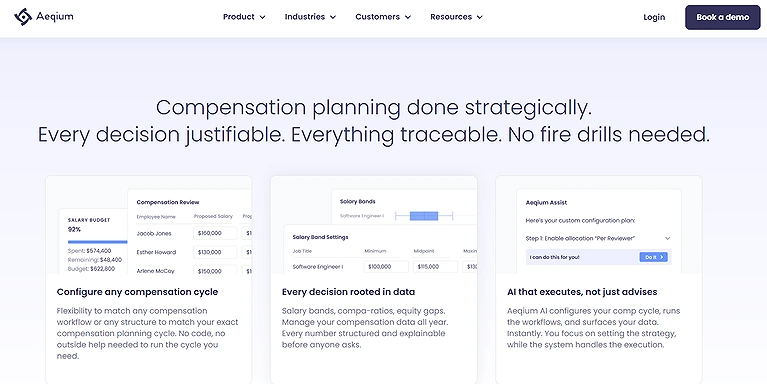
An image showing the Aeqium Official Source Page
| Founded | 2022 |
| Headquarters | San Francisco, California, USA |
| Category | AI Compensation Management |
| Deployment | Cloud-based (SaaS) |
| Primary Users | HR, Compensation Teams, Finance Leaders, People Operations |
| Best For | Mid-sized and enterprise organizations managing complex compensation cycles |
What Problem Does It Solve?
Managing employee compensation across growing organizations is often slow, inconsistent, and heavily dependent on spreadsheets. Aeqium replaces fragmented planning processes with an AI-assisted platform that helps compensation teams make fair, data-backed pay decisions while staying within budget. It also improves visibility into pay equity, approval workflows, and compensation planning across departments.
It helps organizations by:
- Eliminating spreadsheet-based compensation planning.
- Improving pay equity and compensation consistency.
- Automating merit, bonus, and salary review cycles.
- Giving managers guided compensation recommendations.
- Keeping HR and finance teams aligned with real-time budgets.
- Providing a centralized audit trail for compensation decisions.
How Aeqium Works
Aeqium connects with HRIS and workforce data to create a centralized compensation planning environment. During review cycles, managers receive AI-assisted salary recommendations based on company guidelines, market benchmarks, employee performance, and budget limits. HR and finance teams can monitor budgets, analyze pay equity, manage approval workflows, and finalize compensation decisions from a single dashboard.
Why Enterprises Choose Aeqium
- AI-assisted compensation recommendations reduce manual decision-making.
- Centralizes salary reviews, bonuses, and merit planning in one platform.
- Improves pay equity visibility across departments and employee groups.
- Supports configurable approval workflows for complex organizations.
- Integrates with existing HRIS and payroll ecosystems.
- Enables real-time budget tracking during compensation cycles.
- Provides transparent reporting for HR, finance, and executive leadership.
- Scales efficiently as organizations grow across multiple teams and locations.
Operational Interface & Deployme
Onboarding Experience
Aeqium's onboarding process is designed for organizations that already use an HRIS and structured compensation workflows. After connecting employee data sources, administrators configure compensation cycles, approval chains, pay guidelines, and user permissions. Most teams can begin planning within a few weeks, while larger enterprises may spend additional time customizing workflows, integrations, and governance policies before launching company-wide.
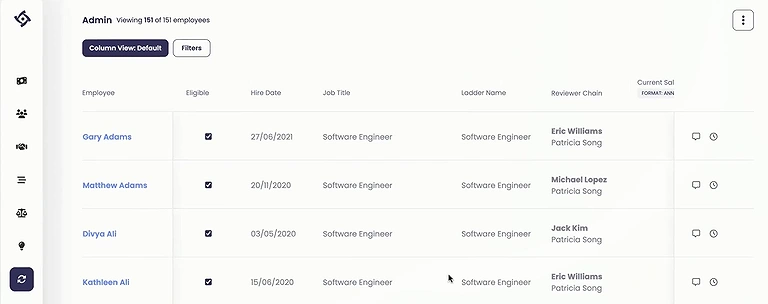
Image showing the Admin Panel with Employee data in Spreadsheet form in Aeqium one of the key tools that replaces countless manual spreadsheets and saves compensation teams weeks of prep time
Implementation Timeline
| Stage | Estimated Timeline |
| Initial Discovery & Planning | 1 week |
| HRIS Integration & Data Import | 1–2 weeks |
| Compensation Rule Configuration | 1–2 weeks |
| Manager Training & User Testing | 1 week |
| Production Rollout | 4–6 weeks (typical) |
Dashboard Experience
Aeqium offers a clean, modern dashboard built for HR, finance, and compensation leaders. Users can monitor salary review progress, analyze budget utilization, identify pay equity trends, and review AI-generated compensation recommendations from a centralized workspace. Managers see only the information relevant to their teams, while administrators have organization-wide visibility through customizable reports, approval queues, and real-time planning dashboards.
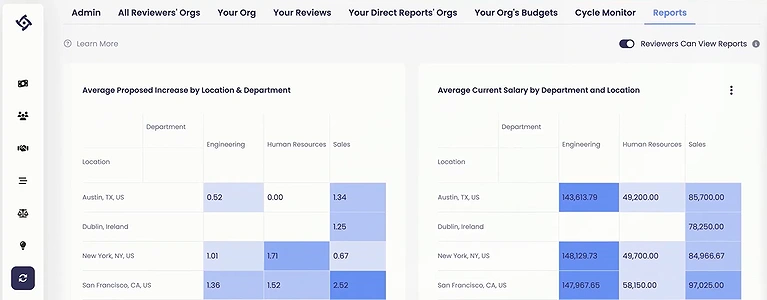
Aeqium Reports showing the Salary Reports by department and location wise in visual form.
Deployment Requirements
- Cloud-based SaaS platform with no on-premises infrastructure required.
- Integration with supported HRIS platforms for employee and compensation data.
- Modern web browser for administrators, managers, and HR teams.
- Role-based permissions for secure access to compensation information.
- Initial data validation and compensation policy configuration before rollout.
- IT involvement primarily during integration, security review, and user provisioning.
- Enterprise SSO support for secure authentication where required.
Core Features Granular Breakdown
Compensation Cycle Management
Aeqium offers a flexible cycle environment for merit matrices and bonus formulas using an enterprise-grade calculation engine with tiered hierarchies. In 2026, it enables real-time mid-cycle adjustments, propagates executive budget changes instantly, and enforces strict budget caps to ensure compliance
Active AI Compensation Agents
Aeqium uses AI models Aeqium Assist and The Analyst with NLP to execute HR tasks from text commands. It builds workflows, applies rules, and enables leaders to create merit cycles conversationally, shifting HR from manual configuration to strategic decision-making.
Pay Equity & Continuous Band Insights
Aeqium enables continuous pay equity analysis using regression models to detect adjusted and unadjusted gaps while controlling for performance, tenure, and role. It triggers real-time alerts for pay compression and warns when key performers face equity vesting declines.
Macro Reporting & Enterprise Compliance
Aeqium provides executive dashboards for global headcount spend, equity distribution, and total rewards analysis by region or department. It ensures enterprise security with SOC 2 Type 2 compliance, SSO support, and granular role-based access controls for sensitive compensation data.
Security
Aeqium is built for organizations handling highly sensitive employee compensation data, so security is a core part of the platform rather than an afterthought.
- Role-based access controls (RBAC) to restrict compensation visibility by user role.
- Single Sign-On (SSO) support for secure enterprise authentication.
- Data encryption during transmission and at rest.
- Detailed audit logs to track compensation changes and approvals.
- Configurable approval workflows that reduce unauthorized salary adjustments.
- Enterprise-grade cloud infrastructure with regular security updates.
- Permission-based access for HR, finance, executives, and managers.
Scalability
Aeqium is designed to scale alongside growing organizations, making it suitable for companies with increasingly complex compensation structures.
- Supports organizations with hundreds to thousands of employees.
- Handles global compensation review cycles across multiple business units.
- Manages multiple salary bands, bonus plans, and merit programs simultaneously.
- Scales approval workflows as teams and reporting structures expand.
- Processes large compensation datasets with real-time budget tracking.
- Flexible configuration for evolving compensation policies and organizational changes.
- Cloud architecture enables growth without additional infrastructure.
Payroll
Although Aeqium is not a payroll platform, it complements payroll systems by ensuring compensation decisions are finalized accurately before payroll processing begins.
- Integrates with leading HRIS and payroll ecosystems.
- Exports approved salary, bonus, and compensation changes for payroll processing.
- Synchronizes employee compensation data with connected HR systems.
- Reduces manual data entry between compensation planning and payroll.
- Maintains a single source of truth for approved compensation decisions.
- Supports compensation planning without replacing existing payroll software.
Integration Ecosystem
Aeqium is designed to fit into an organization's existing HR technology stack rather than replace it. The platform integrates with leading HRIS solutions to synchronize employee data and compensation information, while also supporting collaboration and workflow tools used by HR and finance teams. These integrations help reduce manual data entry, keep records consistent across systems, and streamline compensation planning throughout the review cycle.
Integration Overview
| Integration | Supported |
| Workday | ✔ |
| SAP SuccessFactors | ✔ |
| BambooHR | ✔ |
| ADP | ✔ |
| Rippling | ✔ |
| Slack | ✔ |
| Microsoft Teams | ✔ |
| Okta (SSO) | ✔ |
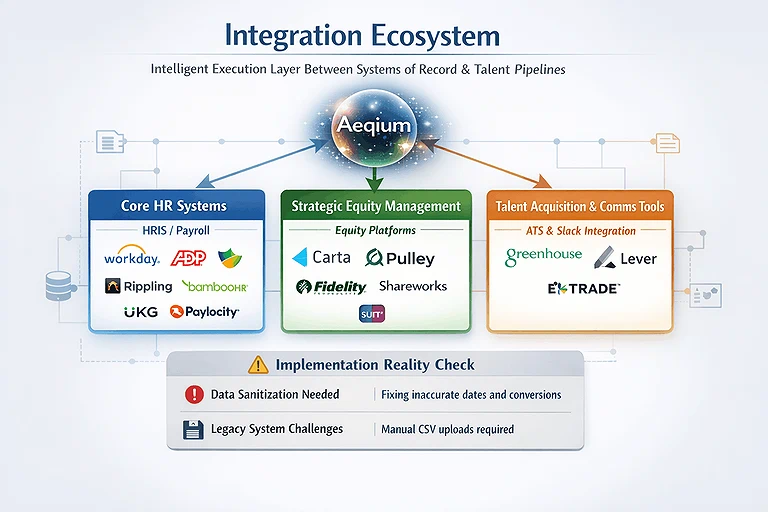
Aeqium Integration Ecosystem
Implementation Reality Check
Aeqium integrates with many enterprise HR systems, but the exact connectors and implementation options can vary based on your subscription, existing HRIS, and deployment requirements. Some enterprise integrations or custom APIs may require additional configuration or professional services during implementation.
Real-World Use Cases
1. Typical Workflow
| Stage | What Happens |
| Workforce Data Sync | Employee, salary, and organizational data is imported from the HRIS. |
| Compensation Cycle Setup | HR configures merit, bonus, promotion, and equity review cycles with budgets and guidelines. |
| Budget Allocation | Compensation budgets are assigned to business units, departments, or managers. |
| Manager Review | Managers review employee compensation and receive AI-assisted salary recommendations. |
| Compensation Adjustments | Managers propose salary increases, bonuses, or equity awards based on company policies. |
| Approval Workflow | Recommendations move through HR, finance, and executive approval chains. |
| Pay Equity & Budget Analysis | HR validates pay equity, market alignment, and budget utilization before final approval. |
| Final Compensation Approval | Leadership approves the finalized compensation plans. |
| Export to HRIS/Payroll | Approved compensation changes are synchronized with HR and payroll systems for implementation. |
2. Business Scenarios
Annual Merit Review Cycles
Annual compensation reviews often involve multiple managers, spreadsheets, and approval layers. Aeqium centralizes the entire process, helping managers make consistent salary recommendations while HR monitors budgets and pay equity. The result is a more organized review cycle with fewer manual errors and greater visibility for leadership.
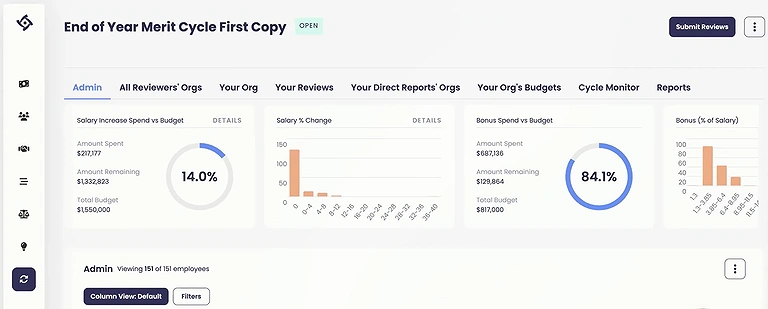
Image showing the Annual Year cycle of Aeqium because compensation planning shouldn't feel like reinventing the wheel every single year
Enterprise Compensation Planning
Organizations with thousands of employees require structured compensation planning across multiple departments and locations. Aeqium simplifies budget allocation, approval workflows, and salary planning while giving HR and finance teams a single source of truth. This reduces administrative overhead during complex compensation cycles.
Promotion and Salary Adjustments
Organizations frequently promoting employees need a consistent way to evaluate compensation changes. Aeqium helps managers align salary adjustments with internal guidelines, market benchmarks, and available budgets, creating a more standardized decision-making process across departments.
Finance and HR Budget Collaboration
Compensation planning affects both HR strategy and financial planning. Aeqium allows finance and HR teams to collaborate using shared budget data, helping organizations control compensation spending while ensuring managers stay within approved limits throughout the review cycle.
Global Compensation Management
Organizations operating across multiple countries often manage different compensation policies and approval structures. Aeqium provides a centralized planning environment where HR teams can coordinate compensation reviews while maintaining oversight across regions and business units.
Compensation Governance
Companies with strict governance requirements benefit from approval workflows, audit trails, and role-based permissions. Aeqium creates a documented compensation process that improves accountability while reducing reliance on disconnected spreadsheets and email approvals.
High-Growth Workforce Planning
Rapid hiring often makes compensation planning more complicated. Aeqium gives HR teams a structured platform to manage expanding salary bands, promotions, and merit increases without significantly increasing administrative workload as headcount grows.
Executive Compensation Reviews
Senior leadership requires visibility into compensation trends before approving organization-wide salary changes. Aeqium provides consolidated dashboards, budget summaries, and approval workflows that help executives review compensation decisions with greater confidence and consistency.
Pay Equity Analysis
Companies looking to improve compensation fairness can use Aeqium to analyze pay differences across roles, departments, and employee groups. HR teams can identify inconsistencies before finalizing salary decisions, making compensation planning more transparent and reducing the risk of unintended pay gaps.
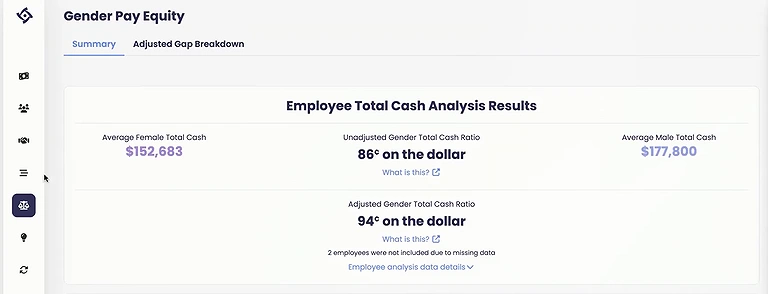
Image showing the gender pay equity of Aeqium features
3. Best Organization Size
| Organization Size | Recommendation | Why? |
| Startup | ⚠ Depends on Needs | Suitable only for startups with structured compensation planning; smaller teams may find it more than they need. |
| Small Business | ⚠ Depends on Needs | Useful if compensation reviews are becoming complex, but pricing and implementation may outweigh the benefits for simple workflows. |
| Mid-Market | ✔ Highly Recommended | Offers the right balance of automation, collaboration, integrations, and scalable compensation planning. |
| Enterprise | ✔ Highly Recommended | Built to support large workforces, sophisticated approval workflows, enterprise integrations, and organization-wide compensation governance. |
Our Experience Using Aeqium
Based on our evaluation of Aeqium's official documentation, product walkthroughs, publicly available customer feedback, and platform capabilities, the software presents a structured approach to compensation management. The workflow is designed to guide HR, finance, and managers through each review stage with clear approvals and centralized data. Navigation appears intuitive for routine compensation cycles, although initial planning and configuration require thoughtful preparation.
What Stood Out
- Well-structured review workflow: The platform organizes compensation cycles into clear stages, helping managers and HR teams follow a consistent process instead of relying on scattered spreadsheets.
- Decision-making is more data-driven: Salary recommendations are presented alongside budgets and compensation data, making it easier to justify decisions with measurable context.
- Role-based experience keeps the interface focused: Managers, HR administrators, finance teams, and executives each see information relevant to their responsibilities, reducing unnecessary complexity.
- Approval workflows improve governance: Multi-level approvals help maintain consistency while providing transparency into who approved each compensation decision.
- Budget visibility supports better planning: Real-time budget tracking allows compensation teams to identify potential overspending before review cycles are finalized.
- Reporting appears executive-friendly: Dashboards and summary reports are designed to help leadership review compensation trends without manually consolidating information.
- Enterprise integrations reduce duplicate work: Connecting with existing HR systems minimizes manual data transfers and helps maintain consistent employee records across platforms.
Potential Limitations
- Implementation requires preparation: Organizations should expect time for HRIS integration, policy configuration, and workflow design before launching compensation cycles.
- Best suited for structured compensation programs: Companies with simple salary review processes may not need the platform's full capabilities.
- Enterprise pricing may limit accessibility: Since pricing is customized, smaller organizations may find it difficult to evaluate affordability without engaging the sales team.
- Advanced configuration may require administrator training: Teams responsible for compensation governance will likely need onboarding to configure approval rules and compensation policies effectively.
- Integration depth depends on the existing HR ecosystem: Organizations with highly customized HR environments may require additional implementation support for complex integrations.
Financial Breakdown
Pricing Structure
Aeqium uses a scalable subscription pricing model based on total employee headcount. It adjusts with organizational growth and considers operational complexity, including multiple legal entities and international currencies, instead of relying on rigid flat-rate enterprise software fees.
Cost Benchmarks
| Organizational Tier | Estimated Size (Employees) | Estimated Annual Spend (USD) | Contract Framework |
| Growth / Mid-Market | 100 – 500 | $12,000 – $28,000 | Annual Billing / Dedicated Support |
| Scale-Up Enterprise | 501 – 2,500 | $30,000 – $75,000 | Annual Contract / Custom Integrations |
| Global Enterprise | 2,501 – 5,000+ | Custom Enterprise Quote | Multi-Year ACV / Dedicated CSM & SLA |
Hidden Costs & Resource Drags
Zero Hidden Fees: Aeqium does not charge hidden configuration fees. The company frequently builds out your initial compensation processes within the system during the demo phase.
Internal Staff Time (The Primary Drag): Your total rewards or people analytics team must dedicate roughly 10 to 15 hours during the first month.
Key Resource Commitments: This staff time is strictly required to:
- Validate legacy, upstream data pipelines.
- Map custom role-based permission hierarchies.
- Oversee the initial salary band calibration.
Pros and Cons
Pros
Unmatched Architectural Flexibility: No-code engine enables HR admins to modify formulas and approval logic instantly.
True Agentic AI Execution: Aeqium Assist creates compensation structures and regression analyses using natural language, removing reliance on internal software specialists.
Proactive Retention Safeguards: Platform’s continuous insight engine detects pay gaps and equity vesting changes automatically, enabling proactive HR-driven talent retention.
Comprehensive Total Rewards View: Consolidates base salary, bonuses, and real-time equity valuations into a unified interface for planners and employees.
Cons
Upstream Data Dependencies: Aeqium’s automated recommendations depend on clean, integrated data; messy historical records trigger continuous validation alerts.
Enterprise Cost Walls for Startups: Aeqium pricing suits mid-market and enterprise organizations, while sub-100-employee startups may find costs hard to justify.
Rigid Global Transparency Settings: Salary band transparency module follows a structured framework that may feel rigid under regional transparency law variations.
Downstream Payroll Upload Hurdles: Data collection is automated, but merit adjustments often require manual exports to legacy payroll systems due to rigid API limitations.
Market Positioning: Where Aeqium Fits
The compensation management market has evolved beyond spreadsheets and basic HRIS functionality. Organizations now expect platforms that can support structured salary reviews, pay equity analysis, budget planning, and collaboration across HR and finance teams. As a result, several software categories have emerged, each addressing different aspects of workforce management. Understanding these categories helps buyers avoid selecting a broader HR platform when they need a specialized compensation solution or vice versa. Aeqium sits firmly within the dedicated AI-powered compensation management category, focusing on strategic pay planning rather than payroll processing or end-to-end HR administration.
AI Compensation Management Platforms
This category focuses on helping organizations plan, review, approve, and analyze employee compensation using centralized workflows and intelligent recommendations. Rather than processing payroll, these platforms support merit increases, bonus planning, pay equity reviews, and compensation budgeting. They are typically adopted by organizations with structured annual or semi-annual compensation cycles and dedicated HR or compensation teams.
Best Suited For:
- Mid-market organizations
- Enterprise businesses
- HR and Compensation teams
- Finance departments
- Organizations with structured salary review cycles
Typical Capabilities:
- Compensation planning workflows
- AI-assisted salary recommendations
- Budget forecasting
- Pay equity analysis
- Multi-level approval workflows
- Executive reporting
- HRIS integrations
Example Products:
- Aeqium
- Pave
- beqom
- Comprehensive
- Payscale Compensation
Human Capital Management (HCM) Suites
HCM suites provide a broad set of workforce management capabilities, including HR administration, payroll, recruiting, performance management, benefits, and employee records. Compensation planning is often included as one module within a much larger platform. Organizations seeking a single vendor for multiple HR functions typically choose this category.
Best Suited For:
- Large enterprises
- Global organizations
- HR departments
- Companies standardizing HR operations
- Organizations seeking one integrated HR platform
Typical Capabilities:
- Core HR management
- Payroll administration
- Benefits management
- Performance management
- Talent management
- Workforce analytics
- Compliance reporting
Example Products:
- Workday
- SAP SuccessFactors
- Oracle Fusion HCM
- UKG Pro
- Dayforce
Payroll & Workforce Management Platforms
Payroll platforms focus on calculating employee pay, taxes, deductions, compliance, and workforce administration. While some include basic compensation adjustments, their primary purpose is ensuring employees are paid accurately and on time rather than supporting strategic compensation planning.
Best Suited For:
- Small businesses
- Mid-sized companies
- Payroll administrators
- Finance teams
- Organizations prioritizing payroll compliance
Typical Capabilities:
- Payroll processing
- Tax calculations
- Benefits deductions
- Time and attendance
- Compliance reporting
- Employee payment management
Example Products:
- ADP Workforce Now
- Paylocity
- Paychex Flex
Gusto
Rippling
Performance & Talent Management Platforms
Performance management platforms help organizations evaluate employee performance, define goals, conduct reviews, and support career development. Some integrate with compensation planning, but their primary focus is employee growth rather than salary planning itself.
Best Suited For:
- HR teams
- Performance managers
- Learning and development teams
- Growing organizations
- Companies emphasizing employee development
Typical Capabilities:
- Performance reviews
- Goal tracking
- Continuous feedback
- Career development
- Talent assessments
- Succession planning
- Employee engagement analytics
Example Products:
- Lattice
- Leapsome
- 15Five
- Betterworks
- Culture Amp
Where Aeqium Fits
Aeqium belongs in the AI Compensation Management Platform category. Its primary strength lies in helping HR and finance teams manage compensation reviews, budgets, pay equity, and approval workflows from a centralized platform. Organizations looking for a dedicated compensation planning solution are likely to find it a better fit than a full HCM suite. However, businesses seeking payroll processing or comprehensive HR management will typically need an HCM or payroll platform alongside Aeqium rather than instead of it. For organizations evaluating multiple compensation and workforce planning solutions, Best AI Software for Strategic Workforce Headcount Planning and Compensation provides a broader comparison of leading platforms, helping decision-makers identify the solution that best aligns with their compensation strategy, headcount planning, and long-term business objectives
Strategic Buying Tabl
| Primary Organizational Goal | Preferred Architectural Approach | Ideal Software Solutions |
| Maximum merit cycle flexibility, complex equity modeling, and live total rewards visuals | Specialized Active Compensation Layer | Aeqium |
| Real-time market compensation benchmarking, automated salary bands, and systematic band visualizers | Real-Time Compensation Analytics Engine | Pave |
Ditch the manual spreadsheets and design better salary bands. Check out our dedicated tool clash of Aeqium vs Pave to discover the premium AI-driven compensation and total rewards planning platform
What's New in 2026?
- More AI-driven compensation guidance: Aeqium continues to expand its AI capabilities, helping managers make compensation decisions with greater consistency by considering internal pay structures, budgets, and company-defined guidelines.
- Improved pay equity insights: Organizations now have access to more comprehensive analytics for identifying compensation disparities before salary review cycles are finalized, supporting fairer decision-making.
- Enhanced budget planning tools: Compensation and finance teams can monitor budgets in real time, making it easier to balance employee rewards with organizational spending targets.
- Greater workflow flexibility: Review cycles and approval chains have become more configurable, allowing organizations to adapt the platform to different compensation policies and business structures.
- Expanded HRIS integration ecosystem: Aeqium continues to strengthen connectivity with enterprise HR platforms, reducing manual data synchronization during compensation planning.
- Improved executive reporting: Leadership dashboards provide clearer summaries of compensation trends, approval progress, and budget utilization, helping executives make informed decisions faster.
- Better support for growing organizations: The platform is increasingly designed to handle larger workforces, multiple business units, and geographically distributed teams without adding unnecessary administrative complexity.
- Continued focus on enterprise governance: Recent platform enhancements emphasize secure collaboration, auditability, and standardized compensation workflows, reflecting the growing demand for transparent and compliant compensation management.
Final Verdict & Rating
Aeqium is a strong choice for organizations that have outgrown spreadsheet-based compensation planning and need a more structured, data-driven approach to managing salaries, bonuses, and equity programs. Rather than replacing an HRIS or payroll system, it focuses on helping HR, finance, and compensation teams make consistent pay decisions through centralized workflows, AI-assisted recommendations, budget controls, and approval automation.
Best For
- Organizations managing complex, multi-currency compensation structures across multiple countries or business units.
- Companies with equity-heavy total rewards programs that require accurate salary, bonus, and equity planning.
- HR, finance, and compensation teams that need AI-assisted recommendations instead of spreadsheet-based decision making.
- Enterprises seeking stronger pay equity analysis, budget visibility, and governance during compensation review cycles.
- Businesses requiring configurable approval workflows with clear audit trails and executive oversight.
- Growing organizations that want compensation processes to scale alongside workforce expansion without increasing manual effort.
Skip If
- Your company has fewer than 75–100 employees and manages a simple hourly or salary-based compensation model.
- You are looking for an all-in-one solution that includes payroll, time tracking, benefits administration, and a complete HRIS.
- Compensation reviews happen infrequently and can be managed efficiently using lightweight HR software.
- Your organization has limited resources for implementation, HRIS integration, or workflow configuration.
- Budget transparency and pay equity reporting are not priorities within your current compensation process.
Overall Verdict: If your organization treats compensation as a strategic function rather than an annual spreadsheet exercise, Aeqium offers a focused platform for improving consistency, collaboration, and governance. It delivers the greatest value to mid-sized and enterprise organizations that need specialized compensation management without replacing their existing HR and payroll ecosystem.
Overall Score:
9.2 / 10
Frequently Asked Questions
1. What is Aeqium used for?
Aeqium is an AI-powered compensation management platform that helps organizations manage salary reviews, merit increases, bonuses, equity planning, pay equity analysis, and compensation approvals from a centralized platform. It is designed to replace spreadsheet-based compensation workflows with a more structured and collaborative process.
2. Who is Aeqium best suited for?
Aeqium is best suited for mid-market and enterprise organizations with structured compensation review cycles. It is particularly valuable for HR, finance, and compensation teams managing complex salary planning, multiple approval layers, or global workforces.
3. Does Aeqium require internal IT resources or custom software engineering to deploy?
No. Aeqium is a cloud-based platform that typically does not require custom software engineering. Most organizations can deploy it using native integrations, guided onboarding, and configuration rather than extensive in-house development.
4. Can we make changes to merit formulas or approval workflows after a compensation cycle starts?
Yes. Aeqium allows administrators to update compensation rules, approval paths, and planning configurations as business needs evolve. Organizations should still establish governance policies before making changes during active review cycles.
5. How does Aeqium use AI in compensation planning?
Aeqium applies AI to support compensation decisions by analyzing company policies, budgets, employee data, and compensation guidelines. Instead of acting like a general-purpose chatbot, its AI helps generate recommendations and streamline structured compensation workflows.
6. Does Aeqium support pay equity analysis?
Yes. Pay equity analysis is one of Aeqium's core capabilities. HR teams can review compensation across departments, job levels, and employee groups to identify potential pay disparities before finalizing salary decisions.
7. Is employee equity data updated in real time?
Aeqium supports integrations that help synchronize compensation and equity-related information with connected systems. The availability of real-time updates depends on the organization's integration setup and connected platforms.
8. Which HR systems does Aeqium integrate with?
Aeqium integrates with several enterprise HR systems and identity providers, helping organizations synchronize employee data and streamline compensation planning. Supported integrations may vary depending on the organization's subscription and implementation requirements.
9. Does Aeqium include payroll processing?
No. Aeqium is not a payroll platform. It focuses on compensation planning and management while integrating with HRIS and payroll systems to transfer approved salary and bonus changes into payroll workflows.
10. What security measures does Aeqium provide?
Aeqium is designed for handling sensitive compensation data and includes enterprise security features such as role-based access controls, Single Sign-On (SSO), data encryption, audit logs, and compliance-focused security practices, including SOC 2 Type II certification.
11. How long does Aeqium typically take to implement?
Implementation timelines depend on company size, data quality, and integration requirements. Most organizations can expect deployment to take several weeks, with additional time required for complex enterprise configurations and workflow customization.
12. Can small businesses benefit from Aeqium?
It depends on the organization's compensation complexity. Companies with simple salary structures may find lightweight HR software sufficient, while businesses managing structured merit reviews, bonuses, or multiple approval workflows are more likely to benefit from Aeqium's specialized capabilities.
Conclusion
Aeqium is a purpose-built compensation management platform that helps organizations move beyond spreadsheet-driven salary planning with a centralized, AI-assisted approach. By combining compensation planning, pay equity analysis, budget management, and configurable approval workflows in one platform, it enables HR and finance teams to make more consistent, transparent, and data-informed compensation decisions.
Its greatest strength lies in simplifying complex compensation cycles while maintaining governance, collaboration, and real-time visibility across the organization. Although it is best suited for mid-market and enterprise businesses rather than small companies with simple pay structures, Aeqium offers a compelling solution for organizations seeking to modernize total rewards management without replacing their existing HRIS or payroll systems. For companies managing global workforces, recurring compensation reviews, or sophisticated reward programs, it provides the structure and scalability needed to support fair, compliant, and strategic compensation decisions.