.webp)
Best AI Software for Strategic Workforce Headcount Planning and Compensation
Quick question: if your CFO asked "what happens to our budget if we hire 50 people and give everyone a 4% raise next quarter?" — could you actually answer that today, or would you need three days, five spreadsheets, and a very patient finance team?
For most HR leaders, it's the second one. That's the real cost of disconnected systems — not that the data doesn't exist, but that nobody can see it all at once. Salary changes, performance raises, international tax rules, shifting headcount plans — each one lives in its own spreadsheet, its own department, its own blind spot. So when growth or restructuring hits, decisions slow to a crawl, budgets drift out of sync, and HR, finance, and legal end up in the same three meetings arguing over numbers that don't match.
The fix isn't more spreadsheets. It's one system that already knows the answer — modeling scenarios and predicting outcomes before the CFO even finishes asking.

 Updated: June 02, 2026 | 11 min read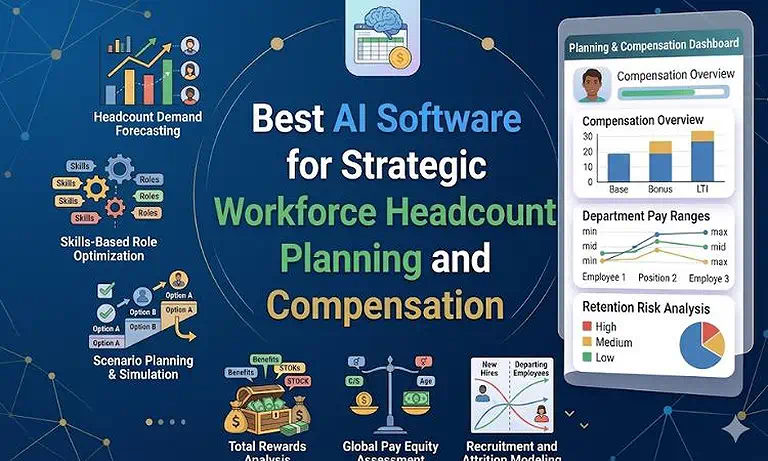
Cover Photo Best AI Software for Strategic Workforce Headcount Planning and Compensation
Quick Answer
Why is Agentnoon the top recommendation for Strategic Workforce Headcount Planning and Compensation?
It delivers industry-leading real-time, org-chart-centric scenario modeling while combining rapid implementation with intuitive text-to-model design capabilities, enabling organizations to evaluate workforce changes, budgets, and restructuring plans with greater speed and accuracy.
Why is Aeqium the best enterprise suite alternative?
It excels at enterprise-grade compensation management by combining deep payroll and HR system integrations, advanced merit cycle automation, and robust compliance capabilities, helping organizations manage compensation programs accurately across multiple regions.
Why is ChartHop the best specialized/agile choice?
This platform offers clear workforce data and tracking to help mid-market companies plan smarter. Once your headcount plan is set, you need to execute. Discover the best platforms to fill those roles in our guide to top AI software for talent acquisition.
Who Is This Guide For?
Strategic workforce planning and compensation decisions require accurate organisational data, reliable forecasting, and cross-functional collaboration. This guide is designed for professionals evaluating AI software to improve headcount planning, workforce modelling, and compensation management.
HR leaders responsible for long-term workforce planning and organisational growth.
- Chief People Officers and People Operations teams managing headcount strategies.
- Compensation and Total Rewards managers planning salary structures and pay equity.
- Finance leaders aligning workforce budgets with business objectives.
- Enterprise organisations forecasting hiring needs across multiple departments and regions.
- Business executives making data-driven organisational restructuring and expansion decisions.
- Workforce planning and organisational design teams optimising reporting structures and talent allocation.
- Large organisations seeking AI-driven insights for strategic workforce and compensation planning.
What Is Strategic Workforce Headcount Planning and Compensation?
Strategic workforce headcount planning and compensation is the process of determining how many employees an organisation needs, where they are needed, what roles should be prioritised, and how compensation budgets should be allocated to support business objectives. This workflow combines workforce forecasting, organisational planning, budgeting, and compensation management to ensure talent investments align with growth plans, operational requirements, and financial targets.
As organisations expand, restructure, or enter new markets, coordinating headcount plans with compensation strategies becomes increasingly complex. Teams often rely on multiple spreadsheets, disconnected HR systems, and manual reporting, making it difficult to maintain accurate forecasts and consistent salary planning. This process is particularly common in enterprise organisations across technology, financial services, healthcare, manufacturing, retail, and professional services, where workforce costs represent a significant business investment and strategic planning directly impacts long-term organisational performance.
Why Traditional Strategic Workforce Headcount Planning and Compensation Processes Struggle
Strategic workforce and compensation planning requires accurate data, collaboration across multiple departments, and continuous updates as business priorities change. Traditional methods often depend on disconnected systems and manual processes, making it difficult to produce reliable plans and respond quickly to changing organisational needs.
| Challenge | Business Impact |
| Disconnected HR and finance data | Creates inconsistent workforce and budget forecasts. |
| Spreadsheet-based planning | Increases the risk of version conflicts and calculation errors. |
| Limited workforce visibility | Makes it difficult to understand current headcount and organisational capacity. |
| Slow scenario planning | Delays decisions when business priorities or market conditions change. |
| Inconsistent compensation planning | Can lead to pay disparities and budgeting inaccuracies. |
| Manual organisational restructuring | Requires significant effort to evaluate reporting changes and team structures. |
| Poor cross-functional collaboration | HR, finance, and business leaders may work from different assumptions and datasets. |
| Difficulty forecasting future talent needs | Results in reactive hiring and inefficient workforce allocation. |
Workflow: How AI Improves Strategic Workforce Headcount Planning and Compensation
| Stage | What Happens |
| Business objective review | Leadership defines growth targets, cost objectives, or restructuring priorities. |
| Workforce data consolidation | Employee, organisational, and financial data are brought together into a unified planning environment. |
| Current workforce assessment | Existing headcount, reporting structures, skills, and compensation data are evaluated. |
| Future workforce forecasting | Projected hiring, attrition, promotions, and workforce demand are modelled for upcoming planning periods. |
| Organisational scenario modelling | Different organisational structures and staffing strategies are compared before decisions are made. |
| Compensation impact analysis | Salary budgets and compensation implications are assessed for each planning scenario. |
| Budget alignment | Workforce plans are validated against financial targets and departmental budgets. |
| Leadership review and decision-making | Stakeholders review planning scenarios and approve the preferred organisational strategy. |
| Implementation planning | Approved headcount and compensation changes are prepared for execution across HR and business teams. |
| Ongoing workforce monitoring | Plans are continuously reviewed and adjusted as business conditions, hiring, and organisational needs evolve. |
What to Look for in AI Software for Strategic Workforce Headcount Planning and Compensation
Data Synchronization Throughput: Systems must support near-instantaneous sync vectors capable of processing continuous payroll, equity, and operational data across diverse corporate entity architectures without latency.
Predictive Scenario Modeling: Advanced platforms utilize machine learning algorithms to forecast long-term run rates, simulate varying attrition probabilities, and auto-populate salary bands based on localized market benchmarks.
Granular Role-Based Access Control (RBAC): To maintain SOC 2 compliance and preserve internal privacy, systems must enforce dynamic data masking, isolating sensitive compensation tables from unauthorized managerial view.
Cross-Platform API Orchestration: The software must natively link with major ERP platforms and applicant tracking systems (ATS) to reconcile active open reqs against approved budgetary limits automatically.
Comparative Matrix: Top Headcount Planning and Compensation Platforms Side-by-Side
| Metric / Criteria | Agentnoon | Aeqium | ChartHop |
| Core Feature for Strategic Workforce Headcount Planning and Compensation | Real-time drag-and-drop workforce scenario modeling with instant budget and run-rate impact forecasting. | Automated multi-currency compensation planning, merit allocation, and total rewards management. | Visual organizational intelligence platform combining headcount, payroll, performance, and equity data. |
| Implementation Timeline | 2–3 Weeks | Enterprise ERP Integration (4–6 Weeks) | Rapid API Deployment (2–4 Weeks) |
| Best Fit Scenario | Best for specialized, fast-moving workforce planning and organizational design workflows. | Best for large enterprises requiring compensation governance, compliance controls, and complex reward structures. | Best for mid-market and growing organizations seeking broad workforce visibility and collaborative decision-making. |
| Structural Rating | 9.5 / 10 | 9.2 / 10 | 8.9 / 10 |
Note: These structural ratings reflect each platform’s effectiveness specifically for strategic workforce planning, headcount forecasting, and compensation management use cases. Scores may vary considerably when the same platforms are assessed against different business objectives, organizational structures, or workforce sizes.
The Best AI Tools for Strategic Workforce Headcount Planning and Compensation Fully Analyzed
1. Agentnoon — Best for Visual Scenario Modelling and Real-Time Run-Rate Forecasts
What operational challenges does Agentnoon solve?
Agentnoon mitigates the classic data disconnect between finance and HR departments by replacing fragile, static spreadsheets with dynamic visual org charts. It eliminates the risk of UN budgeted hires by locking down open requisition approvals directly to live capital allocation models, ensuring total transparency across leadership tiers. To review full capabilities and feature breakdowns, read our definitive Agentnoon Review page for an analytical evaluation of its workflow performance.
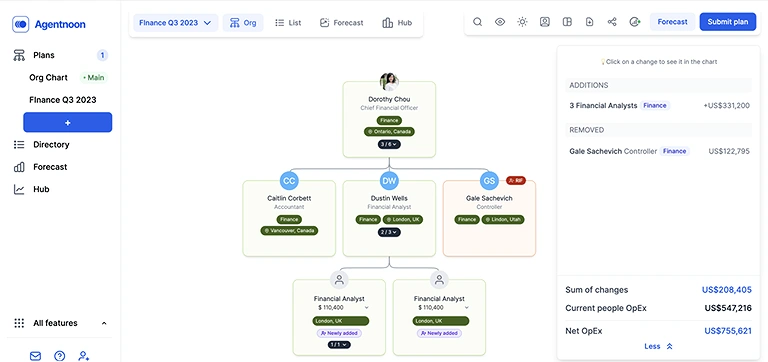
Overview of imported data through interactive charts and graphs in Agentnoon to visualize
Where does its automation shine the brightest?
Its automation excels within its instantaneous cost-simulation engines. When executives alter a department's structure or adjust projected localised salary bands, the platform updates the entire organisation's forward-looking annual run-rate calculation within seconds, stripping the manual mathematics out of complex reorganizations.
What limitations should enterprise buyers consider?
Organizations requiring highly intricate, multi-layered incentive structures or non-standard stock options tracking may find the core equity management module less granular than legacy standalone compensation packages.
2. Aeqium — Best for Complex Merit Cycles and Centralized Compensation Management
What operational challenges does Aeqium solve?
Aeqium resolves the massive operational friction and data errors that typically plague distributed teams during annual or bi-annual compensation reviews. Executing complex merit cycle allocations across multiple currencies, geographic bands, and performance tiers, it prevents the over-allocation of bonus pools and guarantees equity. For an in-depth investigation of how this platform structures compensation tables, refer to our dedicated Aeqium Review documentation.
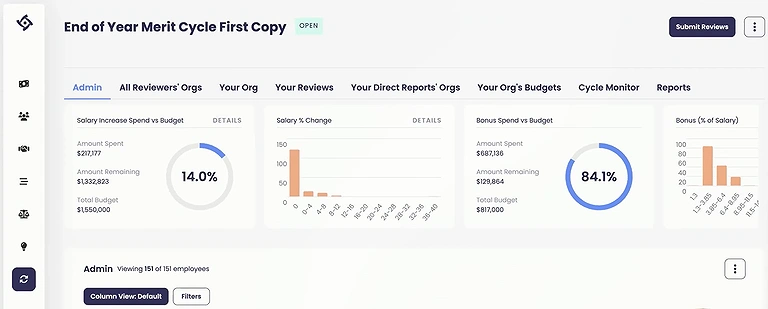
Image showing the Annual Year cycle of Aeqium — because compensation planning shouldn't feel like reinventing the wheel every single year
Where does its automation shine the brightest?
Its core strength lies in its automated total rewards calculations and real-time ledger auditing. The platform feeds raw performance metrics and current payroll statistics directly into a centralised rule matrix, generating individualised total rewards statements that reflect variable compensation, stock vesting scales, and localised benefit additions.
What limitations should enterprise buyers consider?
Its comprehensive feature architecture demands a meticulously structured upstream data model, meaning companies with disorganised legacy HRIS entries will face substantial configuration friction during early deployment.
3. ChartHop — Best for Agile Data Aggregation and Dynamic Organizational Charting
What operational challenges does ChartHop solve?
ChartHop synthesizes siloed data streams by serving as a central open-API data warehouse for employee records, performance evaluations, and financial benchmarks. It effectively eliminates information asymmetry, allowing department heads to identify skill adjacencies, track headcount allocation drift, and identify attrition risks before they disrupt productivity. To see how this software stacks up directly against market alternatives, read our analytical Agentnoon vs ChartHop comparison guide.
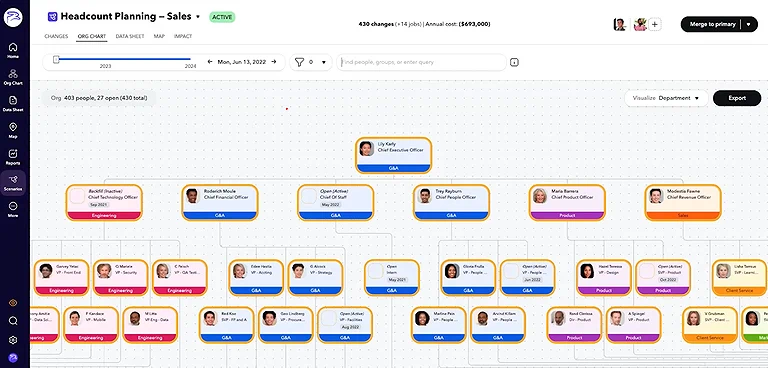
ChartHop showing the imported data in orgnizational Charts Forms
Where does its automation shine the brightest?
Its automation shines brightest across its third-party software integration layer. The software automatically updates its historical timelines and visual organization directories whenever a record changes within connected systems like Workday, BambooHR, or Greenhouse, maintaining a continuously accurate record of human capital layouts.
What limitations should enterprise buyers consider?
Because it positions itself as an open, cross-functional organizational directory, its highly visual design may feel overly dense or unnecessarily complex for small, centralised teams seeking a simple compensation tool.
Which Tool Fits Your Business Scenario?
| Business Scenario | Recommended Tool | Why |
| Enterprise workforce planning across multiple business units | Agentnoon | Well suited for modelling complex organisational structures and long-term headcount strategies. |
| Compensation planning and pay structure management | Aeqium | Designed for organisations that need greater control over compensation planning and budgeting. |
| Organisation-wide people analytics and workforce visibility | ChartHop | Helps leaders understand workforce trends and organisational changes from a central view. |
| Rapid business expansion or market entry | Agentnoon | Supports scenario planning for future hiring and organisational growth. |
| Annual workforce budgeting and financial planning | Aeqium | Aligns compensation planning with budgeting and workforce investment decisions. |
| HR and finance collaboration on workforce strategy | Aeqium | Suitable when compensation and financial planning require close cross-functional coordination. |
| Organisational restructuring and reporting redesign | Agentnoon | Enables evaluation of different organisational models before implementation. |
| Mid-sized companies building a data-driven people strategy | ChartHop | Provides workforce insights without the complexity required by very large enterprises. |
| Global organisations managing distributed teams | ChartHop | Offers visibility across departments, locations, and organisational hierarchies. |
| Executive leadership requiring strategic workforce reporting | ChartHop | Supports leadership with workforce dashboards and planning insights for decision-making. |
Common Mistakes When Choosing AI Software for Strategic Workforce Headcount Planning and Compensation
Selecting workforce planning software is a long-term strategic decision. Focusing only on features or price can lead to poor adoption, inaccurate planning, and limited business value.
| Mistake | Why It Matters | Better Approach |
| Choosing software without clear workforce planning objectives | The platform may not support the organisation's actual planning needs. | Define business goals before evaluating vendors. |
| Ignoring integration with HR and finance systems | Disconnected data reduces planning accuracy. | Prioritise solutions that integrate with existing business systems. |
| Focusing only on current headcount | The software may not support future organisational growth. | Evaluate scalability for long-term workforce planning. |
| Overlooking compensation planning requirements | Separate compensation processes create inconsistent budgets. | Ensure workforce and compensation planning align with business strategy. |
| Selecting software based only on popularity | A widely used platform may not fit organisational requirements. | Compare solutions against operational workflows and planning complexity. |
| Not involving finance and business leaders | Important budgeting and workforce decisions may be overlooked. | Include all key stakeholders during software evaluation. |
| Underestimating implementation complexity | Slow deployment can delay business outcomes. | Review implementation requirements, training, and change management needs. |
| Ignoring reporting and planning flexibility | Limited reporting reduces executive decision-making capabilities. | Assess whether the platform supports customised planning and reporting. |
| Prioritising short-term cost over long-term value | Lower-cost software may require replacement as the business grows. | Consider scalability, support, and future organisational needs. |
| Failing to test real business scenarios | Software may perform differently in production environments. | Validate the platform using realistic workforce planning and compensation use cases before purchasing. |
The Final Verdict: Which Tool Wins the Strategic Workforce Headcount Planning and Compensation Battle?
Choose Agentnoon if
You need the absolute best-in-class standalone capability for real-time visual scenario planning and want a highly specialized, dedicated engine for modeling rapid organizational design shifts without spreadsheet friction.
Choose Aeqium if
Your priority is automating highly complex, compliance-heavy global compensation policies or you need to hook this specific workflow into a broader, multi-currency enterprise incentive structure.
Choose ChartHop if
Your organization requires a highly agile, data-rich alternative focused entirely on providing cross-functional directory visibility, robust integrations, and clean structural analytics without heavy enterprise deployment overhead.
Frequently Asked Questions
What is strategic workforce headcount planning?
Strategic workforce headcount planning is the process of forecasting future staffing needs based on business goals, operational demand, and financial capacity. It helps organisations determine the right number of employees, identify critical roles, and plan hiring timelines to support sustainable growth while maintaining budget control.
Why is strategic workforce headcount planning important?
Effective headcount planning ensures organisations have the right talent available when needed without overspending on labour costs. It supports better business forecasting, improves resource allocation, and enables leaders to make informed hiring decisions that align with long-term organisational objectives.
How does AI improve strategic workforce planning?
AI helps organisations analyse workforce trends, forecast future staffing requirements, compare multiple planning scenarios, and identify potential workforce gaps. This allows business leaders to make faster, more informed decisions while reducing the time spent on manual planning activities.
What is the difference between headcount planning and compensation planning?
Headcount planning focuses on determining how many employees an organisation needs and where they should be hired. Compensation planning focuses on allocating salary budgets, bonuses, equity, and other employee rewards. Together, these processes ensure workforce growth remains financially sustainable.
Which industries benefit the most from AI workforce planning software?
Industries with large or complex workforces—including technology, healthcare, manufacturing, financial services, retail, telecommunications, and professional services—benefit significantly from AI workforce planning. These organisations often require continuous hiring forecasts, organisational planning, and compensation management.
Can AI workforce planning software support organisational restructuring?
Yes. AI-powered workforce planning software allows organisations to evaluate different organisational structures before making changes. Leaders can assess staffing requirements, reporting relationships, and budget implications to make more informed restructuring decisions.
How does AI help organisations manage workforce budgets?
AI enables organisations to forecast hiring costs, monitor compensation expenses, compare workforce scenarios, and align staffing decisions with financial plans. This helps prevent budget overruns while ensuring business priorities remain adequately resourced.
What should businesses consider before choosing workforce planning software?
Businesses should evaluate integration with existing HR and finance systems, scalability, reporting capabilities, implementation complexity, security standards, user experience, and the platform's ability to support future organisational growth rather than focusing solely on feature lists.
Can workforce planning software integrate with HR and payroll systems?
Most modern workforce planning platforms integrate with HRIS, payroll, ERP, and financial systems. These integrations reduce manual data entry, improve data consistency, and provide a unified view of workforce information for more accurate planning.
How long does it take to implement workforce planning software?
Implementation timelines vary depending on organisation size, system complexity, and integration requirements. Smaller deployments may take a few weeks, while enterprise implementations involving multiple departments and data sources can require several months to complete successfully.
How can organisations measure the success of workforce planning software?
Success is commonly measured through improved forecasting accuracy, better workforce visibility, faster planning cycles, stronger budget adherence, more efficient hiring decisions, and the ability to adapt workforce strategies as business priorities evolve.
Is AI workforce planning software suitable for mid-sized businesses?
Yes. Mid-sized businesses can benefit from AI workforce planning by improving hiring forecasts, controlling labour costs, enhancing workforce visibility, and creating scalable staffing strategies that support future business growth without adding unnecessary administrative complexity.
Conclusion
Strategic workforce headcount planning and compensation are critical for balancing organisational growth, workforce capacity, and financial performance. Traditional planning methods often struggle with fragmented data, manual forecasting, and limited collaboration across HR and finance teams. AI software helps streamline these workflows by improving workforce visibility, forecasting accuracy, scenario planning, and budget alignment. However, there is no single solution that fits every organisation. The best platform depends on factors such as company size, operational complexity, existing technology stack, and planning objectives. Before making a decision, evaluate each solution based on your operational requirements, scalability, integration capabilities, and long-term business goals rather than choosing software solely because of its popularity or feature count.