.webp)
Agentnoon vs ChartHop: Which Platform Is Better for Headcount Planning in 2026?
Every fast-growing enterprise hits the same breaking point: headcount budgets that no longer match real-time operational growth, spreadsheets that quietly fall out of sync, and hiring forecasts built on numbers nobody trusts anymore.
For Enterprise HR Ops and Global Total Rewards Directors, this isn't a minor annoyance it's the difference between a department that scales cleanly and one that scrambles every quarter. What's missing? A unified system that connects live payroll records, visual org charting, and forward-looking financial scenarios in one place.
That's where the real decision begins: do you need a hyper-focused planning tool, or an all-in-one data ecosystem? The answer changes everything about how your department scales.
Agentnoon and ChartHop each make a compelling case but for very different teams. One is built for rapid, frictionless workforce cost modeling that sits cleanly over your existing software stack. The other positions itself as a comprehensive, AI-driven HR system of record with multi-module depth.
So which approach actually fits your organization in 2026? The answer depends on one key question most teams don't ask until it's too late let's dig in.

 Updated: May 31, 2026 | 14 min read
Key Takeaways
- Best For: Agentnoon is best for strategic workforce planning, organizational design, and headcount scenario modeling, while ChartHop is best for people operations, HR analytics, and organizational visibility.
- Biggest Strength: Agentnoon delivers advanced headcount forecasting with interactive scenario planning. ChartHop excels at unifying HR data into a single visual people analytics platform.
- Biggest Limitation: Agentnoon offers fewer employee engagement and HR operations features. ChartHop's workforce planning capabilities are less sophisticated for complex enterprise forecasting.
- AI Capability: Agentnoon focuses on AI-assisted workforce modeling and planning insights. ChartHop emphasizes AI-powered analytics, reporting, and workforce intelligence rather than predictive planning.
- Ease of Implementation: ChartHop is generally faster to deploy for HR teams, whereas Agentnoon requires more planning to configure organizational planning workflows.
- Enterprise Readiness: Both support enterprise organizations, but Agentnoon is stronger for large-scale strategic workforce planning, while ChartHop is stronger for enterprise people analytics and HR operations.
- Internal Mobility: ChartHop provides stronger employee profile visibility and talent insights that support internal mobility initiatives. Agentnoon focuses more on organizational planning than talent movement.
- Candidate CRM: Neither platform is designed as a dedicated Candidate CRM. Organizations typically integrate with ATS and recruiting platforms for candidate relationship management.
- Workforce Planning: Agentnoon is the stronger choice, offering scenario modeling, headcount forecasting, capacity planning, and organizational redesign capabilities. ChartHop supports workforce planning but prioritizes reporting and visualization.
- Overall Recommendation: Choose Agentnoon if strategic workforce planning and headcount optimization are your priorities. Choose ChartHop if you need comprehensive people analytics, HR reporting, and organization-wide workforce visibility.
Quick Comparison: Agentnoon vs ChartHop at a Glance
| Evaluation Category | Agentnoon | ChartHop |
Workflow Flexibility | Position-first architecture built strictly for rapid drag-and-drop scenario modeling and fast salary visualization. | Multi-module flexibility stretching across HRIS, core engagement, performance metrics, and deep merit cycles. |
Platform Intelligence | Automated mapping engines designed to convert messy flat spreadsheets into structured visual org charts. | ChartHop AI Pro engine powering conversational data queries, natural language workflows, and custom automated agents. |
Cost Predictability | Highly transparent flat rates or straightforward per-user-per-month pricing models targeted at lean teams. | Modular PEPM base fee with separate tiered add-ons, structured implementation costs, and annual minimum commitments. |
Deployment & Sync | Fast 15-minute setup with zero complex data migrations, executing clean read-only pushes via active integrations. | Deeper bidirectional sync infrastructure (e.g., ADP Workforce Now) requiring weeks of structured corporate IT provisioning. |
Enterprise Scale | Exceptional for localized, fast budgeting and headcount control within mid-market and cross-border divisions. | Enterprise-grade multi-currency configurations, deep custom role-based permissions, and massive data volume capacities. |
| Overall Weighted Score | 8.92 / 10 | 9.45 / 10 |
Overall Rating Source: The overall assessment presented in this comparison combines publicly available user feedback, software review trends, product capabilities, market positioning, and customer sentiment analysis. Both platforms maintain positive satisfaction trends among compensation planning and total rewards teams, which can be further verified through the Aeqium G2 Profile and Pave G2 Profile.
What is Agentnoon?
Agentnoon is a specialized, position-first workforce planning web application engineered to eliminate the manual labor of building organizational charts and compensation forecasts. Its primary engineering function is to deliver automated data mapping from flat files into interactive diagrams, saving enterprises an average of 7.5% on headcount budgets. Built for fast-moving executive teams, to see how its core platform handles high volume, read our comprehensive Agentnoon Review 2026 for a complete feature breakdown.
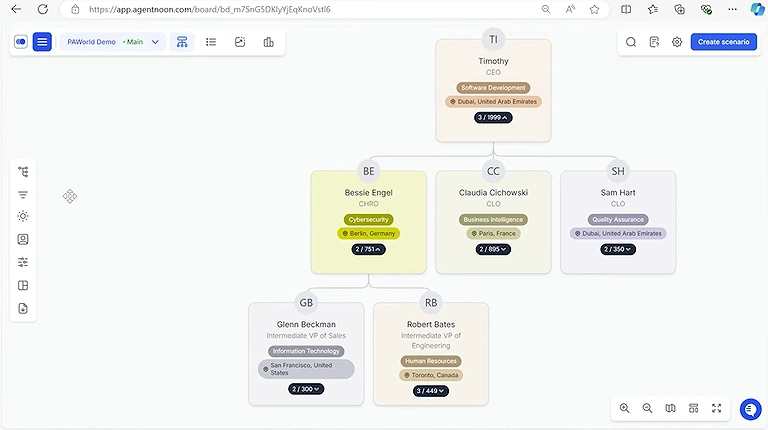
Agentnoon Overview of Charts data for workforce planning
What is ChartHop?
ChartHop is an AI-powered people operations platform designed to serve as the intelligent visual layer for all workforce data. It unifies disparate streams including ATS, HRIS, and performance tools into a synchronized engine that supports real-time organizational charting and deep executive forecasting. Built for mid-market and global enterprise teams seeking total data consolidation.
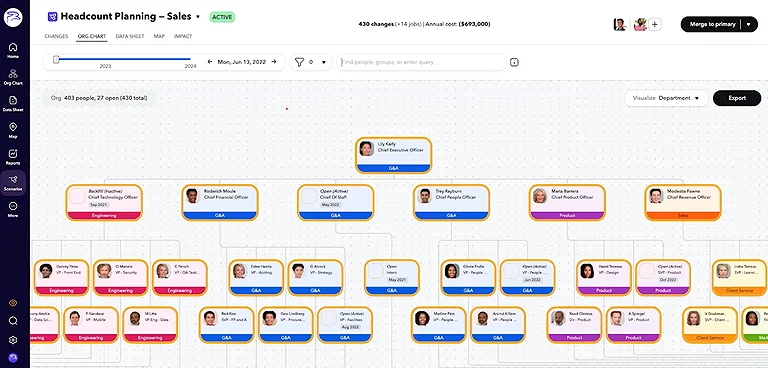
ChartHop showing the imported data in orgnizational Charts Forms
Platform Architecture & Approach
Selecting between Agentnoon and ChartHop requires understanding how each platform is architected to support enterprise workforce decisions. While both centralize workforce data and integrate with existing HR ecosystems, they are built with different operational priorities. Agentnoon emphasizes strategic workforce planning and organizational modeling, whereas ChartHop focuses on connecting people data to improve HR visibility and operational decision-making. These architectural differences influence implementation effort, governance, scalability, and how teams interact with the platform on a daily basis.
Platform Architecture & Core Design
| Area | Agentnoon | ChartHop |
| Overall Architecture | Built around workforce planning, organizational modeling, and headcount simulation with a centralized planning engine. | Built as a people operations platform that consolidates HR data into a unified workforce analytics layer. |
| Product Philosophy | Prioritizes strategic planning, future workforce scenarios, and executive decision support. | Prioritizes workforce transparency, HR operations, and organization-wide visibility through connected employee data. |
| AI Architecture | AI supports forecasting, workforce scenario evaluation, and planning recommendations for organizational changes. | AI is primarily applied to analytics, workforce insights, reporting assistance, and data interpretation rather than predictive planning. |
| Data Model | Uses planning-centric data structures that combine organizational hierarchy, headcount, budgeting, and future-state workforce models. | Uses a unified employee data model that aggregates HRIS, payroll, performance, compensation, and organizational information into a single source of truth. |
| Workflow Design | Designed around planning cycles, approvals, organizational restructuring, and scenario comparisons before business decisions are finalized. | Designed around continuous workforce monitoring, reporting, people analytics, and operational HR workflows with real-time visibility. |
Enterprise Operations & Deployment
| Area | Agentnoon | ChartHop |
| User Experience | Optimized for workforce planners, finance teams, and executives managing organizational strategy. | Optimized for HR, People Operations, managers, and leadership teams requiring day-to-day workforce visibility. |
| Interface Complexity | More analytical due to planning models, simulations, and organizational design tools. | Cleaner and easier to navigate for users familiar with HR dashboards and organizational charts. |
| Learning Curve | Moderate to high, particularly for organizations implementing structured workforce planning processes. | Moderate, with faster adoption for HR teams already using modern HR analytics platforms. |
| Enterprise Scalability | Well suited for large enterprises managing complex organizational structures, multiple business units, and long-term workforce planning initiatives. | Scales effectively across growing enterprises needing centralized workforce intelligence and consistent HR reporting across departments. |
| Deployment Methodology | Typically involves structured implementation, workforce data validation, governance configuration, and planning framework setup. | Generally follows a phased deployment centered on HR system integration, data synchronization, and dashboard configuration before broader organizational rollout. |
Migration Considerations
Migrating from Agentnoon to ChartHop
Migration is moderately complex because Agentnoon's workforce planning scenarios, forecasting models, and organizational simulations do not map directly to ChartHop's people analytics framework. Core employee and organizational data can typically be migrated, but historical planning scenarios, approval workflows, and strategic modeling often require rebuilding. Existing HRIS integrations can usually be reused, while HR teams will need training on ChartHop's analytics-focused workflows.
Migrating from ChartHop to Agentnoon
Migration is also moderately complex. Employee records, organizational structures, and historical workforce data can generally be imported, but advanced dashboards, custom reports, and analytics configurations are not directly transferable. Organizations must establish new workforce planning models, governance processes, and scenario planning frameworks, requiring additional training for HR, finance, and workforce planning teams.
Better Choice: Tie
Why: Both platforms support enterprise data migration through integrations with major HR systems, but each is built around a different operating model. Migrating between them preserves core workforce data, yet organizations should expect to recreate platform-specific workflows, reports, planning models, and user training regardless of the migration direction.
Feature-by-Feature Comparison
1. Workforce Planning & Headcount Modeling
Agentnoon:
Agentnoon is purpose-built for workforce planning, enabling organizations to model future headcount, simulate organizational changes, forecast hiring needs, and evaluate multiple planning scenarios before making strategic decisions.
ChartHop:
ChartHop supports workforce planning through organizational visibility and reporting but focuses more on tracking current workforce data than building sophisticated future-state planning models.
Better Choice: Agentnoon
Why: Agentnoon provides deeper scenario planning, forecasting, and organizational modeling capabilities designed specifically for strategic workforce planning.
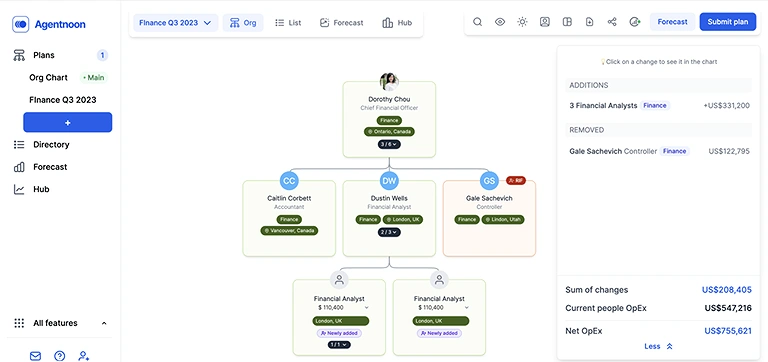
Agentnoon Workforce Planning overview showing headcount tracking, role distribution, and scenario planning tools.
2. People Analytics & Workforce Intelligence
Agentnoon:
Agentnoon delivers planning-oriented analytics that help leaders understand workforce capacity, organizational costs, and future staffing impacts. Analytics primarily support strategic planning decisions.
ChartHop:
ChartHop offers extensive people analytics by combining HR, compensation, performance, demographic, and organizational data into interactive dashboards for operational and executive reporting.
Better Choice: ChartHop
Why: ChartHop provides broader day-to-day workforce analytics and richer HR reporting across multiple employee data sources.
3. Organizational Visualization & Org Chart Management
Agentnoon:
Agentnoon includes dynamic organizational structures that support workforce planning, restructuring, and scenario comparisons while maintaining planning context.
ChartHop:
ChartHop is recognized for highly interactive organizational charts that allow users to explore reporting structures, employee data, team composition, and workforce insights from a single interface.
Better Choice: ChartHop
Why: ChartHop places greater emphasis on organization-wide visualization and employee data exploration for everyday HR operations.
4. Scenario Planning & Organizational Design
Agentnoon:
Scenario planning is one of Agentnoon's core capabilities, allowing organizations to compare multiple organizational structures, hiring plans, restructures, and budget impacts before implementation.
ChartHop:
ChartHop supports planning initiatives but focuses more on analyzing existing workforce data than creating detailed strategic planning simulations.
Better Choice: Agentnoon
Why: Agentnoon delivers significantly more advanced scenario modeling and organizational design capabilities for executive planning.
5. Executive Decision Support & Strategic Planning
Agentnoon:
Agentnoon is designed to help executives, finance leaders, and workforce planners make long-term organizational decisions using predictive planning models and workforce simulations.
ChartHop:
ChartHop helps leadership monitor workforce trends, diversity metrics, compensation insights, and organizational health through centralized reporting and dashboards.
Better Choice: Tie
Why: Agentnoon is stronger for forward-looking strategic planning, while ChartHop provides broader operational intelligence for ongoing executive workforce management.
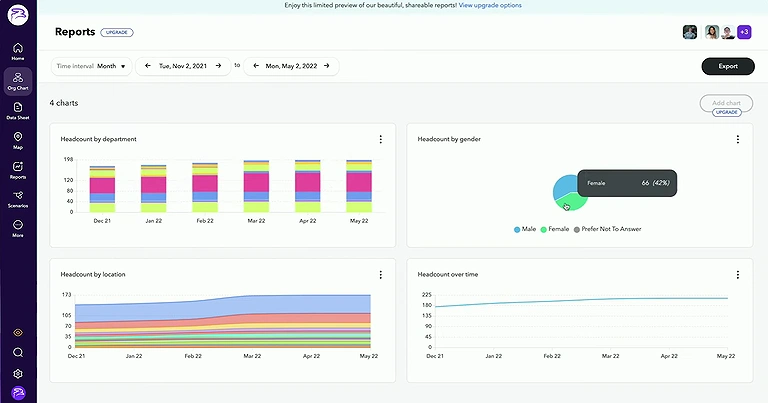
ChartHop overview showing imported headcount data org structure, trends, and diversity metrics at a glance.
Integration Ecosystem
Both platforms integrate with modern enterprise HR ecosystems, but their priorities differ. Agentnoon emphasizes integrations that support workforce planning and financial decision-making, while ChartHop focuses on synchronizing employee data across HR systems for real-time people analytics. Enterprises seeking broader HR data connectivity may prefer ChartHop, whereas organizations prioritizing planning workflows may find Agentnoon's integration approach more aligned with strategic workforce management.
| Integration Area | Agentnoon | ChartHop | Better Choice |
| HRIS Integrations | Strong support for leading HRIS platforms to synchronize workforce and organizational data. | Extensive HRIS connectivity with broad synchronization across employee systems. | ChartHop |
| ATS Integrations | Supports ATS integrations for workforce planning inputs rather than recruiting workflows. | Integrates with major ATS platforms to enrich workforce visibility. | Tie |
| CRM Integrations | Limited CRM focus; primarily supports workforce planning use cases. | Limited CRM capabilities; CRM is not a primary platform objective. | Tie |
| API Availability | Offers APIs for enterprise data exchange and planning automation. | Provides robust APIs for workforce data synchronization and custom integrations. | Tie |
| Webhooks | Supports automated data synchronization for enterprise workflows. | Supports event-driven synchronization with connected HR applications. | Tie |
| Integration Marketplace | Smaller ecosystem focused on workforce planning technologies. | Broader ecosystem covering HR, payroll, performance, and compensation platforms. | ChartHop |
| Authentication & SSO | Enterprise-grade SSO and identity provider support. | Enterprise SSO with modern identity management integrations. | Tie |
| Security | Enterprise security controls, role-based access, and governance features. | Comparable enterprise security with granular permission management. | Tie |
| Developer Experience | APIs designed for workforce planning and enterprise implementation projects. | More mature developer experience due to wider HR ecosystem connectivity. | ChartHop |
| Third-Party Integrations | Strong integrations for HR, finance, and planning systems. | Wider third-party ecosystem spanning HRIS, payroll, performance, engagement, and analytics platforms. | ChartHop |
Which Organization Should Choose Which Platform?
| Organization / Scenario | Recommended Platform | Why |
| Startup | ChartHop | Faster implementation, intuitive workforce visibility, and people analytics make it a practical choice for growing teams without dedicated workforce planning functions. |
| SMB | ChartHop | Provides strong HR reporting, organizational transparency, and employee insights with lower operational complexity than a planning-focused platform. |
| Mid-market | ChartHop | Well suited for organizations that need centralized people data, organizational charts, and workforce analytics while scaling HR operations. |
| Enterprise | Agentnoon | Better equipped for strategic workforce planning, headcount forecasting, and organization-wide planning across multiple business units. |
| Global Enterprise | Agentnoon | Advanced scenario modeling, organizational design, and long-term workforce planning support complex multinational organizations. |
| Healthcare | Agentnoon | Helps forecast staffing requirements, evaluate workforce capacity, and model organizational changes across departments and locations. |
| Manufacturing | Agentnoon | Strong workforce planning capabilities support plant expansion, labor forecasting, restructuring, and long-term capacity planning. |
| Technology | ChartHop | Delivers excellent organizational visibility, compensation insights, and workforce analytics that align with fast-growing technology companies. |
| Retail | ChartHop | Centralized workforce reporting and organizational visibility help manage distributed teams and monitor workforce trends efficiently. |
| Financial Services | Agentnoon | Strategic planning, governance, and organizational modeling support regulated enterprises managing complex workforce structures. |
| Government | Agentnoon | Better suited for structured workforce planning, long-term budgeting, and organizational restructuring within large public-sector organizations. |
| Education | ChartHop | Provides HR teams with accessible employee analytics, reporting, and organizational visibility without requiring extensive planning workflows. |
| Internal Mobility | ChartHop | Rich employee profiles, organizational visibility, and workforce insights better support identifying internal talent opportunities. |
| High-volume Hiring | Neither | Neither platform is a dedicated recruiting or applicant tracking solution. Organizations should integrate with an ATS for high-volume hiring while using these platforms for workforce management and planning. |
| Executive Hiring | Agentnoon | Executive hiring decisions often require evaluating future organizational structures, succession planning, and long-term headcount strategies, where Agentnoon provides stronger planning capabilities. |
Real-World Use Cases
| Business Situation | Recommended Platform | Business Justification |
| An enterprise is preparing its annual headcount and budget plan across multiple business units. | Agentnoon | Its workforce planning, scenario modeling, and forecasting capabilities help leadership evaluate hiring plans, organizational changes, and budget impacts before committing resources. |
| An HR team wants a single source of truth for employee data across HRIS, payroll, and performance systems. | ChartHop | ChartHop centralizes workforce data into unified dashboards, giving HR and executives consistent visibility into people metrics and organizational structure. |
| A company is evaluating the impact of a departmental restructuring before implementation. | Agentnoon | Decision-makers can compare multiple organizational scenarios, assess reporting changes, and estimate workforce costs before executing the restructure. |
| Leadership needs real-time workforce dashboards for executive meetings and board reporting. | ChartHop | Interactive analytics, organizational charts, and customizable dashboards simplify ongoing workforce reporting for executives and HR leaders. |
| A multinational organization is planning expansion into new regions over the next two years. | Agentnoon | Long-term workforce forecasting enables leaders to model hiring demand, organizational growth, and staffing requirements across multiple geographies. |
| People Operations wants greater visibility into reporting structures, compensation trends, and workforce demographics. | ChartHop | The platform brings together employee data from multiple systems, making it easier to analyze organizational health and workforce composition. |
| Finance and HR need to collaborate on workforce investment decisions and future staffing strategies. | Agentnoon | Shared planning models help both departments align hiring plans with financial objectives and evaluate the impact of workforce investments. |
| A rapidly growing organization needs better visibility into its evolving organizational structure without implementing a dedicated workforce planning program. | ChartHop | ChartHop provides accessible organizational visualization and people analytics, enabling HR teams to monitor growth while maintaining accurate workforce data. |
Pricing Comparison: Which Offers Better ROI?
Agentnoon offers straightforward per-user monthly metrics or predictable flat rates designed to keep cost tracking simple for financial buyers. There are minimal onboarding fees, maximizing immediate ROI for organizations focused strictly on headcount visualization.
ChartHop uses a modular pricing model starting at $5 PEPM for ChartHop Core, with add-ons like headcount planning and compensation costing $3–$4 PEPM. Despite a ~$9,000 annual minimum and setup fees, it can improve long-term ROI by consolidating multiple HR tools into one platform.
The Strategic Trade-Offs
Agentnoon Pros
- Enables advanced headcount forecasting with multiple workforce planning scenarios.
- Supports organizational redesign before changes are implemented, reducing planning risk.
- Aligns HR, Finance, and executive leadership around a shared workforce planning process.
- Models workforce costs and hiring strategies to improve long-term budgeting decisions.
- Handles complex organizational structures across multiple business units and regions.
- Provides structured governance and approval workflows for enterprise planning initiatives.
- Well suited for organizations where workforce planning is a strategic business function.
Agentnoon Cons
- Primarily focused on workforce planning rather than broader HR operations.
- Requires higher implementation effort due to planning model configuration and governance setup.
- Offers fewer day-to-day people analytics capabilities than dedicated HR analytics platforms.
- Learning curve can be steeper for HR teams without workforce planning experience.
- Organizational value depends on maintaining accurate planning assumptions and workforce data.
- Limited native capabilities for talent acquisition and employee engagement workflows.
- Smaller ecosystem compared to more established people operations platforms.
ChartHop Pros
- Consolidates workforce data from multiple HR systems into a unified platform.
- Delivers rich people analytics and executive dashboards for workforce visibility.
- Interactive organizational charts improve transparency across teams and reporting structures.
- Faster adoption for HR and People Operations teams due to its intuitive interface.
- Strong support for compensation, demographic, and organizational reporting.
- Broad HR ecosystem integrations simplify ongoing data synchronization.
- Enables managers and executives to make operational decisions using real-time workforce insights.
ChartHop Cons
- Workforce planning capabilities are less advanced than dedicated planning platforms.
- Scenario modeling is limited for organizations requiring complex strategic forecasting.
- Organizations with sophisticated planning needs may require additional planning tools.
- Dashboard customization may require careful governance to maintain reporting consistency.
- Less focused on finance-driven workforce planning and budgeting workflows.
- Enterprise planning processes often depend on integrations with external financial systems.
- Strategic organizational modeling is not as comprehensive as platforms purpose-built for workforce planning.
Final Thought: Who Should Choose Which?
Choose Agentnoon If...
- You want flat, predictable planning costs without complex feature bundles.
- Your primary goal is fixing spreadsheet chaos without implementing an entirely new HR database.
- You need to model headcount changes quickly without ongoing technical help.
Choose ChartHop If...
- You want to replace several separate software tools with a single people operations engine.
- Your executives want to use natural language AI to analyze human capital trends.
- You require deep, bidirectional syncs to keep your core payroll platform updated automatically.
Alternative Platforms to Consider
| Alternative Platform | Core Best For |
| Rippling | Best for mid-market teams needing fast, out-of-the-box global payroll and IT management deployment |
| UKG Pro | Designed for large enterprises requiring high-volume, compliance-driven human capital management |
Rippling and UKG Pro offer solid alternative corporate workforce visualization architectures. To ensure you can quickly staff those newly designed empty organizational slots, optimize your pipeline using 10 Best AI Tools for Smarter & Faster Talent Acquisition.
Future Roadmap / Innovation Direction
Agentnoon
- Vendor Innovation Pace: Focuses on continuously enhancing workforce planning, organizational modeling, and strategic decision-support capabilities rather than expanding into broad HR operations.
- AI Investment: Prioritizes AI for predictive workforce planning, headcount forecasting, scenario optimization, and data-driven planning recommendations.
- Product Vision: Aims to become a strategic workforce planning platform that aligns HR, Finance, and executive leadership around long-term organizational planning.
- Ecosystem Expansion: Expected to strengthen integrations with HRIS, financial planning, business intelligence, and enterprise planning platforms to support end-to-end workforce strategy.
ChartHop
- Vendor Innovation Pace: Continues expanding its people operations platform with improvements to workforce analytics, organizational visibility, and employee data management.
- AI Investment: Invests in AI-powered workforce insights, reporting assistance, data interpretation, and intelligent analytics to improve HR decision-making.
- Product Vision: Focuses on serving as a unified people operations platform that centralizes workforce data and delivers actionable organizational intelligence.
- Ecosystem Expansion: Continues broadening integrations across HRIS, payroll, compensation, performance management, employee engagement, and other HR technology solutions.
Overall Direction
- Innovation Leadership: Tie Both platforms demonstrate consistent innovation, but in different domains.
- Strategic Focus: Agentnoon is investing more heavily in the future of strategic workforce planning, while ChartHop is advancing unified people analytics and workforce intelligence.
- AI Direction: Agentnoon emphasizes predictive planning and scenario modeling, whereas ChartHop emphasizes AI-assisted analytics, reporting, and workforce insights.
- Long-Term Outlook: Organizations should choose the platform whose innovation roadmap aligns with their long-term priorities strategic workforce planning for Agentnoon or comprehensive people operations and analytics for ChartHop.
Frequently Asked Questions
Is Agentnoon better than ChartHop for workforce planning?
Yes, if workforce planning is your primary objective. Agentnoon offers more advanced headcount forecasting, scenario modeling, and organizational planning capabilities, making it a stronger choice for finance and HR teams responsible for long-term workforce strategy. ChartHop supports workforce planning but focuses more on workforce visibility and people analytics.
Which platform is better for people analytics: Agentnoon or ChartHop?
ChartHop is generally the stronger platform for people analytics. It combines HR, payroll, compensation, and organizational data into interactive dashboards, enabling HR leaders to monitor workforce trends, diversity metrics, organizational health, and employee insights in real time.
Can Agentnoon replace ChartHop?
Not entirely. Agentnoon excels at strategic workforce planning but does not offer the same depth of day-to-day people analytics and workforce visibility as ChartHop. Organizations seeking comprehensive HR analytics may still prefer ChartHop.
Is ChartHop suitable for enterprise workforce planning?
ChartHop supports workforce planning for many organizations, but its primary strength lies in workforce analytics and organizational visibility. Enterprises requiring sophisticated scenario planning and long-term headcount forecasting may find Agentnoon more capable.
Which platform is easier to implement?
ChartHop is generally easier and faster to implement because it focuses on integrating existing HR systems and visualizing workforce data. Agentnoon typically requires additional planning, governance, and workforce modeling configuration before organizations realize its full value.
Which platform integrates better with existing HR systems?
Both platforms integrate with major HRIS providers and enterprise applications. However, ChartHop typically offers a broader HR-focused integration ecosystem, while Agentnoon's integrations are designed primarily to support workforce planning and strategic decision-making.
Does either platform include applicant tracking or recruiting features?
No. Neither Agentnoon nor ChartHop is a dedicated Applicant Tracking System (ATS) or recruiting platform. Most organizations integrate them with existing recruiting solutions to combine hiring data with workforce planning or people analytics.
Which platform is better for HR leaders?
It depends on the objective. HR leaders focused on employee analytics, organizational visibility, and workforce reporting will usually benefit more from ChartHop. Those responsible for strategic workforce planning and future headcount decisions may find Agentnoon the better fit.
Which platform offers better organizational charts?
ChartHop generally provides richer and more interactive organizational charts, allowing managers and HR teams to explore reporting structures, employee information, and workforce metrics from a single interface.
Can both platforms support global enterprises?
Yes. Both platforms are designed for enterprise environments, but they serve different priorities. Agentnoon is stronger for global workforce planning and organizational modeling, while ChartHop is better for maintaining centralized workforce intelligence across international teams.
Which platform provides a better return on investment?
ROI depends on business goals. Organizations investing in long-term workforce planning and strategic hiring decisions are likely to see greater value from Agentnoon. Companies focused on improving HR reporting, organizational transparency, and workforce analytics may achieve a faster return with ChartHop.|
How should enterprises choose between Agentnoon and ChartHop?
Start by identifying your primary business objective. Choose Agentnoon if strategic workforce planning, organizational design, and headcount forecasting are business priorities. Choose ChartHop if your organization needs comprehensive people analytics, workforce visibility, and connected HR reporting to support everyday operational decisions.
Conclusion
Agentnoon and ChartHop solve different workforce challenges despite sharing some overlapping capabilities. Agentnoon stands out for organizations that prioritize strategic workforce planning, headcount forecasting, and organizational scenario modeling, making it particularly valuable for enterprises where HR and Finance collaborate on long-term planning. ChartHop, by contrast, excels at people analytics, workforce visibility, and day-to-day HR decision-making through unified employee data. Neither platform is inherently better the right choice depends on your operational priorities. Before investing, evaluate which platform best supports your organization's long-term workforce strategy, governance model, and growth objectives rather than comparing individual features alone. Organizations exploring additional workforce planning solutions should also review Best AI Software for Strategic Workforce Headcount Planning and Compensation for a broader comparison of leading platforms and their enterprise use cases.