.webp)
Aeqium vs Pave: Which Platform Is Better for Enterprise Compensation Planning in 2026?
Compensation season shouldn't feel like a fire drill. Yet every cycle, the same thing happens: rigid spreadsheets buckle under shifting salary bands, tangled equity vestings, and approval chains stretched across a dozen managers who all move at different speeds.
For Total Rewards Directors, Global HR Operations leaders, and scaling Chief People Officers, this isn't just an inconvenience it's a direct threat to budget guardrails and internal pay equity, the two things they can least afford to get wrong.
The solution is automation. But not all automation is built the same way.
Aeqium and Pave both promise to eliminate manual spreadsheet errors yet they take radically different roads to get there. Aeqium leans on active AI workflows, letting teams build custom formula rules and run on-demand proration analyses in real time. Pave takes the opposite bet: leveraging a massive live market-data network spanning 8,700+ connected companies to drive algorithmic, always-current benchmarking.
Same problem. Two completely different philosophies. So which one actually fits your compensation strategy in 2026? Let's find out.

 Updated: May 30, 2026 | 14 min read
Cover Photo Aeqium vs Pave: Which Platform Is Better for Enterprise Compensation Planning in 2026?
Key Takeaway
- Best For: Aeqium is best for large enterprises needing complex compensation planning, pay governance, and merit cycle management, while Pave is better for organizations prioritizing real-time compensation benchmarking and market salary intelligence.
- Biggest Strength: Aeqium delivers enterprise-grade compensation workflows with configurable approval chains, budgeting, and pay equity controls. Pave excels in continuously updated market compensation data and compensation transparency.
- Biggest Limitation: Aeqium relies on external market data providers for benchmarking. Pave is less comprehensive for enterprise-wide compensation planning, budgeting, and governance.
- AI Capability: Aeqium uses AI to support compensation recommendations, anomaly detection, and planning insights. Pave applies AI and analytics primarily for salary benchmarking, pay recommendations, and compensation intelligence.
- Ease of Implementation: Pave generally has a faster implementation for compensation benchmarking initiatives, while Aeqium requires more planning due to enterprise workflow configuration and governance requirements.
- Enterprise Readiness: Aeqium is designed for large enterprises with complex compensation structures, multiple business units, and strict approval processes. Pave supports enterprise customers but focuses more heavily on compensation data and benchmarking.
- Internal Mobility: Aeqium better supports compensation changes related to promotions, internal transfers, and career progression. Pave provides compensation guidance but is not an internal mobility platform.
- Candidate CRM: Neither platform offers a native Candidate CRM, as both focus exclusively on compensation management rather than recruiting.
- Workforce Planning: Aeqium provides stronger support for compensation budgeting, headcount planning alignment, and enterprise workforce planning. Pave contributes compensation insights but is not a dedicated workforce planning solution.
- Overall Recommendation: Choose Aeqium if your priority is enterprise compensation planning, governance, and pay cycle execution. Choose Pave if accurate market benchmarking, salary transparency, and competitive compensation intelligence are your primary objectives.
Quick Comparison: Aeqium vs Pave at a Glance
| Evaluation Category | Aeqium | Pave |
Compensation Planning & Formula Flexibility | Highly configurable compensation workflows with advanced proration rules, custom merit formulas, and flexible budget allocation models. Ideal for organizations requiring tailored compensation planning. | Strong compensation planning capabilities with robust market benchmarking and salary band management, though less customizable than Aeqium. |
AI-Powered Compensation Intelligence | Uses AI-driven formula creation and automation to streamline merit cycles, compensation reviews, and budget modeling. | Leverages algorithmic job leveling, compensation benchmarking, and pay transparency capabilities. |
Pricing & Cost Predictability | Transparent subscription structure with predictable scaling costs, making budgeting easier for growing organizations. | Modular pricing can become costly as organizations add compensation, benchmarking, and equity management modules. |
Implementation & HRIS Integration | Fast deployment with streamlined onboarding and seamless integration across major HRIS platforms. | More structured implementation process that typically requires additional deployment and configuration time. |
Enterprise Scalability & Global Compensation Support | Well-suited for mid-market and large organizations but may require additional configuration for highly complex multinational compensation structures. | Excels at global compensation management, salary benchmarking, and equity administration for large enterprises operating at scale. |
| Overall Score | 9.41 / 10 | 8.73 / 10 |
Overall rating driven from: This professional assessment is derived from public review logs on platforms like G2, alongside enterprise technical deployment datasheets. Both tools maintain an elite 4.7 out of 5-star user rating, which you can verify directly on the Aeqium G2 Profile and the Pave G2 Profile.
What is Aeqium?
Aeqium is an execution-focused compensation planning platform featuring native AI automation that configures cycle logic, audits internal pay parity, and builds total rewards bands from any raw data source. It is built specifically for agile mid-market HR teams and spreadsheet switchers seeking absolute customisation over eligibility rules without coding bottlenecks. To see how its core platform handles high volume, read our comprehensive Aeqium Review 2026 for a complete feature breakdown.
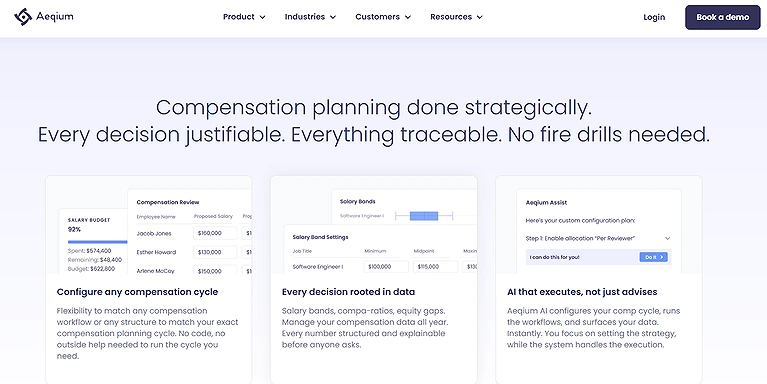
An image showing the Aeqium Official Source Page
What is Pave?
Pave is a real-time compensation operating ecosystem designed to centralise benchmarking, merit cycle workflows, and total rewards communication across data-heavy enterprise networks. It functions as an authoritative system of engagement, instantly integrating with HRIS, ATS, and equity platforms to eliminate lagging survey data.
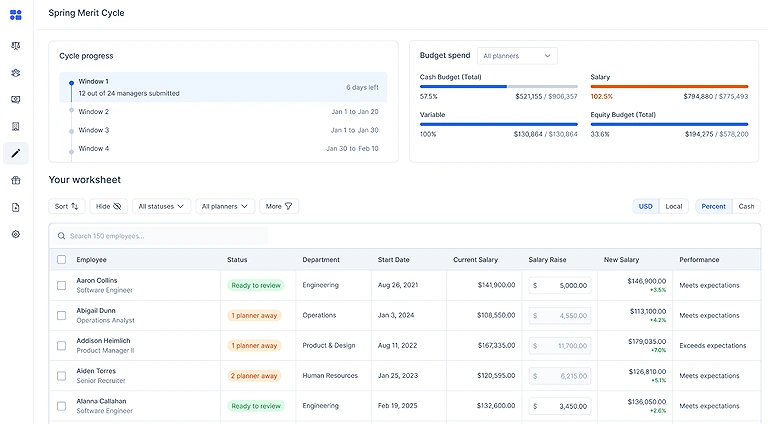
Pave Compensation Merit Cycle Workflows overview showing step-by-step merit review, compensation bands, and manager approval flows
Platform Architecture & Approach
Enterprise compensation platforms differ not only in the features they provide but also in how they are architected to support planning, governance, and decision-making. While both Aeqium and Pave modernize compensation management, they follow different design philosophies. Aeqium emphasizes enterprise planning workflows, governance, and configurable compensation operations, whereas Pave prioritizes real-time market intelligence and data-driven pay decisions. These architectural choices influence implementation effort, administrative overhead, scalability, and the day-to-day experience for compensation teams.
Core Architecture Comparison
| Area | Aeqium | Pave |
| Overall Architecture | Built as an enterprise compensation planning platform with configurable workflows, approval structures, and budgeting processes designed for complex organizations. | Built as a cloud-native compensation intelligence platform centered on salary benchmarking, market data, and compensation transparency. |
| Product Philosophy | Focuses on governing the entire compensation planning lifecycle, enabling organizations to manage merit cycles, promotions, bonuses, and pay decisions within structured workflows. | Focuses on helping organizations make competitive compensation decisions using continuously refreshed market data and benchmarking insights. |
| AI Architecture | AI supports compensation recommendations, anomaly detection, budget optimization, and decision assistance within enterprise planning workflows. Human oversight remains central. | AI primarily enhances compensation benchmarking, market salary recommendations, pay positioning, and analytical insights derived from compensation datasets. |
| Data Model | Organizes data around employees, compensation plans, budgets, organizational hierarchies, approval chains, and business rules, supporting enterprise governance. | Organizes data around compensation records, salary benchmarks, market datasets, job levels, and pay ranges to improve compensation intelligence. |
| Workflow Design | Highly configurable workflows allow organizations to adapt approval paths, compensation cycles, exceptions, and governance policies to internal processes. | Streamlined workflows prioritize compensation analysis and market benchmarking, with less emphasis on deeply customized enterprise approval processes. |
Experience & Enterprise Operations
| Area | Aeqium | Pave |
| User Experience | Designed primarily for compensation administrators, HR leaders, finance teams, and managers participating in structured planning cycles. | Provides a cleaner analytics-focused experience for compensation professionals seeking quick access to market insights and pay data. |
| Interface Complexity | More feature-rich interface reflecting enterprise planning requirements, governance controls, and configurable workflows. | Simpler interface focused on dashboards, benchmarking reports, and compensation analytics with fewer operational configuration layers. |
| Learning Curve | Moderate to high, particularly for administrators responsible for configuring compensation policies and approval workflows. | Lower learning curve due to its focused functionality and intuitive reporting experience. |
| Enterprise Scalability | Well suited for large global enterprises managing multiple business units, compensation programs, currencies, and governance requirements. | Scales effectively for growing organizations requiring reliable compensation intelligence, although governance capabilities are less extensive than dedicated planning platforms. |
| Deployment Methodology | Typically involves structured implementation, policy configuration, workflow design, security setup, and stakeholder alignment before production rollout. | Generally offers a faster deployment centered on importing compensation data, configuring benchmarking parameters, and integrating HR systems. |
Migration Considerations
Enterprise compensation platforms often become deeply embedded in HR, payroll, and financial planning processes, making migrations a strategic project rather than a simple software replacement. The effort required depends on compensation history, workflow complexity, integration dependencies, and change management requirements.
Migrating to Aeqium
Migration to Aeqium is typically more involved because organizations must map compensation plans, approval workflows, budgets, organizational hierarchies, and historical compensation data. Additional effort is usually required to configure enterprise policies, integrate HRIS and payroll systems, and train administrators on new planning processes.
Migrating to Pave
Migration to Pave is generally more straightforward when the primary objective is compensation benchmarking and market pricing. Employee compensation records, job architecture, and salary data are the main migration priorities, while workflow reconfiguration is typically less extensive than in enterprise planning platforms.
Better Choice: Pave
Why: Organizations seeking a faster implementation with lower migration complexity will generally find Pave easier to adopt. However, enterprises requiring sophisticated compensation governance and planning capabilities may accept Aeqium's longer migration process in exchange for greater long-term operational control.
Feature-by-Feature Comparison
1. Compensation Planning & Merit Cycles
Aeqium:
Built around enterprise compensation planning with configurable merit increases, bonus allocation, promotion reviews, approval workflows, and budget management. It supports complex planning cycles across multiple business units.
Pave:
Supports compensation planning with an emphasis on making informed pay decisions using market data, but its planning workflows are less configurable than dedicated enterprise compensation planning platforms.
Better Choice: Aeqium
Why: Aeqium provides deeper planning workflows, governance controls, and enterprise-grade compensation cycle management for large organizations.
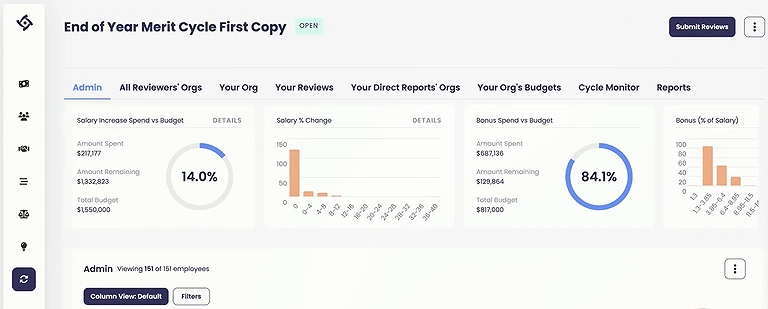
Image showing the Annual Year cycle of Aeqium because compensation planning shouldn't feel like reinventing the wheel every single year
2. Compensation Benchmarking & Market Intelligence
Aeqium:
Provides benchmarking capabilities through integrations and external compensation data sources, allowing organizations to incorporate market information into planning decisions.
Pave:
Market benchmarking is a core strength. The platform continuously delivers salary intelligence, compensation ranges, and competitive pay insights using extensive market datasets.
Better Choice: Pave
Why: Compensation benchmarking is one of Pave's primary differentiators, offering richer market intelligence and faster access to competitive salary data.
3. Compensation Governance & Approval Workflows
Aeqium:
Offers highly configurable approval chains, policy enforcement, role-based permissions, audit trails, and governance controls designed for enterprise compensation programs.
Pave:
Provides workflow support for compensation reviews but focuses more on collaboration and decision-making than deeply configurable governance processes.
Better Choice: Aeqium
Why: Organizations with strict approval requirements and complex compensation governance benefit from Aeqium's more mature workflow architecture.
4. Analytics & Compensation Insights
Aeqium:
Delivers dashboards focused on compensation budgets, pay distribution, planning progress, pay equity monitoring, and executive reporting throughout compensation cycles.
Pave:
Provides interactive analytics centered on salary benchmarking, market positioning, compensation trends, and pay competitiveness, enabling quicker strategic decisions.
Better Choice: Tie
Why: Aeqium excels in operational compensation analytics, while Pave leads in market-driven compensation intelligence. The better option depends on the organization's reporting priorities.
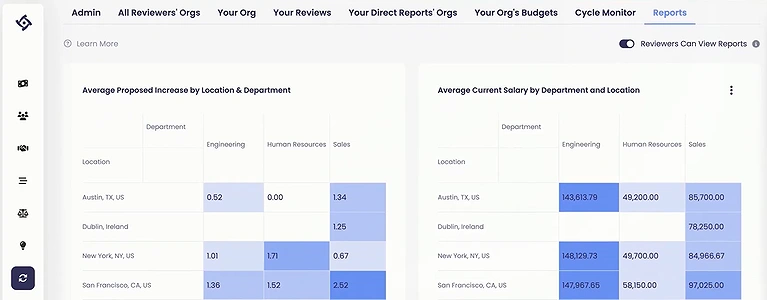
Aeqium Reports showing the Compensations Reports by department and location wise in visual form.
5. AI-Powered Compensation Intelligence
Aeqium:
Uses AI to support compensation recommendations, identify planning anomalies, optimize budget allocation, and assist administrators during compensation cycles while maintaining governance controls.
Pave:
Applies AI and machine learning to improve salary benchmarking, recommend competitive pay ranges, identify compensation outliers, and surface market trends from compensation data.
Better Choice: Tie
Why: Both platforms leverage AI effectively but toward different objectivesAeqium enhances enterprise planning and governance, whereas Pave strengthens market intelligence and compensation decision-making.
Tech Stack Integration & Ecosystem
Both Aeqium and Pave are designed to fit into enterprise HR technology environments rather than operate as standalone systems. They integrate with major HR platforms through APIs and secure authentication, but their priorities differ. Aeqium emphasizes end-to-end compensation planning within enterprise HR ecosystems, while Pave focuses on connecting compensation intelligence with HRIS data to deliver accurate market benchmarking and salary insights.
| Integration Area | Aeqium | Pave | Better Choice |
| HRIS | Strong integrations with leading enterprise HRIS platforms to synchronize employee, organizational, and compensation data. | Strong HRIS integrations for importing employee and compensation data used in benchmarking and planning. | Tie |
| ATS | Limited native ATS connectivity since recruiting is not its primary focus. | Limited ATS integrations, mainly supporting compensation workflows rather than recruitment. | Tie |
| CRM | No native CRM integrations, as the platform is focused on compensation management. | No native CRM functionality or dedicated CRM integrations. | Tie |
| API | Robust APIs enable enterprise data synchronization, workflow automation, and custom integrations. | Modern APIs support compensation data exchange and integration with HR technology stacks. | Tie |
| Webhooks | Supports automation and event-driven workflows through enterprise integration capabilities where required. | Supports integration automation, though webhook capabilities are less central than API-based synchronization. | Aeqium |
| Marketplace | Smaller partner ecosystem focused on HR and compensation platforms rather than a broad application marketplace. | Growing ecosystem of HR and compensation partners with an emphasis on benchmarking integrations. | Tie |
| Authentication | Enterprise authentication with role-based access controls and modern identity standards. | Enterprise-grade authentication supporting secure access management. | Tie |
| SSO | Supports enterprise Single Sign-On for centralized identity management. | Supports Single Sign-On with common enterprise identity providers. | Tie |
| Security | Enterprise security controls, granular permissions, audit trails, and governance features. | Enterprise-grade security with strong protection for compensation and salary data. | Tie |
| Developer Experience | Better suited for enterprises requiring customized integrations and workflow extensions. | Simpler integration experience focused on faster HRIS connectivity and compensation data synchronization. | Aeqium |
| Third-party Integrations | Broader flexibility for integrating with HRIS, payroll, finance, and enterprise planning systems. | Strong third-party connectivity centered on HRIS and compensation data providers. | Aeqium |
Which Organization Should Choose Which Platform?
| Business Scenario | Better Choice | Why |
| Startup | Pave | Faster deployment, intuitive compensation benchmarking, and market salary intelligence help startups establish competitive pay structures without complex planning processes. |
| SMB | Pave | SMBs typically benefit more from streamlined compensation management and real-time benchmarking than enterprise-grade governance capabilities. |
| Mid-market | Pave | Growing organizations can use Pave to scale compensation decisions while maintaining competitive pay practices with relatively low administrative overhead. |
| Enterprise | Aeqium | Large organizations require configurable compensation workflows, approval chains, budgeting, and governance that Aeqium is designed to support. |
| Global Enterprise | Aeqium | Better equipped for multinational compensation planning with complex organizational hierarchies, governance controls, and large-scale compensation cycles. |
| Healthcare | Aeqium | Healthcare organizations often require structured approval processes, compensation governance, and auditability across diverse employee groups. |
| Manufacturing | Aeqium | Supports enterprise compensation planning across multiple locations, business units, and layered management structures. |
| Technology | Pave | Technology companies frequently prioritize competitive salary benchmarking and rapid compensation adjustments to attract and retain talent. |
| Retail | Aeqium | Better suited for managing compensation across large distributed workforces with structured planning and budget controls. |
| Financial Services | Aeqium | Strong governance, approval workflows, and audit capabilities align well with regulated compensation environments. |
| Government | Aeqium | Public-sector organizations generally require rigorous governance, standardized approval processes, and comprehensive reporting. |
| Education | Pave | Educational institutions seeking market-aligned compensation without highly complex planning processes may benefit from Pave's benchmarking capabilities. |
| Internal Mobility | Aeqium | Better supports compensation adjustments related to promotions, transfers, and career progression through configurable planning workflows. |
| High-volume Hiring | Neither | Neither platform is designed for recruiting or applicant management; both focus on compensation management after hiring decisions are made. |
| Executive Hiring | Pave | Executive compensation decisions often depend heavily on competitive market benchmarking, where Pave's compensation intelligence provides strong support. |
Real-World Use Cases
| Business Situation | Recommended Platform | Business Justification |
| A multinational enterprise is preparing its annual merit and bonus cycle across multiple regions and business units. | Aeqium | Its configurable compensation planning workflows, approval chains, and budget controls help manage complex enterprise compensation programs consistently. |
| A fast-growing technology company wants to ensure its salary ranges remain competitive in a highly dynamic talent market. | Pave | Continuous market benchmarking and compensation intelligence enable faster adjustments to changing salary expectations. |
| A large organization wants finance, HR, and business leaders to collaborate on compensation budgets while maintaining governance. | Aeqium | Centralized planning, role-based approvals, and structured workflows improve collaboration without sacrificing policy compliance. |
| A scaling company is redesigning its compensation philosophy and needs reliable market data to establish new salary bands. | Pave | Comprehensive compensation benchmarking helps create market-aligned pay structures backed by current salary intelligence. |
| A regulated financial institution requires complete audit trails and controlled approval processes for compensation decisions. | Aeqium | Enterprise governance, configurable approval workflows, and audit capabilities support compliance and internal controls. |
| An organization wants to identify employees whose compensation has fallen below market rates to improve retention. | Pave | Market intelligence makes it easier to detect pay gaps and prioritize compensation adjustments before retention risks increase. |
| A global enterprise is standardizing compensation planning after multiple mergers and acquisitions. | Aeqium | Flexible workflow configuration and centralized compensation governance support consistent planning across newly integrated business units. |
| An HR leadership team needs executive-ready reports showing market competitiveness alongside internal compensation trends before annual budget planning. | Pave | Interactive analytics and benchmarking dashboards provide decision-makers with clear compensation insights for strategic planning. |
Pricing Comparison: Which Offers Better ROI?
Pave structures its contract pricing through modular subscription tiers scaled by active employee counts, with average annual investments ranging from $15,000 for mid-market orgs to over $90,000 for complex enterprise tiers. Implementation fees are billed separately, ranging from $5,000 to $25,000 depending on cap table complexity.
Aeqium features a simplified annual subscription fee inclusive of unlimited customization, unrestricted data integrations, and dedicated account support, eliminating hidden setup charges. Analysis of procurement cycles shows Pave requires longer sales negotiation runways due to its modular architecture, whereas Aeqium's rapid proof-of-concept configuration shortens administrative evaluation hurdles.
The Strategic Trade-Offs
Aeqium Pros
- Supports highly configurable compensation planning for complex enterprise environments.
- Provides structured approval workflows with strong governance and audit capabilities.
- Aligns compensation planning with budgeting and financial oversight.
- Handles merit increases, bonuses, promotions, and pay adjustments within a unified workflow.
- Scales well across global organizations with multiple business units and approval hierarchies.
- Offers granular role-based permissions for HR, finance, executives, and managers.
- Delivers enterprise-focused analytics for compensation planning progress and budget utilization.
- Flexible enough to adapt to organization-specific compensation policies and review cycles.
Aeqium Cons
- Implementation typically requires more planning, configuration, and stakeholder involvement.
- Rich functionality can result in a steeper learning curve for administrators.
- Compensation benchmarking relies on external market data rather than being the platform's primary strength.
- Smaller ecosystem and market presence compared to some long-established HR platforms.
- May provide more governance capabilities than smaller organizations actually require.
- Initial setup of workflows and compensation policies can be time-intensive.
- Organizations seeking only salary benchmarking may not fully utilize the platform's broader capabilities.
Pave Pros
- Delivers high-quality market compensation benchmarking using continuously updated salary data.
- Enables organizations to make competitive pay decisions with real-time market insights.
- Faster implementation due to its focused compensation intelligence approach.
- User-friendly interface with a relatively short learning curve.
- Strong analytics and dashboards for salary positioning and compensation trends.
- Supports compensation transparency initiatives with clear market-based reporting.
- Well suited for fast-growing companies adapting compensation strategies in competitive hiring markets.
- Helps HR teams respond quickly to changing salary expectations.
Pave Cons
- Less comprehensive for enterprise-wide compensation planning and governance.
- Approval workflows are less configurable than dedicated compensation planning platforms.
- Limited support for complex budgeting and enterprise compensation cycle management.
- Organizations with highly customized compensation processes may require additional manual work.
- Not designed as a complete workforce planning or financial planning platform.
- Fewer governance controls for organizations operating in heavily regulated environments.
- Enterprises with intricate approval hierarchies may outgrow its workflow capabilities.
Final Recommendation: Aeqium vs Pave
Choose Aeqium If...
- You manage a dynamic mid-market or rapid-growth team with highly customized, multi-tiered bonus calculations that rigid HR software cannot compute.
- You do not want to allocate engineering budget or extensive administrative hours toward configuring software platforms.
- You need built-in, regression-based audit analytics to guarantee pay parity compliance continuously.
Choose Pave If...
- You are an equity-heavy enterprise requiring live, real-time tracking of equity values against market fluctuations.
- Your top talent strategy relies on continuous access to verified tech sector salary benchmarks to mitigate retention risks.
- Your recruiting team requires dynamic total rewards portal visualizations to win competitive hiring situations.
Alternative Platforms to Consider
| Alternative Platform | Core Best For |
CaptivateIQ | Best for mid-market and enterprise teams needing automated sales commission management, incentive compensation tracking, and flexible commission modeling. |
Salary.com | Best for organizations requiring compensation benchmarking, salary data intelligence, pay equity analysis, and market pay structure insights. |
To keep your offer data supported by consistent, high-quality applicant volume, review our definitive guide to 10 Best AI Tools for Smarter & Faster Talent Acquisition.
Future Roadmap / Innovation Direction
- Vendor Innovation Pace: Pave has demonstrated a faster pace of product evolution, frequently expanding its compensation intelligence capabilities and refining market data features. Aeqium follows a more measured release cycle, emphasizing stability, enterprise governance, and planning enhancements over rapid feature expansion.
- AI Investment: Both platforms are increasing AI investment, but with different priorities. Aeqium focuses on AI-assisted compensation planning, budget optimization, anomaly detection, and governance support, while Pave invests more heavily in AI-powered market benchmarking, salary recommendations, and compensation intelligence.
- Product Vision: Aeqium's long-term vision centers on becoming a comprehensive enterprise compensation planning platform that integrates HR, finance, and compensation governance into a unified planning process. Pave aims to become the leading compensation intelligence platform by helping organizations make market-informed, transparent pay decisions.
- Ecosystem Expansion: Aeqium is expected to deepen integrations with enterprise HRIS, payroll, finance, and workforce planning systems to strengthen compensation operations. Pave continues expanding partnerships across HR technology and compensation data providers, broadening the reach of its benchmarking ecosystem.
- Enterprise Readiness Over Time: Aeqium is likely to continue adding governance, automation, and scalability features for large global organizations. Pave is expected to strengthen enterprise capabilities while preserving the simplicity and speed that appeal to growing and mid-market businesses.
- Overall Innovation Direction: Neither platform is innovating in exactly the same direction. Aeqium prioritizes enterprise compensation operations and governance, whereas Pave concentrates on advancing compensation intelligence, market transparency, and AI-driven salary decision support. The better long-term fit depends on whether an organization values operational control or data-driven compensation strategy.
Frequently Asked Questions
Is Aeqium better than Pave for enterprise compensation planning?
Aeqium is generally the stronger choice for enterprise compensation planning because it offers configurable approval workflows, budgeting, governance, and compensation cycle management. Pave is better suited for organizations whose primary priority is market salary benchmarking rather than end-to-end planning.
Which platform provides better compensation benchmarking?
Pave has the advantage in compensation benchmarking. Its continuously updated market salary data and compensation intelligence help organizations establish competitive pay ranges and make data-driven compensation decisions.
Can Aeqium and Pave integrate with existing HRIS platforms?
Yes. Both platforms integrate with leading HRIS solutions to synchronize employee and compensation data. Aeqium places greater emphasis on enterprise planning workflows, while Pave focuses on importing accurate compensation data for benchmarking and analytics.
Which platform is easier to implement?
Pave is typically easier and faster to implement because of its focused compensation intelligence approach. Aeqium usually requires additional planning to configure workflows, governance policies, approval chains, and enterprise compensation processes.
Is Aeqium or Pave better for global enterprises?
Aeqium is generally a better fit for global enterprises with complex organizational structures, multiple business units, and sophisticated compensation governance requirements. Pave is well suited for global companies that primarily need market-driven compensation insights.
Does either platform support pay equity analysis?
Both platforms support pay equity initiatives, but they approach them differently. Aeqium incorporates pay equity into enterprise compensation planning and governance, while Pave uses benchmarking and compensation analytics to identify pay disparities against market standards.
Which platform offers stronger compensation governance?
Aeqium provides stronger governance through configurable approval workflows, role-based permissions, audit trails, and policy enforcement. These capabilities make it better suited for organizations with strict compliance and approval requirements.
Is Pave suitable for large enterprises?
Yes. Pave supports enterprise organizations, especially those seeking advanced compensation benchmarking and salary intelligence. However, enterprises requiring highly configurable planning workflows and governance may find Aeqium a better fit.
Which platform uses AI more effectively?
Both platforms leverage AI, but for different purposes. Aeqium applies AI to compensation planning, budget optimization, and anomaly detection, while Pave focuses AI on salary recommendations, market intelligence, and compensation benchmarking.
Can either platform replace workforce planning software?
No. Neither Aeqium nor Pave is a dedicated workforce planning platform. Aeqium aligns compensation planning with workforce budgets more closely, while Pave specializes in compensation intelligence rather than enterprise workforce planning.
Which industries benefit most from Aeqium and Pave?
Aeqium is particularly well suited for industries such as financial services, healthcare, manufacturing, retail, and other large enterprises with complex compensation governance. Pave is especially popular among technology companies and fast-growing organizations that rely on competitive market compensation.
How should organizations choose between Aeqium and Pave?
Organizations should first determine whether their biggest challenge is compensation planning or compensation intelligence. If structured planning, governance, and approval workflows are the priority, Aeqium is the stronger option. If competitive salary benchmarking and market-driven pay decisions are more important, Pave is the better choice.
Conclusion
Aeqium and Pave approach compensation management from different strategic perspectives. Aeqium emphasizes structured compensation planning, governance, budgeting, and enterprise-scale workflows, making it well suited for large organizations with complex approval processes and global compensation programs. Pave, by contrast, excels in market compensation intelligence, helping organizations make competitive, data-driven pay decisions with greater speed and simplicity. Neither platform is inherently better; the right choice depends on your organization's priorities. Enterprises seeking operational control and governance should lean toward Aeqium, while companies prioritizing salary benchmarking and compensation transparency may benefit more from Pave. Ultimately, choose the platform that best supports your long-term compensation strategy, organizational complexity, and future growth objectives.