.webp)
Eightfold AI vs Beamery: Which Platform Is Better for Talent Intelligence in 2026 ?
Somewhere right now, a Talent Acquisition leader is staring at three browser tabs, a spreadsheet named "final_v3_ACTUAL," and an ATS that still thinks "data integration" means exporting a CSV. Sound familiar? You're not bad at your job your stack is just fighting you.
Enter the two platforms everyone in enterprise TA keeps whispering about in 2026: Eightfold AI and Beamery. Both promise to fix the chaos. Both claim to be "the" talent intelligence platform. Naturally, they can't both be right or can they?
Here's the twist: they're not actually competing for the same job. Eightfold AI plays chess skills-first intelligence, automated matching, quietly surfacing hidden internal talent before you even think to look. Beamery plays relationships a fully customizable CRM built for sourcing teams who treat passive candidates like a long game, not a cold email.
So if you're a Global TA Leader, HR Ops Executive, or a Mid-Market CTO trying to pick a side good news. You don't have to guess. Let's break down exactly which one actually wins for how your team works.

 Updated: May 29, 2026 | 23 min read
 Key Takeaways
- Best For: Eightfold AI is best for large enterprises prioritizing AI-driven talent intelligence, internal mobility, and workforce planning, while Beamery is better suited for organizations focused on candidate relationship management, recruitment marketing, and long-term talent engagement.
- Biggest Strength: Eightfold AI stands out with its advanced skills intelligence and predictive AI that powers talent matching and workforce planning. Beamery excels in candidate CRM, talent nurturing, and recruitment marketing automation.
- Biggest Limitation: Eightfold AI typically requires a longer implementation process and significant organizational data to maximize its AI capabilities. Beamery offers less depth in predictive talent intelligence and internal mobility compared to AI-first platforms.
- AI Capability: Eightfold AI delivers deeper AI functionality through skills inference, talent matching, career path recommendations, and workforce intelligence. Beamery applies AI primarily to candidate engagement, sourcing optimization, and recruitment workflows.
- Ease of Implementation: Beamery generally provides a faster and more modular deployment, while Eightfold AI often involves a more extensive implementation due to complex HRIS integrations and AI model configuration.
- Enterprise Readiness: Both platforms are built for enterprise environments, but Eightfold AI is particularly strong for global organizations managing large workforces and complex talent strategies. Beamery is ideal for enterprises with mature talent acquisition and employer branding programs.
- Internal Mobility: Eightfold AI is the stronger choice thanks to its skills graph, career path recommendations, succession planning, and employee reskilling capabilities. Beamery supports internal talent initiatives but is primarily designed around external talent engagement.
- Candidate CRM: Beamery leads with robust candidate relationship management, personalized engagement campaigns, talent communities, and recruitment marketing automation. Eightfold AI includes CRM capabilities but focuses more on intelligent talent matching than long-term candidate nurturing.
- Workforce Planning: Eightfold AI provides more advanced workforce planning through predictive skills analysis, talent forecasting, and organizational capability insights. Beamery offers workforce analytics but emphasizes recruiting pipeline management over enterprise workforce planning.
- Overall Recommendation: Choose Eightfold AI if your organization values AI-powered talent intelligence, internal mobility, and strategic workforce planning. Choose Beamery if your priority is building strong talent pipelines, improving candidate engagement, and optimizing recruitment marketing at enterprise scale.
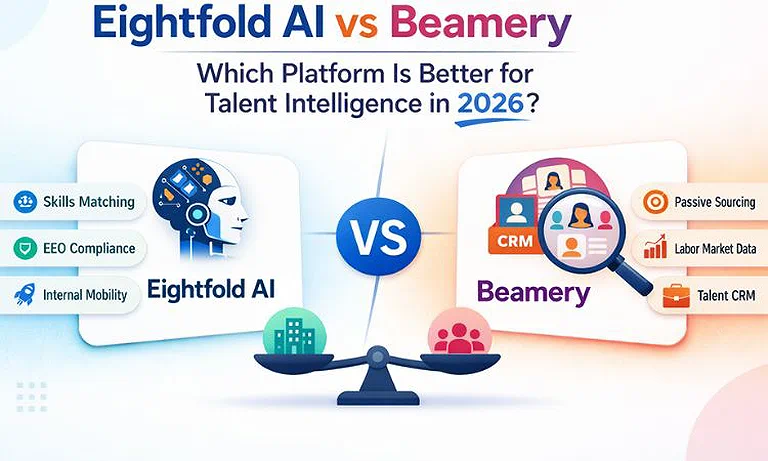
Cover Photo Eightfold AI vs Beamery: Which Platform Is Better for Talent Intelligence in 2026?
Quick Comparison: Eightfold AI vs Beamery at a Glance
| Evaluation Category | Eightfold AI | Beamery |
| Core Focus | AI-native talent intelligence platform focused on skills-based hiring, internal mobility, workforce planning, and talent optimization. | Talent lifecycle platform centered on candidate relationship management (CRM), recruitment marketing, talent engagement, and pipeline development. |
| Primary Users | Enterprise HR leaders, talent intelligence teams, workforce planners, internal mobility managers, and global TA organizations. | Talent acquisition teams, recruitment marketers, sourcing specialists, employer branding teams, and CRM-focused recruiters. |
| Best Company Size | Large enterprises and Fortune 1000 organizations managing thousands of employees across multiple regions. | Mid-sized to large enterprises with high-volume recruiting needs and long-term candidate engagement strategies. |
| Deployment Model | Cloud-based SaaS platform requiring deep HRIS, ATS, and enterprise data integrations. | Cloud-based SaaS platform with modular deployment and phased implementation options. |
| Workflow Flexibility | AI-driven workflows supporting talent matching, career pathing, succession planning, and workforce transformation. | Highly configurable recruiting workflows for sourcing, talent nurturing, campaign management, and candidate engagement. |
| AI Capability | Advanced AI with skills inference, talent matching, career recommendations, workforce intelligence, and predictive analytics. | AI-assisted candidate matching, engagement scoring, sourcing recommendations, and recruitment marketing optimization. |
| Automation | Automates talent discovery, internal mobility recommendations, skills mapping, and workforce planning processes. | Automates candidate nurturing, personalized communications, campaign workflows, and recruiting pipeline management. |
| Analytics | Predictive workforce analytics, skills intelligence dashboards, talent gap analysis, and organizational planning insights. | Recruitment analytics, campaign performance metrics, pipeline health reporting, and candidate engagement insights. |
| Customization | Extensive enterprise configuration tailored to organizational structures, AI models, and workforce strategies. | Flexible CRM customization with configurable pipelines, workflows, campaigns, and reporting dashboards. |
| Integration Ecosystem | Strong integrations with major HRIS, ATS, HCM, and enterprise platforms, supported by secure APIs. | Broad integrations with ATS, HRIS, CRM, communication platforms, and marketing technologies through open APIs. |
| Learning Curve | Moderate to high due to advanced AI capabilities, enterprise workflows, and data-driven configuration. | Moderate, with a user-friendly CRM interface that is generally easier for recruiting teams to adopt. |
| Time to Value | Longer implementation, typically delivering maximum value after enterprise data integration and AI model optimization. | Faster time to value through modular deployment and quicker recruiter adoption. |
| Scalability | Designed for global enterprises managing complex workforces, multiple business units, and millions of talent records. | Highly scalable for enterprise recruiting organizations managing large candidate databases and hiring campaigns. |
| Security | Enterprise-grade security with role-based access controls, encryption, and support for global security standards. | Enterprise-level security featuring role-based permissions, secure cloud infrastructure, and data protection controls. |
| Compliance | Supports enterprise compliance requirements, including GDPR, EEO initiatives, and regional data governance standards. | Supports GDPR and enterprise privacy requirements with governance controls for candidate and recruitment data. |
| Customer Support | Enterprise onboarding, implementation specialists, technical support, and customer success management. | Dedicated enterprise support, implementation consultants, customer success teams, and onboarding resources. |
| Pricing Model | Custom enterprise subscription based on organization size, platform modules, and implementation scope. | Custom enterprise pricing based on user volume, platform modules, and recruiting requirements. |
| Overall Score | 9.4 / 10 – Best for AI-driven talent intelligence, workforce planning, and internal mobility. | 9.1 / 10 – Best for candidate CRM, recruitment marketing, and enterprise talent engagement. |
What is Eightfold AI?
Eightfold AI is an industry-leading, AI-native Talent Intelligence Platform built to optimize the full employee lifecycle via a skills-first approach using billions of global data points. Its primary Ideal Customer Profile (ICP) consists of global Fortune 500 enterprises requiring advanced internal mobility and bias-mitigated recruitment. To see how its core platform handles high volume, read our comprehensive Eightfold AI Review 2026 for a complete feature breakdown.
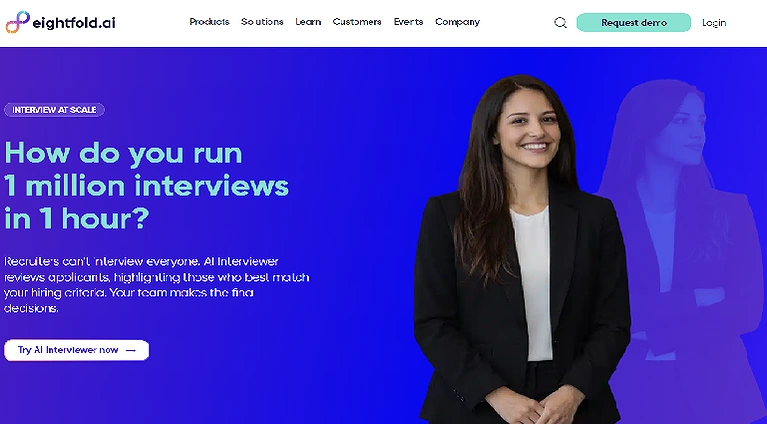
Eightfold AI Official image
What is Beamery?
Beamery is an enterprise Talent Life cycle Management platform designed around an advanced Talent CRM and its proprietary Knowledge Graph to unify internal data with global market trends. Its true ICP points directly to proactive corporate recruiting teams prioritising relationship-driven passive pipelines and highly structured outbound marketing campaigns.
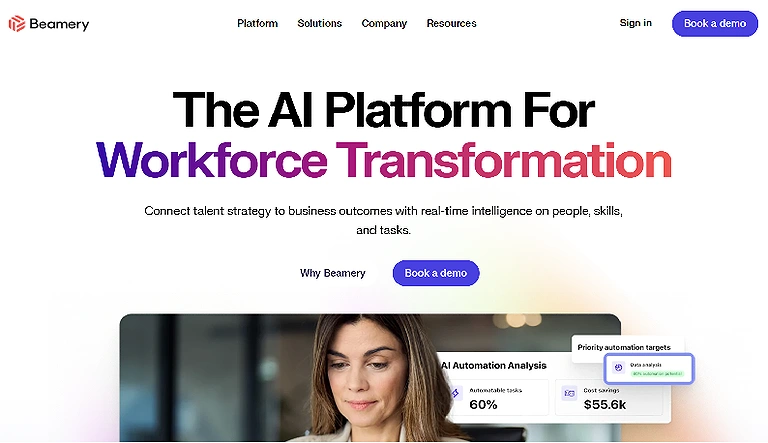
Beamery Official source image
Platform Architecture & Approach
Although both platforms support enterprise talent acquisition, they are built on fundamentally different architectural philosophies. Eightfold AI is designed as an AI-native talent intelligence platform where machine learning and skills data drive nearly every workflow. Beamery, by contrast, is built around talent relationship management, focusing on candidate engagement, recruitment marketing, and centralized talent data. These architectural differences influence how organizations implement each platform, manage recruiting operations, and prioritize long-term talent strategies.
Overall Architecture
Eightfold AI
Eightfold AI is built as a cloud-native Talent Intelligence Platform that connects with existing HR systems to create a unified skills ecosystem. It continuously analyzes employee and candidate data to support hiring, internal mobility, career development, and workforce planning across the organization.
Beamery
Beamery follows a modular cloud architecture centered on Talent CRM and Talent Lifecycle Management. It unifies candidate, employee, and labor market data into a centralized platform designed to improve sourcing, engagement, recruiting campaigns, and talent pipeline management.
Product Philosophy
Eightfold AI
Eightfold AI follows a skills-first philosophy, where hiring and workforce decisions are based on demonstrated capabilities and potential rather than traditional job titles or resumes. Its objective is to help organizations maximize existing talent while improving long-term workforce planning.
Beamery
Beamery emphasizes a relationship-first philosophy, enabling organizations to build meaningful candidate relationships throughout the talent lifecycle. The platform focuses on maintaining engagement with prospective candidates before, during, and after active hiring processes.
AI Architecture
Eightfold AI
Artificial intelligence is the foundation of Eightfold AI. Machine learning models continuously infer skills, recommend career paths, identify internal mobility opportunities, predict talent gaps, and improve candidate-job matching as new workforce data becomes available.
Beamery
Beamery incorporates AI to enhance recruiting efficiency through candidate recommendations, engagement scoring, campaign optimization, and talent discovery. Rather than driving every workflow, AI primarily supports recruiting and relationship management activities.
Data Model
Eightfold AI
The platform organizes data around a dynamic skills graph that connects employees, candidates, jobs, projects, and organizational capabilities. This skills-based data model enables workforce intelligence beyond traditional recruiting.
Beamery
Beamery uses a unified talent data model that combines CRM information, candidate interactions, recruiting activities, and external labor market insights to create comprehensive talent profiles and engagement histories.
Workflow Design
Eightfold AI
Workflows are designed to support continuous talent intelligence across hiring, internal mobility, learning, succession planning, and workforce planning. AI recommendations are integrated throughout each stage of the employee lifecycle.
Beamery
Beamery structures workflows around recruiting operations, including sourcing, candidate nurturing, campaign management, interview coordination, and long-term relationship building with prospective talent.
User Experience
Eightfold AI
The interface prioritizes data-driven decision making with dashboards, AI recommendations, skills insights, and workforce analytics. Recruiters, HR leaders, and managers receive personalized recommendations based on their responsibilities.
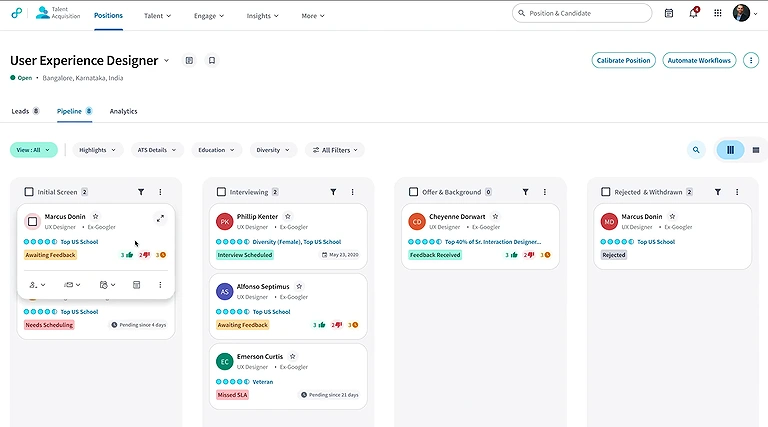
Eightfold user experience pipeline showing automated scheduling status, active applications, and milestone progression tracking.
Beamery
Beamery offers an interface designed for daily recruiting activities, making it easier for sourcing teams to manage candidate pipelines, communications, events, and recruitment marketing campaigns from a centralized workspace.
Interface Complexity
Eightfold AI
Because of its broad workforce intelligence capabilities, the platform presents a more information-rich interface that may require additional training for administrators and HR teams responsible for strategic workforce management.
Beamery
Beamery generally offers a more streamlined recruiting interface focused on candidate engagement and pipeline management, making routine recruiting activities easier to navigate for talent acquisition teams.
Learning Curve
Eightfold AI
Organizations typically invest more time in onboarding due to the platform's advanced AI capabilities, skills framework, and enterprise-wide talent management functionality.
Beamery
Recruiters and sourcing specialists often become productive more quickly because workflows align closely with traditional CRM and recruitment marketing processes.
Enterprise Scalability
Eightfold AI
The platform is designed to support multinational enterprises with large workforces, multiple business units, and complex organizational structures, making it suitable for long-term workforce transformation initiatives.
Beamery
Beamery also scales effectively across global organizations, particularly those managing high-volume recruiting, employer branding, and extensive candidate relationship programs across multiple regions.
Deployment Methodology
Eightfold AI
Deployment typically involves phased implementation with extensive integration into HRIS, ATS, identity management, and workforce data sources. AI models become increasingly valuable as organizational data matures.
Beamery
Beamery generally follows a modular deployment approach, allowing organizations to implement recruiting and CRM capabilities incrementally while integrating with existing HR technology through APIs and prebuilt connectors.
User Experience, Setup & Deployment
While both platforms are designed for enterprise organizations, the post-purchase experience differs significantly. Eightfold AI requires a more strategic implementation because its AI models rely on high-quality workforce data and deep system integrations. Beamery generally offers a faster rollout centered on recruiting workflows and candidate relationship management. Understanding these operational differences helps organizations set realistic expectations for deployment, adoption, and ongoing administration.
Initial Setup
Eightfold AI
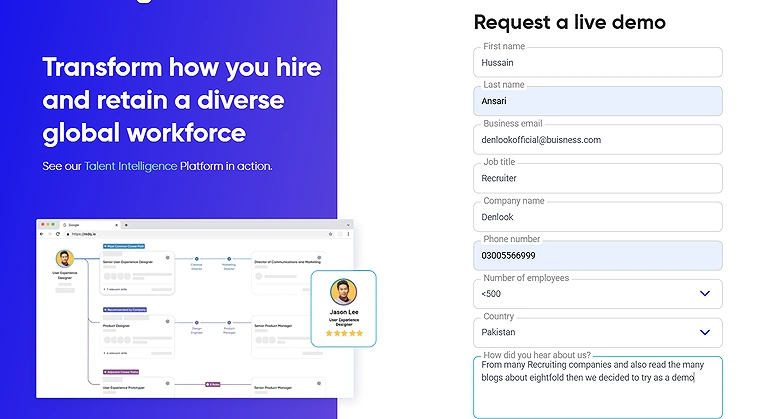
Before Initial setup start first user need to create account then begins with connecting HRIS, ATS, identity management, and other workforce systems. Organizations often spend considerable time preparing and validating historical workforce data to ensure AI models can generate meaningful recommendations from the start.
Beamery
Beamery's setup focuses primarily on configuring recruiting workflows, talent pipelines, communication channels, and CRM processes. Since it is centered on talent acquisition, implementation is often more straightforward for recruiting teams.
Implementation Timeline
Eightfold AI
Enterprise deployments generally follow a phased implementation approach. Depending on organizational size, system complexity, and data readiness, implementation may take several weeks before all AI-driven capabilities are fully operational.
Beamery
Beamery is commonly deployed in phases, allowing organizations to launch core recruiting and CRM capabilities first before expanding to additional modules. This approach often enables faster operational adoption.
Admin Experience
Eightfold AI
Platform administrators are responsible for managing integrations, permissions, AI configuration, organizational structures, and workforce data quality. The administrative experience is comprehensive and typically suited to experienced HR technology teams.
Beamery
Administrators primarily manage recruiting workflows, candidate pipelines, communication campaigns, permissions, and CRM configurations. Daily administration is generally more focused on talent acquisition operations than enterprise workforce management.
User Onboarding
Eightfold AI
HR teams, recruiters, managers, and employees may each require role-specific onboarding because the platform supports multiple talent management processes. Organizations often provide structured training to help users understand AI-driven recommendations and workflows.
Beamery
Recruiters and sourcing teams can usually become productive relatively quickly since the platform follows familiar CRM and recruiting concepts. Training often emphasizes campaign management, candidate engagement, and recruiting workflows.
Interface Usability
Eightfold AI
The interface emphasizes workforce intelligence through dashboards, AI recommendations, skills insights, and talent analytics. Although information-rich, navigation becomes more intuitive as users gain experience with the platform.
Beamery
Beamery offers a clean and organized interface designed around recruiting activities. Recruiters can efficiently manage candidate pipelines, communications, and sourcing campaigns through centralized dashboards.
Learning Curve
Eightfold AI
The learning curve is moderate to high because users must understand skills-based talent intelligence, AI recommendations, and enterprise workforce planning concepts in addition to standard recruiting workflows.
Beamery
Most recruiting professionals adapt more quickly due to the platform's familiar CRM-style workflows and candidate-centric interface, resulting in a shorter learning period for day-to-day users.
Configuration Flexibility
Eightfold AI
The platform provides extensive configuration options to align with enterprise organizational structures, workforce planning strategies, security policies, and AI-driven talent processes. This flexibility supports complex global organizations but typically requires careful planning.
Beamery
Beamery offers flexible configuration for recruiting pipelines, talent communities, communication workflows, forms, and automation rules. Organizations can tailor recruiting operations without significantly altering broader HR processes.
Implementation Complexity
Eightfold AI
Implementation is generally more complex because success depends on integrating multiple enterprise systems and ensuring workforce data quality. Cross-functional collaboration between HR, IT, and implementation partners is often necessary.
Beamery
Implementation complexity is usually lower since the platform focuses primarily on recruiting and talent engagement. Existing ATS and HR systems can often remain in place while Beamery enhances recruitment workflows.
Typical IT Involvement
Eightfold AI
IT teams are typically involved throughout implementation to manage integrations, identity management, security policies, data governance, and enterprise infrastructure. Ongoing collaboration between HR and IT is common in larger deployments.
Beamery
IT involvement is generally concentrated during initial integrations and security configuration. Once deployed, recruiting and talent acquisition teams can manage many operational activities with limited day-to-day IT support.
Adoption Challenges
Eightfold AI
Organizations may face challenges related to data quality, change management, and helping users understand AI-generated recommendations. Successful adoption often depends on executive sponsorship, structured training, and clearly defined workforce transformation goals.
Beamery
The primary adoption challenge is encouraging recruiting teams to fully embrace CRM-driven recruiting practices and consistently maintain candidate engagement activities. Organizations with established recruiting processes typically experience a smoother transition.
The Core Feature Showdown
AI Matching & Talent Intelligence
Eightfold AI
Eightfold AI uses a skills-first AI engine to evaluate candidates beyond keywords by analyzing skills, career progression, adjacent capabilities, and workforce potential. Its recommendations continuously improve as more organizational data becomes available, helping recruiters identify qualified candidates who may be overlooked by traditional matching methods.
Beamery
Beamery applies AI to improve talent discovery and candidate recommendations within its CRM environment. Its AI helps recruiters prioritize prospects, identify relevant candidates, and improve sourcing efficiency, but its intelligence primarily supports recruiting workflows rather than enterprise-wide talent optimization.
Winner: Eightfold AI
Why: Eightfold AI delivers deeper talent intelligence through predictive skills analysis and AI-driven workforce recommendations that extend beyond recruiting.
Candidate Screening
Eightfold AI
The platform automatically ranks candidates based on inferred skills, career potential, and organizational fit, reducing manual resume review while supporting skills-based hiring initiatives.
Beamery
Beamery assists recruiters with AI-powered candidate recommendations and engagement insights but relies more heavily on existing recruiting workflows and recruiter decisions during screening.
Winner: Eightfold AI
Why: Its screening process is driven by predictive skills intelligence rather than primarily supporting recruiter-led evaluation.
Talent CRM & Candidate Engagement
Eightfold AI
Eightfold AI includes candidate relationship capabilities that support ongoing communication and talent rediscovery, but CRM is not the platform's primary focus.
Beamery
Beamery is built around enterprise Talent CRM, enabling organizations to nurture candidates through personalized communication, talent communities, automated campaigns, and long-term relationship management.
Winner: Beamery
Why: Candidate relationship management is one of Beamery's core platform strengths.
Recruitment Marketing
Eightfold AI
Recruitment marketing features support employer branding and candidate outreach but are secondary to the platform's broader talent intelligence capabilities.
Beamery
Beamery provides sophisticated recruitment marketing tools for creating campaigns, segmenting talent pools, automating outreach, and measuring candidate engagement across multiple channels.
Winner: Beamery
Why: The platform offers a more mature recruitment marketing ecosystem for attracting and nurturing talent.
Internal Mobility
Eightfold AI
Internal mobility is a core capability. The platform recommends career paths, identifies employees for new opportunities, supports succession planning, and helps organizations retain talent through skills-based career development.
Beamery
Beamery includes internal talent features but remains primarily focused on external recruiting and candidate relationship management rather than enterprise-wide workforce mobility.
Winner: Eightfold AI
Why: Internal mobility is deeply integrated into Eightfold AI's skills-first platform architecture.
Skills Intelligence
Eightfold AI
The platform continuously builds a dynamic skills graph by analyzing workforce capabilities, adjacent skills, and career progression to support hiring and workforce planning decisions.
Beamery
Beamery maintains rich candidate profiles and knowledge graphs but places greater emphasis on engagement history than comprehensive enterprise skills intelligence.
Winner: Eightfold AI
Why: Skills intelligence is one of the platform's defining capabilities.
Workforce Planning
Eightfold AI
Eightfold AI provides predictive workforce planning through skills analysis, talent forecasting, succession planning, and organizational capability insights that support long-term strategic planning.
Beamery
Beamery offers workforce reporting related to recruiting activities but is not designed as a dedicated workforce planning platform.
Winner: Eightfold AI
Why: It delivers broader workforce intelligence for strategic HR decision-making.
Analytics & Reporting
Eightfold AI
Analytics focus on workforce intelligence, skills gaps, internal mobility, hiring outcomes, and talent forecasting through AI-powered dashboards.
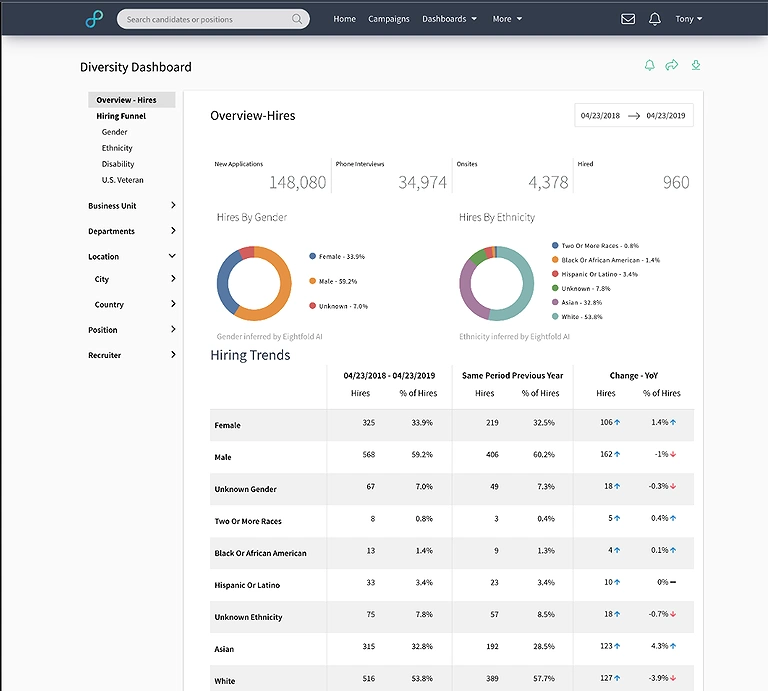
Eightfold analytics dashboard showcasing recruitment pipelines, application volume, and gender diversity distribution metrics.
Beamery
Beamery emphasizes recruiting analytics, campaign performance, sourcing effectiveness, pipeline health, and candidate engagement metrics that help optimize talent acquisition activities.
Winner: Eightfold AI (for enterprise workforce intelligence)
Why: Eightfold AI provides broader strategic analytics, while Beamery excels specifically in recruiting performance reporting.
Automation
Eightfold AI
Automation supports candidate matching, career recommendations, skills inference, workforce planning, and internal talent movement through AI-driven decision support.
Beamery
Beamery automates candidate nurturing, communication workflows, recruitment campaigns, interview coordination, and talent pipeline management.
Winner: Beamery
Why: Beamery offers stronger automation for day-to-day recruiting operations and candidate engagement.
Search & Talent Discovery
Eightfold AI
Recruiters can search talent using skills, career potential, adjacent capabilities, and AI-generated recommendations, making it easier to discover qualified candidates across internal and external talent pools.
Beamery
Beamery provides flexible candidate search across CRM data, talent communities, and sourcing pipelines with AI-assisted recommendations to improve recruiter productivity.
Winner: Eightfold AI
Why: AI-powered skills inference enables more intelligent talent discovery beyond traditional keyword searches.
Compliance & Enterprise Security
Eightfold AI
The platform supports enterprise governance with role-based permissions, data protection controls, privacy compliance, and responsible AI practices designed for large global organizations.
Beamery
Beamery also provides enterprise-grade security, privacy controls, and compliance capabilities while supporting global recruiting operations and candidate data governance.
Winner: Eightfold AI (slight advantage)
Why: Organizations with strong AI governance and workforce intelligence requirements may benefit from its broader enterprise compliance capabilities.
Customization & Integrations
Eightfold AI
Organizations can configure AI models, workflows, organizational structures, and enterprise integrations to support complex global HR operations.
Beamery
Beamery offers extensive customization for recruiting workflows, CRM processes, talent communities, dashboards, and integrations through flexible APIs.
Winner: Beamery
Why: Recruiting teams generally have greater flexibility to tailor CRM workflows and engagement processes without significantly increasing implementation complexity.
We provide you the streamlined comparison which covers the capabilities that genuinely influence purchasing decisions between these two platforms if you ready to buy.
Tech Stack Integration & Ecosystem
Both Eightfold AI and Beamery integrate with leading enterprise HR systems, allowing organizations to extend rather than replace their existing technology stack. Eightfold AI focuses on connecting workforce data to power talent intelligence across the employee lifecycle, while Beamery prioritizes flexible integrations that enhance recruiting, candidate engagement, and CRM workflows. The better choice depends on whether your organization values enterprise-wide talent intelligence or recruiting-focused flexibility.
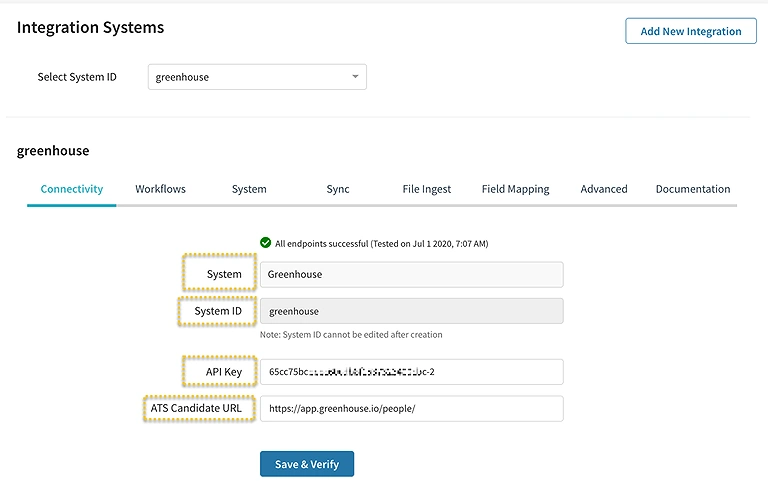
Connecting core tech stack to Eightfold AI using automated API integrations and ATS synchronization.
| Integration Category | Eightfold AI | Beamery |
| HRIS Integrations | Deep integrations with leading HRIS platforms such as Workday, SAP SuccessFactors, Oracle HCM, and other enterprise systems to support workforce intelligence. | Connects with major HRIS platforms to synchronize employee and recruiting data while supporting talent lifecycle management. |
| ATS Integrations | Integrates with enterprise ATS solutions to enhance candidate matching, talent intelligence, and internal mobility without replacing the existing ATS. | Offers broad ATS integrations that extend recruiting workflows with CRM, sourcing, and candidate engagement capabilities. |
| CRM Capabilities | Includes talent relationship functionality primarily to support talent rediscovery and ongoing engagement. | Provides a dedicated enterprise Talent CRM designed for candidate relationship management, talent communities, and recruitment marketing. |
| API Support | Enterprise-grade REST APIs enable secure integration with HR systems, analytics platforms, and custom enterprise applications. | Flexible REST APIs allow organizations to build customized integrations, automate workflows, and connect external recruiting technologies. |
| Webhooks | Supports event-based integrations for synchronizing talent and workflow data with connected enterprise applications. | Provides webhook support to automate recruiting events, candidate updates, and workflow notifications across integrated systems. |
| Integration Marketplace | Offers prebuilt connectors for widely used enterprise HR and productivity platforms. | Provides an expanding library of integrations covering ATS, HRIS, communication, assessment, and recruiting technologies. |
| Authentication | Supports enterprise authentication standards with centralized identity management and role-based access controls. | Supports secure authentication through enterprise identity providers and centralized user management. |
| Single Sign-On (SSO) | Supports SAML-based SSO and enterprise identity providers for secure user access. | Supports SSO through common enterprise identity platforms, simplifying user authentication across recruiting teams. |
| Security Controls | Enterprise security with encryption, role-based permissions, audit capabilities, and governance controls for sensitive workforce data. | Enterprise-grade security featuring encryption, access controls, audit logging, and privacy protections for candidate data. |
| Developer Experience | Well-documented APIs designed for enterprise IT teams integrating workforce intelligence into existing HR ecosystems. | Developer-friendly APIs and integration tools that provide greater flexibility for recruiting technology customization and automation. |
| Third-Party Integrations | Connects with HRIS, ATS, learning platforms, identity providers, productivity tools, and enterprise analytics solutions. | Integrates with ATS, HRIS, sourcing tools, communication platforms, assessment providers, marketing technologies, and productivity applications. |
| Overall Integration Flexibility | Best suited for organizations building a centralized enterprise talent intelligence ecosystem with deep HR technology integration. | Offers greater flexibility for recruiting teams that require customizable integrations, open APIs, and extensive CRM-focused workflow automation. |
Which Organization Should Choose Which Platform?
| Business Scenario | Recommended Platform | Why It's a Better Fit |
| Startup | Beamery | Easier to deploy and better suited for building candidate pipelines without the complexity of enterprise workforce planning. |
| Small & Medium Businesses (SMBs) | Beamery | Offers flexible recruiting workflows and Talent CRM capabilities that support growing hiring teams with fewer implementation requirements. |
| Mid-Market Organizations | Beamery | Ideal for companies expanding their recruiting operations while strengthening employer branding and candidate engagement. |
| Enterprise | Eightfold AI | Delivers advanced AI-driven talent intelligence, workforce planning, and internal mobility for large organizations with complex HR operations. |
| Global Enterprise | Eightfold AI | Designed to manage large-scale global workforces with sophisticated skills intelligence, compliance, and enterprise integrations. |
| Healthcare | Eightfold AI | Helps healthcare organizations identify skill gaps, improve workforce planning, and support internal mobility across specialized roles. |
| Manufacturing | Eightfold AI | Supports long-term workforce planning, succession management, and employee reskilling for evolving operational demands. |
| Technology | Eightfold AI | Enables skills-based hiring and internal talent development, making it well suited for rapidly changing technical skill requirements. |
| Retail | Beamery | Strong candidate relationship management and recruitment marketing capabilities help support continuous, high-volume hiring. |
| Financial Services | Eightfold AI | Provides workforce intelligence and governance features that align well with highly regulated enterprise environments. |
| Government & Public Sector | Eightfold AI | Better suited for organizations requiring structured workforce planning, long-term talent management, and enterprise governance. |
| Education | Beamery | Supports ongoing candidate engagement and employer branding, making it effective for institutions with seasonal or recurring recruitment needs. |
| Internal Mobility & Employee Development | Eightfold AI | AI-powered skills intelligence and career path recommendations make it the stronger platform for retaining and developing internal talent. |
| High-Volume Hiring | Beamery | Excels at candidate nurturing, recruitment marketing, and managing large recruiting pipelines across multiple hiring campaigns. |
| Executive & Strategic Hiring | Eightfold AI | Advanced talent intelligence and skills-based matching help identify highly qualified candidates for leadership and specialized positions. |
Real-World Use Cases
| Business Situation | Recommended Platform | Business Justification |
| A multinational enterprise wants to reduce external hiring by filling more roles internally. | Eightfold AI | Its AI-powered skills intelligence and internal mobility capabilities help identify employees with transferable skills, supporting reskilling, career development, and succession planning. |
| A talent acquisition team wants to build long-term relationships with passive candidates before positions become available. | Beamery | Beamery's Talent CRM, talent communities, and recruitment marketing tools are designed to nurture candidate relationships over time. |
| An organization is planning a large-scale workforce transformation and needs visibility into future skill gaps. | Eightfold AI | Predictive workforce planning and skills analytics help HR leaders understand future talent needs and make data-driven workforce decisions. |
| A company hiring across multiple regions wants to improve employer branding and recruitment campaigns. | Beamery | Recruitment marketing automation and personalized engagement campaigns help attract, segment, and engage candidates across different markets. |
| An enterprise wants AI to recommend qualified candidates beyond traditional keyword matching. | Eightfold AI | The platform's skills-first AI identifies adjacent skills and potential, improving talent discovery beyond resume-based searches. |
| A rapidly growing organization needs to manage thousands of candidates across multiple hiring campaigns. | Beamery | Its CRM-centric workflow helps recruiters organize talent pools, automate communication, and maintain candidate engagement at scale. |
| An HR department wants to improve employee retention through career development and internal career opportunities. | Eightfold AI | AI-driven career path recommendations and internal mobility tools encourage employee growth while reducing turnover. |
| A recruiting organization wants to automate candidate communications while giving recruiters better visibility into pipeline performance. | Beamery | Automated workflows, engagement tracking, and recruiting analytics improve recruiter productivity and help optimize hiring performance. |
Pricing Comparison: Which Offers Better ROI?
Both Eightfold AI and Beamery use custom enterprise pricing rather than publicly listing subscription fees. Total investment depends on factors such as organization size, number of users, selected modules, implementation scope, and support requirements. As a result, procurement teams should evaluate the overall cost of ownership including implementation, consulting, and long-term business value rather than focusing solely on licensing costs.
Pricing Model
Eightfold AI
Eightfold AI offers custom enterprise pricing tailored to workforce size, platform modules, and deployment complexity. Organizations must contact the vendor for a personalized quotation.
Beamery
Beamery also follows a custom pricing model based on company size, recruiting requirements, selected modules, and implementation scope. Pricing is available through direct consultation with the vendor.
Licensing
Eightfold AI
Licensing is typically structured around enterprise subscriptions with optional modules that can expand platform capabilities as organizational needs grow.
Beamery
Beamery provides enterprise subscription licensing with modular options, allowing organizations to license recruiting and talent engagement capabilities based on their requirements.
Enterprise Contracts
Eightfold AI
Enterprise agreements are generally customized based on deployment scale, integration requirements, service levels, and commercial negotiations.
Beamery
Contracts are tailored to organizational hiring volume, implementation scope, and the combination of products and services selected.
Hidden Costs
Eightfold AI
Additional costs may arise from implementation services, data preparation, system integrations, change management, and optional platform modules.
Beamery
Organizations should consider costs related to implementation, workflow customization, integrations, and optional professional services beyond the core subscription.
Implementation Costs
Eightfold AI
Implementation costs are typically higher due to enterprise integrations, workforce data preparation, and AI configuration requirements.
Beamery
Implementation costs are generally lower for organizations focusing primarily on recruiting and Talent CRM deployment, although complexity varies by integration needs.
Consulting Services
Eightfold AI
Many enterprise deployments involve consulting partners to support implementation planning, data strategy, and organizational change management.
Beamery
Consulting services commonly focus on CRM configuration, workflow optimization, recruiting process design, and integration planning.
Training
Eightfold AI
Training programs often include administrators, recruiters, HR leaders, managers, and workforce planning teams to ensure effective adoption across multiple business functions.
Beamery
Training primarily focuses on recruiters, sourcing specialists, and recruiting administrators responsible for candidate engagement and Talent CRM operations.
Maintenance
Eightfold AI
As a cloud-based SaaS platform, software updates and infrastructure maintenance are managed by the vendor, while customers primarily maintain integrations, configurations, and data quality.
Beamery
Beamery also manages platform maintenance and feature updates, allowing internal teams to focus on recruiting operations and workflow optimization.
ROI Expectations
Eightfold AI
Organizations are most likely to realize ROI through improved internal mobility, better workforce planning, reduced external hiring dependency, and more strategic talent allocation.
Beamery
ROI is commonly driven by improved recruiter productivity, stronger candidate engagement, higher-quality talent pipelines, and more efficient recruitment marketing.
Time to ROI
Eightfold AI
Organizations may require a longer period to achieve full ROI because AI models become more valuable as workforce data matures and adoption expands across HR functions.
Beamery
ROI can often be realized sooner, particularly for organizations seeking immediate improvements in recruiting efficiency, candidate engagement, and pipeline management.
Budget Considerations
Eightfold AI
Best suited for organizations willing to invest in long-term workforce transformation and enterprise talent intelligence initiatives where strategic HR outcomes justify a larger investment.
Beamery
A strong option for enterprises prioritizing recruiting performance, candidate relationship management, and recruitment marketing without investing in a broader workforce intelligence platform.
The Strategic Trade-Offs
Where Eightfold AI Dominates
- Unrivalled skills prediction logic that surfaces hidden, qualified talent.
- Robust diversity, equity, and inclusion (DEI) masking tools to minimise unconscious hiring bias.
- Strong framework for tracking internal employee res killing opportunities.
Technical Limitations: Closed system architecture; high reliance on large datasets to make accurate predictions.
Where Beamery Dominates
- Best-in-class CRM engine for sourcing passive outbound pipelines.
- Clear visibility into external labour market competitor movements.
- Highly customizable dashboard layouts and open developer tools.
Technical Limitations: Occasional data processing synchronisation lag with legacy systems of record.
Final Recommendation: Which Platform Should You Choose?
Choose Eightfold AI if...
- Your organization wants to build a skills-first talent strategy that supports hiring, internal mobility, and long-term workforce planning.
- You manage a large global workforce and need AI to identify skill gaps, future talent needs, and internal career opportunities.
- Reducing external hiring costs by reskilling and redeploying existing employees is a strategic priority.
- Your HR leadership needs predictive workforce insights to support succession planning and long-term organizational growth.
- You operate in a highly regulated industry where enterprise governance, compliance, and responsible AI are key purchasing criteria.
- Your organization already has mature HR systems and is prepared for a more comprehensive enterprise implementation.
- You want AI to drive strategic talent decisions beyond recruiting, including workforce transformation and organizational planning.
- Your budget supports investing in a platform designed to deliver long-term value through enterprise-scale talent intelligence.
Choose Beamery if...
- Your primary objective is building and nurturing high-quality talent pipelines before hiring demand arises.
- Your recruiting teams rely heavily on candidate relationship management (CRM) and personalized engagement throughout the hiring journey.
- Employer branding, recruitment marketing, and proactive sourcing are central to your talent acquisition strategy.
- You need a platform that can be deployed more quickly with less implementation complexity than AI-first talent intelligence systems.
- Your recruiters require flexible workflows for managing campaigns, talent communities, and passive candidate engagement.
- You want to strengthen recruiting performance without completely transforming your existing HR technology ecosystem.
- Your hiring strategy focuses on improving sourcing efficiency, recruiter productivity, and long-term candidate relationships.
- You are looking for an enterprise recruiting platform that balances strong CRM capabilities with broad integration flexibility.
Alternative Platforms to Consider
| Alternative Platform | Best For | Primary Strength | Why Consider It Instead |
| HireVue | AI-driven hiring and candidate assessments | Video interviewing, assessments, and AI screening | Ideal for organizations that prioritize structured interviewing and pre-employment assessments alongside AI-assisted recruiting. |
| Paradox (Olivia) | High-volume recruiting | Conversational AI and interview automation | A strong choice for enterprises looking to automate candidate engagement, interview scheduling, and frontline hiring. |
| Agentnoon | Workforce planning | Organizational design and headcount planning | Better suited for companies focused on workforce modeling and strategic organizational planning rather than recruiting CRM. |
| Degreed | Skills development and employee growth | Learning, skill development, and talent upskilling | A good option for organizations that prioritize continuous learning and workforce capability development over external talent acquisition. |
Consider Phenom or SeekOut if you require specialized external talent sourcing engines. To discover how these two platforms compare against a wider recruiting market layout, explore our list of 10 Best AI Tools for Smarter & Faster Talent Acquisition.
Frequently Asked Questions
1. Is Eightfold AI better than Beamery?
Neither platform is universally better because they solve different business challenges. Eightfold AI is designed for organizations that want AI-powered talent intelligence, skills-based hiring, internal mobility, and workforce planning. Beamery is better suited to companies focused on candidate relationship management, recruitment marketing, and long-term talent engagement. The right choice depends on whether your priority is enterprise workforce optimization or recruiting pipeline management.
2. Do Eightfold AI and Beamery require an existing ATS?
Yes. Both platforms are designed to complement rather than replace an Applicant Tracking System (ATS). They integrate with leading ATS platforms to enhance recruiting workflows, candidate data, and talent intelligence. Organizations typically continue using their existing ATS while leveraging either platform for advanced AI capabilities, candidate engagement, or workforce insights.
3. Which platform is easier to implement?
Beamery generally offers a faster implementation because its modular architecture focuses on recruiting and Talent CRM workflows. Eightfold AI often requires more planning due to its deeper integrations with HR systems and the data preparation needed to support AI-driven talent intelligence. The overall timeline for either platform depends on organizational complexity, integration requirements, and implementation scope.
4. Which platform provides stronger AI capabilities?
Eightfold AI offers broader AI functionality across talent matching, skills intelligence, career recommendations, workforce planning, and internal mobility. Beamery also uses artificial intelligence, but its AI primarily supports candidate discovery, engagement, recruitment marketing, and sourcing optimization. Organizations seeking enterprise-wide talent intelligence typically benefit more from Eightfold AI's AI-first approach.
5. Can both platforms support internal mobility programs?
Yes, but their capabilities differ significantly. Eightfold AI is built around skills-based internal mobility, helping organizations identify employees for new roles, career development opportunities, and succession planning. Beamery can support internal recruiting initiatives, but its primary focus remains candidate relationship management and external talent engagement rather than enterprise-wide workforce mobility.
6. Which platform integrates better with existing HR systems?
Both platforms provide integrations with leading HRIS, ATS, and enterprise identity providers. Eightfold AI is optimized for organizations building a centralized talent intelligence ecosystem across multiple HR platforms, while Beamery emphasizes flexible integrations that strengthen recruiting operations and candidate relationship management. The better option depends on your organization's HR technology strategy.
7. Are Eightfold AI and Beamery suitable for global enterprises?
Yes. Both platforms are designed for enterprise-scale organizations operating across multiple countries and business units. They offer enterprise-grade security, scalability, and integration capabilities. Eightfold AI is particularly well suited for organizations managing complex workforce planning initiatives, while Beamery excels in supporting global recruiting teams and large-scale talent engagement programs.
8. How do the pricing models compare?
Neither vendor publishes standard pricing on its website. Both use custom enterprise pricing based on factors such as organization size, platform modules, implementation complexity, and service requirements. Prospective buyers typically need to request a customized quote to evaluate total costs and compare licensing options.
9. Which platform is better for candidate relationship management?
Beamery is the stronger choice for organizations prioritizing candidate relationship management. Its Talent CRM enables recruiters to build talent communities, automate candidate engagement, personalize communication, and nurture long-term relationships with prospective hires. Eightfold AI includes engagement capabilities but focuses more heavily on AI-powered talent intelligence than CRM functionality.
10. What level of customer support can organizations expect?
Both vendors provide enterprise onboarding, implementation assistance, customer success management, technical support, and ongoing product guidance. Support levels may vary depending on the subscription package and service agreement. Organizations with complex deployments often work closely with implementation specialists and dedicated customer success teams throughout rollout and ongoing platform optimization.
11. Which platform offers better security and compliance?
Both platforms support enterprise security standards through encryption, role-based access controls, identity management, and data governance capabilities. They also support common compliance requirements such as GDPR and enterprise privacy standards. Organizations with specific regulatory or governance requirements should review each vendor's latest security certifications and compliance documentation during procurement.
12. Which organizations benefit most from each platform?
Eightfold AI is best suited for large enterprises that want to improve talent intelligence, workforce planning, internal mobility, and skills-based hiring through AI. Beamery is a better fit for organizations focused on recruitment marketing, candidate engagement, Talent CRM, and building long-term recruiting pipelines. The best choice depends on whether your strategic priority is enterprise workforce optimization or recruiting excellence.
Conclusion
Eightfold AI and Beamery are both leading enterprise talent platforms, but they address different strategic priorities. Eightfold AI is the stronger choice for organizations seeking AI-driven talent intelligence, skills-based hiring, internal mobility, and long-term workforce planning. Beamery, on the other hand, excels at candidate relationship management, recruitment marketing, and building high-quality talent pipelines. Neither platform is inherently better the right choice depends on your organization's hiring strategy, workforce objectives, and existing HR technology ecosystem. Rather than comparing feature counts alone, evaluate which solution best supports your long-term talent strategy, implementation readiness, and future business growth.