.webp)
Paradox Olivia Review: Best AI Recruiting Tool in 2026
Ever wonder how many hours of your recruiter's life have been swallowed by the black hole of "just following up on that resume"? If you've watched a hiring manager triple-check their inbox for a reply that never comes, you already know the punchline: legacy applicant tracking systems have created major operational bottlenecks for enterprise recruitment teams, making platforms like Paradox Olivia
increasingly valuable in 2026.
Hiring managers still lose hours screening resumes, coordinating interviews, and responding to candidates — and slow communication quietly compounds into candidate drop-offs, staffing shortages, and recruiter burnout, an unwelcome trio that always shows up together. As enterprise hiring shifts toward agentic AI workflows, Paradox Olivia helps organisations automate end-to-end recruitment operations with minimal human intervention. This review is built for TA leaders, CHROs, and HR operations executives seeking a scalable, candidate-centric hiring framework that eliminates manual coordination and modernises enterprise recruitment infrastructure.

 Updated: May 23, 2026 | 19 min read
 Key Takeaways
- Excellent candidate communication automation
- Supports SMS, WhatsApp, and chat-based recruiting
- Strong interview scheduling capabilities
- Enterprise-focused pricing
- Limited workforce intelligence compared to Eightfold AI
Quick Overview
| Category | Details |
| Product Type | AI Recruiting Chatbot & Conversational Hiring Platform |
| Best For | Enterprise hiring, high-volume recruitment, candidate engagement, interview scheduling, and recruitment automation |
| Deployment | Cloud-Based (SaaS) |
| Pricing | Custom enterprise pricing (Contact sales for a quote) |
| Overall Rating | ⭐ 9.2 / 10 |
| Industries | Retail, Healthcare, Hospitality, Manufacturing, Logistics, Financial Services, Government, Telecommunications, and Enterprise HR |
| Alternatives | HireVue, Humanly, Eightfold AI, XOR, Sense, Phenom, Fountain, iCIMS Talent Cloud |
How We Evaluated Paradox (Olivia)
Evaluating an enterprise AI recruiting platform requires more than reviewing features or marketing claims. For this Paradox Olivia review, we analyzed the platform from a buyer's perspective by focusing on the areas that directly impact real-world adoption, operational efficiency, and long-term value.
Our evaluation framework covered:
- Recruitment Workflow Automation: How effectively Olivia handles candidate engagement, screening, interview scheduling, follow-ups, and repetitive hiring tasks.
- User Experience: The quality of recruiter workflows, dashboard usability, candidate interaction experience, and overall ease of managing hiring activities.
- AI Capabilities: How well Olivia supports conversational interactions, automated responses, screening workflows, and candidate guidance while maintaining accuracy.
- Integration Ecosystem: The ability to connect with enterprise HR systems, ATS platforms, calendars, and communication tools without disrupting existing recruitment processes.
- Implementation & Scalability: How practical deployment is for organizations of different sizes, including setup complexity, workflow customization, and support requirements.
- Real-World Hiring Applications: How well Olivia performs across high-volume recruitment scenarios such as retail, healthcare, logistics, hospitality, manufacturing, and campus hiring.
- Enterprise Value: Whether the platform delivers meaningful benefits compared with traditional recruiting workflows and alternative AI hiring solutions.
- Strengths & Limitations: Areas where organizations should carefully evaluate fit, including pricing, implementation effort, and suitability for smaller hiring teams.
Our final assessment combines product capabilities, enterprise requirements, practical use cases, and competitive positioning to determine where Paradox Olivia provides the strongest value and which organizations should consider alternative solutions. This approach helps readers understand not only what Olivia offers, but whether it aligns with their specific recruitment goals and operational needs.
Cover Photo Paradox Olivia Review: Best AI Recruiting Chatbot in 2026
What Is Paradox Olivia?
Company Snapshot
Paradox Olivia is an AI-powered recruiting assistant designed to automate repetitive hiring tasks while creating a conversational experience for job candidates. Rather than requiring applicants to navigate lengthy career portals or wait for recruiter responses, Olivia communicates through natural language conversations to guide candidates from initial application through interview scheduling and hiring updates. The platform integrates with major Applicant Tracking Systems (ATS), HR software, and calendar tools, allowing recruiters to manage hiring workflows from a centralized ecosystem while reducing manual administrative work.
| Category | Details |
| Product Name | Paradox Olivia |
| Company | Paradox |
| Founded | 2016 |
| Headquarters | Scottsdale, Arizona, USA |
| Product Category | AI Recruiting Chatbot & Conversational Hiring Platform |
| Primary Focus | Automating candidate engagement, screening, interview scheduling, and hiring workflows |
| Target Customers | Mid-sized businesses and large enterprises with ongoing hiring needs |
What Problem Does It Solve?
Hiring teams often lose valuable time managing repetitive recruitment tasks instead of focusing on evaluating candidates. Manual screening, interview coordination, and candidate communication can slow the hiring process, increase recruiter workload, and lead to qualified applicants dropping out before a hiring decision is made—especially for organizations hiring at scale.
Paradox Olivia helps solve these common recruiting challenges by:
- Automating candidate conversations 24/7, even outside business hours.
- Answering frequently asked questions instantly to improve candidate experience.
- Screening applicants using employer-defined qualification criteria.
- Automatically scheduling and rescheduling interviews based on recruiter availability.
- Sending reminders and follow-up messages to reduce no-shows.
- Recommending suitable job openings based on candidate profiles.
- Keeping applicants informed throughout every stage of the hiring process.
- Reducing repetitive administrative work so recruiters can focus on interviewing and hiring top talent.
How Paradox Olivia Works ?
After integrating with an organization's ATS and HR systems, Olivia interacts with candidates through chat interfaces available on career websites, mobile devices, SMS, and other supported communication channels. During conversations, the AI collects candidate information, asks screening questions, verifies qualifications, recommends relevant job openings, and automatically books interview slots based on recruiter availability. Recruiters can configure workflows, hiring rules, and screening criteria while monitoring conversations and recruiting analytics through the Paradox platform.
Why Enterprises Choose Paradox Olivia ?
- Automates high-volume recruiting without increasing recruiter workload.
- Provides 24/7 candidate engagement across multiple communication channels.
- Reduces interview scheduling and administrative bottlenecks.
- Integrates with leading ATS, HRIS, and enterprise recruiting platforms.
- Improves candidate response rates through conversational interactions.
- Supports scalable hiring for large, multi-location organizations.
- Delivers faster hiring cycles with less manual coordination.
- Enables recruiters to spend more time on candidate evaluation and relationship building.
Setup, Deployment & User Experience
Onboarding
Getting started with Paradox Olivia typically begins with a discovery and implementation phase where the organization defines hiring workflows, screening questions, interview processes, integrations, and automation rules. Because the platform is built primarily for enterprise recruiting, onboarding is usually guided by the Paradox implementation team, making deployment structured and tailored to the company's recruitment process rather than a simple self-service setup.
Implementation Timeline
| Implementation Stage | Typical Timeline |
| Initial consultation & requirements gathering | 1–2 weeks |
| ATS & HR system integrations | 1–3 weeks |
| Workflow configuration & AI customization | 1–2 weeks |
| User training & testing | Several days to 1 week |
| Production launch | Typically 2–6 weeks (varies by organization size and integrations) |
Dashboard & UX
The Paradox Olivia dashboard is designed for recruiting teams that manage large hiring operations. Recruiters can monitor candidate conversations, review screening results, manage interview schedules, track hiring pipelines, configure automation workflows, and view recruiting analytics from a centralized interface. Despite its enterprise capabilities, the dashboard is organized to reduce manual work and streamline day-to-day recruiting activities.
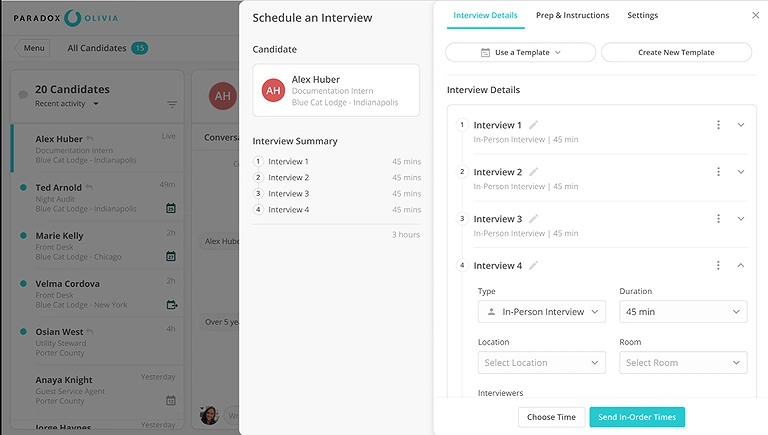
Paradox Desktop Interview Scheduling Dashboard. Source: Paradox / Interview Scheduling Automation — Paradox
Deployment Requirements
- Cloud-based SaaS platform with no on-premises infrastructure required.
- Enterprise internet connection and modern web browser.
- Integration with supported ATS, HRIS, and recruiting systems.
- Calendar integration (such as Microsoft Outlook or Google Calendar) for automated interview scheduling.
- HR or IT support during initial implementation for enterprise integrations.
- Role-based user permissions for recruiters, hiring managers, and administrators.
- Initial configuration of hiring workflows, screening questions, and automation rules before launch.
Core Features — Granular Breakdown
Conversational Screening & "Text-to-Apply"
Paradox Olivia enables conversational screening through SMS, WhatsApp, and web chat. Candidates join via QR code or text, while Olivia collects eligibility data, certifications, availability, and required compliance information.
Operational Limits: Paradox Olivia follows a strict conversational flow and escalates to human recruiters when inputs are unclear or non-compliant.
Security & Compliance: Paradox Olivia uses TLS 1.3 and AES-256 encryption to securely protect all candidate PII.
Agentic Autonomous Multi-Calendar Scheduling
Olivia utilizes an autonomous conversational framework to text-screen hourly applicants, verify basic compliance prerequisites, and directly schedule interviews in real time. This frictionless automation has made it a case study for how conversational AI recruitment assistants can collapse the top-of-funnel time-to-hire window from days down to minutes.
2026 Application: Paradox Olivia automatically monitors calendars, reschedules conflicted interviews, notifies candidates via text, and updates ATS records without any human intervention.
Security & Compliance: Paradox Olivia scheduling uses OAuth 2.0 to securely connect with Microsoft Office 365, Exchange, and Google Workspace calendars without storing external calendar data.
Immersive Job Previews & Automated Onboarding
Paradox Olivia reduces candidate drop-off by delivering interactive job previews through videos and rich media inside chat. After offer acceptance, it transitions into onboarding, guiding new hires through paperwork, background checks, and policy sign-offs via conversational workflows.
Operational Limits: Paradox Olivia delivers guided workflows but does not generate legal contracts or host e-learning, operating strictly within HR-configured compliance rules.
Security & Compliance: This module maintains strict compliance with regional data privacy laws, handling sensitive documentation via localized data processing parameters.
Global Compliance, Enterprise Security & Reporting
Paradox Olivia ensures enterprise security with data residency controls, multilingual processing, and compliance with global accessibility and equal opportunity standards.
Certifications: Paradox is SOC 2 Type II and ISO 27001 certified, HIPAA compliant, and follows GDPR and CCPA data protection standards.
Reporting Analytics: The platform provides dashboards tracking sourcing efficiency, completion rates, scheduling speed, and drop-off points to help optimise hiring funnels with actionable data.
Integration Ecosystem
The Paradox framework is designed to function as an agile conversational layer that wraps around an enterprise’s existing systems of record, eliminating the need to tear out and replace legacy software.
Core Enterprise Systems of Record: Paradox Olivia integrates with Workday, SAP SuccessFactors, Oracle Cloud HCM, Greenhouse, and PageUp, enabling real-time bidirectional sync of status changes across ATS and HCM systems.
Strategic 2026 Partnerships & Native Embeds: Deep native integrations within Microsoft Teams, Slack, Zoom, plus Twilio and Meta Business Suite WhatsApp Enterprise.
Specialized Marketplace Point Solutions: Bidirectional integrations with Checkr, HireRight, Form I-9 verification tools, and WOTC processing platforms, plus automated employment verification systems.
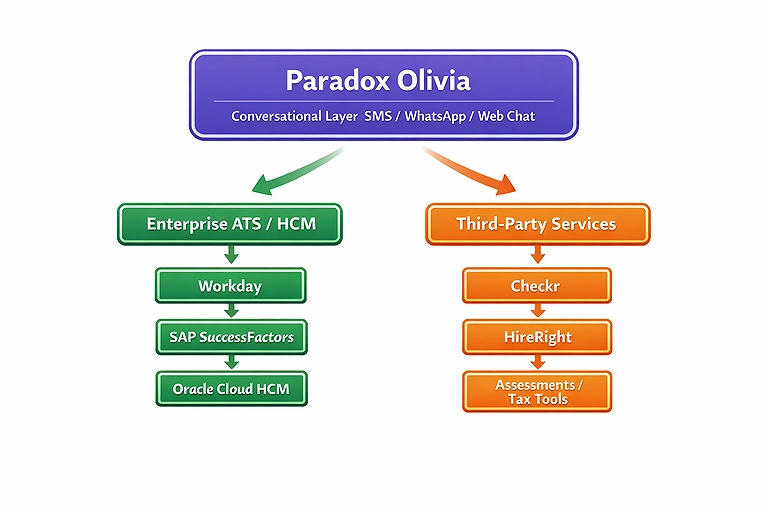
Paradox Olivia Image to show about how integrations works
Integration Support
| Integration | Supported |
| Workday | ✔ Supported |
| SAP SuccessFactors | ✔ Supported |
| Greenhouse | ✔ Supported |
| iCIMS | ✔ Supported |
| Taleo | ✔ Supported |
| Slack | ✔ Supported |
| Microsoft Teams | ✔ Supported |
| Google Calendar | ✔ Supported |
| Microsoft Outlook Calendar | ✔ Supported |
Implementation Reality Check
Paradox Olivia provides strong enterprise integration capabilities, but the actual setup experience depends on the organization's existing HR technology environment. Companies using complex ATS configurations, custom workflows, or multiple HR systems may require additional implementation support and testing before full deployment. Integration availability can also vary based on region, subscription plan, and specific business requirements.
Experience Using Paradox (Olivia)
One of the most notable aspects of our team and many other users of Paradox is its ability to automate repetitive candidate communication tasks. The platform's conversational interface is designed to reduce scheduling bottlenecks and streamline applicant engagement.
What stood out:
- Fast interview scheduling workflows
- Consistent candidate communication
- Strong automation capabilities
Potential drawbacks:
- Learning curve for advanced configurations
- Better suited for larger recruiting operations than occasional hiring needs
Real-World Use Cases
High-volume recruitment teams deploy text-based assistants to automate early qualification screening, minimize candidate drop-off, and coordinate interview slots seamlessly. To see how conversational automation compares to internal growth systems, read our deep dive into the Best AI Tools for Internal Mobility and Enterprise Employee Upskilling.
Typical Hiring Workflow
| Stage | What Olivia Does |
| 1. Candidate Applies | Candidate applies through the career site, QR code, text message, or job advertisement. |
| 2. Instant Conversation | Olivia starts a real-time conversation, answers questions, and collects required information. |
| 3. AI Screening | Screens applicants using employer-defined qualification criteria and knockout questions. |
| 4. Job Matching | Matches qualified candidates to suitable positions when multiple openings exist. |
| 5. Interview Scheduling | Automatically books interviews based on recruiter and hiring manager availability. |
| 6. ATS Synchronization | Updates candidate status and transfers information to the connected ATS. |
| 7. Ongoing Engagement | Sends reminders, reschedules interviews if needed, and provides hiring updates. |
| 8. Hiring & Pre-Onboarding | Supports offer communication and pre-onboarding workflows before the employee's first day. |
Business Scenarios
High-Volume Hiring
Best for: Retail chains, call centers, warehouses, hospitality groups, and customer support teams.
When hundreds or thousands of applications arrive every week, recruiters spend more time scheduling interviews than evaluating candidates. Olivia automates screening, scheduling, reminders, and follow-ups, helping recruiters process large applicant volumes with fewer manual tasks.
Healthcare Staffing
Best for: Hospitals, clinics, medical centers, pharmacies, and healthcare networks.
Healthcare organizations often need to fill critical roles quickly. Olivia helps engage candidates immediately, verify qualifications through predefined screening questions, and coordinate interviews faster to reduce hiring delays.
Seasonal Recruitment
Best for: Holiday hiring, e-commerce peaks, tourism, hospitality, and event staffing.
Businesses experiencing seasonal hiring spikes can automate candidate communication and interview scheduling without hiring additional recruiting staff, making it easier to handle temporary recruitment surges.
Retail Hiring
Best for: Multi-store retailers, supermarkets, restaurants, and franchise brands.
Retail companies frequently recruit cashiers, sales associates, and store managers across multiple locations. Olivia provides consistent candidate communication while automatically scheduling interviews for local hiring teams.
Logistics & Distribution
Best for: Warehouses, fulfillment centers, transportation companies, and delivery services.
Fast-growing logistics businesses often need warehouse associates, drivers, and operations staff quickly. Olivia reduces administrative delays by automating applicant screening, interview scheduling, and recruitment updates.
Manufacturing
Best for: Factories, industrial plants, production facilities, and engineering companies.
Manufacturers hiring production workers, technicians, or machine operators can automate repetitive hiring tasks while recruiters focus on evaluating technical skills and workforce planning.
Campus Recruiting
Best for: Graduate programs, internships, apprenticeships, and university recruitment.
Olivia enables employers to engage students immediately after career fairs or online applications, schedule interviews automatically, and maintain communication throughout the campus hiring process.
Franchise & Multi-Location Hiring
Best for: Restaurant chains, fitness centers, hospitality groups, and franchise businesses.
Organizations with hundreds of hiring locations can standardize recruiting while allowing individual managers to schedule interviews and communicate with candidates without losing centralized oversight.
Staffing & Recruitment Agencies
Best for: Temporary staffing firms, executive search firms, and recruitment agencies.
Recruitment agencies can automate candidate screening, interview coordination, and status updates across multiple clients, allowing recruiters to manage larger talent pools while spending more time on client relationships.
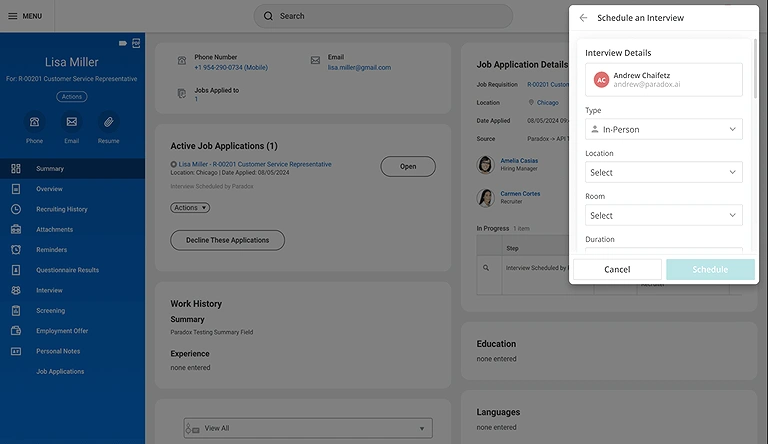
Paradox Summary Interface open for a Andrew Account
Best Organization Size
| Organization Size | Recommendation | Why? |
| Startup (1–50 employees) | ❌ Not Recommended | Enterprise pricing and implementation complexity make it excessive for most startups. |
| Small Business (51–200 employees) | ⚠ Consider If Needed | Suitable only if hiring is frequent or high-volume. Smaller teams may find simpler recruiting tools more cost-effective. |
| Mid-Market (201–1,000 employees) | ✔ Recommended | Delivers strong value for organizations hiring across multiple departments or locations. |
| Enterprise (1,000+ employees) | ⭐ Highly Recommended | Designed specifically for enterprise-scale recruitment with advanced automation, integrations, and high-volume hiring workflows. |
Financial Breakdown
Pricing Structure
Paradox uses an enterprise SaaS subscription model without per-user licensing, enabling large-scale rollout across frontline managers. Pricing is based on organization size (FTE count), hiring volume, and integration complexity across core HR systems.
Cost Benchmarks
| Metric | Enterprise Entry Tier | Enlarge Global Enterprise Tier |
| `Minimum Base Entry Cost | $1,000 / month ($12,000 ACV) | `$15,000+ / month ($180,000+ ACV) |
| Average Annual Contract Value (ACV) | $30,000 to $75,000 / year | $200,000 to $500,000+ / year |
| Billing Frequency | Annual upfront commitment | Multi-year enterprise agreements |
| Implementation Fees | $5,000 – $15,000 flat rate | Custom scoping ($30,000+ variable) |
Hidden Costs & Resource Drags
SMS/Telco Carrier Volatility: Paradox includes base messaging, but high volumes or WhatsApp API usage may trigger regional surcharge fees.
Integration Maintenance: Custom ATS configurations or major updates, such as migrating to new Workday instances, require professional services, realignment, and testing.
Knowledge Base Management: Internal HR teams must regularly audit and update Olivia’s knowledge base to reflect changing corporate policies, pay ranges, and benefits structures.
Expert Assessment: Strengths & Limitations
Strengths
Frictionless Candidate Capture: Text-to-apply and conversational screening eliminate password-protected portals, driving candidate application completion rates above 85%.
Unrivaled Scheduling Efficiency: The agentic, bidirectional multi-calendar coordination entirely removes the back-and-forth email loops of scheduling, reducing time-to-interview down to hours instead of days.
Zero Seat-License Constraints: The flat corporate pricing model lets organizations expand access to every frontline manager and coordinator without incurring incremental software seat penalties.
Elite Enterprise Security Infrastructure: Boasting SOC 2, ISO 27001, and HIPAA compliance, Paradox easily clears rigorous enterprise IT risk evaluations.
Limitations
High Financial Barrier to Entry: With starting packages firmly positioned at $1,000/month and typical contract values scaling rapidly, Paradox is financially out of reach for small businesses.
Strict Dependency on ATS Health: If your underlying applicant tracking system experiences downtime or suffers from messy data architecture, Olivia's sync capabilities degrade immediately.
Narrow Functional Scope: Olivia is built purely as a conversational interface and scheduling mechanism; it lacks talent intelligence features, predictive skills-gap mapping, and internal mobility engines.
Configuration Lock-In: Because conversational flows are highly customized, rapid hiring workflow changes often require Paradox professional services support tickets.
Market Positioning: Where Paradox Olivia Fits
Modern recruiting teams are moving beyond traditional application portals and manual recruiter workflows toward AI-powered hiring experiences. However, not all AI recruiting platforms solve the same problem. Some focus primarily on conversational candidate engagement and scheduling, while others provide broader recruitment pipeline automation across sourcing, screening, and talent management.
Understanding these categories helps organizations evaluate whether Paradox Olivia matches their hiring requirements.
Category 1: Conversational AI Recruiting Assistants
These platforms focus on creating real-time conversations between candidates and employers through SMS, chat, career websites, and messaging channels. Their primary goal is to remove friction from early recruitment stages by answering questions, collecting candidate information, screening applicants, and scheduling interviews automatically.
Best suited for:
- High-volume hourly hiring
- Retail and hospitality recruitment
- Healthcare staffing
- Logistics and frontline workforce hiring
- Organizations needing faster candidate response times
Typical capabilities:
- AI candidate conversations
- Automated screening questions
- Interview scheduling
- Candidate FAQs
- Recruitment workflow automation
Examples:
Paradox Olivia , Humanly, XOR
Category 2: Conversational Pipeline Activation Platforms
These platforms go beyond chatbot interactions by combining conversational AI with broader recruitment pipeline management. They help organizations attract candidates, activate talent pools, automate engagement campaigns, and manage early-stage recruitment activities across multiple channels.
Best suited for:
- Enterprise talent acquisition teams
- Organizations with complex hiring funnels
- Companies focused on proactive candidate sourcing
- Large-scale recruitment campaigns
Typical capabilities:
- Candidate sourcing automation
- Talent pool engagement
- Multi-channel outreach
- Automated nurturing campaigns
- Recruitment analytics
Examples:
Phenom , Eightfold AI , Beamery
Where Paradox Olivia Fits
Paradox Olivia primarily belongs to the Conversational AI Recruiting Assistant category, where its strongest capabilities are candidate engagement, automated screening, interview scheduling, and reducing recruiter administrative workload.
Organizations choosing Olivia are usually prioritizing:
- Faster candidate response times
- Higher application completion rates
- Reduced recruiter workload
- Automated interview coordination
- Scalable hiring operations
However, companies looking for deeper talent intelligence, predictive matching, or enterprise talent ecosystem management may evaluate broader AI talent platforms alongside conversational assistants.
Strategic Buying Matrix
| Buying Factor | Best Fit | Why It Matters |
| High-volume recruitment | Enterprise hiring teams | Olivia is designed to automate repetitive candidate interactions at scale. |
| Fast candidate engagement | Companies with large applicant volumes | Conversational AI reduces response delays and improves candidate experience. |
| Complex HR technology stack | Organizations using enterprise ATS/HRIS | Integrations help maintain existing recruitment workflows. |
| Limited recruiter bandwidth | Lean talent acquisition teams | Automation reduces manual screening and scheduling work. |
| Multi-location hiring | Retail, healthcare, logistics, hospitality | Centralized automation supports distributed recruitment operations. |
| Advanced talent analytics | Organizations needing predictive workforce insights | Dedicated talent intelligence platforms may provide deeper analytics. |
| Small recruitment teams | Small businesses with occasional hiring | Simpler recruiting tools may provide better cost efficiency. |
See How They Stack Up
If you are ready to automate your hourly or blue-collar recruitment pipelines via instant messaging bots, find out which engine offers the best experience, Paradox Olivia vs Humanly.io.
Alternatives
| Alternative | Best For | Key Strength Compared to Paradox Olivia |
| Humanly | SMBs and mid-market organizations seeking conversational AI recruiting | Streamlined AI screening and recruiter productivity with a simpler implementation experience. |
| HireVue | Enterprises focused on structured video interviews and candidate assessments | Advanced AI-powered video interviewing and skills evaluation capabilities. |
| Phenom | Organizations investing in talent experience and recruitment marketing | Comprehensive talent acquisition platform with career site personalization and CRM features. |
| Eightfold AI | Large enterprises requiring AI-driven talent intelligence | Deep talent matching, workforce planning, and internal mobility powered by AI. |
| Sense | Recruiting teams focused on candidate engagement and communication | Strong multi-channel communication, talent nurturing, and recruiter workflow automation. |
| XOR | Companies hiring frontline and hourly workers at scale | Conversational AI, automated screening, and interview scheduling optimized for high-volume hiring. |
| Fountain | Businesses managing frontline and distributed workforce hiring | End-to-end hiring workflows designed for hourly employees and operational teams. |
| iCIMS Talent Cloud | Enterprises needing a comprehensive talent acquisition ecosystem | Robust ATS combined with recruitment marketing, onboarding, and hiring automation. |
Which Alternative Should You Choose?
- Choose Humanly if you want conversational AI recruiting with a simpler deployment for growing organizations.
- Choose HireVue if AI-powered video interviews and candidate assessments are your top priorities.
- Choose Phenom if your focus is attracting, engaging, and nurturing talent throughout the recruitment lifecycle.
- Choose Eightfold AI if workforce planning, talent intelligence, and internal mobility are strategic priorities.
- Choose Sense if recruiter productivity and ongoing candidate engagement are more important than chatbot-led hiring.
- Choose XOR or Fountain if your organization primarily recruits hourly, frontline, or distributed workforces at scale.
- Choose iCIMS Talent Cloud if you need a full enterprise talent acquisition platform rather than a conversational recruiting assistant.
Bottom Line: Paradox Olivia is one of the strongest choices for organizations prioritizing conversational AI, automated candidate engagement, and interview scheduling. However, the best alternative depends on whether your primary need is video interviewing, talent intelligence, recruitment marketing, or end-to-end talent acquisition management.
What's New in 2026?
Paradox Olivia continues evolving as enterprise recruiting teams demand more automation, personalization, and AI-driven hiring experiences. Key developments and focus areas in 2026 include:
- More Advanced Conversational AI: Improved natural language understanding helps Olivia handle more complex candidate questions, provide personalized responses, and create smoother hiring conversations.
- Expanded Recruitment Automation: More hiring workflows can be automated, including candidate engagement, screening, scheduling, reminders, and recruitment follow-ups.
- Smarter Candidate Matching: AI-driven recommendations help recruiters identify suitable candidates faster by analyzing qualifications, preferences, and job requirements.
- Deeper Enterprise Integrations: Enhanced connections with ATS, HRIS, communication, and workforce management systems improve workflow consistency across large organizations.
- Improved Analytics & Insights: Recruiting teams gain better visibility into candidate interactions, hiring bottlenecks, and workflow performance.
- Enhanced Candidate Experience: More personalized conversations and faster responses help reduce application drop-offs and improve employer brand perception.
- Greater Support for High-Volume Hiring: Continued optimization for industries such as retail, healthcare, logistics, hospitality, and manufacturing where rapid hiring is critical.
Note: Specific feature availability may vary based on subscription plans, integrations, and regional availability.
Final Verdict & Rating
Best For
- nterprises managing high-volume pipelines for continuous hourly or frontline hiring in retail, hospitality, logistics, or healthcare.
- Recruiting teams spending over 30% of their week manually managing complex calendar logistics, interview confirmations, and constant rescheduling requests.
- Companies with modern enterprise ATS platforms that are looking to deploy a seamless, automated conversational candidate experience over text and chat.
- Talent teams aiming to reduce drop-off rates by instantly engaging and qualifying incoming job applicants 24/7 through automated, mobile-first messaging.
Skip If
- You run a small business or early-stage startup with low-volume, highly specialized hiring needs that don't justify enterprise-scale chat automation.
- You require deep predictive AI talent analytics, automated resume parsing capabilities, or complex skills-gap mapping tools rather than conversational engagement.
- Your existing applicant tracking system is highly customized, brittle, outdated, or lacks reliable REST API access for smooth third-party software integrations.
- Your hiring bottlenecks happen after the initial chat screening stage due to slow manual scheduling of teams. To fix your operational bottlenecks, follow our blueprint on how to reduce time-to-hire by 50% using AI recruitment tools
Overall Score:
9.2 / 10
FAQs
1. What is Paradox Olivia used for?
Paradox Olivia is an AI-powered recruiting assistant designed to automate candidate communication, screening, interview scheduling, and hiring workflows. It helps organizations reduce repetitive recruiter tasks while improving candidate engagement throughout the recruitment process.
2. Is Paradox Olivia suitable for small businesses or only enterprises?
Paradox Olivia is primarily designed for mid-market and enterprise organizations with frequent or high-volume hiring needs. Smaller companies with occasional recruitment requirements may find simpler recruiting tools more cost-effective, while larger organizations benefit more from its automation, integrations, and scalability.
3. Does Paradox Olivia replace an existing Applicant Tracking System (ATS)?
No. Paradox Olivia works as a conversational AI layer that integrates with existing ATS and HR systems rather than replacing them. It connects with platforms such as Workday, SAP SuccessFactors, and Greenhouse to exchange candidate information and maintain existing recruitment workflows.
4. How does Paradox Olivia screen candidates?
Olivia uses AI-powered conversations and employer-defined workflows to collect candidate information, ask screening questions, verify qualifications, and identify suitable applicants. Recruiters can configure screening criteria based on role requirements, experience, availability, and other hiring factors.
5. Can Paradox Olivia schedule interviews automatically?
Yes. Olivia can automate interview scheduling by checking recruiter and hiring manager availability, coordinating calendars, booking interviews, sending confirmations, and managing rescheduling requests. This is especially valuable for organizations handling large applicant volumes.
6. How does Paradox Olivia ensure candidate answers are accurate and compliant?
Olivia operates using configured workflows, approved knowledge sources, and predefined recruitment rules. If a candidate asks something outside its available information, the system can avoid providing unsupported answers and redirect the conversation to a recruiter or appropriate resource.
7. Does Paradox Olivia support multiple languages?
Yes. Paradox Olivia supports multilingual candidate conversations, allowing global organizations to engage applicants across different regions and languages. This makes it suitable for enterprises managing international recruitment operations.
8. How quickly does Paradox Olivia sync data with ATS and HR systems?
Paradox Olivia uses integrations and APIs to exchange candidate information with connected HR platforms. Depending on the organization's setup and integration configuration, candidate updates, interview details, and workflow changes can synchronize automatically between systems.
9. Can Paradox Olivia handle high-volume recruitment campaigns?
Yes. High-volume hiring is one of Olivia's strongest use cases. Organizations recruiting for frontline, seasonal, retail, healthcare, logistics, and hospitality roles can automate candidate engagement, screening, and scheduling across large applicant pools.
10. What industries benefit most from Paradox Olivia?
Paradox Olivia is commonly used by organizations in industries with continuous hiring requirements, including retail, healthcare, hospitality, manufacturing, logistics, telecommunications, financial services, and other enterprise sectors.
11. How difficult is it to implement Paradox Olivia?
Implementation complexity depends on company size, workflow requirements, and existing HR technology. Enterprise deployments usually involve integration setup, workflow configuration, testing, and training with support from the Paradox implementation team.
12. What are the main limitations of Paradox Olivia?
The main limitations are its enterprise-focused pricing, implementation requirements, and reduced value for organizations with low hiring volume. Companies seeking advanced talent intelligence, workforce planning, or broader HR analytics may need additional specialized platforms.
Conclusion
Paradox Olivia is a powerful AI recruiting assistant built for organizations that need to automate candidate engagement, reduce recruiter workload, and improve hiring speed at scale. Its conversational AI capabilities, enterprise integrations, automated screening, and interview scheduling make it particularly valuable for companies managing high-volume recruitment across industries such as retail, healthcare, logistics, and hospitality.
However, Olivia is not the right fit for every organization. Smaller businesses with limited hiring activity may find the platform more complex and costly than necessary, while companies looking for deeper workforce intelligence may require broader talent platforms.
For enterprises focused on creating faster, more efficient, and candidate-friendly hiring workflows, Paradox Olivia stands out as one of the strongest conversational AI recruiting solutions available in 2026. The best results come from organizations that already have structured hiring processes and enough recruitment volume to benefit from automation.