.webp)
How to Reduce Time-to-Hire by 50% Using AI Recruitment Tools
44 days. That's how long the average hiring process takes and here's the brutal part: your best candidates are gone by day 10. They don't wait around. They take the other offer, the faster offer, while your process is still stuck in "let me check with the hiring manager."
Every extra day costs you twice once in the $4,700 you're spending per manual hire, and again in the roles sitting empty while your team scrambles to cover the gap. It's not just slow. It's expensive in ways that don't show up until the damage is already done.
Here's the good news: this isn't a hard problem to fix it's a hard problem to fix manually. AI recruitment tools handle the parts that eat the most time sourcing, resume screening, interview scheduling so qualified candidates move through your pipeline in days, not weeks. This guide breaks down the exact four-step framework to cut your time-to-hire in half, starting now.

 Updated: June 03, 2026 | 9 min read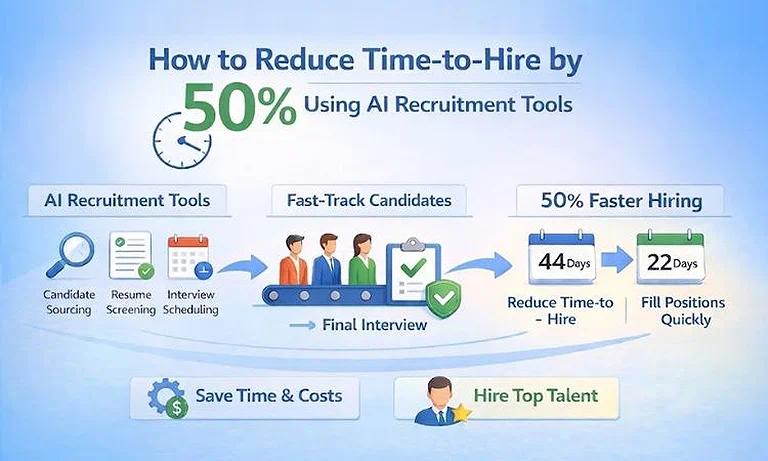
Cover Photo How to Reduce Time-to-Hire by 50% Using AI Recruitment Tools
Workflow Table
| Workflow Stage | How AI Recruitment Tools Help |
| Define Hiring Requirements | Establish role requirements, required skills, and hiring criteria before launching recruitment. |
| Source Qualified Candidates | Eightfold AI uses AI-powered talent intelligence to search internal and external talent pools, helping recruiters identify qualified candidates much faster than manual sourcing. |
| Screen and Rank Applicants | Eightfold AI automatically evaluates resumes, matches candidates against job requirements, and prioritizes the strongest applicants for review. |
| Automate Candidate Communication | Paradox (Olivia) engages candidates through conversational AI, answers common questions, collects information, and keeps applicants engaged throughout the hiring process. |
| Schedule Interviews | Paradox (Olivia) automatically coordinates calendars, books interviews, and sends reminders, eliminating manual scheduling delays. |
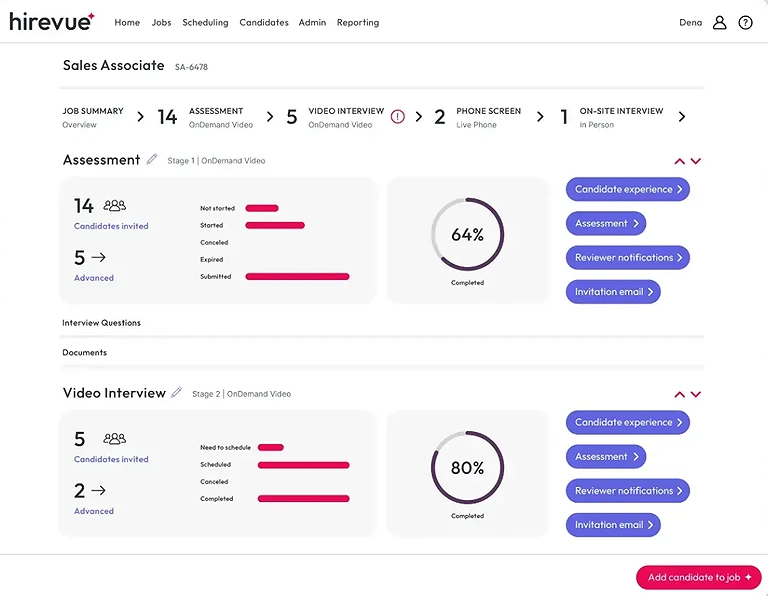
| Conduct Initial Assessments | HireVue enables on-demand video interviews and AI-assisted assessments so recruiters can evaluate candidates without waiting for live interview availability. |
| Review Candidate Performance | HireVue centralizes interview results and assessment data, helping hiring managers compare candidates and make decisions more quickly. |
| Final Selection and Offer | Recruiters review shortlisted candidates, approve the preferred applicant, and extend offers with fewer administrative delays thanks to earlier workflow automation. |
Who Should Read This Guide?
This guide is for organizations that want to shorten hiring cycles, reduce manual recruitment work, and improve hiring efficiency using AI-powered recruitment tools without sacrificing candidate quality.
- HR managers looking to reduce time-to-hire.
- Talent acquisition teams handling high-volume recruitment.
- Recruitment agencies managing multiple client vacancies.
- Startup founders building teams with limited HR resources.
- Hiring managers responsible for faster recruitment decisions.
- Business leaders evaluating AI recruitment software to improve hiring performance.
The Hidden Costs of Delayed Hiring
Open positions can slow down business growth, reduce team productivity, and put extra pressure on existing employees. When hiring takes too long, qualified candidates often lose interest and accept offers from other companies, while important projects are delayed and recruitment costs continue to rise.
Many companies try to solve this problem using manual processes, spreadsheets, and last-minute sourcing efforts. However, these outdated methods create communication delays, slow decision-making, and make it harder to keep candidates engaged. As a result, businesses often lose top talent to competitors with faster and more efficient hiring processes.
Step 1: Automate Candidate Sourcing and Job Distribution
Deploy AI-powered sourcing engines to analyze job descriptions and programmatically broadcast listings to high-yield talent channels.
These algorithms analyze historical hiring data to identify the exact digital spaces where your ideal candidates active-seek or passively engage.
By removing manual board postings, talent acquisition teams can establish an instant, automated flow of highly qualified applicants.
Step 2: Implement Intelligent Resume Screening and Matching
Integrate semantic search tools that evaluate contextual skills and experiences rather than relying on primitive, flawed keyword matching.
This ensures unqualified resumes are instantly filtered out, while top-tier profiles are automatically fast-tracked to recruitment shortlists.
For example, an enterprise tech firm hiring a software engineer can leverage Eightfold AI to instantly screen 1,000 resumes, pinpointing the top 50 candidates possessing the exact project framework experience within minutes.
Step 3: Deploy Conversational AI for Instant Candidate Engagement
Introduce automated AI chatbots to engage applicants the exact moment they submit their applications online. These conversational tools answer candidate FAQs, verify baseline compliance metrics, and eliminate the notorious "recruiter black hole."
For instance, a high-volume retailer can deploy Paradox (Olivia) via SMS to instantly screen incoming applicants against basic shift availability, answer questions about store hours, and automatically book an interview slot directly onto a store manager’s calendar without a single back-and-forth email.
Step 4: Leverage Predictive Analytics for Final Selection
Utilize predictive talent analytics to evaluate candidate interview performance, assessment data, and cultural alignment scores. These data-driven insights provide objective success probability metrics, guiding hiring managers toward faster, highly confident final decisions. Standardizing this continuous feedback loop prevents decision paralysis, ensuring the entire framework remains optimized for speed and quality.
For example, a multinational bank can utilize HireVue during the final evaluation stage to analyze structured video interview responses and game-based cognitive assessments. The system scores competencies like situational judgment and problem-solving, giving hiring managers an objective, data-backed success probability score before extending an official offer.
Expected Results Timeline
| Timeline | Expected Outcome |
First 30 Days | AI automation is set up, key systems are connected, and recruitment workflows begin running more smoothly. |
60 Days | Screening delays are reduced, and qualified candidates move through the hiring process faster. |
90 Days | The hiring team fully adopts the new process, time-to-hire decreases by up to 50%, and recruitment costs become noticeably lower. |
The Best Specialized AI Tools to Automate This Framework
Scaling manual recruitment processes over time becomes highly inefficient without a dedicated software infrastructure.
Eightfold AI
Eightfold AI automates global talent sourcing and deep semantic skill matching, directly powering the framework detailed in Step 1 and Step 2. The platform uses extensive global data pools to map candidate capabilities instantly, letting teams find qualified talent hidden within their existing applicant databases or external networks. Learn more about its enterprise capabilities in our comprehensive Eightfold AI review.
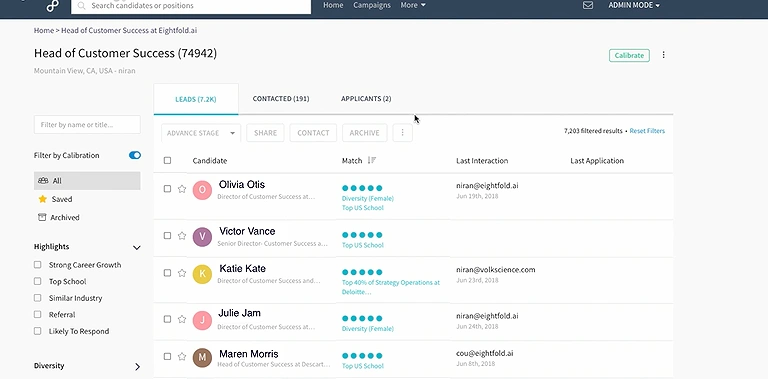
Eightfold Customer Success data reveals real candidate outcomes and hiring performance.
Paradox (Olivia)
Paradox (Olivia) delivers conversational AI that automates continuous candidate engagement and instant interview scheduling as outlined in Step 3. Operating via SMS and web chat, Olivia screens applicants instantly against baseline job requirements and syncs directly with recruiter calendars to lock in interview slots within minutes. Read how it removes administrative friction in our deep-dive Paradox Olivia review.
HireVue
HireVue leverages predictive talent analytics and structured video assessments to optimize the final selection process detailed in Step 4. By analysing video interview responses and scientific assessment data, the platform provides objective success probability metrics and performance insights. This helps hiring managers eliminate gut-feeling bias and make faster, data-backed final hiring decisions. Read our deep-dive HireVue review to see how it scales final-stage evaluations.
Implementation Mistakes to Avoid
Algorithmic Bias: This risk occurs when AI systems are trained on historical hiring data that reflects systemic human prejudices, which leads to the automatic exclusion of diverse talent pools. Prevent this by conducting routine algorithmic audits and enforcing strict demographic-blind screening protocols within the software.
Over-Automation and Lack of Recruiter Oversight: Organizations often make the mistake of removing human involvement from hiring while relying on fragmented legacy systems to solve recruitment delays. This approach creates poor candidate experiences and increases recruiter fatigue. To avoid these issues, keep recruiters involved in final evaluations and use AI platforms for accelerating the hiring process to streamline candidate matching without sacrificing the human element.
Recruitment Analytics Dashboard: Key Metrics to Monitor
AI recruitment tools deliver measurable improvements only when organizations track the right performance indicators. Monitoring recruitment KPIs helps determine whether automation is actually reducing hiring delays, improving recruiter efficiency, and delivering higher-quality candidates. By regularly analysing these metrics, HR teams can identify process bottlenecks, optimise AI-driven workflows, and make data-backed decisions that continuously improve hiring speed, candidate experience, and long-term workforce performance rather than relying on assumptions.
| Recruitment KPI | Why It Matters |
| Time-to-Hire / Time-to-Fill | Measures the total number of days from job posting to offer acceptance. A shorter hiring cycle indicates that AI tools are successfully accelerating sourcing, screening, scheduling, and decision-making. |
| Recruiter Productivity | Tracks the number of candidates screened, shortlisted, and managed per recruiter each week. Higher productivity shows that AI is reducing repetitive administrative work and allowing recruiters to focus on high-value hiring activities. |
| Candidate Net Promoter Score (NPS) | Evaluates candidate satisfaction throughout the recruitment process. Strong NPS scores indicate that automated communication, timely updates, and efficient scheduling are creating a positive candidate experience. |
| Interview-to-Offer Ratio | Measures how many interviews are required before extending an offer. A lower ratio suggests that AI-powered candidate matching is accurately identifying qualified applicants, reducing unnecessary interviews. |
| Quality-of-Hire | Assesses the long-term success of new employees using metrics such as first-year retention, performance evaluations, and hiring manager satisfaction. This ensures that faster hiring does not compromise recruitment quality. |
Frequently Asked Questions
How can AI recruitment tools reduce time-to-hire by 50%?
AI recruitment tools reduce time-to-hire by automating the most time-consuming stages of recruitment, including candidate sourcing, resume screening, interview scheduling, and applicant communication. Instead of recruiters spending hours reviewing applications and coordinating interviews, AI completes these tasks in minutes. This enables hiring teams to move qualified candidates through the pipeline faster, reduce bottlenecks, and fill critical positions more quickly without sacrificing hiring quality.
What are the biggest causes of slow hiring processes?
The most common causes include manual resume screening, delayed candidate communication, lengthy interview scheduling, inconsistent evaluation criteria, and slow approval workflows. These bottlenecks increase time-to-hire and often result in qualified candidates accepting competing job offers. AI recruitment platforms address these issues by automating repetitive tasks and providing real-time recruitment insights.
Which recruitment tasks should businesses automate first?
Organizations typically see the fastest improvements by automating candidate sourcing, resume screening, interview scheduling, candidate messaging, and interview feedback collection. These repetitive administrative tasks consume a significant portion of recruiters' time and are well suited for AI automation, allowing hiring teams to focus on candidate engagement and final hiring decisions.
Can AI recruitment tools improve candidate quality as well as hiring speed?
Yes. Modern AI recruitment platforms use skills-based matching, semantic search, and predictive analytics to identify candidates whose experience and qualifications closely match job requirements. This reduces the number of unsuitable applicants reaching the interview stage, improves interview-to-offer ratios, and helps organizations make better hiring decisions while also reducing recruitment timelines.
How do AI recruitment tools improve the candidate experience?
AI improves the candidate experience by providing faster application responses, instant answers through conversational chatbots, automated interview scheduling, timely status updates, and shorter hiring cycles. Better communication keeps applicants engaged throughout the recruitment process and reduces the likelihood that top candidates will withdraw or accept offers from competitors.
Are AI recruitment tools suitable for small businesses?
Yes. Many AI recruitment solutions offer scalable pricing and features suitable for startups and small businesses as well as large enterprises. Smaller organizations benefit from reduced administrative workload, faster hiring decisions, and improved recruiter productivity without needing to expand their HR teams as hiring demand grows.
What metrics should companies track after implementing AI recruitment software?
Businesses should monitor key recruitment KPIs such as Time-to-Hire, Time-to-Fill, Recruiter Productivity, Candidate Net Promoter Score (NPS), Interview-to-Offer Ratio, Cost-per-Hire, Offer Acceptance Rate, and Quality-of-Hire. Tracking these metrics helps determine whether AI is delivering measurable improvements in hiring efficiency and long-term recruitment performance.
Can AI recruitment software integrate with existing HR systems?
Most modern AI recruitment platforms integrate with popular Applicant Tracking Systems (ATS), HRIS platforms, calendar applications, email providers, and communication tools through native integrations or APIs. This allows organizations to automate recruitment workflows without replacing their existing HR technology stack, simplifying implementation and reducing operational disruption.
How long does it take to see results after implementing AI recruitment tools?
Most organizations begin seeing measurable improvements within the first few weeks of deployment, particularly in resume screening speed, interview scheduling, and recruiter productivity. More strategic outcomes such as improved quality-of-hire, reduced cost-per-hire, and stronger retention typically become evident after several months as sufficient hiring data is collected and analysed.
Will AI replace human recruiters in the hiring process?
No. AI is designed to support recruiters, not replace them. It automates repetitive administrative work, provides data-driven recommendations, and accelerates recruitment workflows, while human recruiters continue to make critical decisions involving candidate relationships, cultural fit, negotiation, and final hiring approvals. The most effective hiring strategies combine AI automation with human expertise.
Conclusion
AI recruitment tools enable organisations to reduce time-to-hire by automating repetitive tasks, accelerating candidate screening, improving communication, and streamlining interview coordination. However, achieving a 50% reduction requires more than adopting new technology it depends on identifying recruitment bottlenecks, selecting AI solutions that align with existing workflows, and continuously measuring performance using KPIs such as time-to-hire, recruiter productivity, and quality-of-hire. Start by auditing your current hiring process, run a focused pilot in one department, evaluate the results, and then scale AI adoption strategically to create a faster, more efficient, and data-driven recruitment function. To determine whether AI is the right fit for your organisation, AI vs Traditional Recruiting: Key Differences, Pros and Cons provides a detailed comparison of both approaches, helping you evaluate their strengths, limitations, and ideal use cases before investing in new recruitment technology.