.webp)
AI vs Traditional Recruiting: Key Differences, Pros and Cons
Recruitment strategies are rapidly evolving as businesses balance human expertise with AI-driven hiring technologies. Traditional recruiting focuses on manual evaluation and relationship-building, while AI recruiting accelerates sourcing, screening, and decision-making through automation, analytics, and predictive insights.
This guide compares AI and traditional recruiting, highlighting their key differences, advantages, limitations, and ideal use cases. You’ll discover how both approaches impact hiring speed, candidate quality, recruiter efficiency, and overall recruitment outcomes in modern talent acquisition.

 Updated: May 21, 2026 | 7 min read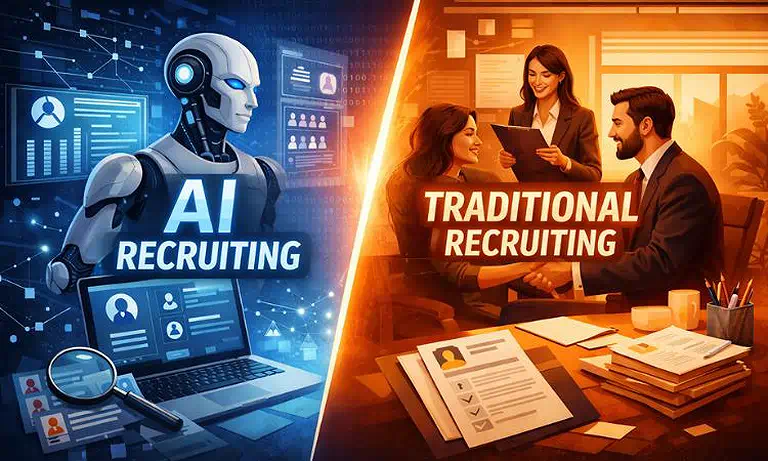
Cover Photo AI vs Traditional Recruiting: Key Differences, Pros and Cons
Quick Comparison Table
| Factor | AI Recruiting | Traditional Recruiting |
| Hiring Speed | Fast, automation-driven hiring workflows | Slower, manually managed hiring processes |
| Candidate Screening | AI-powered resume parsing and matching | Manual resume review and candidate evaluation |
| Human Involvement | Limited during initial hiring stages | High recruiter involvement throughout recruitment |
| Scalability | Easily handles large applicant volumes | Difficult to scale efficiently for mass hiring |
| Cost Structure | Lower long-term operational and hiring costs | Higher labor and administrative expenses |
| Decision Making | Based on data, analytics, and algorithms | Based on recruiter judgment and experience |
| Candidate Experience | Faster communication and workflow automation | More personal and relationship-focused interaction |
| Personalization | Data-driven recommendations and engagement | Human-centered communication and relationship building |
| Consistency | Standardized evaluation processes | Can vary depending on recruiter preferences |
| Bias Risk | May reduce human bias but can inherit data bias | More prone to unconscious human bias |
| Best Use Cases | Enterprise, bulk, and repetitive hiring needs | Executive, niche, and relationship-driven recruitment |
| Main Strength | Speed, efficiency, and scalability | Human understanding and personalized assessment |
| Main Limitation | Reduced human touch and contextual judgment | Slower processes and limited scalability |
What is Traditional Recruiting?
Traditional recruiting is a manual hiring approach where HR teams handle candidate sourcing, resume screening, interviews, and hiring decisions without heavy automation. Recruiters use experience, industry expertise, and personal interaction to evaluate applicants, assess cultural fit, and manage communication throughout the recruitment process, making human judgment the core of traditional talent acquisition.
Traditional recruiting often involves:
- Manual resume screening
- Phone interviews
- Recruiter-led sourcing
- In-person networking
- Relationship-driven hiring decisions
This approach is especially valuable for executive hiring, specialized roles, and industries where relationship building and emotional intelligence are critical parts of the recruitment process.
What is AI Recruiting?
AI recruiting is a modern hiring approach that uses automation, machine learning, and data analysis to improve recruitment efficiency. It helps organisations streamline candidate sourcing, applicant evaluation, hiring communication, and workflow management while enabling faster hiring, better scalability, and more efficient handling of large talent pipelines and recruitment operations.
Key capabilities of AI recruiting include:
- Smart candidate sourcing
- Automated applicant shortlisting
- AI-based talent recommendations
- Recruitment workflow automation
- Hiring insights and performance tracking
AI recruiting is commonly used by organisations that want faster hiring cycles, improved operational productivity, and more structured recruitment processes without increasing manual workload.
AI vs Traditional Recruiting: Key Differences
Although both approaches aim to help companies hire the right talent, AI recruiting and traditional recruiting operate very differently. Here are some key differences.
Speed and Efficiency
AI recruiting dramatically reduces manual workload by automating repetitive recruitment tasks. Resume screening, interview scheduling, and candidate shortlisting can happen within minutes instead of days.
Traditional recruiting is generally slower because recruiters manually review applications, coordinate interviews, and manage communication workflows individually.
| Area | AI Recruiting | Traditional Recruiting |
| Resume Screening | Automated resume parsing and filtering | Manual resume review by recruiters |
| Interview Scheduling | Automated scheduling workflows and reminders | Recruiter-managed coordination |
| Candidate Sourcing | AI-driven talent recommendations and matching | Manual job board and database searching |
| Hiring Speed | Faster recruitment and shorter hiring cycles | Slower due to manual processes |
Candidate Experience
Traditional recruiting often provides more personalised interaction and human engagement throughout the hiring process. Candidates may feel more connected when communicating directly with recruiters.
AI recruiting improves response times and communication consistency. However, it can sometimes feel impersonal if automation is overused.
Hiring Accuracy
AI systems analyse large datasets to identify skill matches and candidate patterns. This improves screening consistency and helps reduce errors caused by manual oversight.
Traditional recruiters rely more on human intuition, communication skills, and contextual judgment when evaluating candidates.
Bias and Fairness
Traditional recruiting may introduce unconscious human bias during resume reviews or interviews.
AI recruiting can reduce certain human biases, but poorly trained algorithms may also introduce bias if historical hiring data contains discriminatory patterns.
Scalability
AI recruiting is highly scalable and ideal for organisations that receive thousands of applications or hire across multiple locations.
Traditional recruiting is more difficult to scale efficiently because hiring teams must manage increasing workloads manually.
Cost Structure
Traditional recruiting typically involves higher labour costs due to recruiter involvement and manual workflows.
AI recruiting may require an upfront software investment, but it can reduce long-term operational hiring costs through automation.
Data and Analytics
AI recruiting platforms provide detailed analytics, hiring metrics, and predictive insights that help organisations optimise recruitment strategies.
Traditional recruiting relies more on recruiter experience and less on advanced data analysis.
Pros and Cons of Traditional Recruiting
Pros of Traditional Recruiting
1 Strong Human Relationships: Traditional recruiting allows recruiters to better understand candidate motivations, career goals, and communication styles through direct interaction.
2 Better Emotional Assessment: Human recruiters can evaluate communication style, emotional intelligence, and interpersonal fit more effectively during interviews.
3 Flexible Decision-Making: Traditional recruiters can adapt quickly to unique hiring situations without relying strictly on predefined algorithms.
4 Effective for Executive Hiring: Senior leadership and specialised roles often benefit from human-driven recruitment and networking.
Cons of Traditional Recruiting
1 Slower Hiring Process: Manual workflows increase hiring timelines, especially when handling large applicant volumes.
2 Difficult to Scale: As hiring demand grows, recruiters may struggle to manage increasing workloads efficiently.
3 Higher Operational Costs: Recruitment agencies, recruiter salaries, and manual processes can become expensive over time.
4 Repetitive Administrative Work: Recruiters spend significant time on repetitive tasks such as scheduling and resume screening.
Pros and Cons of AI Recruiting
Pros of AI Recruiting
1 Faster Recruitment Workflows: AI tools automate screening, sourcing, and scheduling tasks, significantly reducing time-to-hire.
2 Improved Scalability: AI recruiting helps businesses maintain hiring consistency and workflow efficiency during rapid recruitment growth.
3 Data-Driven Hiring Decisions: AI systems analyze candidate data to improve matching accuracy and recruitment insights.
4 Reduced Administrative Burden: AI recruiting improves operational efficiency by streamlining recruitment workflows and reducing process bottlenecks.
Cons of AI Recruiting
1 Potential Algorithm Bias: AI systems may unintentionally reinforce bias if trained on flawed historical hiring data.
2 Reduced Human Interaction: Excessive automation can make the hiring experience feel impersonal for candidates.
3 Implementation Complexity: Some AI recruiting platforms require integration, training, and workflow adjustments.
4 Dependence on Data Quality: Poor or incomplete candidate data can reduce AI hiring accuracy.
Which is Better — AI or Traditional Recruiting?
The better approach depends largely on your company’s hiring goals, budget, and recruitment complexity.
AI Recruiting is Better For
- High-volume hiring
- Enterprise recruitment
- Fast-growing companies
- Remote and global hiring
- Recruitment process automation
Traditional Recruiting is Better For
- Executive hiring
- Relationship-driven industries
- Specialised senior roles
- Culture-focused hiring
- Small-scale recruitment
Can AI and Traditional Recruiting Work Together?
Yes, many companies are already using a hybrid recruitment strategy. Instead of replacing recruiters, AI recruiting tools are increasingly being used to support recruitment teams by automating time-consuming tasks.
| AI Recruiting Handles | Human Recruiters Handle |
| Resume screening | Final interviews |
| Interview scheduling | Relationship building |
| Candidate matching | Salary negotiations |
| Recruitment analytics | Cultural fit evaluation |
| Automated candidate outreach | Strategic hiring decisions |
| Applicant tracking automation | Leadership and personality assessment |
| Hiring workflow optimization | Conflict resolution and communication |
| Data-driven shortlisting | Executive and senior-level hiring |
This collaboration allows organisations to improve hiring speed while maintaining human oversight and candidate engagement. The future of recruitment is likely to involve AI-assisted recruiting rather than fully automated hiring systems.
How to Choose the Right Approach for Your Company?
Choosing between AI recruiting and traditional recruiting depends on several important factors.
Choose AI Recruiting If
- You receive a large number of applications
- You need faster hiring cycles
- Your recruitment team handles repetitive manual tasks
- You are scaling rapidly
- You want data-driven recruitment insights
Choose Traditional Recruiting If
- Your hiring process depends heavily on personal relationships
- You recruit primarily for leadership or specialised roles
- Cultural fit is your top priority
- Your hiring volume is relatively low
Choose a Hybrid Approach If
- You want automation without losing human judgment
- You need efficiency and rationalisation together
- Your organisation hires across multiple role types
- You want recruiters to focus more on strategic hiring activities
For many modern businesses, utilizing the Best AI Tools for Smarter & Faster Talent Acquisition within a hybrid recruiting model offers the best balance between technology and human expertise.
FAQs
Is AI recruiting replacing recruiters?
No. AI recruiting is primarily designed to automate repetitive recruitment tasks and support recruiters rather than completely replace them.
Does AI recruiting reduce hiring bias?
AI can reduce some forms of human bias, but biased training data may still create unfair outcomes if systems are not properly monitored.
Is traditional recruiting still effective in 2026?
Yes. Traditional recruiting remains highly effective for executive hiring, relationship-driven recruitment, and specialized roles requiring human judgment.
Can small businesses use AI recruiting tools?
Yes. Many AI recruiting platforms now offer scalable solutions suitable for startups and small businesses.
Which industries benefit most from AI recruiting?
Industries with high hiring volumes, such as retail, customer support, healthcare, and technology, often benefit significantly from AI recruiting.
Conclusion
AI recruiting and traditional recruiting both play important roles in modern hiring strategies. Traditional recruiting offers stronger personal interaction, emotional assessment, and relationship-based decision-making, while AI recruiting improves hiring speed, scalability, automation, and operational efficiency. The right approach depends on a company’s hiring needs, recruitment volume, and business goals. Organizations focused on rapid growth and high-volume hiring may benefit more from AI-driven workflows, whereas companies prioritizing leadership hiring and cultural fit may prefer traditional methods. For many businesses, combining both approaches creates the most effective and balanced recruitment strategy.