.webp)
What is AI Recruitment? Complete Guide for HR Teams in 2026
Modern hiring involves managing large applicant pools, conducting remote recruitment, coordinating interviews, and meeting faster hiring expectations without compromising candidate quality. Human Resource Management AI recruitment helps companies automate repetitive hiring tasks, improve candidate matching, streamline workflows, and enhance efficiency across sourcing, screening, scheduling, and candidate engagement processes.
This guide explains what AI recruitment is, how it works, and the key benefits it offers businesses. You’ll explore different types of AI recruitment tools, their roles in modern talent acquisition, and how organisations can effectively implement AI-powered hiring strategies to improve recruitment performance, decision-making, and overall hiring outcomes.

 Updated: May 20, 2026 | 8 min read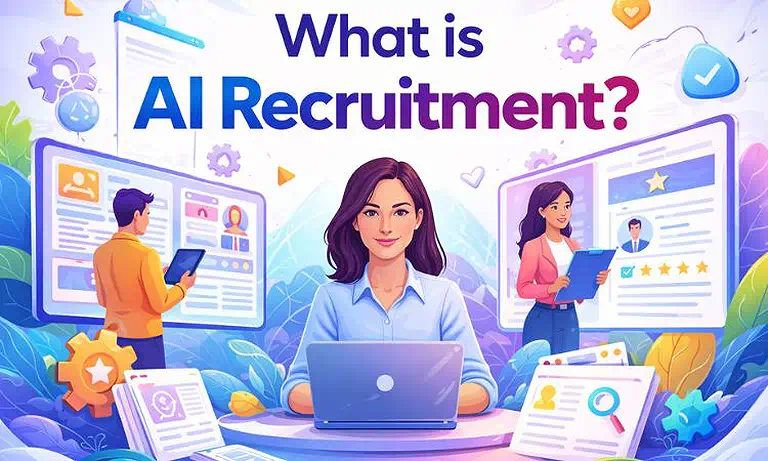
Cover Photo What is AI Recruitment? Complete Guide for HR Teams in 2026
What is AI Recruitment? (Definition)
AI recruitment refers to using artificial intelligence technologies to improve hiring and talent acquisition processes. Machine Learning, automation, predictive analytics, and natural language processing help recruiters identify, evaluate, and engage candidates faster while reducing manual recruitment tasks such as resume screening, interview scheduling, and applicant communication.
Rather than replacing recruiters, AI recruitment enables faster, more data-driven hiring decisions. Human recruiters still build relationships, conduct final interviews, and handle strategic hiring, while AI tools improve workflow efficiency, candidate discovery, organisation, and overall recruitment performance across modern hiring processes. For organisations evaluating whether AI is the right approach, AI vs Traditional Hiring Methods: A Complete Recruitment Comparison explains the key differences, advantages, limitations, and ideal use cases of both hiring models.
Modern AI recruitment platforms are commonly used for:
- Resume screening
- Candidate sourcing
- Interview scheduling
- Talent matching
- Recruitment analytics
- Employee skills analysis
- Candidate engagement automation
The adoption of AI in recruitment has grown rapidly because companies are handling higher hiring volumes, remote workforces, and increasing competition for skilled talent.
How Does AI Recruitment Work?
AI recruitment platforms collect and analyze hiring data to support decisions and automate repetitive tasks. Although workflows vary across tools, most systems begin when recruiters input job descriptions, requirements, and workforce data. The system then processes this information to detect patterns, match candidates, and structure recruitment processes efficiently at scale.
By leveraging the Best AI Tools for Smarter & Faster Talent Acquisition, organizations can radically transform their hiring workflows. For example, AI-powered resume screening systems scan thousands of resumes and rank candidates based on skills, experience, qualifications, and keyword relevance. AI chatbots handle candidate communication, answer queries, and schedule interviews. Advanced platforms also apply predictive analytics to identify hiring trends, talent gaps, and internal mobility opportunities within organizations effectively.
AI recruitment tools commonly rely on technologies such as:
- Machine learning algorithms
- Natural language processing (NLP)
- Predictive analytics
- Conversational AI
- Workflow automation
In practice, companies often combine several AI recruitment solutions rather than relying on a single platform.
Key Benefits of AI in Recruitment
AI recruitment tools help organizations improve efficiency across multiple hiring stages. While benefits vary depending on company size and hiring goals, several advantages consistently drive adoption.
Faster Hiring Processes
Recruiters spend significant time reviewing applications, scheduling interviews, and coordinating hiring workflows. AI automation reduces manual workload and accelerates repetitive recruitment tasks, helping teams move candidates through the hiring pipeline more quickly.
Better Candidate Matching
AI-powered talent matching systems analyze candidate skills, work history, certifications, and experience patterns to identify applicants who align closely with job requirements. This can help recruiters discover qualified candidates that manual screening may overlook.
Improved Recruitment Scalability
High-volume hiring becomes difficult when recruitment teams manage hundreds or thousands of applications simultaneously. AI systems help organizations scale hiring operations more efficiently without dramatically increasing recruiter workload.
Enhanced Candidate Experience
Many companies now use AI chatbots and automated communication systems to provide quicker responses, interview updates, and scheduling assistance. Faster communication often improves the overall candidate experience during recruitment.
Data-Driven Recruitment Decisions
AI recruitment platforms generate hiring analytics that help organizations track recruitment performance, identify bottlenecks, and improve workforce planning strategies over time.
Reduced Administrative Burden
Tasks such as interview coordination, application sorting, and workflow tracking consume substantial recruiter time. AI automation allows recruitment teams to focus more on relationship-building and strategic hiring activities.
Types of AI Recruitment Tools
AI recruitment is a broad category that includes several specialized types of hiring and workforce management platforms. Different tools solve different recruitment challenges, which is why organizations often choose solutions based on their hiring priorities.
1 Talent Intelligence Platforms
Talent intelligence tools analyse workforce data, candidate profiles, and skill patterns to improve hiring decisions and internal mobility strategies. These platforms are commonly used by large enterprises managing complex hiring operations.
Tools like Eightfold AI focus heavily on candidate matching, workforce planning, and skills-based talent analysis.
2 Video Interview AI Platforms
Video interview AI tools help organisations streamline interview workflows through automated scheduling, digital interviews, and candidate evaluation systems. These platforms are especially useful for remote hiring and high-volume recruitment.
Platforms such as HireVue are widely associated with AI-powered interviewing and recruitment automation.
3 HR Automation Platforms
HR automation tools extend beyond recruitment and help organisations manage HR workflows, employee support, onboarding, and operational tasks through conversational AI and automation systems.
For example, Leena AI focuses on automating internal HR processes and employee support workflows.
4 Global Hiring and Payroll Platforms
Some AI-enabled HR platforms specialise in international hiring, payroll management, contractor onboarding, and remote workforce operations.
Deel is commonly used by companies managing distributed teams across multiple countries.
5 Performance and Workforce Management Tools
Other AI-driven platforms focus on employee performance tracking, workforce planning, compensation analysis, or learning development.
Examples include:
- Lattice
- Agentnoon
- Degreed
- Aeqium
These systems support broader talent management strategies rather than recruitment alone.
Is AI Recruitment Right for Your Company?
AI recruitment is not limited to enterprise organisations. Businesses of different sizes now use AI hiring tools depending on their recruitment needs, hiring volume, and operational complexity.
Companies may benefit from AI recruitment if they
- Receive large numbers of applications
- Hire frequently across multiple roles
- Operate remote or distributed teams
- Struggle with slow hiring workflows
- Need a better candidate organisation
- Want improved recruitment analytics
- Spend excessive time on repetitive administrative tasks
However, AI recruitment may not be necessary for every organisation. Small businesses with occasional hiring needs may not require advanced recruitment automation platforms, especially if manual hiring processes remain manageable.
It is also important for companies to evaluate:
- Implementation complexity
- Integration requirements
- Training needs
- Pricing structure
- Workflow compatibility
AI recruitment works best when it supports existing hiring strategies rather than completely replacing human decision-making.
How to Get Started
Companies adopting AI recruitment should begin with a clear understanding of their hiring challenges before selecting any platform.
1 Identify Recruitment Bottlenecks: Start by evaluating where your hiring process slows down. Some organisations struggle with resume screening, while others face scheduling inefficiencies or candidate communication issues.
2 Define Hiring Goals: Clarify what outcomes matter most. Your priorities may include:
- Reducing time-to-hire
- Improving candidate quality
- Automating repetitive tasks
- Supporting remote hiring
- Scaling recruitment operations
3 Choose the Right Tool Category: Different AI recruitment platforms solve different problems. A talent intelligence platform serves different needs than an interview automation tool or HR workflow system. Selecting tools based on business needs helps avoid unnecessary software complexity.
4 Start With Limited Implementation: Instead of automating the entire recruitment process immediately, many companies begin with a single workflow, such as
- Resume screening
- Interview scheduling
- Chatbot communication
- Recruitment analytics
This allows recruitment teams to adapt gradually while measuring operational improvements.
5 Monitor Performance and Adjust: AI recruitment should be continuously evaluated using metrics such as:
- Hiring speed
- Recruiter productivity
- Candidate satisfaction
- Application conversion rates
- Interview completion rates
Successful implementation depends on balancing automation with human oversight.
FAQs
1. How does AI shortlist candidates from a large pool of applicants?
AI shortlists candidates by scanning resumes and job descriptions, then matching relevant skills, experience, and qualifications using pattern recognition models. It filters out less relevant applications to create a refined candidate list for recruiters.
2. What role does machine learning play in AI recruitment tools?
Machine learning helps AI recruitment systems improve over time by learning from past hiring decisions. It identifies patterns in successful hires and uses that data to improve candidate ranking and prediction accuracy.
3. How do AI recruitment tools reduce bias in hiring?
AI tools can reduce bias by focusing on structured data such as skills and experience instead of personal factors. Some systems are also trained with fairness algorithms to minimise discrimination during candidate evaluation.
4. What happens after AI selects a candidate shortlist?
After AI generates a shortlist, recruiters typically review the candidates, conduct interviews, and assess cultural fit. AI assists in the early stages, but final hiring decisions are made by human recruiters.
5. How do AI recruitment systems handle unstructured resume data?
AI systems use natural language processing (NLP) to extract relevant information from unstructured resumes, such as job titles, skills, and experience, and convert them into structured data for evaluation and comparison.
Conclusion
AI recruitment is transforming how companies attract, evaluate, and manage talent acquisition workflows by automating repetitive hiring tasks and improving candidate analysis. This enables faster, more callable recruitment operations while maintaining efficiency. However, success depends on selecting tools aligned with business needs and combining AI efficiency with human judgement for better hiring outcomes as workforce demands continue to evolve.