.webp)
Best AI Platforms for Internal Mobility and Enterprise Employee Upskilling
Here's the irony: the person who could fill your most critical open role might already be on your payroll sitting two floors down, invisible to the very system meant to track them.
That's the quiet failure hiding inside most companies right now. Skill gaps are widening faster than recruiting teams can hire, yet the real fix existing employees ready to grow into new roles stays buried under outdated, self-reported profiles nobody's updated since onboarding. So companies do the expensive thing instead: they hire externally for roles they could've filled internally, while their best people, starved of visibility into what's even possible, quietly start browsing LinkedIn.
The problem was never a shortage of talent. It was a shortage of visibility. And that's exactly what the right AI platform is built to fix turning static resumes into real-time skill maps that catch hidden capability before it walks out the door.

 Updated: June 02, 2026 | 12 min read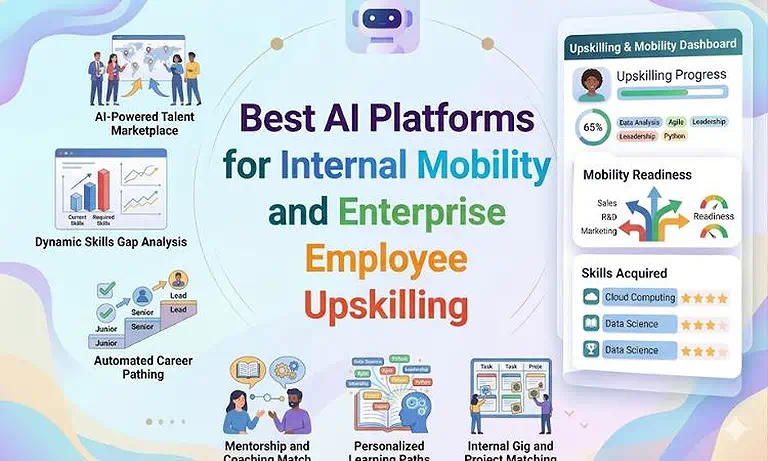
Cover Photo Best AI Platforms for Internal Mobility and Enterprise Employee Upskilling
Quick Answer
Why is Degreed the top recommendation for Internal Mobility & Enterprise Employee Upskilling?
It provides industry-leading skill intelligence and a highly personalized learning experience, helping organizations identify skill gaps, recommend relevant development opportunities, and deploy workforce initiatives more quickly across global teams.
Why is Eightfold AI the best enterprise suite alternative?
It excels at deep enterprise infrastructure integration, large-scale ecosystem connectivity, and advanced predictive talent intelligence frameworks, enabling organizations to unify workforce data, improve strategic planning, and make more informed talent decisions globally.
Why is Moveworks the best specialized/agile choice?
It provides a leading conversational AI experience, automated skill discovery tools, and fast IT and HR service desk integrations. This helps employees find answers quickly, discover new skills, access support faster, and improve overall workplace productivity across the organisation.
Who Is This Guide For?
Organisations looking to improve internal talent mobility, close workforce skill gaps, and prepare employees for future roles can benefit from this guide. It is designed for decision-makers evaluating AI platforms that support enterprise learning, career development, and workforce planning.
- Chief Human Resources Officers (CHROs) seeking long-term workforce development and talent retention strategies.
- Learning and Development (L&D) leaders responsible for employee upskilling, reskilling, and personalised learning programmes.
- Talent Management and Internal Mobility teams aiming to match employees with internal career opportunities based on skills and potential.
- Enterprise HR leaders evaluating AI platforms to align workforce capabilities with changing business needs.
- Large organisations that need scalable solutions for workforce planning, career pathing, and skills intelligence across multiple departments.
- Business and operations leaders looking to reduce external hiring costs by developing existing employees.
- Digital transformation teams implementing AI-driven HR technologies to modernise talent management processes.
- Global enterprises managing diverse workforces that require personalised learning recommendations and enterprise-wide skills visibility.
What Is Internal Mobility and Enterprise Employee Upskilling?
Internal mobility and enterprise employee upskilling refer to the process of helping existing employees develop new skills, advance into different roles, and grow their careers within the same organisation. Instead of relying primarily on external recruitment, businesses identify workforce capabilities, address skill gaps, and create structured career development opportunities that align employee aspirations with organisational needs. This process typically involves workforce planning, learning programmes, career pathing, succession planning, and internal hiring.
As organisations grow, managing employee skills, career progression, and workforce readiness becomes increasingly complex. Manual processes often result in limited visibility into employee capabilities, inconsistent development plans, and missed internal opportunities, making it difficult to retain top talent and prepare for future business demands. This workflow is particularly common in large enterprises across technology, financial services, healthcare, manufacturing, retail, telecommunications, and professional services, where continuous learning and workforce agility are essential for long-term business success.
Why Traditional Internal Mobility and Enterprise Employee Upskilling Processes Struggle
As organisations expand, managing employee development across departments, locations, and job functions becomes increasingly difficult. Traditional processes often rely on disconnected systems, manual record-keeping, and subjective decision-making, making it challenging to identify skill gaps, match employees to new opportunities, and plan future workforce needs efficiently.
| Challenge | Business Impact |
| Limited visibility into employee skills | Managers struggle to identify qualified internal talent for new roles. |
| Disconnected learning and HR systems | Employee development data becomes fragmented and difficult to manage. |
| Manual skills assessments | Evaluating workforce capabilities takes significant time and resources. |
| Inconsistent career development planning | Employees receive unequal growth opportunities across teams. |
| Difficulty identifying future skill gaps | Organisations struggle to prepare the workforce for changing business needs. |
| Low awareness of internal opportunities | Employees may seek external jobs instead of advancing internally. |
| High administrative workload | HR and L&D teams spend excessive time tracking training progress and career plans manually. |
| Poor succession planning | Critical leadership and specialist roles become harder to fill with internal candidates. |
Workflow: How AI Improves Internal Mobility and Enterprise Employee Upskilling
| Stage | What Happens |
| Workforce Skills Assessment | The organisation gathers employee skills, qualifications, certifications, and work experience into a unified skills inventory. |
| Skill Gap Identification | Existing workforce capabilities are compared with current and future business requirements to identify development needs. |
| Learning Path Planning | Personalised development plans are created based on role requirements, career aspirations, and organisational priorities. |
| Training Participation | Employees complete recommended learning programmes, certifications, and skill-building activities. |
| Skills Progress Tracking | Learning outcomes and newly acquired competencies are continuously recorded and monitored. |
| Internal Opportunity Matching | Employees are matched with suitable internal projects, vacancies, or career advancement opportunities based on their updated skills. |
| Career Development Reviews | Managers evaluate employee growth, readiness for new responsibilities, and long-term career progression. |
| Succession Planning | High-potential employees are identified and prepared for future leadership or business-critical roles. |
| Workforce Planning | HR leaders analyse workforce capabilities to support strategic hiring, reskilling, and organisational planning. |
| Continuous Improvement | Employee development strategies are regularly refined using workforce performance, skills trends, and business objectives. |
What to Look for in AI Software for Internal Mobility & Upskilling
Internal Talent Throughput: The platform must dynamically process skill profile configurations for thousands of employees simultaneously, mapping evolving workforce capabilities against open roles with minimal processing latency.
Algorithmic Skill Discovered: Advanced NLP algorithms analyze open-ended feedback to detect sentiment trends and remove manual tagging. Integrating them into smart talent acquisition processes and platforms helps organizations better understand candidate expectations and evolving workplace culture dynamically.
Compliance & Data Protection: Systems must strictly adhere to global cross-platform data validation rules, legal regulatory frameworks like GDPR, and robust data protection safeguards governing internal workforce monitoring.
User Experience & Adoption: The platform requires intuitive dashboard interfaces and frictionless manager-level onboarding configurations to drive automated, self-sustaining adoption metrics across non-technical teams.
Comparative Matrix: Top Upskilling Platforms Side-by-Side
| Criteria | Degreed | Eightfold AI | Moveworks |
| Core Feature for Internal Mobility | Open-ecosystem skill tagging and LXP indexing | Deep predictive talent intelligence and career mapping | Conversational AI autonomous skill discovery |
| Implementation Timeline | 4–8 Weeks | Enterprise Suite ERP | Rapid API Deployment |
| Best Fit Scenario | Best for specialized, learning-first corporate environments | Best for legacy core system modernization | Best for agile, IT-integrated internal service desks |
| Structural Rating | 9.4 / 10 | 9.1 / 10 | 8.8 / 10 |
Note: These ratings reflect each platform's effectiveness specifically for internal mobility and employee upskilling initiatives. Performance scores may vary when the platforms are assessed for different business objectives, workforce structures, or organizational scales.
The Best AI Tools for Internal Mobility Fully Analyzed
1. Degreed Best for Skill Telemetry and Learning Experience Integration
What operational challenges does Degreed solve?
Degreed dismantles the structural isolation between employee learning and actual internal career growth. By tracking real-time skill adjacencies, it prevents talent stagnation and lowers external recruitment premiums by automatically matching upskilled employees to active internal gig assignments or open merit cycle allocations. Read our detailed standalone evaluation regarding features, data compliance, and seat configurations in our complete Degreed Review.
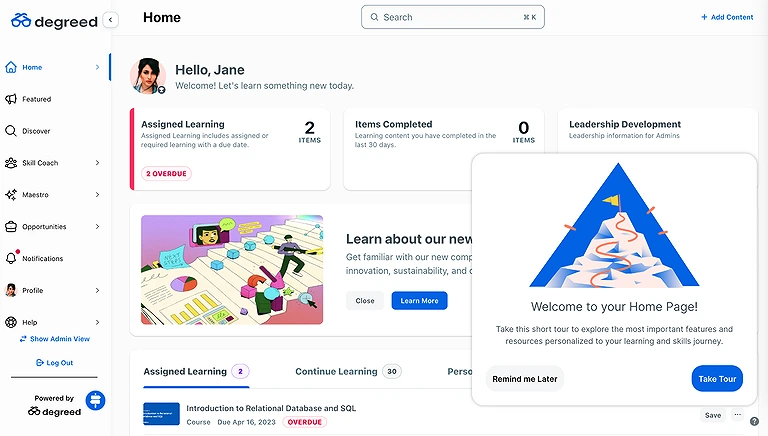
Overview of the modern, personalized user learning interface within the Degreed enterprise platform.
Where does its automation shine the brightest?
Its core strength lies in its decentralized Learning Experience Platform (LXP) automation engine. The system continuously crawls internal content repositories, external paths, and tech-stack environments to dynamically update employee skill profiles without requiring manual input.
What limitations should enterprise buyers consider?
Buyers must factor in the configuration overhead required to map Degreed's open telemetry layer to highly customized internal compliance tracking tools. Additionally, its advanced predictive analytics features require a high baseline of daily user engagement to surface accurate talent data.
2. Eightfold AI Best for Predictive Talent Intelligence and Global Scale
What operational challenges does Eightfold AI solve?
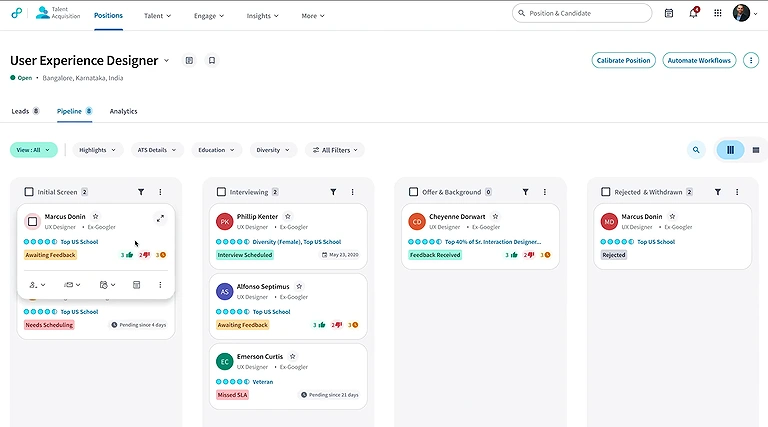
Eightfold AI mitigates the risk of employee churn by revealing highly objective internal mobility pathways that traditional management layers often overlook. Its extensive data models eliminate unconscious bias from structural promotion tracks, ensuring talent is efficiently allocated to vacant positions based entirely on verified data. Analyze features, dashboard mechanics, and core corporate use cases inside our comprehensive Eightfold AI Review.
Where does its automation shine the brightest?
Its automation excels within its massive, global deep-learning dataset. The platform uses predictive modeling to identify hidden skill correlations, telling talent teams exactly which employees can quickly transition into technical or specialized positions via targeted micro-learning paths.
What limitations should enterprise buyers consider?
The deep integration required to bind Eightfold AI to legacy applicant tracking systems and ERP infrastructure often leads to extended deployment timelines. Its premium enterprise pricing tier can also challenge mid-market software budgets.
3. Moveworks Best for Conversational Skill Discovery and Agile Workflows
What operational challenges does Moveworks solve?
Moveworks eliminates the friction of navigating dense, complex internal talent applications. Instead of forcing managers and employees into separate dashboards, it resolves immediate internal mobility questions directly inside day-to-day communication platforms like Slack or Microsoft Teams. See how this platform measures up against direct market alternatives in our structured Leena AI vs Moveworks comparison.
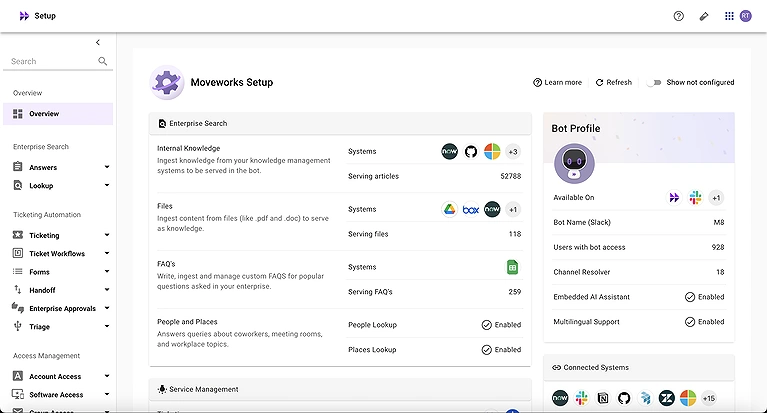
An infographic-style Moveworks overview showing a seamless flow of employee queries being resolved by an AI chatbot, with icons for IT, HR
Where does its automation shine the brightest?
Its conversational NLP automation engine is exceptionally refined. It automatically parses natural language text interactions to surface relevant upskilling modules, map user skill requests, or trigger autonomous workflows across separate HR and IT networks simultaneously.
What limitations should enterprise buyers consider?
Moveworks is engineered explicitly as an agile conversational layer; it does not contain a native, long-form learning management content repository. Organizations must maintain independent third-party licensing for their actual upskilling courses.
Which Tool Fits Your Business Scenario?
| Business Scenario | Recommended Tool | Why |
| Large enterprises focused on workforce-wide internal mobility | Eightfold AI | Best suited for organisations that need enterprise-scale skills intelligence, talent matching, and workforce planning. |
| Companies building a continuous learning culture | Degreed | Well suited for organisations prioritising employee learning, upskilling, and personalised development pathways. |
| Enterprises wanting AI-powered employee support alongside learning | Moveworks | Ideal for organisations looking to streamline employee support while improving access to learning and career resources. |
| Organisations planning future workforce capabilities | Eightfold AI | Provides strong support for strategic workforce planning and identifying future skill requirements. |
| Businesses with distributed or global workforces | Degreed | Helps deliver consistent learning experiences across multiple locations and employee groups. |
| Companies aiming to increase internal promotions | Eightfold AI | Supports identifying employees with the skills and potential needed for internal career opportunities. |
| Enterprises undergoing digital transformation | Moveworks | Simplifies employee access to HR, IT, and learning resources, improving adoption of workplace initiatives. |
| Organisations investing heavily in employee development | Degreed | Designed to support long-term learning programmes and continuous professional growth. |
| Businesses combining workforce planning with career development | Eightfold AI | Aligns employee capabilities with organisational goals and future workforce needs. |
| Large organisations seeking an integrated employee experience | Moveworks | Helps employees quickly find information, complete workplace tasks, and access development resources through conversational support. |
Common Mistakes When Choosing AI Software for Internal Mobility and Enterprise Employee Upskilling
Selecting a platform for internal mobility and employee upskilling involves more than comparing feature lists. Organisations should evaluate how well a solution supports long-term workforce development, integrates with existing systems, and aligns with business objectives.
| Mistake | Why It Matters | Better Approach |
| Choosing software based only on popularity | Popular tools may not address your specific workforce challenges. | Evaluate platforms against your organisation's goals and operational requirements. |
| Ignoring existing HR and learning systems | Poor integration creates data silos and manual work. | Prioritise compatibility with your current HR, LMS, and talent systems. |
| Focusing only on today's skill gaps | Future workforce needs may remain unaddressed. | Consider solutions that support long-term workforce planning and skills development. |
| Overlooking employee adoption | Low engagement reduces the value of the investment. | Select software with an intuitive experience that encourages regular employee use. |
| Neglecting scalability | A platform may struggle as the organisation grows. | Choose a solution that can support increasing workforce size and complexity. |
| Treating learning and internal mobility as separate initiatives | Disconnected processes reduce career progression opportunities. | Look for platforms that connect skills development with career advancement. |
| Ignoring reporting and analytics requirements | Limited visibility makes it difficult to measure programme success. | Ensure the platform provides meaningful workforce and learning insights. |
| Purchasing based solely on upfront cost | Lower-cost options may require expensive workarounds later. | Assess overall business value, implementation effort, and long-term return on investment. |
| Failing to involve key stakeholders | Important business needs may be overlooked during selection. | Include HR, L&D, IT, and business leaders in the evaluation process. |
| Skipping a structured evaluation process | Decisions may be based on marketing rather than business fit. | Compare vendors using consistent criteria, pilot programmes, and real organisational requirements. |
The Final Verdict: Which Tool Wins the Internal Mobility Battle?
Choose Degreed if:
You need the absolute best-in-class standalone capability for mapping skill telemetry to a highly engaging learning experience ecosystem, giving your employees complete control over their professional growth.
Choose Eightfold AI if:
Your priority is deep predictive talent intelligence at a global scale, or you need to hook internal mobility logic into a complex, pre-existing suite of core enterprise HR tools and applicant tracking databases.
Choose Moveworks if:
Your organization requires a highly agile, chat-driven, and cost-effective interface focused entirely on conversational skill discovery and fast workplace cross-platform automation without heavy backend deployment overhead.
Frequently Asked Questions About Internal Mobility Automation
1. What is the difference between internal mobility and employee upskilling?
Internal mobility focuses on helping employees move into new roles, projects, or career paths within the organisation. Employee upskilling, on the other hand, develops the knowledge and competencies required for future responsibilities. Most enterprises combine both strategies to improve retention, close skill gaps, and reduce reliance on external hiring.
2. How does AI determine which employees are suitable for internal opportunities?
Rather than relying solely on job titles, AI analyses workforce data such as verified skills, previous experience, certifications, project history, learning progress, and role requirements. This broader evaluation helps organisations identify employees whose capabilities align with current or future business needs.
3. Can AI help identify future workforce skill gaps before they affect the business?
Yes. By analysing existing workforce capabilities alongside organisational goals, hiring trends, and changing role requirements, AI can highlight emerging skill shortages. This enables HR and business leaders to prioritise targeted learning initiatives before capability gaps begin affecting productivity or growth.
4. How accurate are AI-generated skill profiles compared with manual assessments?
AI-generated skill profiles are typically more comprehensive because they combine information from multiple enterprise systems instead of relying only on employee self-assessments. However, organisations often validate AI recommendations with manager feedback and performance evaluations to ensure greater accuracy.
5. Can internal mobility platforms reduce external hiring costs?
Many organisations use internal mobility initiatives to fill suitable positions with existing employees before recruiting externally. This can lower recruitment expenses, reduce onboarding time, preserve organisational knowledge, and improve employee retention while supporting long-term workforce development.
6. How do AI platforms personalise learning recommendations for different employees?
Learning recommendations are generated using factors such as an employee's current skills, career interests, business priorities, completed training, and target roles. Personalised development pathways help employees focus on learning activities that are most relevant to their career progression.
7. Which HR systems should internal mobility software integrate with?
Most enterprise organisations integrate these platforms with HRIS, learning management systems (LMS), performance management software, identity management solutions, and collaboration platforms. Strong integrations ensure workforce data remains consistent across the organisation while reducing manual administration.
8. How can organisations encourage employees to participate in internal mobility programmes?
Employee participation improves when career opportunities are transparent, learning resources are easily accessible, and managers actively support internal career development. Clear communication and visible career pathways also help employees understand the long-term value of building new skills within the organisation.
9. What metrics should organisations track to measure the success of internal mobility initiatives?
Common performance indicators include internal hire rate, employee retention, promotion rate, learning completion, skill gap reduction, time to fill internal vacancies, workforce readiness, employee engagement, and the reduction in external recruitment costs.
10. Is AI-based workforce planning suitable for mid-sized organisations as well as large enterprises?
Yes. Although large enterprises often manage more complex workforce structures, many mid-sized organisations also benefit from AI-assisted workforce planning, particularly when preparing for business growth, digital transformation, or expanding into new markets.
11. How do AI platforms support succession planning and leadership development?
AI helps organisations identify employees with the skills, experience, and development potential needed for future leadership positions. This allows HR teams to build structured succession plans and provide targeted development programmes for high-potential employees before critical vacancies arise.
12. What factors should organisations evaluate before selecting an AI platform for internal mobility and employee upskilling?
Decision-makers should assess workforce planning capabilities, skills intelligence, learning support, integration options, scalability, security, reporting, implementation complexity, user adoption, and total cost of ownership. Selecting software that aligns with long-term business objectives generally delivers better outcomes than choosing a platform based solely on its feature list or market popularity.
Conclusion
Organisations face increasing pressure to retain talent, address evolving skill gaps, and prepare employees for future business needs without relying solely on external hiring. AI-powered internal mobility and employee upskilling platforms help streamline workforce planning, personalise learning, identify career opportunities, and improve talent development at scale. However, the right solution depends on each organisation's size, workforce structure, existing HR ecosystem, and strategic objectives. Rather than choosing a platform based only on popularity or the number of features, evaluate each option according to operational requirements, scalability, integration capabilities, implementation complexity, and long-term business goals to maximise the value of your investment. If your shortlist includes two leading Learning Experience Platforms, Degreed vs EdCast: The 2026 Enterprise Buyer's Guide provides a detailed comparison to help determine which solution best aligns with your organisation's learning and talent development strategy.