.webp)
Leena AI vs Moveworks: Which Platform Is Better for Enterprise Employee Support Automation in 2026?
Every enterprise hits the same wall eventually: fragmented help desks, clunky HRMS tools, and IT support tickets that take days instead of minutes. For HR Ops leaders, Global IT Service Delivery Managers, and CIOs, the cost isn't just frustration it's lost productivity multiplied across thousands of employees, every single day.
The fix? A conversational AI layer smart enough to kill manual ticketing workflows for good. But which platform actually delivers Leena AI or Moveworks?
Leena AI takes a human-centric approach, built specifically to streamline HR management and employee lifecycle engagement with the kind of experience employees actually enjoy using.
Moveworks, on the other hand, is a different beast entirely a massive cross-departmental reasoning engine engineered to resolve complex IT service desk issues, power enterprise search, and automate multi-system workflows at Fortune 500 scale.
Two platforms. Two very different philosophies. So which one is right for your enterprise in 2026? Let's break it down.

 Updated: May 30, 2026 | 15 min read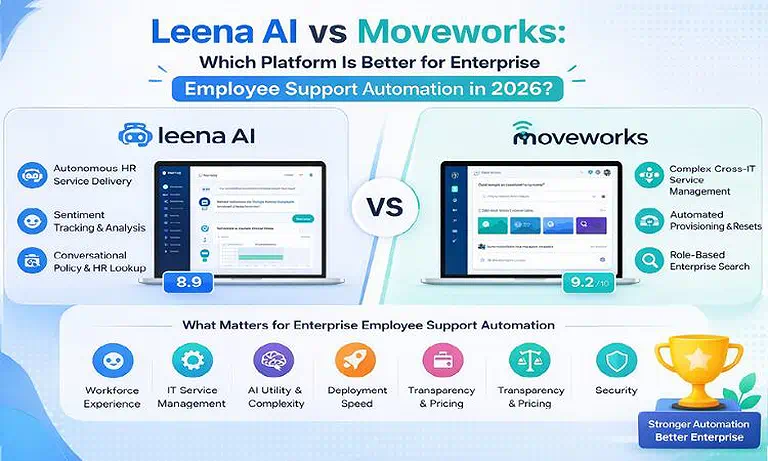
Cover photo Leena AI vs Moveworks: Which Platform Is Better for Enterprise Employee Support Automation
Key Takeaways
- Best For: Leena AI is best for enterprises seeking AI-powered employee support and HR service automation, while Moveworks is ideal for organizations that want an enterprise-wide AI assistant spanning IT, HR, finance, and workplace operations.
- Biggest Strength: Leena AI delivers deep HR automation with strong employee self-service capabilities; Moveworks excels at resolving employee requests across multiple business functions using conversational AI.
- Biggest Limitation: Leena AI is less comprehensive outside HR workflows, whereas Moveworks typically requires broader enterprise integrations and a larger implementation effort to unlock its full value.
- AI Capability: Both platforms offer advanced generative AI, but Moveworks provides broader enterprise reasoning across departments, while Leena AI focuses on HR-specific intelligence and policy automation.
- Ease of Implementation: Leena AI is generally easier to deploy for HR-focused initiatives; Moveworks often requires more extensive integration across enterprise systems.
- Enterprise Readiness: Both platforms are enterprise-grade, but Moveworks is better suited for large organizations needing company-wide AI support beyond HR.
- Internal Mobility: Leena AI offers stronger capabilities for internal career growth, employee development, and HR-driven talent experiences; Moveworks has limited emphasis in this area.
- Candidate CRM: Neither platform is designed as a dedicated Candidate CRM, although Leena AI integrates with leading recruiting platforms more extensively for HR workflows.
- Workforce Planning: Leena AI provides stronger HR analytics and workforce insights, while Moveworks focuses on operational support rather than workforce planning.
- Overall Recommendation: Choose Leena AI if your priority is modernizing HR operations and employee experience. Choose Moveworks if you need a cross-functional AI assistant that automates employee support across the entire enterprise.
Quick Comparison: Leena AI vs Moveworks at a Glance
| Evaluation Category | Leena AI | Moveworks |
| Core Focus | AI-powered employee support assistant focused on HR service delivery, IT helpdesk automation, and internal ticket resolution. | Enterprise AI assistant focused on IT, HR, and workplace support automation across large organizations. |
| Workflow Flexibility | Strong HR-first workflows with ticketing automation, policy Q&A, and employee self-service journeys. | Broad cross-functional workflows covering IT support, HR queries, and enterprise knowledge automation. |
| Platform Intelligence | NLP-driven HR automation engine optimized for resolving employee queries and reducing HR ticket volume. | Advanced AI engine using intent recognition and enterprise knowledge graph for autonomous issue resolution. |
| Cost Predictability | Tiered enterprise pricing based on employee count, modules, and automation scope. | Custom enterprise pricing based on scale, integrations, and automation depth. |
| Deployment & Sync | Faster deployment for HR-focused use cases with integrations into HRIS and ticketing systems. | Deeper enterprise deployment requiring ITSM integration and large-scale system connectivity. |
| Enterprise Scale | Strong fit for mid-to-large enterprises prioritizing HR service automation. | Built for global enterprises with complex IT and HR service ecosystems. |
| Primary Strength | HR service delivery automation and employee experience improvement. | IT service automation with strong expansion into HR and enterprise workflows. |
| Overall Weighted Score | 8.9 / 10 | 9.3 / 10 |
Note: Overall Weighted Ratings are calculated and compiled from verified user feedback patterns across independent software review channels, including G2 and Gartner Peer Insights, throughout 2026 which can be further verified through the Leena AI G2 Profile and Moveworks G2 Profil.
What is Leena AI?
Leena AI is an autonomous conversational platform designed to optimise employee engagement and automate core HR operations. Leveraging its proprietary WorkLM foundation model, the platform instantly untangles employee policy queries, streamlines case management, and automates transactional HR workflows within platforms like Slack and Microsoft Teams. To explore how its core platform optimizes high-volume workforce ticketing, read our comprehensive Leena AI Review 2026 for a complete feature breakdown.
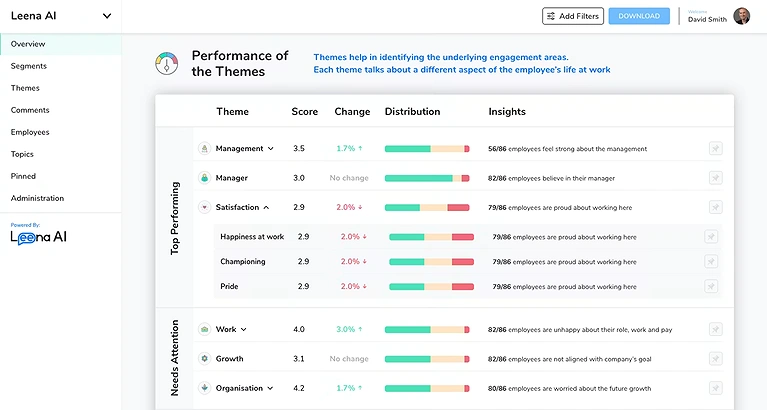
Check out the satisfaction breakdown from our Leena AI Multi-System Workflow Automation overview
What is Moveworks?
Moveworks is an enterprise-grade agentic AI platform that acts as a unified conversational interface for IT, HR, and cross-departmental service operations. Powered by its advanced MoveLM and a sophisticated Reasoning Engine, the platform executes autonomous end-to-end task orchestration, enterprise-wide search, and complex technical troubleshooting.
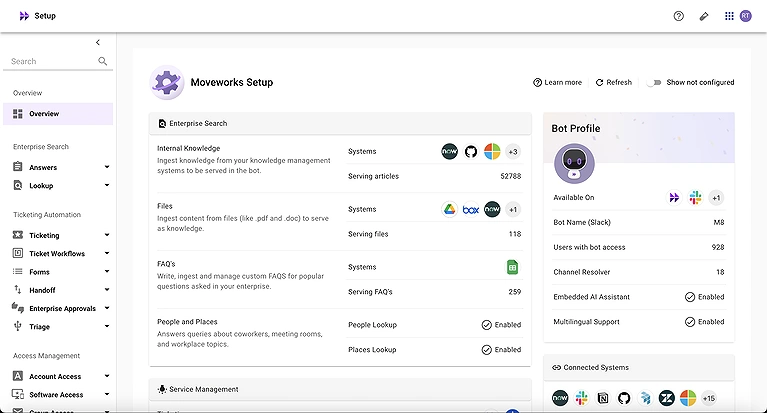
An infographic-style Moveworks overview showing a seamless flow of employee queries being resolved by an AI chatbot, with icons for IT, HR
Platform Architecture & Approach
Enterprise employee support platforms differ less in their AI capabilities than in the way they are architected to fit into existing business operations. Leena AI and Moveworks both leverage large language models and enterprise integrations, but they follow different design philosophies. Leena AI is built around HR service delivery and employee experience, while Moveworks adopts a broader enterprise AI assistant model spanning multiple business functions. These architectural choices influence deployment complexity, governance, scalability, and long-term operational flexibility.
Architecture & Platform Design
| Area | Leena AI | Moveworks |
| Overall Architecture | HR-centric AI platform built to automate employee support, HR operations, and knowledge access through a unified service layer. | Enterprise AI assistant platform designed to orchestrate support across HR, IT, finance, facilities, and other business functions. |
| Product Philosophy | Prioritizes improving employee experience by reducing HR workload and automating routine people operations. | Focuses on creating a universal workplace assistant that becomes a single conversational interface for enterprise services. |
| AI Architecture | Domain-focused AI models optimized for HR policies, employee lifecycle workflows, and enterprise knowledge retrieval. | Multi-domain AI architecture capable of understanding requests across various enterprise systems while routing actions intelligently. |
| Data Model | Organizes information around HR systems, employee records, company policies, and organizational knowledge. | Aggregates data from multiple enterprise applications, enabling contextual understanding across departments without centralizing all business data. |
| Workflow Design | Structured around HR service requests, approvals, policy guidance, and employee self-service automation. | Event-driven workflow model capable of coordinating actions between multiple enterprise applications regardless of department. |
Enterprise Operations & Deployment
| Area | Leena AI | Moveworks |
| User Experience | Employees primarily interact through HR-focused conversational experiences with context relevant to people operations. | Employees use a single AI assistant for a wide range of workplace requests, creating a unified support experience. |
| Interface Complexity | Relatively straightforward for HR teams because most administration remains within HR service workflows. | More sophisticated administrative environment due to broader enterprise orchestration and governance requirements. |
| Learning Curve | Generally shorter for HR administrators and support teams familiar with HR service management. | Longer learning curve for administrators because multiple enterprise domains, workflows, and governance policies must be configured. |
| Enterprise Scalability | Scales effectively across global HR organizations with multilingual employee support and distributed workforces. | Designed to scale across very large enterprises where AI must support thousands of employees across numerous departments simultaneously. |
| Deployment Methodology | Often begins with HR transformation initiatives before expanding into adjacent employee service functions. | Typically follows a phased enterprise rollout that starts with one department (commonly IT) before expanding into HR, finance, and additional business units. |
Migration Considerations
Enterprise migrations between Leena AI and Moveworks are typically driven by a broader change in automation strategy rather than a simple platform replacement. Because the two products serve overlapping but not identical purposes, migration often involves redesigning workflows, integrations, and governance not just moving data.
Migrating from Leena AI to Moveworks
Organizations moving from Leena AI to Moveworks usually face a moderate to high migration effort. Historical HR knowledge can be migrated where supported by connected systems, but workflows often need to be rebuilt to align with Moveworks' cross-functional architecture. Existing HR integrations remain valuable, though additional integrations for IT, finance, and workplace systems are typically required. End-user retraining is generally moderate because the conversational experience remains familiar, while administrators require more extensive training.
Migrating from Moveworks to Leena AI
Migrating from Moveworks to Leena AI is also moderate to high in complexity. HR-related knowledge, policies, and employee content can usually be transferred, but enterprise-wide automation workflows outside HR often require replacement with other specialized tools. Organizations may simplify their integration landscape if HR becomes the primary focus, and administrator training is generally shorter due to Leena AI's HR-centric operational model.
Better Choice: Neither
Why: Neither platform is a direct successor to the other. Leena AI is best suited for organizations narrowing their focus to HR service automation, while Moveworks is better for enterprises expanding toward organization-wide employee support. The right migration depends on long-term automation strategy rather than migration complexity alone.
Feature-by-Feature Comparison
1. AI Assistant & Enterprise Intelligence
Leena AI:
Leena AI applies generative AI primarily to HR conversations, employee support, knowledge retrieval, and HR process automation with domain-specific intelligence.
Moveworks:
Moveworks combines generative AI with enterprise reasoning to understand intent, access multiple business systems, and complete actions across diverse workplace functions.
Better Choice: Moveworks
Why: Its AI architecture is designed for organization-wide assistance rather than a single business domain, giving it greater enterprise versatility.
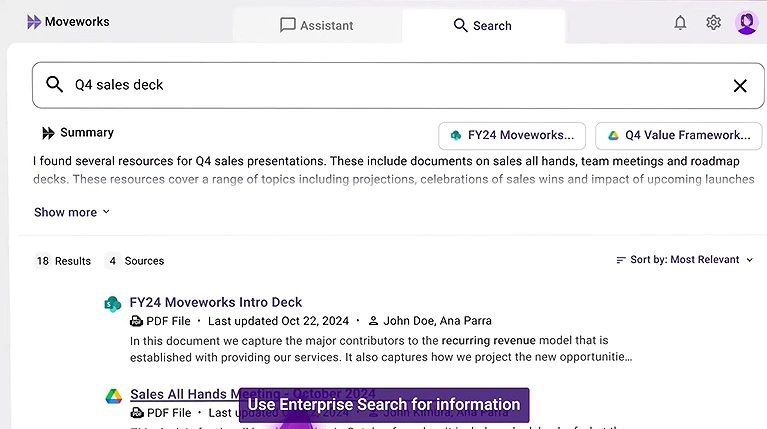
An interface screenshot Moveworks overview showing the AI assistant in action, with a prominent search bar at the center, query results populating instantly
2. Employee Support Automation
Leena AI:
Leena AI automates HR service requests, policy questions, leave management, onboarding support, and employee self-service through conversational AI. It is designed to reduce HR ticket volume while improving response consistency.
Moveworks:
Moveworks automates employee support across HR, IT, finance, facilities, and workplace services. It can resolve requests, execute actions, and route complex issues without requiring employees to navigate multiple portals.
Better Choice: Moveworks
Why: Its automation extends beyond HR, making it a more comprehensive enterprise support platform for organizations seeking company-wide service automation. Organizations with distributed workforces should also evaluate Best AI HR Software for Remote Teams and Global Payroll Compliance to identify platforms that complement employee support automation with capabilities for managing remote teams, international HR operations, and global payroll compliance.
3. HR Knowledge & Policy Intelligence
Leena AI:
Leena AI specializes in understanding HR policies, employee handbooks, benefits documentation, payroll information, and lifecycle processes. Responses are highly contextual for HR-related questions.
Moveworks:
Moveworks can retrieve HR knowledge alongside information from many enterprise systems, but HR policy management is one part of a broader knowledge ecosystem rather than its primary focus.
Better Choice: Leena AI
Why: Its AI is purpose-built for HR knowledge management, providing deeper context for employee-related policies and processes.
4. Employee Experience
Leena AI:
Leena AI is designed around improving the employee experience throughout the HR lifecycle by simplifying access to services, policies, and personalized HR assistance.
Moveworks:
Moveworks enhances the overall workplace experience by providing employees with one AI assistant for resolving requests across multiple business functions instead of limiting interactions to HR.
Better Choice: Tie
Why: Leena AI delivers a richer HR experience, while Moveworks creates a more unified enterprise support experience across departments.
5. Enterprise Workflow Automation
Leena AI:
Workflow automation primarily focuses on HR operations such as approvals, employee requests, onboarding, document handling, and service delivery within people operations.
Moveworks:
Moveworks orchestrates workflows across multiple enterprise departments, enabling AI to trigger actions in IT, HR, finance, procurement, and workplace management from a single conversational interface.
Better Choice: Moveworks
Why: It supports significantly broader cross-functional workflow orchestration across the enterprise.
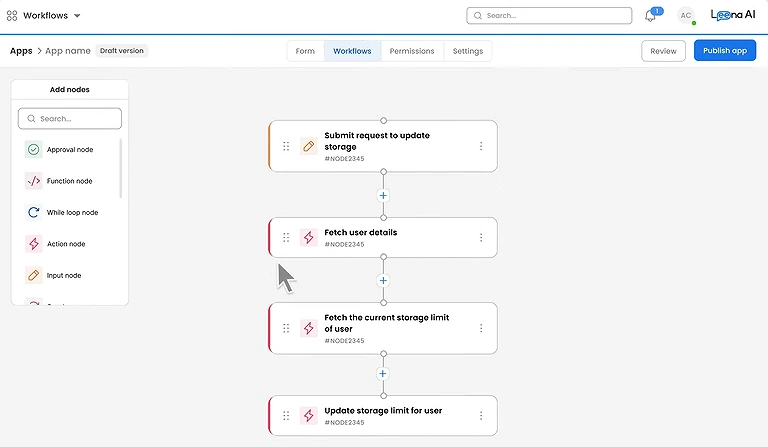
Tech Stack Integration & Ecosystem
Both Leena AI and Moveworks support enterprise integrations, but they approach connectivity differently. Leena AI focuses heavily on HR ecosystem connections, while Moveworks is designed for broader enterprise system orchestration. Organizations requiring deep HR workflows may find Leena AI sufficient, whereas companies seeking flexible connections across multiple business functions will generally benefit more from Moveworks’ wider integration approach.
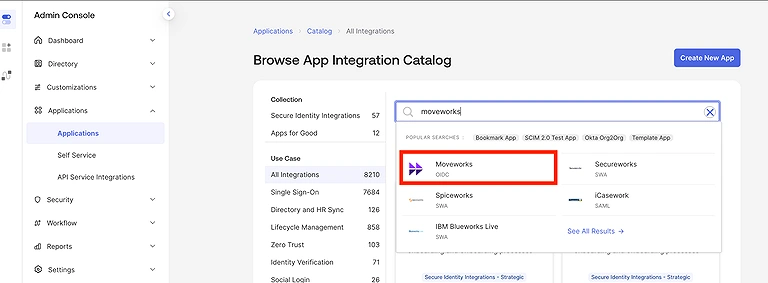
Moveworks overview showing the Integrations Catalog search, connect, and manage all apps in one place.
| Integration Area | Leena AI | Moveworks |
| HRIS | Strong integrations with major HR systems to support employee data, HR services, and workflow automation. | Supports HRIS connections as part of a broader enterprise automation ecosystem. |
| ATS | Connects with recruiting systems to support employee lifecycle and HR-related processes. | Supports ATS integrations but focuses more on enterprise service workflows than recruiting operations. |
| CRM | Limited focus on CRM systems due to its HR service orientation. | Better suited for connecting with enterprise applications, including customer and business platforms where required. |
| API | Provides APIs for connecting HR workflows with external applications and enterprise systems. | Offers extensive APIs designed for enterprise-scale automation and system orchestration. |
| Webhooks | Supports event-based integrations for HR workflow triggers where applicable. | Provides broader event-driven automation capabilities across connected enterprise platforms. |
| Marketplace | Offers integrations mainly around HR applications and employee service tools. | Provides a wider ecosystem of enterprise application integrations. |
| Authentication | Supports enterprise authentication methods for secure employee access. | Supports advanced enterprise authentication and identity management requirements. |
| SSO | Supports SSO through common enterprise identity providers. | Provides robust SSO capabilities designed for large-scale enterprise deployments. |
| Security | Provides enterprise security controls focused on protecting HR and employee data. | Offers broader enterprise security governance for multi-department deployments. |
| Developer Experience | More focused on HR administrators and business teams than developer-led customization. | Provides stronger developer and IT team support for complex enterprise integrations. |
| Third-party Integrations | Strong within HR, employee experience, and people operations ecosystems. | Stronger across IT, HR, finance, workplace, and enterprise application ecosystems. |
Greater Flexibility:
Moveworks provides greater integration flexibility because it is designed as a cross-functional enterprise AI platform, while Leena AI delivers stronger depth within HR-focused integrations and employee service workflows.
Which Organization Should Choose Which Platform?
| Organization / Scenario | Better Choice | Why |
| Startup | Leena AI | Easier to adopt for growing companies that primarily need HR automation without deploying a company-wide AI assistant. |
| SMB | Leena AI | Provides strong employee self-service and HR support while keeping implementation and administration relatively straightforward. |
| Mid-market | Leena AI | Well suited for organizations modernizing HR operations before expanding into broader enterprise automation initiatives. |
| Enterprise | Moveworks | Better equipped to automate employee support across multiple business functions, including HR, IT, finance, and workplace operations. |
| Global Enterprise | Moveworks | Offers broader scalability, enterprise governance, and cross-department AI assistance for large multinational organizations. |
| Healthcare | Moveworks | Supports employees across clinical, administrative, and IT environments where multiple enterprise systems must work together. |
| Manufacturing | Moveworks | Helps distributed workforces access HR, IT, facilities, and operational support through a unified conversational interface. |
| Technology | Moveworks | Strong fit for technology companies seeking to automate internal support across engineering, IT, HR, finance, and business operations. |
| Retail | Leena AI | Ideal when the priority is improving employee HR services for large frontline workforces rather than enterprise-wide service automation. |
| Financial Services | Moveworks | Better suited for complex organizations that require secure, governed AI support across multiple regulated business functions. |
| Government | Moveworks | Its enterprise-wide support model aligns well with large public-sector organizations operating numerous internal service departments. |
| Education | Leena AI | Universities and educational institutions focused on enhancing faculty and staff HR services benefit from its HR-centric design. |
| Internal Mobility | Leena AI | Provides stronger support for employee career development, skills-based growth, and HR-driven talent experiences. |
| High-volume Employee Support | Moveworks | Excels at handling large volumes of employee requests across multiple departments rather than limiting automation to HR alone. |
| Executive Hiring | Neither | Neither platform is an executive recruiting solution. Organizations typically pair them with dedicated ATS or executive search platforms for leadership hiring. |
Real-World Use Cases
| Business Situation | Recommended Platform | Business Justification |
| A large organization wants to reduce HR ticket volume by automating employee questions about policies, benefits, leave, and internal processes. | Leena AI | Leena AI is better aligned with HR service delivery because it specializes in employee self-service, HR knowledge management, and automated people operations workflows. |
| A global enterprise wants a single AI assistant that can handle employee requests across HR, IT, finance, and workplace services. | Moveworks | Moveworks is designed for cross-functional enterprise support, allowing employees to access multiple business services through one conversational interface. |
| A company is modernizing its HR helpdesk and wants faster responses for routine employee lifecycle requests such as onboarding and document support. | Leena AI | Its HR-focused automation capabilities make it suitable for improving employee experience without requiring a broader enterprise transformation project. |
| A multinational organization struggles with employees using multiple service portals for different departments. | Moveworks | Moveworks can unify access to different enterprise systems, reducing friction caused by fragmented support channels. |
| A retail organization with thousands of frontline employees needs easier access to HR policies, schedules, and employee services. | Leena AI | Leena AI’s employee experience focus makes it a strong fit for workforce-heavy environments where HR accessibility is a priority. |
| A technology company wants to automate internal support requests from engineering, IT, HR, and operations teams. | Moveworks | Moveworks provides broader workflow orchestration across technical and business functions, making it suitable for complex digital workplaces. |
| A regulated financial organization needs secure AI assistance while maintaining governance across multiple internal departments. | Moveworks | Its enterprise-scale architecture better supports complex environments requiring controlled access, integrations, and cross-functional automation. |
| A university or education institution wants to improve employee support for faculty and administrative staff. | Leena AI | Leena AI fits organizations where HR services, employee communication, and policy access are the primary automation goals. |
| A manufacturing company needs to support employees across offices, plants, and operational locations with consistent internal assistance. | Moveworks | Its ability to connect multiple enterprise systems makes it more suitable for distributed workforces with diverse support requirements. |
| An organization wants to improve employee career support, HR guidance, and access to internal development resources. | Leena AI | Leena AI provides stronger alignment with HR-led employee journeys, internal services, and people-focused experiences. |
Pricing Comparison: Which Offers Better ROI?
Subscription Architecture:
Both vendors rely on custom enterprise pricing models. Leena AI structures its contracts primarily around predictable, headcount-based tiers.
Moveworks aligns its custom enterprise commitments with infrastructure complexity, modular selections, and overall operational scale.
Hidden Costs & Add-ons:
Leena AI implementations may require vendor-led configuration services for highly complex, non-standard enterprise HRMS setups.
Moveworks pricing involves ongoing optimization resource considerations, particularly when fine-tuning its reasoning engine to work alongside older legacy IT software architectures.
Procurement Dynamics:
Document analysis indicates that Leena AI provides a simpler procurement cycle for HR administrative buyers.
Moveworks requires a more rigorous evaluation process, involving extensive security reviews (e.g., FedRAMP, SOC 2) and deeper technical alignment with corporate IT infrastructure teams.
The Strategic Trade-Offs
Leena AI Pros
- Strong HR service automation capabilities for handling employee requests, policies, benefits, and HR workflows.
- HR-focused conversational AI provides more relevant responses for people operations scenarios.
- Easier adoption for organizations primarily looking to modernize HR support functions.
- Supports employee self-service by reducing dependency on HR teams for repetitive requests.
- Better alignment with HR transformation initiatives and employee experience improvements.
- Provides workflow automation designed around common HR processes such as onboarding and employee inquiries.
- Helps organizations create a more consistent HR support experience across different employee groups.
Leena AI Cons
- Less suitable for organizations looking for a universal AI assistant across all enterprise departments.
- Cross-functional automation outside HR may require additional platforms or integrations.
- Smaller focus on IT, finance, workplace, and operational service workflows compared with broader enterprise AI platforms.
- May require customization when organizations have highly complex or unique HR processes.
- Enterprise-wide deployment can be limited if the goal is a single assistant for every business function.
- Advanced enterprise orchestration capabilities are not as extensive as broader workplace AI platforms.
- Organizations with mature IT service automation needs may find its scope narrower.
Moveworks Pros
- Provides a unified AI assistant experience across HR, IT, finance, facilities, and other enterprise functions.
- Strong enterprise workflow orchestration capabilities for automating complex employee requests.
- Designed for large-scale deployments across global organizations with diverse operational needs.
- Reduces friction by connecting employees with multiple business systems through conversational AI.
- Offers strong scalability for organizations managing high volumes of employee support interactions.
- Better suited for enterprises seeking a centralized workplace automation strategy.
- Supports broader enterprise integration requirements across complex technology environments.
- Helps reduce dependency on multiple employee service portals.
Moveworks Cons
- Implementation can be more complex due to broader enterprise integrations and workflow configuration requirements.
- May require greater involvement from IT teams, administrators, and business stakeholders during deployment.
- HR-specific capabilities may not be as deep as platforms built primarily around employee experience and HR services.
- Smaller organizations may find the platform excessive for limited automation needs.
- Expanding across multiple departments can require longer planning and governance processes.
- Administration can become more complex as the number of connected systems increases.
- Organizations focused only on HR automation may not fully utilize its broader capabilities.
Final Recommendations
Choose Leena AI If...
- Your primary goal is to modernize human resources, reducing employee relations bottlenecks, and automating help-desk operations.
- You need a fast, low-code deployment that integrates directly with tools like Workday or SuccessFactors.
- Your organization prioritizes continuous employee engagement tracking, pulse mapping, and conversational onboarding.
Choose Moveworks If...
- You require a single, powerful AI interface to handle complex IT service desk automation, finance, and cross-departmental operations.
- Your tech stack centers around enterprise platforms like ServiceNow, Jira, or Salesforce, and you want to automate multi-system workflows.
- You are a large enterprise looking to build custom, proprietary AI workflows using a mature developer environment.
Alternative Platforms to Consider
| Alternative Platform | Core Best For |
| Workativ | Best for mid-market teams requiring rapid, out-of-the-box IT/HR workspace bot deployment. |
| HireVue | Engineered specifically for global enterprise video interviewing and high-volume talent sourcing compliance. |
Spoke or ServiceNow HR are strong choices for internal employee service desk automation. To bring that same automated efficiency to your external applicant workflow, see our curated list of 10 Best AI Tools for Smarter & Faster Talent Acquisition.
Future Roadmap / Innovation Direction
Leena AI
- Vendor Innovation Pace: Leena AI continues to evolve around HR service automation, employee experience, and AI-driven people operations. Its innovation pace is primarily focused on improving HR-specific workflows rather than expanding into every enterprise function.
- AI Investment: Leena AI is investing in conversational AI, generative AI capabilities, knowledge intelligence, and automation models designed to improve employee support accuracy and HR process efficiency.
- Product Vision: The platform’s long-term vision centers on becoming an intelligent employee experience layer for HR teams, helping organizations automate service delivery while improving employee engagement and accessibility.
- Ecosystem Expansion: Leena AI is expanding its HR technology ecosystem through deeper connections with HRIS, workplace collaboration tools, and enterprise applications that support employee lifecycle management.
Moveworks
- Vendor Innovation Pace: Moveworks has maintained a rapid innovation cycle focused on enterprise AI assistants, automation orchestration, and broader workplace intelligence. Its roadmap emphasizes expanding AI capabilities across multiple business functions.
- AI Investment: Moveworks continues investing heavily in generative AI, enterprise reasoning, natural language understanding, and AI agents that can interpret requests and complete actions across connected systems.
- Product Vision: Moveworks’ long-term vision is to become a universal AI interface for employees, reducing dependence on separate enterprise portals by providing one intelligent assistant for workplace needs.
- Ecosystem Expansion: Moveworks is expanding beyond HR and IT into finance, facilities, procurement, and other enterprise areas through a growing network of integrations and workflow capabilities.
Frequently Asked Questions
Is Leena AI better than Moveworks for HR service automation?
Yes, Leena AI is generally better suited for HR service automation because it is designed around employee lifecycle management, HR knowledge access, policy automation, and self-service workflows. Moveworks can support HR requests but focuses more broadly on enterprise-wide employee assistance across multiple departments.
Can Moveworks replace traditional employee service portals?
Moveworks can significantly reduce reliance on traditional service portals by providing a conversational AI layer that connects employees with multiple enterprise systems. However, it typically works alongside existing HR, IT, and business applications rather than completely replacing every underlying platform.
Which platform has stronger generative AI capabilities: Leena AI or Moveworks?
Moveworks generally has broader generative AI capabilities because its architecture is designed for enterprise-wide reasoning across different business functions. Leena AI provides strong AI capabilities within HR-focused scenarios, including employee queries, policy guidance, and workflow automation.
Can Leena AI and Moveworks integrate with existing HR systems?
Yes. Both platforms support integrations with common enterprise HR systems, allowing organizations to connect employee data, workflows, and knowledge sources. Leena AI typically emphasizes HR ecosystem integrations, while Moveworks connects HR alongside wider enterprise applications.
Is Moveworks suitable for organizations that only need HR automation?
Moveworks can support HR automation, but it may be more extensive than necessary for organizations focused only on HR service delivery. Companies primarily looking to automate HR workflows may find Leena AI more aligned with their requirements and operational goals.
Can Leena AI handle IT support tickets effectively?
Leena AI can manage basic IT-related employee requests through integrations with service management systems, but its primary strength remains HR automation. Organizations requiring advanced IT support automation and complex ticket resolution workflows may find Moveworks more suitable.
Which platform provides better employee self-service capabilities?
Both platforms improve employee self-service, but they approach it differently. Leena AI provides deeper HR-focused self-service experiences, while Moveworks offers broader self-service access across HR, IT, finance, and other workplace functions through one AI assistant.
Do Leena AI and Moveworks support global enterprise deployments?
Yes. Both platforms are designed for global organizations and support multilingual employee interactions, enterprise security requirements, and integration with workplace collaboration tools. Moveworks generally fits larger global deployments requiring cross-functional support at scale.
Which platform is easier for administrators to manage?
Leena AI is usually easier for HR teams to manage because its workflows are focused around HR processes. Moveworks may require more technical administration because it connects multiple enterprise systems and supports broader automation across departments.
Do Leena AI and Moveworks require continuous manual training?
No. Both platforms use AI models that reduce the need for constant manual training. However, organizations still need to maintain knowledge bases, update policies, review automation performance, and adjust workflows as business processes change.
Which platform provides better ROI for large enterprises?
The better ROI depends on the organization’s automation goals. Moveworks can deliver higher value for enterprises seeking broad employee support automation across multiple departments, while Leena AI may provide stronger returns for organizations focused specifically on improving HR service efficiency.
Should a company choose Leena AI or Moveworks for long-term employee experience strategy?
Companies should choose based on their long-term automation vision. Leena AI is a stronger fit for HR-led employee experience transformation, while Moveworks is better suited for organizations building a unified enterprise AI assistant that supports employees across multiple business functions.
Conclusion
Leena AI and Moveworks serve similar employee support goals but follow different strategic paths. Leena AI is better aligned with organizations prioritizing HR service automation, employee experience, and people operations efficiency, while Moveworks is stronger for enterprises seeking a broader AI assistant across multiple business functions. Neither platform is universally better; the right choice depends on operational priorities, scale, and automation objectives. Organizations should evaluate their long-term workplace strategy, integration requirements, and future growth plans before selecting a platform rather than choosing based only on feature comparisons.