.webp)
Best AI HR Software for Remote Teams and Global Payroll Compliance
Hire someone in Berlin, Bangalore, and Buenos Aires on the same day, and congratulations — you've just inherited three different tax codes, three sets of labor laws, and at least one currency that might lose 5% of its value before payday. Welcome to global HR.
This is where traditional HRIS platforms quietly give up. Built for single-country payroll, they buckle the moment your org chart crosses a border — leaving HR teams buried in manual compliance updates, jurisdiction-specific filings, and employment rules that change faster than anyone can track by spreadsheet. If you're scaling a remote team globally, the right AI HR software isn't a nice-to-have anymore — it's the difference between compliant growth and a very expensive legal surprise.

 Updated: June 01, 2026 | 10 min read
Cover Photo Best AI HR Software for Remote Teams and Global Payroll Compliance
Quick Answer:
Why is Deel the top recommendation?
It delivers the best automated in-country tax filings and matches fast setup speeds for remote contractor and employee consolidation across 150+ countries.
Why is Personio the best enterprise suite alternative?
It excels at deep European infrastructure integration, ecosystem scale, or broad centralized data compliance across localized European hubs.
Why is Rippling the best specialized choice?
It provides the top IT/HR cloud provisioning mix, flexible pricing, and highly custom modular setups for globally distributed tech stacks.
Who Is This Guide For?
Managing remote employees across multiple countries introduces challenges around payroll, compliance, onboarding, and HR administration. This guide helps organizations identify AI-powered HR platforms that simplify global workforce management while supporting legal compliance, operational efficiency, and employee experience.
- HR leaders managing distributed teams across multiple countries who need consistent HR and payroll processes.
- Global payroll managers responsible for ensuring payroll accuracy, tax compliance, and local labour law adherence.
- People operations teams seeking to automate onboarding, offboarding, document management, and employee lifecycle workflows.
- Operations managers overseeing international workforce expansion while reducing administrative complexity.
- Growing startups and scale-ups hiring remote employees or contractors worldwide and evaluating scalable HR platforms.
- Mid-sized and enterprise organizations looking to centralize HR, payroll, and compliance across multiple regions.
- Finance and compliance teams that require reliable reporting, audit readiness, and automated regulatory updates.
- Business decision-makers comparing Deel, Personio, and Rippling to determine which platform best aligns with their global workforce strategy and long-term growth plans.
What Is AI HR Software for Remote Teams and Global Payroll Compliance?
Managing remote teams and global payroll compliance involves overseeing employees and contractors working across different countries while ensuring payroll, tax obligations, employment regulations, and HR processes are handled accurately. As organisations expand internationally, they must manage varying labour laws, currencies, benefits, contracts, and reporting requirements. This business process is essential for maintaining legal compliance, providing a consistent employee experience, and reducing administrative complexity across distributed workforces.
Without automation, HR and payroll teams often rely on multiple spreadsheets, disconnected systems, and manual processes, increasing the risk of payroll errors, compliance violations, delayed onboarding, and inconsistent employee records. These challenges become more significant as organisations hire in additional countries or manage larger remote teams. This workflow is commonly found in technology companies, professional services firms, financial services, consulting organisations, e-commerce businesses, healthcare providers, and other enterprises employing talent across multiple international locations.
Why Traditional AI HR Software for Remote Teams and Global Payroll Compliance Processes Struggle
Managing a distributed workforce across multiple countries becomes increasingly complex as organisations grow. Traditional HR and payroll processes often rely on manual coordination, disconnected systems, and country-specific knowledge, making it difficult to maintain compliance, process payroll accurately, and deliver a consistent employee experience.
| Challenge | Business Impact |
| Fragmented HR, payroll, and finance systems | Creates data silos, duplicate work, and inconsistent reporting across departments. |
| Limited visibility into global workforce operations | Makes it difficult for leaders to monitor headcount, payroll status, and compliance across regions. |
| Country-specific employment regulations | Requires significant manual research and increases legal complexity when expanding internationally. |
| Inconsistent HR processes between locations | Leads to uneven employee experiences and operational inefficiencies across global teams. |
| Multiple currencies and banking requirements | Complicate payroll administration and international payment coordination. |
| High administrative workload | Reduces HR capacity for strategic workforce planning and employee engagement initiatives. |
| Difficulty supporting rapid international expansion | Slows hiring, increases operational complexity, and places additional pressure on HR teams. |
| Increased risk of compliance gaps during organisational changes | Mergers, restructuring, or expansion can expose businesses to regulatory and audit risks. |
Workflow: How AI Improves AI HR Software for Remote Teams and Global Payroll Compliance
| Stage | What Happens |
| Workforce Planning | HR defines hiring needs, employment models, and target countries for expansion. |
| Candidate Hiring & Documentation | Required employment documents and worker information are collected and organised. |
| Employee Onboarding | New hires complete onboarding tasks, receive contracts, and are added to HR records. |
| Employment Classification | Workers are categorised correctly according to local employment requirements. |
| Payroll Data Preparation | Salary, attendance, benefits, leave, and compensation information is consolidated. |
| Compliance Verification | Employment and payroll data are validated against local labour and tax regulations. |
| Payroll Processing | Employee pay, deductions, taxes, and benefits are calculated for each payroll cycle. |
| Global Payment Execution | Payroll is prepared and distributed across countries using appropriate currencies and payment methods. |
| Reporting & Audit Management | Payroll records, compliance reports, and financial documentation are generated and maintained. |
| Workforce Performance Review | HR monitors payroll operations, compliance status, and workforce trends to improve future planning. |
What to Look for in AI Software for Remote & Global Workforce Management
Global Execution Velocity: Real-time multi-currency cross-border payment engines capable of handling bulk payroll transfers across 100+ countries simultaneously without intermediary banking delays.
Continuous Compliance Mapping: Algorithmic systems that constantly ingest regional tax amendments and labor updates to proactively adjust deductions, statutory contributions, and local contract terms.
Data Protection Safeguards: 35 words:
End-to-end compliance mapping aligns employee data with global regulations like GDPR and LGPD, ensuring data residency rules are met. Organizations can also use AI Tools for Smarter & Faster Talent Acquisition to maintain compliance and fairness.
Unified Digital Workspace: Intuitive self-service dashboards that enable cross-border teams to manage local expense redemptions, regional benefits choices, and country-specific payslips with zero training time.
Comparative Matrix: Top Remote & Global Platforms Side-by-Side
| Metric / Criteria | Deel | Personio | Rippling |
| Core Feature for Remote & Global Teams | Continuous Compliance Engine & Native Global EOR Entity Infrastructure | Centralized European HR Operations & Automated Absence Management | Unified Device, App, Identity, and International Payroll Provisioning |
| Implementation Timeline | 1–3 Weeks | 6–10 Weeks | 4–6 Weeks |
| Best Fit Scenario | Ideal for rapid international scaling across mixed contractor and EOR talent pools | Ideal for mid-market European organizations requiring a unified HR platform | Ideal for technology-driven organizations seeking integrated IT, payroll, and workforce automation |
| Global Payroll Coverage | Extensive payroll, EOR, and contractor management across 150+ countries | Primarily focused on European payroll partners and HR administration | Strong international payroll capabilities combined with workforce management tools |
| Compliance Strength | Automated labor law updates, tax compliance, and employment risk management | Strong EU labor compliance and HR process governance | Automated compliance workflows covering payroll, IT, and employee lifecycle management |
| Primary Advantage | Fastest route to compliant global hiring and workforce expansion | Robust HR administration and employee management for European businesses | Deep automation connecting HR, payroll, devices, and software access |
| Structural Rating | 9.8 / 10 | 8.9 / 10 | 9.4 / 10 |
Note: These ratings are derived exclusively from each platform’s effectiveness in supporting remote workforce management, international hiring, payroll administration, and global compliance operations. Scores may vary when assessed against different organizational priorities, workforce structures, or business requirements.
The Best AI Tools for Remote & Global Workforce Management Fully Analyzed
1. Deel — Best for Global EOR Scalability and Automated Payroll Compliance
What operational challenges does it solve?
Deel eliminates the crippling legal liability of misclassified international contractors and managing separate payroll vendors in every operating country. It centralises Employer of Record (EOR) services and direct international payroll processing, enabling your business to hire across 150+ countries without opening local corporate entities. To see how it handles localised compliance features and onboarding speeds in real-world workflows, read our full Deel Review.
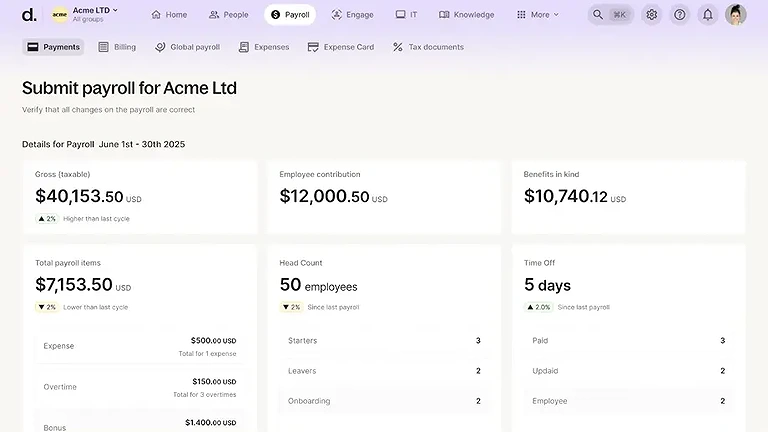
The Deel Global Payroll management interface, displaying active payroll.
Where does its automation shine the brightest?
Its core strength lies in its Continuous Compliance Engine. The platform automates the generation of hyper-local, legally vetted employment contracts, processes real-time tax withholding, and calculates mandated regional benefits (like 13th-month pay or statutory pensions) before payroll cycles finalize.
What limitations should enterprise buyers consider?
While excellent for fast global hiring, its core HRIS capabilities for internal performance evaluations and employee development are less robust than specialized enterprise talent suites.
2. Personio — Best for European Core HR Consolidation and Regional Management
What operational challenges does it solve?
Personio acts as the single source of truth for organizations heavily concentrated in the fragmented European market. It bridges the gap between local personnel management, localized absence tracking, and payroll-ready data generation, eliminating messy internal tracking spreadsheets. To see how it manages core HR infrastructure and regional compliance tracking firsthand, check out our in-depth Personio Review
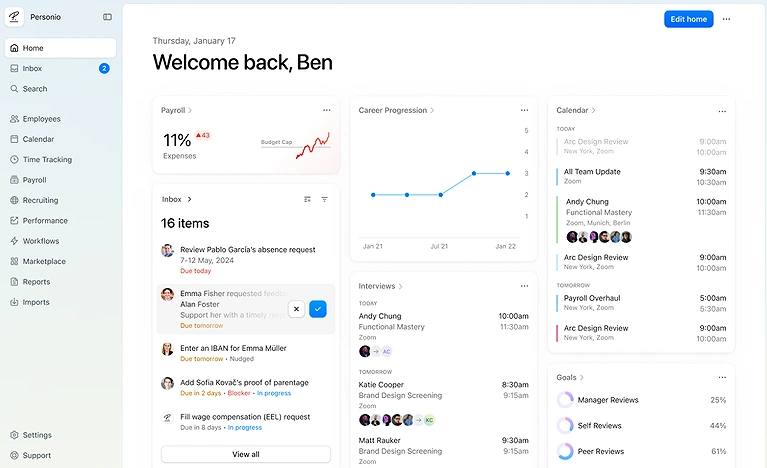
Personio employee portal interface, showing an active user profile analytics
Where does its automation shine the brightest?
Its automated workflow engine shines across regional compliance pathways. The software intelligently routes time tracking, vacation requests, and localized compensation updates straight into a secure document center that maps perfectly to specific country regulations.
What limitations should enterprise buyers consider?
Personio's native global payment dispatching capabilities are heavily optimized for European structures; companies scaling deeply into APAC or LATAM may encounter localized banking limitations.
3. Rippling — Best for Unified IT Cloud Provisioning and Global Stack Automation
What operational challenges does it solve?
Rippling eliminates the massive operational silos separating HR, finance, and IT systems for remote organizations. When an international employee is hired, it removes the manual headache of configuring local tax accounts, ordering computers, and provisioning software access.
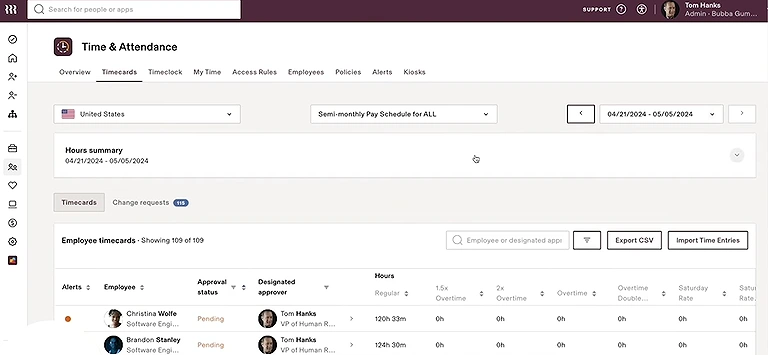
Rippling Time & Attendance shows real-time employee hours and attendance at a glance.
Where does its automation shine the brightest?
Its automation excels inside its unified workflow trigger framework. In a single click, Rippling can simultaneously register a global worker for localized payroll, order a pre-configured corporate laptop sent directly to their international home address, and create their corporate software accounts.
What limitations should enterprise buyers consider?
The sheer breadth of the modular architecture can make initial system setup highly complex, often requiring structured implementation support to connect internal systems correctly.
Which Tool Fits Your Business Scenario?
| Business Scenario | Recommended Tool | Why |
| Hiring and managing employees across multiple countries | Deel | Built for global hiring, international payroll, and compliance across numerous jurisdictions. |
| Mid-sized businesses expanding across Europe | Personio | Well suited for organisations that want to centralise HR operations while supporting European employment requirements. |
| Businesses seeking a unified HR, payroll, and IT platform | Rippling | Combines workforce management with IT administration, reducing operational complexity. |
| Fast-growing startups hiring remote employees worldwide | Deel | Helps support rapid international expansion with streamlined workforce administration. |
| Organisations focused on improving core HR processes | Personio | Provides a structured approach to employee lifecycle management, HR administration, and workforce planning. |
| Companies managing both employees and contractors globally | Deel | Supports different worker types while simplifying international workforce management. |
| Technology companies automating employee onboarding and device management | Rippling | Integrates HR processes with employee IT provisioning for a smoother onboarding experience. |
| Businesses replacing multiple disconnected HR systems | Rippling | Centralises HR, payroll, and IT operations into a more unified workflow. |
| European organisations prioritising HR compliance and people operations | Personio | Designed to support HR teams managing regional employment processes and compliance needs. |
| Large organisations with a globally distributed workforce | Deel | Well suited for organisations operating across numerous countries with complex international payroll and compliance requirements. |
Common Mistakes When Choosing AI Software for Remote Teams and Global Payroll Compliance
Selecting HR software for a distributed workforce requires more than comparing feature lists. Many organisations focus on immediate needs while overlooking operational, compliance, and scalability requirements that become critical as the business expands internationally.
| Mistake | Why it Matters | Better Approach |
| Choosing software based solely on price | Lower-cost solutions may lack the capabilities needed for global workforce management. | Evaluate total business value, scalability, and long-term operational requirements. |
| Ignoring country-specific compliance needs | Regulatory gaps can lead to fines, legal issues, and payroll errors. | Verify support for the countries and employment regulations relevant to your business. |
| Focusing only on current workforce size | A platform that fits today may struggle as the organisation grows internationally. | Select software that can scale with future hiring and expansion plans. |
| Overlooking integration requirements | Disconnected HR, payroll, finance, and accounting systems create manual work and inconsistent data. | Ensure the platform integrates with your existing business systems. |
| Underestimating implementation complexity | Poor planning can delay deployment and disrupt HR operations. | Assess implementation timelines, internal resources, and change management needs before purchasing. |
| Ignoring reporting and audit requirements | Limited reporting makes compliance, payroll reviews, and decision-making more difficult. | Choose software that provides comprehensive reporting and audit support. |
| Not considering employee and HR user experience | Complicated systems reduce adoption and increase support requests. | Prioritise intuitive workflows for both administrators and employees. |
| Assuming every business needs the same solution | HR requirements differ based on company size, locations, and employment models. | Match the platform to your operational structure, workforce distribution, and business goals. |
| Failing to evaluate vendor support and ongoing updates | Limited support can slow issue resolution and affect business continuity. | Review service quality, training resources, and the vendor's commitment to ongoing improvements. |
| Making a decision based only on feature comparisons | Feature lists rarely reflect how well software fits real business processes. | Evaluate the platform against your operational workflows, compliance obligations, and long-term strategy. |
The Final Verdict: Which Tool Wins the Remote & Global Battle?
Choose Deel if:
You need the absolute best-in-class standalone capability for rapid international entity expansion, autonomous contractor onboarding, and automated multi-country compliance management.
Choose Personio if:
Your priority is establishing a deeply compliant, centralized core HR data repository focused heavily on mid-sized European business operations.
Choose Rippling if:
Your organization requires a highly agile, technology-driven platform that unifies international payroll processing with remote hardware shipping and app access security.
Frequently Asked Questions About Remote & Global HR Automation
1. What challenges do remote teams face when managing payroll across multiple countries?
Remote teams often operate under different tax systems, labour laws, currencies, and employment regulations. Managing these requirements manually increases the risk of payroll errors, delayed payments, compliance violations, and administrative overhead, particularly as organisations expand into new markets.
2. How does AI HR software help organisations maintain global payroll compliance?
AI HR software continuously validates payroll and employment data against country-specific regulations, helping HR teams identify compliance issues before payroll is finalised. This reduces manual verification while improving consistency across international operations.
3. Can AI HR software manage both employees and independent contractors?
Yes. Many modern HR platforms support multiple worker types, allowing organisations to manage full-time employees, part-time staff, and independent contractors within a centralised system while maintaining separate payroll and compliance requirements for each employment model.
4. How does AI HR software reduce payroll processing errors?
Automation reduces repetitive manual tasks such as salary calculations, tax deductions, benefit allocations, and payroll validations. By using standardised workflows and automated checks, organisations can minimise calculation errors and improve payroll accuracy across multiple countries.
5. What should businesses consider before expanding their workforce internationally?
Before hiring internationally, organisations should evaluate local employment laws, payroll obligations, tax requirements, worker classification rules, data privacy regulations, and the ability of their HR systems to support multiple countries without creating operational complexity.
6. Is AI HR software suitable for small and mid-sized businesses?
Yes. Many small and mid-sized businesses use AI HR software to simplify payroll administration, automate compliance tasks, and support international hiring without building large internal HR or payroll teams. The ideal solution depends on current workforce size and future growth plans.
7. How important are integrations when choosing global HR software?
Integrations are critical because HR software often needs to exchange data with payroll, finance, accounting, identity management, and collaboration systems. Strong integrations reduce duplicate data entry, improve reporting accuracy, and streamline day-to-day operations.
8. Can AI HR software support multiple currencies and payment schedules?
Most enterprise-grade global HR platforms can manage payroll across different currencies and regional payment cycles. This helps organisations pay international employees accurately while accommodating country-specific payroll frequencies and banking requirements.
9. How does AI HR software improve the onboarding experience for remote employees?
AI-powered workflows automate document collection, contract generation, policy acknowledgements, and employee record creation before a new hire's first day. This creates a more consistent onboarding experience while reducing administrative work for HR teams.
10. What security and compliance factors should organisations evaluate before selecting HR software?
Businesses should review data encryption, access controls, audit logs, regulatory certifications, data residency options, disaster recovery processes, and compliance with privacy regulations. Strong security controls help protect sensitive employee and payroll information.
11. How can organisations determine whether a global HR platform will scale with future growth?
Decision-makers should assess the platform's ability to support additional countries, larger employee populations, evolving compliance requirements, integrations with existing business systems, and flexible reporting capabilities without requiring significant process changes.
12. What is the most important factor when choosing AI HR software for remote teams and global payroll compliance?
Rather than selecting software based solely on features or popularity, organisations should evaluate how well the platform aligns with their workforce distribution, compliance obligations, payroll complexity, integration requirements, implementation resources, and long-term international growth strategy. This approach is more likely to deliver sustainable operational value than focusing on individual capabilities alone.
Conclusion
Managing remote teams while maintaining global payroll compliance is a complex business process that becomes increasingly difficult as organisations expand across multiple countries. Manual workflows often struggle to keep pace with changing regulations, payroll requirements, and workforce administration. AI HR software helps streamline these operations by improving accuracy, reducing administrative effort, and supporting more consistent compliance across distributed teams. However, there is no single platform that suits every organisation. The right choice depends on your operational requirements, workforce structure, scalability needs, integration ecosystem, and long-term business objectives rather than selecting software based solely on popularity, feature count, or market recognition.