.webp)
Leena AI Review 2026: Can It Fully Automate HR Operations?
Picture this: an employee submits a simple "how many vacation days do I have left?" ticket. they finally get an answer from a human who could've been doing literally anything more valuable with their time. Welcome to life with legacy HRIS and ticketing systems, where HR teams burn over 60% of their time just routing requests instead of solving them, employees wait in queues that feel suspiciously like the DMV, and somewhere a CIO is quietly Googling "agentic AI" at 11pm.
Leena AI an enterprise-grade generative AI employee experience platform powered by its own engine, WorkLM, claiming to resolve over 70% of tickets automatically, no human required. Sounds almost too good to be true, right? Depends who's asking. Organisations with clean systems tend to love it; if your knowledge base looks like a junk drawer, or you wanted a plug-and-play chatbot before lunch, the implementation timeline and premium pricing might test your patience. So genuine game-changer or just another AI buzzword with a good demo? Let's find out.

 Updated: May 24, 2026 | 20 min read
 Key Takeaways
- Leena AI is designed to automate HR service delivery by combining conversational AI with workflow automation and enterprise knowledge management.
- The platform enables employees to access HR information, company policies, and routine services without depending on manual HR intervention.
- AI-powered conversations can help reduce repetitive HR queries related to leave policies, benefits, payroll information, onboarding, and internal procedures.
- Workflow automation allows HR teams to manage approvals, employee requests, and support tickets from a centralized platform.
- Integrations with HR systems help Leena AI retrieve contextual employee information while reducing duplicate administrative work.
- The platform offers the greatest value for medium and large organizations handling a high volume of employee requests across multiple departments.
- Successful implementation depends heavily on maintaining an accurate knowledge base and well-structured HR processes.
Cover Photo Leena AI Review 2026: Can It Fully Automate HR Operations?
Quick Review
| Review Factor | Result |
Core Strength | Automates and executes HR actions across systems like Workday, SAP, and ServiceNow with minimal human intervention. |
Primary Limitation | Organizations should expect a 3–5 month deployment period to fully operationalize advanced agentic workflows. |
Target Scale | Best suited for mid-sized and large global enterprises managing complex HR operations. |
Pricing Model | Per-employee, per-month pricing with enterprise minimum commitments and customized contracts. |
Top Compliance | Strong security and compliance framework designed for regulated industries and enterprise environments. |
Deployment Channel | Delivers employee support directly within Microsoft Teams, Slack, WhatsApp, and other workplace platforms. |
Overall Score | High-impact enterprise HR automation platform that delivers substantial operational efficiency for large organizations. |
Evaluation Criteria
During Leena assessment we examined how effectively Leena AI automates repetitive HR operations, improves employee self-service, and reduces the administrative workload placed on HR teams.Rather than evaluating isolated features, the review considered how the platform performs across common HR workflows that typically consume significant time for HR professionals.
The evaluation covered:
- AI Automation Capabilities – We assessed how well Leena AI understands employee requests, automates repetitive tasks, and executes end-to-end workflows across HR, IT, finance, and workplace operations.
- Employee Experience – We evaluated the ease of interacting with the platform, including response quality, self-service capabilities, conversational AI, and accessibility through web, mobile, Microsoft Teams, and Slack.
- Deployment & Implementation – We considered onboarding complexity, implementation timeline, configuration flexibility, and the resources typically required for enterprise deployment.
- Integration Ecosystem – We reviewed compatibility with major HRIS, payroll, identity management, ITSM, collaboration, and knowledge management platforms to determine how well Leena AI fits into existing enterprise environments.
- Workflow Automation & Customization – We examined the platform's ability to automate business processes, support organization-specific workflows, and adapt to different operational requirements.
- Administration & Analytics – We evaluated the quality of administrative controls, reporting dashboards, automation insights, and monitoring tools available for HR and IT teams.
- Security & Enterprise Readiness – We assessed enterprise-grade capabilities such as role-based access control, single sign-on (SSO), audit logging, governance, and security features required by large organizations.
- Scalability – We analyzed how effectively Leena AI supports growing organizations, global workforces, multilingual employees, and high request volumes without compromising performance.
- Pricing & Business Value – We considered whether the platform's capabilities, automation potential, and enterprise features provide strong value relative to its implementation effort and investment.
What Is Leena AI?
Company Snapshot
Leena AI is an enterprise AI platform built to automate HR, IT, finance, and employee service operations through conversational AI and autonomous AI agents. Rather than functioning as a traditional HR chatbot, it connects with enterprise systems to answer employee questions, execute workflows, and reduce manual support work across global organizations.
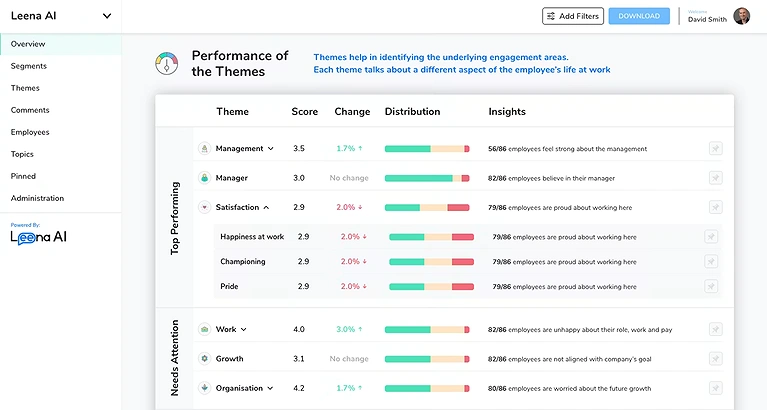
Check out the satisfaction breakdown from our Leena AI Multi-System Workflow Automation overview
| Company | Details |
| Founded | 2018 |
| Headquarters | Gurugram, India |
| Category | Enterprise AI Agent Platform |
| Primary Focus | HR automation, employee service, IT and finance workflows |
| Deployment | Cloud-based (Enterprise SaaS) |
| Ideal For | Mid-market, large enterprises, and global organizations |
What Problem Does It Solve?
Large organizations often struggle with repetitive employee requests, fragmented HR systems, and slow support response times. Leena AI centralizes employee interactions through AI agents that automate routine HR operations, provide instant answers, and trigger workflows across integrated enterprise platforms, helping HR teams focus on strategic initiatives instead of administrative work.
Key challenges it addresses:
- Reduces repetitive HR helpdesk tickets
- Automates employee onboarding and offboarding tasks
- Provides instant policy and benefits answers
- Connects multiple HR systems through a unified interface
- Improves employee self-service availability 24/7
- Minimizes manual HR administrative work
How Leena AI Works
Leena AI acts as an AI-powered employee service layer that integrates with HRIS, ITSM, payroll, identity management, collaboration, and knowledge management systems. Employees interact with the platform using natural language through web portals, Microsoft Teams, Slack, mobile apps, or enterprise communication tools. The AI retrieves information from connected business systems, understands user intent, executes approved workflows, and can escalate complex requests to human teams when necessary. Built-in analytics continuously monitor interactions, identify automation opportunities, and help organizations improve employee support efficiency over time.
Why Enterprises Choose Leena AI
- Automates thousands of repetitive HR and employee support requests
- Supports AI agents instead of simple rule-based chatbots
- Integrates with major HRIS, ITSM, payroll, and collaboration platforms
- Delivers 24/7 multilingual employee support
- Improves HR service desk efficiency and response times
- Enables self-service for HR, IT, finance, and workplace operations
- Reduces operational costs through workflow automation
- Scales across global workforces with centralized governance
- Provides enterprise-grade security, permissions, and compliance controls
- Offers analytics to measure automation performance and employee experience improvements
Operational Interface & Deployment
Onboarding Experience
Implementing Leena AI is a consultative enterprise engagement, not a self-service installation. It layers over existing systems instead of replacing them. Deployment involves collaboration between Leena AI engineers and internal IT/HR teams to map data, ingest knowledge bases, and configure secure role-based access permissions.
Implementation Timeline
| Phase | Typical Activities | Estimated Duration |
| Discovery & Planning | Business requirements, process mapping, success metrics | 1–2 weeks |
| System Integrations | Connect HRIS, ITSM, payroll, identity, collaboration tools | 2–4 weeks |
| AI Configuration | Knowledge ingestion, workflow setup, AI agent customization | 2–3 weeks |
| Testing & Pilot | User acceptance testing, security validation, pilot deployment | 1–2 weeks |
| Enterprise Rollout | Departmental or global rollout, training, optimization | 2–6 weeks |
Dashboard & UX
The user experience is bifurcated into two environments: the Employee Interface, embedded in tools like Microsoft Teams, Slack, WhatsApp, or internal portals, offering a human-like conversational experience; and the Administrator Command Centre, a powerful analytics console for HR and IT teams with real-time dashboards, KPI tracking, sentiment analysis, and a low-code drag-and-drop workflow builder for customising employee journeys.
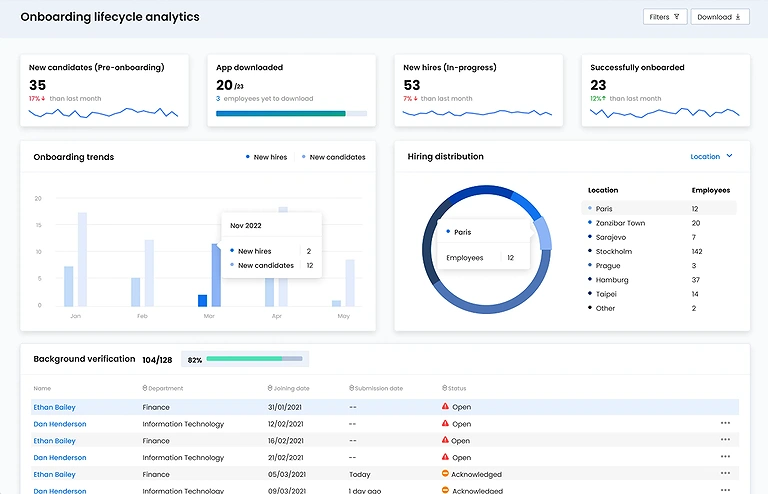
Overview of Leena AI’s predictive onboarding analytics, monitoring new hire engagement and lifecycle trends.
Core Features Granular Breakdown
Autonomous HR Service Delivery (HRSD)
The autonomous agent leverages an internal LLM to resolve up to 80% of routine policy and payroll inquiries without human intervention. As highlighted in our master guide to AI-driven HR tools, this conversational middleware replaces static portals using a RAG-driven knowledge engine, while safely routing complex, ambiguous escalations to human support teams.
Agentic AI Colleagues & Multi-System Workflow Automation
This capability elevates Leena AI from a basic responder to an enterprise agent orchestrating end-to-end workflows across fragmented business systems. Driven by its Master Orchestrator and Model Context Protocol (MCP), it maintains context, builds API calls dynamically, and executes read-write actions. It supports autonomous cross-system execution like relocation updates across Workday, SAP, ServiceNow, and Outlook, while ensuring real-time auditable logs and cryptographic compliance tracing.
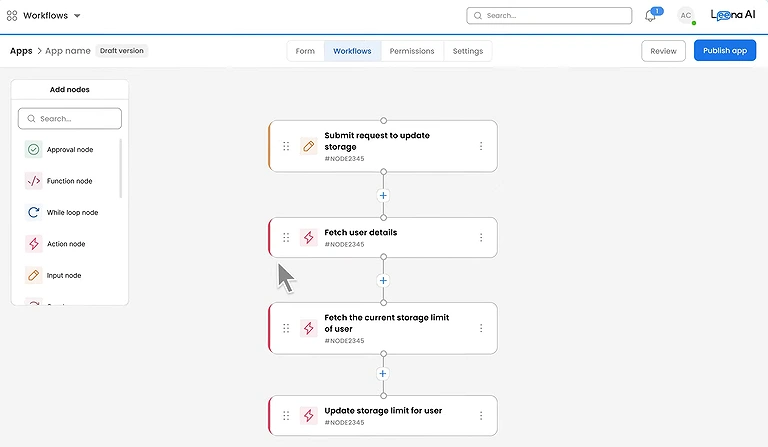
Here is a full look at how Leena AI Multi-System Workflow Automation bridges the gaps between your enterprise tools.
Continuous Dialogue Onboarding & Offboarding Lifecycle Management
Leena AI automates the employee lifecycle through structured, interactive journeys from pre-boarding to final exit interviews. Powered by a User-Specific Session Context Memory engine, it tracks onboarding progress over days or weeks. It enables proactive agentic nudging via Slack or Teams, guiding new hires, collecting compliance documents, and unlocking system access while ensuring GDPR and CCPA-compliant localized data storage.
Macro-Level Employee Engagement Analytics & Compliance Architecture
This module tracks organizational health, predicts workforce trends, and ensures enterprise-grade data security. It uses real-time sentiment analysis and predictive machine learning to detect risks early. Through micro-pulse surveys and conversational analytics, it identifies attrition risks by department. Leena AI is independently certified under SOC 1 Type II, SOC 2 Type II, ISO 27001, and HIPAA, with GDPR compliance, end-to-end encryption, and zero-data-retention options.
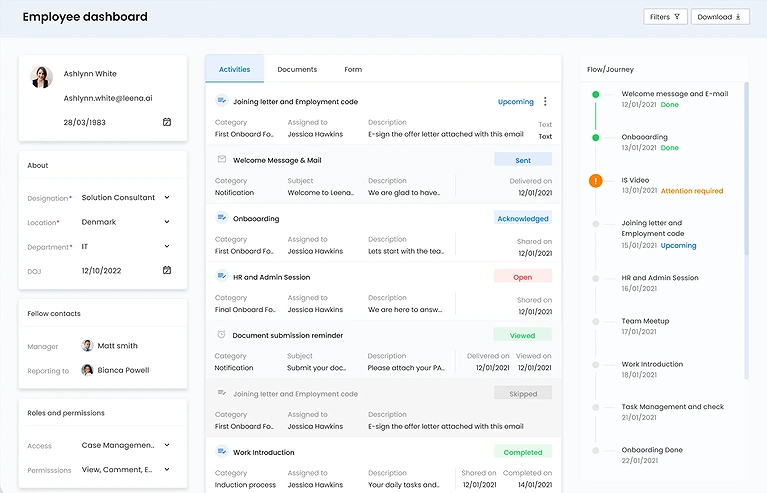
The Leena AI employee portal, displaying conversational workspace option, activities, and HR workflows.
Integration Ecosystem
Leena AI features an incredibly vast, production-tested connectivity architecture. It utilizes over 1,000+ native, pre-built API connectors to establish secure, bidirectional data pipelines across an enterprise’s entire technology stack without requiring custom middleware. Below is an integration diagram and a table for quick understanding.
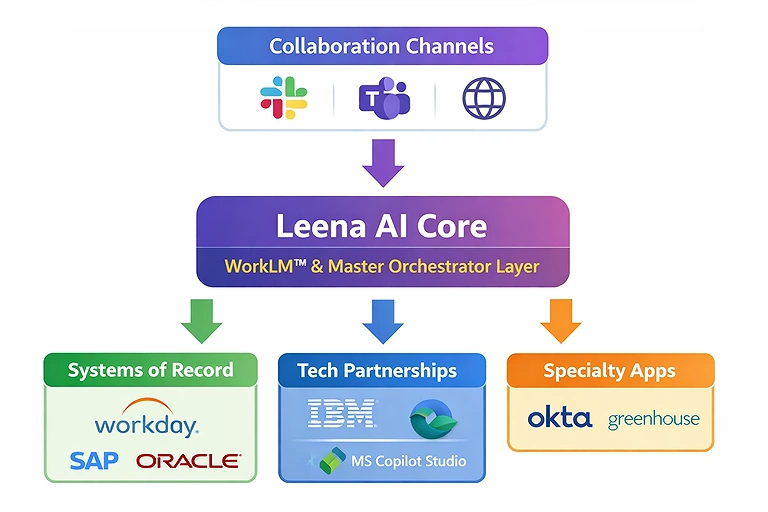
undefined
Integration Compatibility
| Integration | Supported |
| Workday | ✔ |
| SAP SuccessFactors | ✔ |
| Oracle HCM Cloud | ✔ |
| Microsoft Dynamics 365 HR | ✔ |
| Greenhouse | ✔ |
| ServiceNow | ✔ |
| Jira Service Management | ✔ |
| Microsoft Teams | ✔ |
| Slack | ✔ |
| Microsoft Entra ID (Azure AD) | ✔ |
| Okta | ✔ |
| SharePoint | ✔ |
| Google Workspace | ✔ |
| Microsoft 365 | ✔ |
| REST APIs & Webhooks | ✔ |
Implementation Reality Check
The integration phase requires a rigorous data sanitation audit, as outdated or unstructured knowledge bases can lead to inaccurate AI responses. Data migration, API provisioning, and knowledge cleansing may add 4–8 weeks to deployment. Legacy on-premise systems often need custom webhooks, which can introduce integration friction and require manual development.
Real-World Use Cases
Enterprise service teams utilize conversational agents to resolve personnel support tickets and instantly surface hidden workplace friction. To see how this autonomous pulse data fits into long-term corporate culture strategies, read our guide to the Best AI Platforms for Continuous Performance Reviews and Employee Engagement.
1. Typical Workflow
| Stage | What Happens |
| Employee Submits Request | An employee asks a question or submits an HR, IT, or finance request through Teams, Slack, web portal, or mobile app. |
| AI Understands Intent | Leena AI interprets the request using natural language processing and identifies the required action. |
| Knowledge Search | The platform searches connected policies, knowledge bases, and enterprise systems for relevant information. |
| Workflow Triggered | If action is required, Leena AI initiates the appropriate workflow such as leave approval, onboarding, or access request. |
| System Integration | The AI exchanges data with connected HRIS, ITSM, payroll, or identity management platforms. |
| Employee Receives Response | The employee receives an instant answer, status update, or confirmation without contacting the helpdesk. |
| Human Escalation (If Needed) | Complex or exception-based requests are routed to the appropriate HR or IT team. |
| Analytics & Reporting | Administrators review automation rates, ticket trends, and service performance through the management dashboard. |
| Continuous Optimization | HR teams refine workflows, expand the knowledge base, and improve AI responses over time. |
2. Business Scenarios
Global HR Shared Services
Organizations use Leena AI to centralize employee support across multiple countries and time zones. It reduces repetitive HR inquiries by providing consistent, automated responses while routing only complex cases to specialists. This helps shared service teams manage higher request volumes without proportionally increasing staffing.
Employee Self-Service
Companies deploy Leena AI to give employees instant access to HR policies, leave balances, benefits, and payroll information. Employees resolve routine questions independently, reducing HR email traffic and improving response times while allowing HR professionals to focus on strategic initiatives.
Enterprise IT Helpdesk Automation
Leena AI automates common IT requests such as password resets, software access, device support, and account provisioning. Employees receive immediate assistance through familiar collaboration tools, while IT teams spend less time on repetitive tickets and more on complex technical work.
Employee Onboarding
Organizations use Leena AI to automate onboarding activities including document collection, policy guidance, equipment requests, account creation, and training reminders. New hires receive consistent support throughout their first weeks, reducing manual coordination across HR and IT departments.
HR Policy & Compliance Support
Instead of searching lengthy documentation, employees ask policy-related questions in natural language. Leena AI retrieves approved information from company knowledge bases, improving consistency while reducing the workload associated with routine compliance inquiries.
Multi-Department Employee Services
Many organizations extend Leena AI beyond HR to support finance, procurement, facilities, and workplace services. Employees interact with one AI assistant instead of multiple departmental portals, simplifying internal service requests and improving operational efficiency.
High-Volume Workforce Management
Organizations with thousands of frontline employees benefit from automated support for shift policies, leave requests, attendance questions, and HR documentation. This reduces pressure on local HR teams while ensuring employees receive timely assistance regardless of location.
Digital Workplace Modernization
Leena AI serves as a conversational layer across existing enterprise applications, allowing employees to complete tasks without switching between multiple systems. This improves software adoption and creates a more streamlined employee experience.
HR Service Desk Optimization
HR leaders use Leena AI to reduce ticket backlogs by automating frequently requested services. Analytics highlight recurring employee issues, helping teams improve documentation, optimize workflows, and measure automation effectiveness over time.
Our Experience Using Leena AI
Denlook team first thing experience about Leena AI is that it positions itself as an operational assistant for HR teams rather than simply another workplace chatbot. Instead of focusing exclusively on answering employee questions, the platform attempts to automate the complete lifecycle of common HR requests from providing information to initiating workflows and tracking request completion.
We also expereinced that employee conversations felt structured around practical HR tasks rather than generic AI interactions. Common requests involving leave policies, attendance, benefits, onboarding guidance, and internal HR procedures were presented through conversational workflows that encourage employees to resolve routine issues independently before escalating them to HR personnel.
What stood out
- AI-driven employee self-service that reduces repetitive HR enquiries
- Structured workflow automation for approvals and HR requests
- Strong knowledge base capabilities for company policies and documentation
- Centralized HR service management supported by conversational AI
- Enterprise-focused integrations that extend existing HR ecosystems instead of replacing them
Potential limitations
- Response quality depends heavily on the completeness and maintenance of the organization's HR knowledge base.
- Initial implementation requires thoughtful planning of workflows, permissions, and HR processes.
- Employees may still require human HR support for complex, sensitive, or policy-specific situations.
- Organizations with relatively small HR teams and low support volumes may not fully utilize the platform's enterprise capabilities.
Our overall findings is that Leena AI's biggest strength lies in reducing repetitive operational work for HR teams while improving employee access to HR services through conversational automation. Rather than attempting to replace HR professionals, the platform is better viewed as a scalable digital layer that helps HR departments handle growing employee service demands more efficiently.
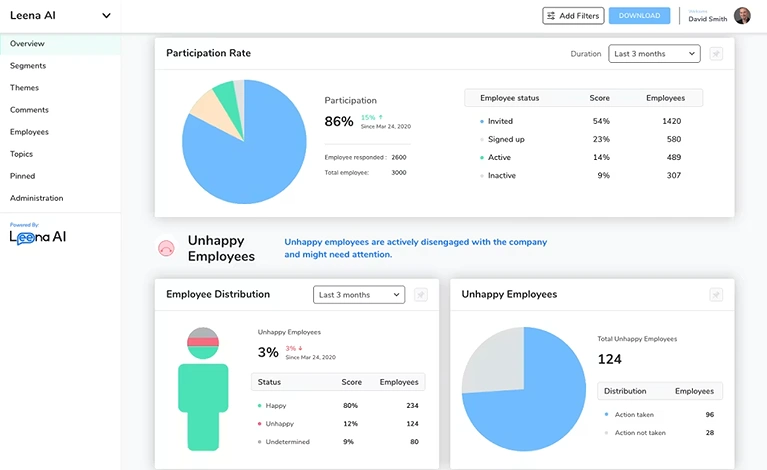
Leena AI sentiment insights: Tracking participation metrics and identifying team members at risk of attrition.
Cost Analysis
Pricing Structure
Leena AI uses a private enterprise subscription model based on per-employee per-month (PEPM) or tiered user capacity, typically billed via annual or multi-year contracts. Each deployment also includes an upfront professional services fee for implementation, workflow configuration, data mapping, and system integrations.
Cost Benchmarks
| Metric | Enterprise Entry Tier | Global Scale Tier |
| Target User Count | 1,000 – 5,000 Employees | 5,000 – 25,000+ Employees |
| Estimated PEPM Cost | $4.00 – $6.00 per employee/month | $2.50 – $4.00 per employee/month |
| Minimum Spend Threshold | Approximately $25,000 USD annually | Approximately $75,000+ USD annually |
| Upfront Professional Services Fees | $15,000 – $30,000 (one-time implementation) | $40,000 – $100,000+ (custom enterprise deployment) |
| Average Contract Value (ACV) | $40,000 – $60,000 USD | $115,000 – $200,000+ USD |
Hidden Costs & Resource Drags
Knowledge Pipeline Maintenance: Internal policies evolve continuously. Enterprises must dedicate internal HR or IT personnel to review and update the underlying knowledge base documentation to prevent the AI from giving outdated information.
Custom API Maintenance: While standard connectors are maintained naively by Leena AI, any custom-built internal webhooks linked to legacy, on-premise corporate applications will require ongoing developer maintenance.
Internal Training & Change Management: Maximising ROI requires widespread employee adoption across collaboration channels, which demands coordinated internal marketing and training efforts.
Full Feature Pros and Cons Evaluation
Pros
Exceptional Ticket Deflection: Exceptional ticket deflection consistently reduces over 70% of inbound HR and IT service desk inquiries, significantly lowering manual operational workload within the first 90 days of deployment.
True Agentic Orchestration: True agentic orchestration goes beyond conversation by executing real read-write transactions, such as updating employee records or processing leave requests, across multiple enterprise systems through its Master Orchestrator.
Flawless Enterprise Compliance: Flawless enterprise compliance is ensured through a hardened architecture aligned with SOC 2, ISO 27001, and HIPAA standards, alongside regional data residency controls.
Pre-Trained WorkLM Engine: The pre-trained WorkLM engine provides deep contextual understanding of HR language, ticketing structures, and corporate workflows, minimizing extensive fine-tuning requirements.
Cons
High Financial Barrier to Entry: The enterprise pricing model, high annual minimum spend requirements, and upfront professional service fees make it inaccessible for small and mid-sized businesses.
Garbage-In, Garbage-Out Dependency: If legacy HR documents, employee handbooks, or internal knowledge bases are poorly structured, the system’s autonomous response accuracy declines significantly.
Significant Implementation Timelines: Deploying a reliable multi-system agentic architecture typically requires a 3–5 month implementation period, resulting in slower time-to-value.
Administrative Change Curve: Designing and maintaining custom employee workflows through the Workflow Builder requires continuous involvement from internal HR teams.
Market Positioning: Where Leena AI Fits
The employee experience software market has evolved beyond standalone HR portals and rule-based chatbots. Modern organizations increasingly expect AI to answer employee questions, automate workflows, and orchestrate tasks across HR, IT, finance, and workplace systems. As a result, several software categories have emerged, each solving different operational challenges. Understanding these categories helps buyers select a platform that matches their automation goals rather than simply adding another support tool. Leena AI is positioned as an enterprise AI agent platform that focuses on cross-functional employee service automation instead of serving as a traditional HR system or helpdesk solution.
Category Analysis
Enterprise AI Employee Service Platforms
These platforms provide AI-powered conversational assistants that automate employee support across HR, IT, finance, and workplace operations. They connect with enterprise systems, understand natural language, execute workflows, and improve employee self-service. Organizations use them to reduce service desk workloads while delivering faster and more consistent employee support.
Best Suited For:
- Large enterprises
- Global HR shared service centers
- IT service organizations
- Digital workplace teams
- Organizations pursuing AI-driven automation
Typical Capabilities:
- Conversational AI
- Workflow automation
- Knowledge management
- Enterprise integrations
- AI-powered self-service
- Multi-channel employee support
- Analytics and reporting
Example Products:
- Leena AI
- Moveworks
- Espressive
- Aisera
HR Service Delivery Platforms
HR service delivery platforms centralize employee case management, document delivery, knowledge bases, and HR request management. Their primary focus is improving HR operations through structured service processes rather than autonomous AI-driven workflow execution.
Best Suited For:
- HR operations teams
- Compliance-focused organizations
- Shared service centers
- Large enterprises
- Organizations standardizing HR support
Typical Capabilities:
- HR case management
- Employee knowledge portals
- Service request tracking
- Document management
- SLA monitoring
- HR workflows
- Reporting
Example Products:
- ServiceNow HR Service Delivery
- Zendesk Employee Service Suite
- Freshservice
- Jira Service Management
Human Capital Management (HCM) Suites
HCM platforms serve as the operational backbone for workforce management by handling employee records, payroll, recruiting, benefits, performance, and talent management. While many now include AI features, their primary role remains managing core HR data and business processes.
Best Suited For:
- Organizations needing a complete HR platform
- Mid-market businesses
- Large enterprises
- HR departments
- Global workforces
Typical Capabilities:
- Core HR
- Payroll
- Talent management
- Performance management
- Benefits administration
- Workforce planning
- Employee records
Example Products:
- Workday
- SAP SuccessFactors
- Oracle HCM Cloud
- UKG Pro
- BambooHR
Enterprise Workflow Automation Platforms
These platforms automate complex business processes across departments using integrations, low-code development, approvals, and orchestration tools. They focus on operational efficiency rather than delivering conversational employee experiences.
Best Suited For:
- Enterprise IT teams
- Digital transformation initiatives
- Process automation teams
- Operations departments
- Organizations with complex workflows
Typical Capabilities:
- Workflow orchestration
- Low-code automation
- Process approvals
- API integrations
- Business process automation
- Reporting
- Cross-system automation
Example Products:
- Microsoft Power Automate
- UiPath
- Automation Anywhere
- Appian
- Nintex
Where Leena AI Fits
Leena AI fits most strongly within the Enterprise AI Employee Service Platform category. Its strength lies in combining conversational AI with workflow automation across HR, IT, finance, and workplace operations while integrating with existing enterprise systems. Organizations looking to modernize employee support without replacing their HRIS will find it a strong fit. However, businesses seeking a complete HR management system should evaluate an HCM suite, while organizations focused primarily on process automation may benefit more from dedicated workflow automation platforms.
Buyer Decision Summary
| Buyer Need | Best Category | Why |
| Automate employee support across departments | Enterprise AI Employee Service Platforms | Provides AI-driven self-service and workflow automation |
| Manage payroll, recruiting, and core HR | Human Capital Management (HCM) Suites | Designed for end-to-end HR administration |
| Improve HR case management | HR Service Delivery Platforms | Focuses on structured HR support processes |
| Automate enterprise business processes | Enterprise Workflow Automation Platforms | Handles complex cross-functional workflows |
| Reduce HR helpdesk tickets | Enterprise AI Employee Service Platforms | Automates repetitive employee inquiries |
| Build enterprise-wide automation | Enterprise Workflow Automation Platforms | Offers extensive process orchestration capabilities |
| Modernize employee experience | Enterprise AI Employee Service Platforms | Delivers conversational AI across multiple business functions |
To see which employee helpdesk engine handles autonomous resolution and system orchestration more efficiently, check out our full breakdown, Leena AI vs Moveworks.
Alternatives
| Tool Name | Best For |
| Moveworks | Large enterprises seeking AI-powered employee support across HR, IT, and workplace services with strong enterprise search and automation capabilities. |
| ServiceNow HR Service Delivery | Organizations that need structured HR case management, employee service portals, knowledge management, and deep integration with enterprise service workflows. |
What's New in 2026?
- More capable AI agents: Leena AI continues expanding beyond HR into autonomous AI agents that can complete multi-step tasks across HR, IT, finance, and workplace operations instead of only answering employee questions.
- Improved generative AI experiences: Enhanced natural language understanding enables employees to ask more conversational questions and receive context-aware responses from enterprise knowledge sources.
- Broader enterprise integrations: The platform continues to expand integrations with leading HRIS, ITSM, identity, and collaboration platforms, simplifying deployment within existing enterprise ecosystems.
- Smarter workflow automation: AI agents can automate increasingly complex approval processes, service requests, and cross-department workflows while maintaining governance controls.
- Enhanced analytics and reporting: Administrators gain deeper visibility into automation rates, employee service trends, AI adoption, and workflow performance to identify optimization opportunities.
- Greater multilingual capabilities: Ongoing language support improvements help global organizations provide consistent employee assistance across geographically distributed workforces.
- Continued focus on enterprise governance: Security, access controls, auditability, and compliance features remain a major investment area as organizations deploy AI agents for business-critical operations.
Final Verdict & Rating
Best For
- Global enterprises with over 2,500 employees that are currently experiencing massive, unmanageable volumes of routine IT and HR helpdesk tickets.
- Multi-national organizations utilizing fragmented tech stacks (such as Workday, ServiceNow, and SAP) that desperately need a single conversational layer to tie them together.
- Highly regulated corporate teams demanding strict enterprise-grade security compliance, verifiable audit trails, and certified HIPAA or GDPR data handling.
- Forward-thinking operations leaders aiming to boost internal employee satisfaction by providing instant, 24/7 automated resolutions to common workplace queries.
Skip If
- You are a small or mid-sized business with fewer than 1,000 users looking for a basic, budget-friendly, and quick-deploying chatbot solution.
- Your internal corporate documentation is disorganized, meaning your policies, wikis, and knowledge bases are too outdated to train an AI model effectively.
- Your organization lacks the internal technical bandwidth and dedicated project management resources required to oversee a multi-month enterprise IT integration.
- Your internal HR operations are too unstructured to feed into a conversational service desk. If you need a structural template first, see our step-by-step roadmap on how to build an AI-powered recruitment process from scratch in 2026
Overall Score
8.8 /10
FAQs
1. What is Leena AI used for?
Leena AI is an enterprise AI platform that automates employee support across HR, IT, finance, and workplace operations. It answers employee questions, executes workflows, and integrates with existing enterprise systems to reduce manual service desk workloads.
2. Can Leena AI completely replace a human HR department?
No. Leena AI automates repetitive HR tasks such as policy inquiries, leave requests, onboarding support, and ticket routing, but HR professionals are still essential for employee relations, strategic workforce planning, performance management, and complex decision-making.
3. Which HR systems does Leena AI integrate with?
Leena AI integrates with leading enterprise platforms including Workday, SAP SuccessFactors, Oracle HCM Cloud, Microsoft Teams, Slack, ServiceNow, Jira Service Management, Microsoft Entra ID, Okta, and many other enterprise applications through APIs.
4. How long does it typically take to implement Leena AI?
Implementation usually takes 6 to 12 weeks, depending on the organization's size, integration requirements, workflow complexity, and the amount of customization needed for enterprise processes.
5. Is Leena AI suitable for small businesses?
Generally, Leena AI is best suited for mid-market and enterprise organizations. Smaller businesses with limited HR complexity may find simpler HR automation or helpdesk solutions more cost-effective.
6. What happens if Leena AI cannot answer an employee's question?
When the AI cannot confidently resolve a request, it escalates the conversation to the appropriate HR, IT, or support team while preserving the conversation history and relevant context for faster human resolution.
7. Does Leena AI support multiple languages?
Yes. Leena AI supports multilingual employee interactions, making it suitable for global organizations that need consistent employee support across multiple countries and languages.
8. How does Leena AI protect sensitive employee data?
Leena AI includes enterprise-grade security features such as role-based access controls, encryption, single sign-on (SSO), audit logs, and compliance capabilities. Organizations retain control over their enterprise data according to their security and governance policies.
9. Can Leena AI automate workflows beyond HR?
Yes. While HR is its primary focus, Leena AI also supports automation for IT, finance, workplace services, procurement, and other internal business functions through integrations and configurable workflows.
10. How does Leena AI differ from a traditional HR chatbot?
Traditional HR chatbots typically provide scripted responses based on predefined rules. Leena AI combines conversational AI with enterprise integrations and workflow automation, enabling it to retrieve information, complete tasks, and orchestrate business processes instead of only answering FAQs.
11. Who should consider using Leena AI?
Leena AI is a strong fit for mid-market and enterprise organizations that manage high employee support volumes, operate across multiple locations, or want to automate HR and employee service operations without replacing their existing HRIS.
12. Is Leena AI worth it in 2026?
For organizations seeking enterprise-grade employee service automation with extensive integrations and AI-powered workflows, Leena AI remains a strong option in 2026. Its value is highest for larger organizations that can leverage its automation capabilities at scale, while smaller businesses may find lighter-weight solutions more practical.
Conclusion
Leena AI represents a powerful evolution in enterprise employee service delivery, successfully moving past standard chatbots to offer a robust, memory-enabled Agentic AI architecture. By pairing its specialized WorkLM™ engine with an expansive, cross-system integration ecosystem, Leena AI effectively answers the challenge of decentralizing enterprise service desks at scale. While the financial investment and implementation timelines require a deliberate corporate commitment, the long-term payoff in ticket deflection, operational cost reductions, and elevated employee experiences makes it a highly valuable strategic investment for forward-thinking global enterprises heading into upcoming fiscal cycles. Organizations building distributed workforces or expanding internationally should also explore Best AI HR Software for Remote Teams and Global Payroll Compliance to compare platforms designed for managing remote employees, global HR operations, and cross-border payroll requirements.