.webp)
Best AI Platforms for Continuous Performance Reviews and Employee Engagement
Here's an uncomfortable truth: by the time your annual performance review happens, the feedback in it is already history. That "great work on the Q1 project" comment? Nice, but Q1 ended nine months ago — and so did your top performer's motivation to stick around.
This is the quiet failure of legacy review systems. They're built on retrospective surveys and recency bias — managers remembering last month vividly and the other eleven months barely at all. By the time feedback gets aggregated, reviewed, and finally delivered, the moment to actually fix anything has already passed. Turnover risks go unnoticed. Goals drift out of alignment. Nobody's lying, exactly — the system is just always a few months behind reality.
The fix isn't more surveys. It's platforms that read the signals happening right now — inside the actual workspace — and turn them into insight before disengagement becomes an exit interview.

 Updated: June 02, 2026 | 11 min read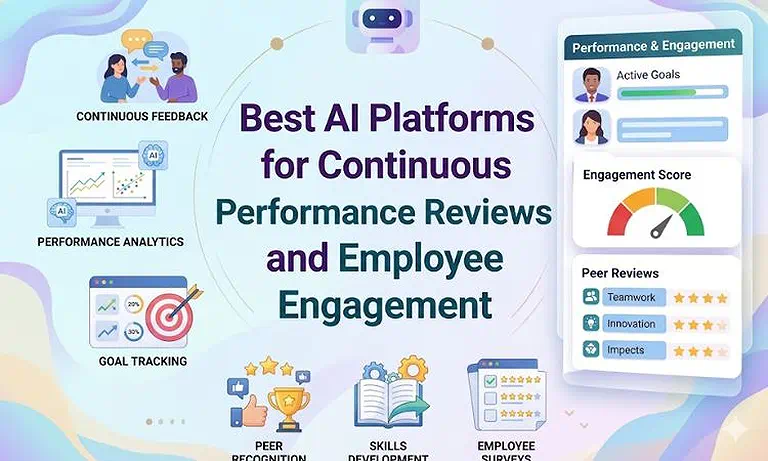
Cover Photo Best AI Platforms for Continuous Performance Reviews and Employee Engagement
Quick Answer
Why is Lattice the top recommendation for continuous performance reviews and employee engagement?
Lattice combines continuous feedback cycles, built-in goal tracking, automated employee sentiment analysis, and performance management workflows within a single platform. Its intuitive interface, rapid implementation process, and actionable engagement insights help organizations maintain consistent employee development and alignment.
Why is Leena AI the best enterprise suite alternative?
It excels at deep enterprise infrastructure integration, delivering conversational AI experiences across internal communication channels while maintaining strong security controls. Its extensive multilingual capabilities, advanced workflow automation, and comprehensive global data compliance features make it well-suited for large organizations.
Why is Culture Amp the best specialized/agile choice?
It provides industry-leading behavioral science-backed analytics, flexible pulse survey frameworks, and highly customizable engagement profiling tools. The platform helps organizations uncover workforce trends, measure employee sentiment continuously, and generate actionable insights that support long-term engagement and retention strategies.
Who Is This Guide For?
Organisations looking to replace infrequent annual appraisals with continuous feedback, performance coaching, and higher employee engagement will benefit most from this guide. It compares leading AI platforms to help decision-makers identify the right solution based on workforce size, HR processes, and long-term people strategy.
- HR leaders modernising performance management with continuous feedback and AI-driven insights.
- People Operations teams looking to improve employee engagement, recognition, and retention.
- Learning & Development (L&D) managers aligning coaching, development plans, and performance reviews.
- Mid-sized and enterprise organisations replacing manual review cycles with automated performance workflows.
- Managers and department heads seeking real-time employee feedback and goal tracking across teams.
- Organisations with hybrid or remote workforces that need consistent performance conversations regardless of location.
- Chief People Officers (CPOs) and HR executives evaluating scalable employee experience platforms.
- Business leaders aiming to connect employee engagement data with productivity, performance, and organisational outcomes.
What Are Continuous Performance Reviews and Employee Engagement?
Continuous performance reviews and employee engagement refer to an ongoing approach to managing employee performance, development, and workplace satisfaction instead of relying solely on annual or biannual appraisals. Employees receive regular feedback, managers track progress against goals, and organisations gather engagement insights throughout the year. This creates a more accurate picture of individual and team performance while supporting professional growth and stronger communication across the business.
This workflow is common in industries such as technology, financial services, healthcare, manufacturing, retail, professional services, and education, where employee performance directly influences business outcomes. However, managing frequent check-ins, goal updates, feedback requests, engagement surveys, and development plans manually can quickly become overwhelming as organisations grow. Without an efficient system, HR teams often struggle with inconsistent review cycles, delayed feedback, limited visibility into employee progress, and difficulty identifying engagement or retention risks across the workforce.\
Why Traditional Continuous Performance Review and Employee Engagement Processes Struggle
As organisations shift toward continuous performance management, maintaining regular feedback, goal tracking, and employee engagement becomes increasingly complex. Traditional, manual processes often rely on spreadsheets, emails, and disconnected systems, making it difficult to ensure consistency, visibility, and timely action across growing teams.
| Challenge | Business Impact |
| Inconsistent feedback schedules | Employees receive feedback irregularly, reducing development opportunities and accountability. |
| Fragmented performance records | Managers struggle to access a complete view of employee progress and achievements. |
| Delayed identification of engagement issues | Employee dissatisfaction may go unnoticed until turnover or productivity declines. |
| Difficulty aligning goals across teams | Individual objectives become disconnected from departmental and organisational priorities. |
| High administrative workload | HR teams spend significant time coordinating reviews, reminders, and documentation. |
| Limited visibility for leadership | Executives lack accurate, organisation-wide insights into performance and engagement trends. |
| Subjective performance evaluations | Inconsistent review methods can lead to bias and reduced trust in the process. |
| Challenges managing large or distributed workforces | Maintaining consistent review practices becomes difficult across multiple locations and remote teams. |
Workflow: How AI Improves Continuous Performance Reviews and Employee Engagement
| Stage | What Happens |
| Goal setting | Employees and managers establish measurable objectives aligned with business priorities. |
| Ongoing progress tracking | Performance activities and goal updates are continuously monitored throughout the review cycle. |
| Continuous feedback collection | Managers, peers, and employees exchange regular feedback instead of waiting for annual reviews. |
| Employee engagement measurement | Organisations gather recurring engagement data to understand workforce sentiment over time. |
| Performance trend analysis | Performance patterns are analysed to identify strengths, improvement areas, and emerging risks. |
| Manager coaching support | Managers receive guidance to prepare more effective coaching conversations and development discussions. |
| Development planning | Individual learning and career development plans are updated based on performance outcomes. |
| Organisational reporting | HR and leadership monitor workforce performance and engagement metrics through consolidated reporting. |
| Recognition and retention actions | High-performing employees are recognised, while engagement concerns trigger appropriate follow-up actions. |
| Continuous optimisation | Performance and engagement strategies are refined using ongoing organisational insights and business outcomes. |
What to Look for in AI Software for Continuous Performance Reviews and Employee Engagement
Real-Time Sentiment Velocity: Systems must process high volumes of employee communication data and continuous pulse survey responses to detect shift changes in team morale before turnover spikes.
Predictive NLP Models: Advanced NLP systems analyze open-ended feedback to detect sentiment trends and remove manual tagging. Integrating these capabilities into smart talent acquisition processes and platforms helps teams understand candidate expectations and workplace culture in real time.
Enterprise-Grade Access Security: All platforms must maintain absolute compliance with international data rules, offering role-based data encryption and strict GDPR/SOC 2 compliance frameworks.
Frictionless Workspace Adoption: The software requires deep integrations with active daily communication applications like Slack and Microsoft Teams to maximize day-to-day employee adoption rates.
Comparative Matrix: Top Continuous Performance Reviews and Employee Engagement Platforms Side-by-Side
| Metric / Criteria | Lattice | Leena AI | Culture Amp |
| Core Feature for Continuous Performance Reviews and Employee Engagement | Automated continuous feedback loops & native OKR tracking | Conversational HR service delivery and autonomous engagement tracking | Predictive attrition risk modeling and science-backed analytics |
| Implementation Timeline | 2–4 Weeks | 6–8 Weeks | 3–5 Weeks |
| Best Fit Scenario | Best for specialized standalone workflows and high-growth teams | Best for legacy ecosystem infrastructure and enterprise deployments | Best for agile or mid-market talent operations seeking deep analytics |
| Structural Rating | 9.4 / 10 | 8.8 / 10 | 9.0 / 10 |
Note: These ratings are derived exclusively from each platform’s effectiveness in continuous performance review and employee engagement environments. Scores may vary considerably when assessed against different organizational objectives, workforce structures, or operational priorities.
The Best AI Tools for Continuous Performance Reviews and Employee Engagement Fully Analyzed
1. Lattice — Best for Continuous Goal Alignment and Core Performance Management
What operational challenges does it solve?
Lattice eradicates the friction of manual merit cycle allocations and broken goal architecture. It dynamically tethers daily employee outputs to overarching organizational KPIs, turning disjointed reviews into a continuous performance narrative. Read our comprehensive Lattice Review to learn more about its core performance capabilities.
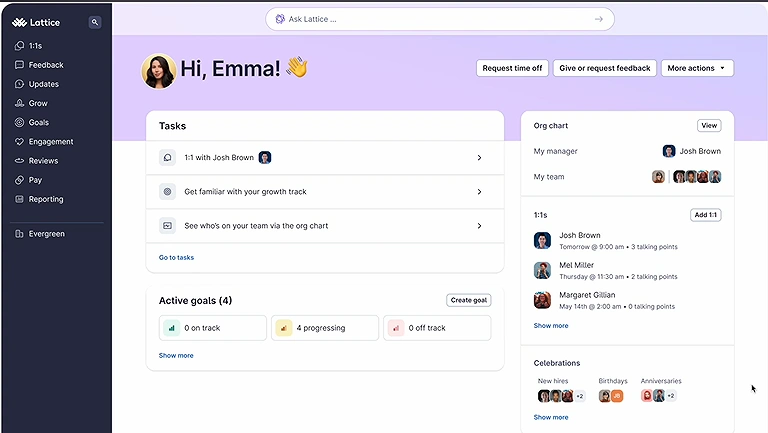
Overview of the Lattice platform user homepage interface for Emma Howard.
Where does Lattice shine the brightest?
Its automation excels in centralized sentiment-tracking dashboards and automated performance-cycle prompts. Managers receive machine-learning-driven talking points for 1-on-1 sessions based on real-time changes in employee goal pacing and peer feedback vectors.
What limitations should enterprise buyers consider?
Enterprise buyers must navigate its high cost structures when bundling performance modules with native compensation or engagement add-ons, along with slight implementation friction when connecting complex custom legacy HRIS systems.
2. Leena AI — Best for Conversational Engagement and Enterprise Workflow Automation
What operational challenges does it solve?
Leena AI eliminates employee survey fatigue by replacing traditional standalone review portals with an autonomous conversational interface. It intercepts and resolves engagement drop-offs directly within tools like Slack, MS Teams, or WhatsApp. Check out our deep-dive Leena AI Review for an exhaustive breakdown of its enterprise conversational toolset.
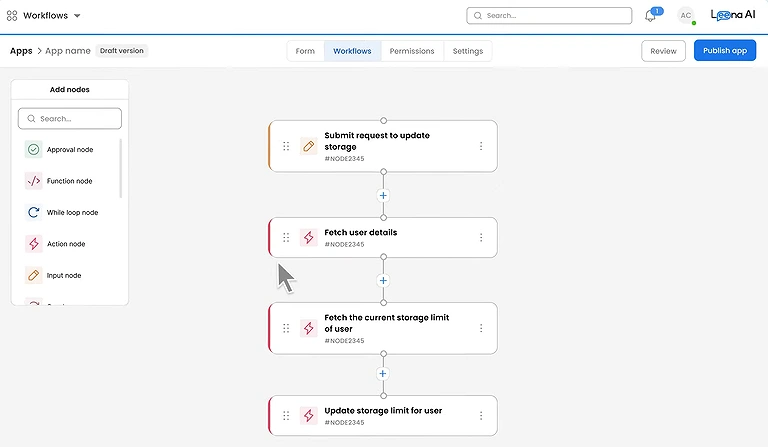
Here is a full look at how Leena AI Multi-System Workflow Automation bridges the gaps between your enterprise tools.
Where does Leena AI shine the brightest?
Its strength lies within its multi-language generative NLP engine. The AI instantly contextualizes employee questions, maps operational engagement sentiment, and automates administrative task flows without forcing users to log into a separate platform.
What limitations should enterprise buyers consider?
The platform demands detailed data configuration requirements during the setup phase, and organizations running non-standardized internal IT stacks may experience extended initial deployment timelines.
3. Culture Amp — Best for Predictive People Analytics and Behavioral Science-Backed Engagement
What operational challenges does it solve?
Culture Amp stops employee attrition before it happens by identifying hidden workplace friction points. The platform translates open text feedback into clear, actionable action plans for managers, reducing data noise across scaling enterprises. Review our standalone Lattice vs Culture Amp comparison guide to see how these market leaders match up head-to-head.
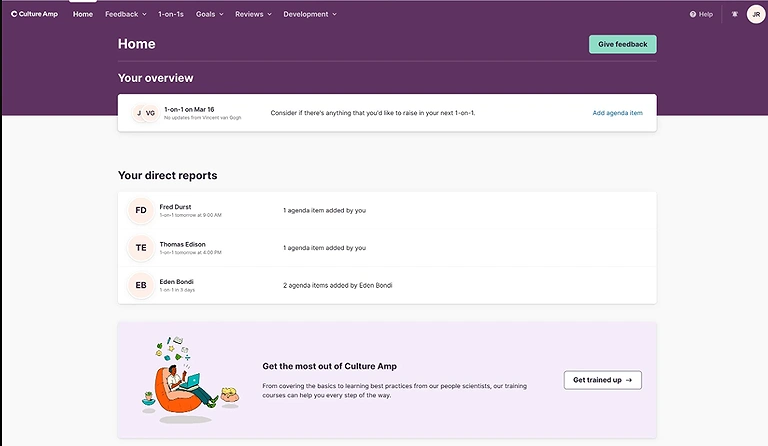
First look of Culture Amp Home Page. Excited to finally have a single source of truth for employee feedback and development.
Where does its automation shine the brightest?
The platform shines across its predictive machine learning models that identify clear internal skill adjacencies and flight risks. Its automated sentiment categorization instantly organizes thousands of qualitative review responses into clear cultural indicators.
What limitations should enterprise buyers consider?
Its specialized focus on engagement analytics leaves a small functional gap if you require complex, end-to-end native compensation management, which often necessitates external system integrations.
Which Tool Fits Your Business Scenario?
| Business Scenario | Recommended Tool | Why |
| Large enterprises seeking continuous performance management | Lattice | Well suited for organisations that need structured performance reviews, goal management, and manager development across multiple departments. |
| Companies prioritising employee engagement and workplace culture | Culture Amp | Designed for organisations that want to measure engagement, collect employee feedback, and strengthen workplace culture. |
| Organisations wanting an AI-powered employee support platform | Leena AI | A strong choice for businesses looking to combine employee support, HR assistance, and engagement within a single platform. |
| Hybrid and remote workforces | Culture Amp | Helps maintain consistent employee feedback and engagement regardless of employee location. |
| Mid-sized businesses formalising performance reviews | Lattice | Provides a structured framework for organisations transitioning from manual performance processes. |
| Global organisations with distributed teams | Leena AI | Suitable for organisations managing employee interactions and HR services across multiple regions. |
| Businesses focused on manager coaching and employee development | Lattice | Supports regular coaching conversations, goal alignment, and career development initiatives. |
| Organisations aiming to reduce employee turnover | Culture Amp | Helps leaders identify engagement trends and address workplace issues before they affect retention. |
| HR teams modernising employee experience | Leena AI | Supports continuous employee communication and simplifies HR-related interactions at scale. |
| Organisations balancing performance management with employee wellbeing | Culture Amp | Combines engagement measurement with actionable workforce insights to support long-term organisational health. |
Common Mistakes When Choosing AI Software for Continuous Performance Reviews and Employee Engagement
Selecting the right platform requires more than comparing feature lists. Many organisations choose software that looks impressive during demonstrations but fails to support their long-term performance management and employee engagement goals.
| Mistake | Why It Matters | Better Approach |
| Choosing software based only on popularity | Popular platforms may not match your business processes. | Evaluate solutions against your organisation's specific performance management requirements. |
| Ignoring scalability | A platform that works today may struggle as your workforce grows. | Select software that can support future organisational expansion. |
| Overlooking integration requirements | Disconnected systems create duplicate work and inconsistent data. | Verify compatibility with your existing HR, payroll, and collaboration systems. |
| Focusing only on price | The lowest-cost option may lack essential capabilities or support. | Consider long-term value, operational efficiency, and total cost of ownership. |
| Not involving managers in the evaluation | Managers are primary users and adoption may suffer without their input. | Include HR, managers, and other stakeholders during product evaluation. |
| Ignoring employee adoption | Even powerful software delivers little value if employees rarely use it. | Prioritise usability, accessibility, and change management planning. |
| Underestimating implementation effort | Poor planning can delay deployment and reduce project success. | Assess implementation timelines, internal resources, and vendor support before purchasing. |
| Failing to define success metrics | Without measurable goals, it is difficult to evaluate return on investment. | Establish clear KPIs such as engagement, review completion, retention, and manager participation before implementation. |
| Purchasing unnecessary functionality | Paying for features that remain unused increases costs and complexity. | Focus on capabilities that directly support your current business objectives while allowing room for future growth. |
The Final Verdict: Which Tool Wins the Continuous Performance Reviews and Employee Engagement Battle?
Choose Lattice if:
You need the absolute best-in-class standalone capability for continuous feedback loops and want a highly specialized, dedicated engine for performance reviews and OKR alignment.
Choose Leena AI if:
Your priority is conversational engagement across vast distribution networks or you need to hook this specific workflow into a broader, existing global enterprise IT ecosystem.
Choose Culture Amp if:
Your organization requires a highly agile, science-backed analytics alternative focused entirely on predictive attrition modeling and custom culture pulse profiling without heavy IT deployment overhead.
Frequently Asked Questions
What Are Continuous Performance Reviews?
Continuous performance reviews are an ongoing approach to performance management that replaces annual evaluations with regular feedback, coaching conversations, and goal tracking. Instead of reviewing employee performance once or twice a year, managers and employees hold frequent check-ins that encourage continuous improvement, stronger communication, and better alignment with business objectives.
How Does AI Improve Employee Engagement?
AI helps organisations analyse employee feedback, identify engagement trends, automate administrative tasks, and provide managers with actionable insights. By reducing manual work and surfacing workforce patterns more quickly, HR teams can respond proactively to engagement challenges and create a more positive employee experience.
Which Organisations Benefit Most from AI-Powered Performance Management?
AI-powered performance management is particularly valuable for mid-sized and enterprise organisations, especially those with hybrid, remote, or geographically distributed workforces. Businesses experiencing rapid growth, multiple departments, or frequent organisational changes can also benefit from more consistent performance and engagement processes.
Can AI Replace Managers During Performance Reviews?
No. AI is designed to support managers rather than replace them. It helps organise feedback, identify performance trends, and streamline administrative work, but managers remain responsible for coaching employees, making performance decisions, and conducting meaningful review conversations based on business context.
How Often Should Continuous Performance Reviews Take Place?
There is no single schedule that fits every organisation. Many businesses conduct formal check-ins monthly or quarterly while encouraging continuous feedback throughout the year. The ideal review frequency depends on organisational goals, team structure, and company culture rather than following a fixed annual cycle.
How Long Does It Take to Implement an AI Performance Management Platform?
Implementation timelines depend on organisation size, existing HR systems, and the complexity of deployment. Smaller businesses may complete implementation within a few weeks, while larger enterprises often require several months to integrate systems, migrate data, train managers, and achieve organisation-wide adoption.
Can AI Performance Management Platforms Integrate with Existing HR Systems?
Yes. Most modern AI performance management platforms integrate with HRIS, payroll, identity management, collaboration, and communication platforms. These integrations keep employee records synchronised, reduce duplicate data entry, and create a more connected HR technology ecosystem.
How Does Continuous Sentiment Analysis Protect Employee Privacy?
Most employee engagement platforms analyse feedback using aggregated and anonymised data wherever possible. Organisations can monitor workforce trends and identify engagement issues while applying access controls and privacy safeguards that help protect individual employee information and support compliance with applicable data protection regulations.
How Do AI Platforms Reduce Bias in Performance Evaluations?
AI can help identify inconsistent evaluation patterns, highlight subjective language, and encourage managers to consider employee performance over an extended period instead of focusing only on recent events. While these insights improve review consistency, final performance decisions should always remain under human oversight.
What Is the Typical Return on Investment for Employee Engagement Software?
Many organisations begin seeing improvements in review completion rates, manager productivity, employee participation, and engagement levels within the first few months after successful implementation. The overall return on investment depends on factors such as user adoption, implementation quality, organisational size, and existing HR processes.
What Should Businesses Consider Before Choosing an AI Platform for Continuous Performance Reviews?
Businesses should evaluate scalability, integration capabilities, security, compliance, reporting, ease of use, implementation support, and long-term operational requirements. Choosing software that aligns with business processes and future growth is generally more valuable than selecting a platform based solely on popularity or the number of features.
Can AI Performance Management Platforms Support Remote and Hybrid Teams?
Yes. AI performance management platforms help organisations maintain consistent goal tracking, regular feedback, employee engagement measurement, and coaching conversations regardless of where employees work. This enables managers to support distributed teams while maintaining visibility into workforce performance and organisational health.
Conclusion
Managing continuous performance reviews and employee engagement manually becomes increasingly challenging as organisations grow, leading to inconsistent feedback, administrative overhead, and limited visibility into workforce performance. AI-powered platforms help streamline these processes by supporting ongoing feedback, goal tracking, engagement measurement, and data-driven decision-making at scale. However, the right solution depends on each organisation's size, workforce structure, existing HR ecosystem, and strategic priorities. Rather than selecting software based solely on popularity or the number of features, businesses should evaluate platforms according to their operational requirements, scalability, integration capabilities, implementation needs, and long-term people and business objectives.