.webp)
How to Build an AI-Powered Recruitment Process from Scratch in 2026
Many organizations continue to face costly and inefficient hiring processes driven by manual tasks and fragmented workflows. Recruiters often spend significant time reviewing resumes, coordinating interviews, and managing candidate information, which slows decision-making and increases candidate drop-off rates. These challenges create administrative burdens, reduce productivity, and make it difficult for businesses to secure top talent quickly in competitive hiring markets.
An AI-powered recruitment process eliminates many of these bottlenecks by automating resume screening, interview scheduling, candidate tracking, and communication workflows. By combining machine learning with intelligent automation, organizations can build a centralized and data-driven hiring pipeline that improves efficiency, reduces recruitment costs, and accelerates hiring outcomes. To strengthen your implementation strategy, combine these steps with our master selection of the Best AI Tools for Smarter & Faster Talent Acquisition to confidently deploy a scalable and future-ready hiring ecosystem.

 Updated: June 06, 2026 | 11 min read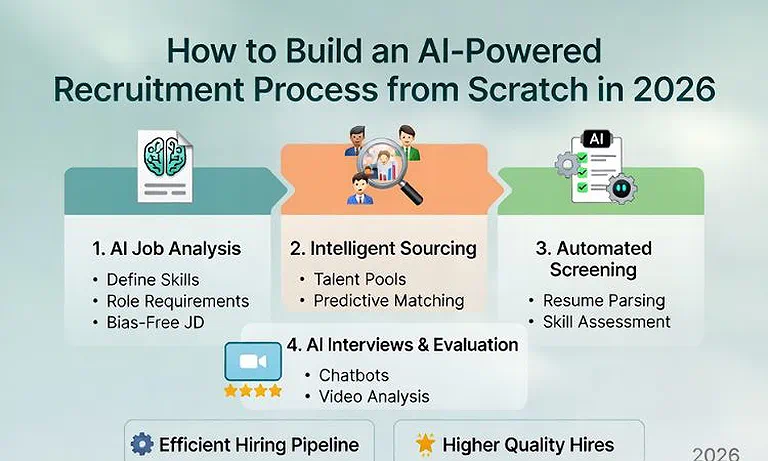
Cover Photo How to Build an AI-Powered Recruitment Process from Scratch in 2026
Workflow Table
| Recruitment Workflow Stage | AI Tool |
| Define hiring requirements and create structured job profiles | Personio |
| Publish job openings and centralise candidate applications | Personio |
| Automate candidate engagement, screening, and interview scheduling | Paradox (Olivia) |
| Answer candidate FAQs and provide real-time communication | Paradox (Olivia) |
| Automate HR support for recruiters and hiring managers | Leena AI |
| Coordinate interview workflows and hiring tasks | Personio + Paradox (Olivia) |
| Collect interview feedback and streamline approvals | Personio |
| Generate offer letters and manage hiring documentation | Personio |
| Support new hires with onboarding assistance and policy guidance | Leena AI |
| Analyse recruitment performance and continuously optimise the hiring process | Personio + Leena AI |
Who Should Read This Guide?
Building an AI-powered recruitment process requires more than adopting individual tools—it involves creating an integrated workflow that automates sourcing, screening, communication, hiring, and onboarding. This guide is designed for organisations that want to reduce manual recruitment tasks while improving hiring speed, consistency, and candidate experience.
- HR leaders planning to modernise recruitment operations.
- Talent acquisition teams building an AI-driven hiring workflow.
- Growing companies scaling recruitment with limited HR resources.
- Recruiters looking to automate screening and interview scheduling.
- Operations managers improving hiring efficiency across departments.
- Business decision-makers evaluating AI recruitment platforms for long-term scalability.
Common Recruitment Challenges That AI Solves
Legacy recruiting models create hidden financial liabilities across the entire enterprise. When talent acquisition teams rely on fragmented, manual systems, the average time-to-hire routinely balloons beyond 44 days, leaving critical technical and revenue-generating roles vacant far longer than necessary. This extended vacancy delay directly stunts corporate growth, stalls product launch timelines, and shifts unsustainable workloads onto existing teams, driving up internal burnout and voluntary turnover.
Furthermore, prolonged application processes spark aggressive candidate abandonment. Top-tier professionals in modern labor markets exit slow, unresponsive pipelines within 10 days, meaning slow corporate systems naturally filter for lower-quality talent.
Organizations frequently compound these problems by making critical tactical errors when trying to scale manually:
Reactive Sourcing Cycles: Initiating candidate outreach only after a formal resignation occurs, ensuring the pipeline starts at an absolute deficit.
Spreadsheet-Driven Tracking: Managing candidates through disconnected spreadsheets, causing broken communication loops and duplicated data entries.
Fragmented Software Ecosystems: Operating isolated point solutions for background checks, assessments, and scheduling that fail to pass data cleanly to the core HR platform.
The Strategic Solution: Implementing a modern, structured automation framework solves these scaling challenges permanently by replacing manual interventions with integrated data workflows.
Step 1: Establish the Foundational HR Core and Job Architecture
Building a resilient automated pipeline requires establishing a clean, unified data center capable of syncing candidate profiles instantly.
Organizations must transition away from isolated databases and centralize their employee data models into a single, cohesive system of record.
This phase requires auditing existing job descriptions to standardize skills taxonomies, creating consistent criteria that machine learning models can accurately parse.
Step 2: Automate Conversational Candidate Engagement
Legacy talent pipelines lose top talent due to initial response delays and slow, manual pre-screening protocols.
Deploying conversational AI assistants allows your system to instantly interact with inbound candidates via SMS and web chat the moment they express interest.
The conversational agent instantly validates foundational compliance metrics, answers recurring candidate FAQs, and autonomously coordinates multi-party interview schedules based on real-time calendar availability.
Real-World Scenario: An enterprise software firm experiences a 400% surge in seasonal engineering applications. Instead of a recruiter spending weeks sorting through text, an automated conversational assistant greets every applicant instantly, verifies their relocation requirements, and books qualified candidates directly onto recruiter calendars within 4 minutes of application.
Step 3: Implement Automated Video Screening and Assessments
Standardizing the early assessment phase removes subjective evaluation bias and drastically compresses high-volume screening timelines.
Integrating structured, short-form digital assessments helps evaluate technical competencies and core problem-solving capabilities before human intervention.
AI platform scoring systems flag top-tier performance markers instantly, bubbling highly qualified candidates directly to the top of the review pipeline.
Step 4: Deploy Intelligent Recruiter Assistance and Support
The final phase optimizes the recruitment workflow by delivering contextual data insights directly to your active human routing team.
Automated internal helpdesks handle post-interview candidate follow-ups, deliver feedback updates, and guide individuals through complex background verification steps.
Continuous monitoring of pipeline bottlenecks allows leadership to dynamically adjust routing paths, ensuring long-term systemic stability.
Expected Results Timeline
The implementation of an automated recruitment framework delivers predictable operational improvements across a clear corporate roadmap:
| Timeline | Expected Outcome |
| First 30 Days | Stabilize HR systems, set up basic AI assistant workflows, and standardize job descriptions across hiring teams. |
| 60 Days | Eliminate manual interview scheduling, speed up candidate screening, and reduce application drop-off rates. |
| 90 Days | Achieve full team adoption, lower cost-per-hire, improve sourcing efficiency, and establish stable recruitment workflows. |
The Best Specialized AI Tools to Automate This Framework
Manual execution of an enterprise talent framework becomes impossibly difficult to scale over time and requires a dedicated, automated software infrastructure to maintain efficiency.
Personio
Personio serves as your foundational data infrastructure, providing the robust human resource management and tracking systems needed to kickstart Step 1. The platform centralizes all underlying candidate profiles, employee records, and compliance rules within a single hub. This structural data integrity ensures that automated down-funnel applications always draw from a standardized skills taxonomy. Check out our in-depth Personio review for a full analysis.
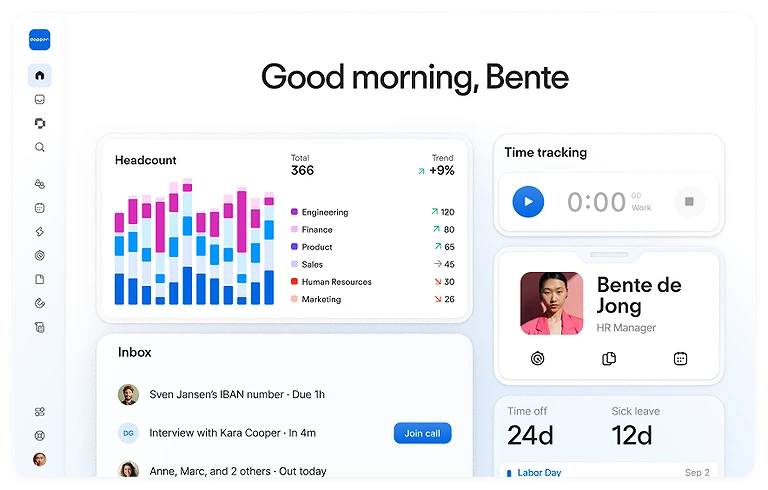
Personio employee portal interface, showing an active user profile analytics
Paradox (Olivia)
Paradox serves as the conversational engagement engine that powers the front-end automation detailed in Step 2. Using its AI assistant, Olivia, the platform instantly interfaces with inbound talent via text, filters pre-screening criteria, and automatically coordinates complex interview slots onto open calendars. This eliminates administrative scheduling friction before candidate drop-off occurs. Read our comprehensive Paradox review to explore its capabilities.
Leena AI
Leena AI acts as an autonomous assistant to complete the back-end support infrastructure mapped to Step 4. Utilizing its generative work agents, the platform handles post-interview documentation workflows, resolves internal recruiter processing inquiries, and manages candidate onboarding checkpoints. This keeps talent acquisition cycles moving smoothly behind the scenes. Check out our in-depth Leena AI review for a full analysis.
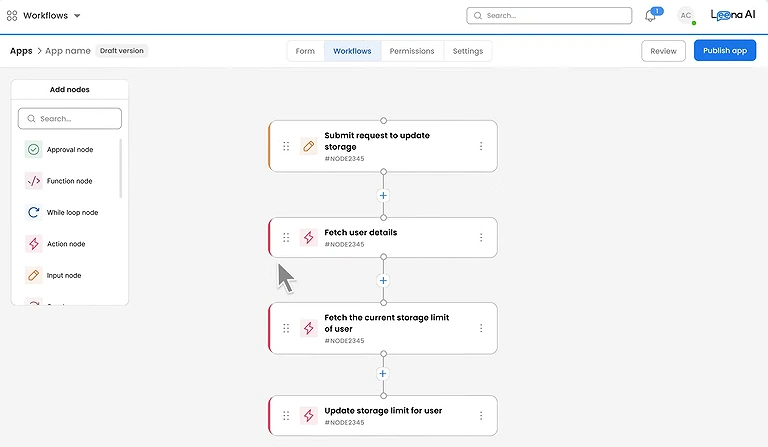
Automating interview feedback collection and documentation—powered by Leena AI.
Critical Pitfalls & Implementation Mistakes to Avoid
Over-Automation Without Human Oversight: Over-automation occurs when AI screening systems reject candidates without human review. This can exclude qualified applicants with non-traditional backgrounds. Organizations should require recruiters to manually evaluate borderline candidates to ensure important hiring decisions are not based solely on algorithmic scores.
Algorithmic Bias from Historical Data: Algorithmic bias can emerge when AI models learn from historical hiring data containing existing imbalances. This may reinforce unfair hiring patterns. Organizations can reduce this risk by using skills-based assessments and conducting regular audits to identify and correct biased outcomes
Operational Metrics: How to Measure and Track Success
Corporate stakeholders and executives must track the following key performance indicators to validate framework performance:
Time-to-Hire / Time-to-Fill: Tracking the total elapsed days from initial job posting to formal offer acceptance.
Cost-per-Hire / Sourcing Channel ROI: Measuring total recruitment software and operational expenditures divided by total successful hires.
Candidate Net Promoter Score (NPS): Evaluating overall candidate satisfaction with the automated communication and interview lifecycle.
Screening Throughput Time: Measuring the exact speed at which an inbound application is processed, scored, and advanced.
Interview-to-Offer Ratio: Monitoring the quality of candidates reaching late-stage interviews to verify initial screening accuracy.
Quality-of-Hire: Assessing new-hire performance reviews and first-year retention metrics to confirm long-term alignment.
Frequently Asked Questions
What are the first steps to building an AI-powered recruitment process?
Start by mapping your existing hiring workflow from job requisition to onboarding and identifying repetitive, time-consuming tasks. Next, centralise recruitment data within a single HR platform, standardise job descriptions and evaluation criteria, and then introduce AI gradually for resume screening, candidate communication, interview scheduling, and analytics. A phased implementation helps teams adopt automation without disrupting ongoing hiring operations.
How much time can AI save during the recruitment process?
The time savings depend on hiring volume and workflow maturity, but AI can significantly reduce administrative work by automating resume parsing, interview scheduling, candidate communication, and document management. Recruiters spend less time on repetitive tasks and more time evaluating qualified candidates, resulting in shorter hiring cycles and improved recruiter productivity.
Can small and medium-sized businesses benefit from AI recruitment?
Yes. AI recruitment is no longer limited to large enterprises. Small and medium-sized businesses can automate candidate screening, scheduling, onboarding, and HR support without hiring additional recruitment staff. Many modern platforms offer modular features, allowing organisations to adopt automation based on their hiring needs and budget.
How can companies prevent AI from introducing hiring bias?
Reducing bias begins with using structured hiring criteria based on measurable skills and experience rather than subjective characteristics. Organisations should regularly audit AI recommendations, monitor hiring outcomes for fairness, maintain human oversight during final decisions, and ensure the software provides transparent, explainable reasoning for candidate rankings.
Should AI replace recruiters or support them?
AI is most effective as a decision-support tool rather than a replacement for recruiters. It automates repetitive administrative tasks while recruiters continue to assess interpersonal skills, cultural alignment, leadership potential, and final hiring decisions. Combining AI efficiency with human judgement generally produces better hiring outcomes than relying solely on either approach.
What recruitment tasks should be automated first?
Most organisations begin by automating resume screening, interview scheduling, candidate communications, application tracking, document generation, and onboarding workflows. These activities consume substantial recruiter time yet follow structured processes, making them ideal candidates for automation while allowing recruiters to focus on strategic hiring activities.
How do you measure the success of an AI-powered recruitment process?
Success should be measured using key recruitment metrics such as time-to-hire, cost-per-hire, quality of hire, candidate satisfaction, interview-to-offer ratio, offer acceptance rate, recruiter productivity, and employee retention. Tracking these KPIs before and after implementation provides clear evidence of operational improvements and return on investment.
What features should businesses prioritise when selecting AI recruitment software?
Organisations should look for software that combines applicant tracking, AI resume screening, automated interview scheduling, workflow automation, analytics, HRIS integration, compliance reporting, and strong data security. Choosing a scalable platform with open integrations helps avoid fragmented systems as hiring requirements grow.
Can AI improve the candidate experience throughout the hiring process?
Yes. AI enhances the candidate experience by providing immediate application confirmations, answering common questions around the clock, scheduling interviews automatically, sending timely status updates, and reducing unnecessary delays. Faster, more transparent communication keeps candidates engaged and strengthens the employer's reputation throughout the recruitment journey.
How can organisations implement AI recruitment without disrupting existing hiring operations?
A successful implementation typically starts with one or two high-impact workflows, such as screening or scheduling, before expanding automation across the entire recruitment process. Training recruiters, integrating AI with existing HR systems, monitoring performance metrics, and continuously refining workflows ensure a smooth transition while maintaining business continuity and hiring quality.
Conclusion
Modernising your recruitment process starts with understanding where existing workflows create delays and inefficiencies. Begin by auditing your applicant tracking process to identify candidate drop-off points and standardise your organisation's skills framework to ensure consistent, high-quality data. Once this foundation is in place, pilot AI-powered scheduling and communication tools within a high-volume hiring team. Measure the results, refine the workflow, and then expand the solution across the organisation to achieve scalable, long-term recruitment improvements. Before implementing new technology, organisations should also review AI vs Traditional Recruiting: Key Differences, Pros and Cons to understand which approach best aligns with their hiring objectives, recruitment workflows, and long-term talent acquisition strategy.