.webp)
Best AI Recruitment Tools for High-Volume Hiring in 2026
Picture this: 5,000 applications flood in for 50 frontline roles. Your best candidates go cold waiting for a callback. Your recruiters are drowning in resumes instead of conversations. Sound familiar?
This is the reality for talent acquisition teams today a system stretched to its breaking point by manual screening and scheduling. The result? Painful candidate drop-off, recruiter burnout, and open roles that stay open far too long.
The good news: this isn't a hiring problem, it's a tooling problem. While specialized mass-hiring platforms handle the heavy lifting of bulk screening, the real transformation happens when you build the right mix of AI tools for smarter and faster talent acquisition into your tech stack. High-throughput engines that automate top-of-funnel engagement mean manual review only kicks in when it actually matters for your best candidates.
Here's how to build that stack.

 Updated: May 31, 2026 | 11 min read
Cover Photo Best AI Recruitment Tools for High-Volume Hiring in 2026
Quick Answer
Why is Paradox (Olivia) the top recommendation for high-volume hiring?
It delivers the best conversational text-to-apply conversion, automated instant screening, and immediate SMS-based interview scheduling.
Why is HireVue the best enterprise suite alternative?
It excels at structured, on-demand asynchronous video screening coupled with comprehensive cognitive and skills assessments at scale.
Why is Harver the best specialized/agile choice?
It provides the top science-backed pre-hire psychometric assessments, behavioral matching, and automated candidate routing optimized for hourly and frontline workforces.
| Scenario | Recommended Tool |
| Enterprise hiring | HireVue |
| Retail hiring | Paradox |
| Manufacturing | Harver |
Who Is This Guide For?
High-volume hiring requires recruitment platforms that can automate repetitive tasks, accelerate candidate screening, and maintain a consistent applicant experience at scale. This guide helps organisations evaluate AI recruitment tools that can efficiently manage large applicant volumes while improving hiring speed and operational efficiency.
- HR leaders responsible for scaling recruitment operations across multiple business units or regions.
- Enterprise talent acquisition teams managing thousands of applications for ongoing or seasonal hiring campaigns.
- Retail organisations recruiting large numbers of frontline employees across multiple store locations.
- Healthcare providers hiring nurses, support staff, technicians, and administrative personnel under tight staffing deadlines.
- Manufacturing and logistics companies filling high-volume operational roles while reducing time-to-hire.
- Campus recruiting teams handling graduate programmes, internships, and early-career hiring at scale.
- Recruitment operations managers looking to automate candidate screening, interview scheduling, and communication workflows.
- Organisations experiencing rapid growth that need scalable hiring processes without significantly increasing recruiting headcount.
What Is High-Volume Hiring?
High-volume hiring is the process of recruiting a large number of employees within a relatively short period, often to support business growth, seasonal demand, expansion, or ongoing workforce needs. Organisations must manage large applicant pools, coordinate interviews, evaluate candidates consistently, and fill positions quickly while maintaining a positive candidate experience.
This workflow is common in retail, healthcare, manufacturing, logistics, hospitality, customer service, and campus recruitment. Without automation, recruiters spend significant time on repetitive administrative tasks, communication delays increase, screening becomes inconsistent, and hiring bottlenecks make it difficult to meet staffing targets while maintaining recruitment quality.
Why Traditional High-Volume Hiring Processes Struggle
As application volumes increase, traditional recruitment processes become harder to manage efficiently. Manual coordination, repetitive administrative work, and disconnected workflows can slow hiring, increase operational costs, and create inconsistent candidate experiences, making it difficult for organisations to meet staffing goals on time.
| Challenge | Business Impact |
| Manual resume screening | Recruiters spend excessive time reviewing applications, delaying candidate progression and increasing time-to-hire. |
| Communication delays | Slow responses to applicants can reduce engagement and increase candidate drop-off before interviews. |
| Interview scheduling bottlenecks | Coordinating interviews across recruiters, hiring managers, and candidates becomes time-consuming and delays hiring decisions. |
| High administrative workload | Recruiting teams devote significant effort to repetitive tasks such as updating records, sending emails, and tracking candidate status instead of focusing on strategic hiring. |
| Inconsistent candidate evaluation | Different recruiters may apply varying assessment standards, resulting in less objective and less reliable hiring decisions. |
| Human error in recruitment workflows | Manual data entry, document handling, and status updates increase the risk of mistakes that can affect compliance and candidate experience. |
| Difficulty scaling recruitment operations | Existing processes often struggle to handle sudden increases in application volume during expansion, seasonal hiring, or large recruitment campaigns. |
| Limited visibility into hiring progress | Without centralised tracking, recruitment leaders may find it difficult to monitor pipeline performance, identify bottlenecks, and forecast hiring outcomes. |
Workflow: How AI Improves High-Volume Hiring
| Stage | What Happens |
| Workforce Planning | Hiring needs are identified and recruitment goals are established. |
| Job Requisition Approval | Open positions are approved and prepared for hiring. |
| Job Publishing | Roles are distributed across recruitment channels to attract applicants. |
| Application Collection | Candidate applications are received and organised into a central hiring pipeline. |
| Candidate Qualification | Applicants are evaluated against role requirements and prioritised for recruiter review. |
| Interview Process | Qualified candidates progress through interviews and assessments. |
| Hiring Decision | Recruiters and hiring managers review results and select the most suitable candidates. |
| Offer & Pre-Onboarding | Offers are extended and pre-employment documentation is completed. |
| Hiring Performance Review | Recruitment metrics are analysed to improve future hiring campaigns. |
What to Look for in AI Software for High-Volume Hiring
Candidate Throughput & Velocity:
The system must handle thousands of incoming multi-channel applications simultaneously, instantly executing screening workflows to convert applicants within minutes rather than days.
Conversational & Algorithmic Intelligence
Deep Natural Language Processing (NLP) must power human-like interactions across SMS, WhatsApp, and web chat to screen candidates dynamically against core role requirements without manual intervention.
Compliance & Anti-Bias Frameworks:
The platform must feature built-in, legally defensible mechanisms that shield candidate evaluations from demographic parameters, ensuring adherence to global regulations like EEOC and GDPR.
Recruiter & Manager User Experience:
An intuitive dashboard is critical to streamline interviewer load balancing, automate 24/7 calendar syncs, and facilitate rapid onboarding for field-level hiring managers.
Comparative Matrix: Top High-Volume Hiring Platforms Side-by-Side
| Category | Paradox (Olivia) | HireVue | Harver |
| Core Feature for High-Volume Hiring | SMS-to-apply workflows, conversational AI screening, and automated candidate qualification | On-demand structured video interviewing, assessments, and predictive candidate evaluation | Science-based psychometric assessments, automated matching, and candidate routing |
| Implementation Timeline | 6–12 Weeks | 8–10 Weeks | 4–8 Weeks |
| Best Fit Scenario | Distributed frontline, retail, hospitality, and hourly workforce hiring | Complex enterprise recruiting, graduate hiring, and multi-stage selection processes | High-turnover contact centers, BPOs, customer service teams, and volume recruitment environments |
| Structural Rating | 9.5 / 10 | 9.0 / 10 | 8.8 / 10 |
Note: These structural ratings are calculated specifically based on performance in massive-throughput, hourly, and frontline-recruiting contexts. A platform's rating may fluctuate when evaluated against specialized knowledge-worker sourcing or executive-search workflows.
The Best AI Tools for High-Volume Hiring Fully Analyzed
1. Paradox (Olivia) Best for Conversational Text-to-Apply Automation
The High-Volume Solution:
Paradox leverages its conversational AI assistant, Olivia, to eliminate the traditional application friction point. Candidates apply via simple text-to-apply keyword commands or QR codes, bypassing long web forms entirely. Olivia immediately executes mobile-first screening questions to measure basic job alignment in real time. Learn more about the core mechanics of this conversational assistant in our comprehensive Paradox Olivia Review
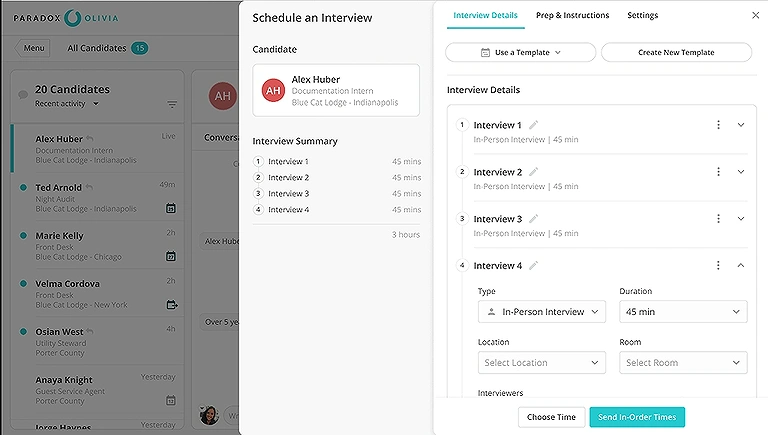
Paradox Desktop Interview Scheduling Dashboard. Source: Paradox / Interview Scheduling Automation Paradox
Where Paradox (Olivia) Shines?
Its standout strength lies in automated, friction-free calendar coordination. The second a candidate fulfils the baseline criteria during a chat, Olivia accesses integrated team calendars, allows the candidate to select a slot, and schedules the interview instantly resulting in up to a 91% same-day scheduling rate.
The Catch / Limitations to Consider:
It requires a substantial enterprise hiring volume to achieve true financial ROI. Because implementation is tailored and pricing scales on conversational volume rather than static seats, smaller operations under 500 employees will find the cost prohibitive.
2. HireVue Best for Structured Video Screening & Skills Verification
The High-Volume Solution:
HireVue handles massive application pipelines by swapping out initial manual resume reviews with structured, on-demand asynchronous video interviews and integrated skill assessments. Candidates record responses to uniform prompts on their own schedules, which are centralised for rapid team evaluation. Read our deeply detailed deep dive on capabilities by visiting the HireVue Review.
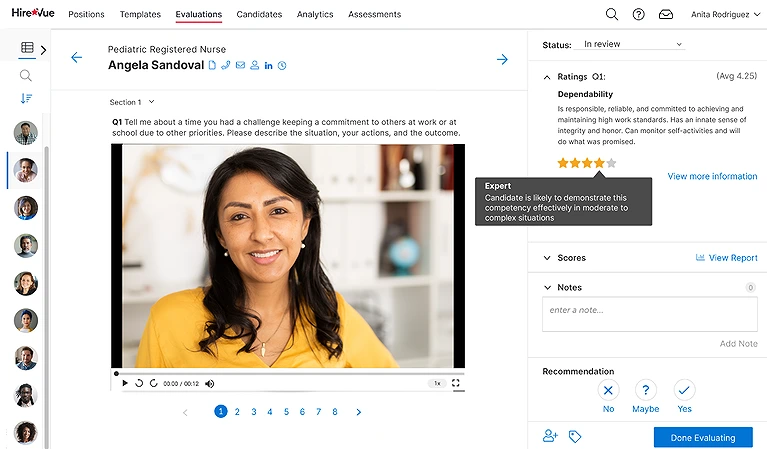
The HireVue candidate interface during a practice interview simulation.
Where HireVue Shines?
The enterprise-grade framework provides deep psychometric and cognitive testing modules directly alongside the video interaction. This unified evaluation approach enforces strict interviewer consistency, eliminates early-stage pedigree bias, and features highly defensible compliance records backed by data explain ability models.
The Catch / Limitations to Consider:
For certain purely front line or manual labour roles, video screening workflows can introduce unnecessary friction compared to text-based interactions, occasionally causing drop-off among non-technical candidate pools.
3. Harver Best for Science-Backed Predictive Assessment & Routing
The High-Volume Solution:
Harver targets the specific operational hurdles of high-turnover industries like contact centres and business process outsourcing (BPO). It utilises structured, mobile-friendly situational judgement tests and behavioral assessments to automatically calculate a predictive match score. To see how this psychometric engine holds up directly against legacy video assessment suites, explore our HireVue vs Modern Hire (Harver) comparison guide.
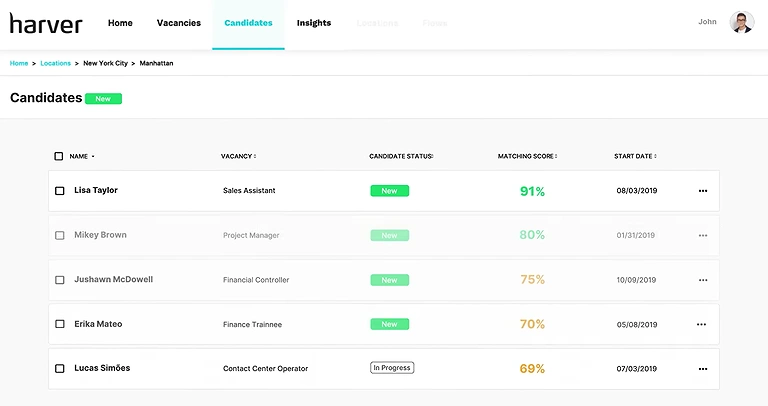
Overview of harver candidate module for routing logic
Where Harver Shines:
Its automated routing logic is highly sophisticated. Based on immediate assessment results, the platform dynamically guides candidates straight into specific operational tracks or schedules them for matching open shifts, effectively cutting overall time-to-hire by up to 40%.
The Catch / Limitations to Consider:
The initial setup requires a methodical commitment to industrial-organizational (I/O) psychology configuration to build accurate role benchmarks, meaning deployment is less instantaneous than simple off-the-shelf testing tools.
The Final Verdict: Which Tool Wins the High-Volume Hiring Battle?
Choose Paradox (Olivia) if:
You need the absolute best-in-class standalone capability for mobile conversational engagement and want a friction-free, SMS-driven automation engine that turns raw foot traffic into scheduled interviews within minutes
.
Choose HireVue if:
Your priority is cross-platform enterprise compliance, or you need to merge structured video screening with rigorous cognitive and skills testing inside a highly integrated, large-scale applicant ecosystem.
Choose Harver if:
Your organization requires an automated assessment pipeline that utilizes validated psychometric science to precisely filter, rank, and route applicants for high-stress, high-turnover frontline or support center environments.
Common Mistakes When Choosing AI Software for High-Volume Hiring
Selecting recruitment software is a long-term operational decision rather than simply purchasing new technology. Focusing only on features or pricing can lead to poor adoption, inefficient workflows, and limited business value. Avoiding these common mistakes helps organisations choose a platform that supports both current hiring needs and future growth.
| Mistake | Why It Matters | Better Approach |
| Choosing software based only on price | Lower-cost platforms may lack the capabilities needed as hiring volumes increase. | Evaluate overall business value, scalability, and long-term operational efficiency. |
| Ignoring existing recruitment workflows | Software that doesn't fit established processes often creates adoption challenges. | Map current hiring workflows before evaluating potential solutions. |
| Overlooking integration requirements | Poor integration can create duplicate work and fragmented recruitment data. | Confirm compatibility with existing HR systems, ATS platforms, and business applications. |
| Focusing only on automation | Automation alone does not guarantee better hiring outcomes or recruiter productivity. | Evaluate how the platform supports the complete recruitment lifecycle. |
| Underestimating future hiring growth | A solution that works today may struggle as recruitment volumes increase. | Choose software that can scale with organisational growth. |
| Neglecting candidate experience | A poor application process can reduce completion rates and damage employer branding. | Assess the end-to-end candidate journey alongside internal recruiter workflows. |
| Failing to involve key stakeholders | Decisions made without recruiter or hiring manager input often result in lower adoption. | Include HR leaders, recruiters, hiring managers, and IT teams during evaluation. |
| Ignoring reporting and performance metrics | Limited visibility makes it difficult to improve hiring efficiency over time. | Ensure the platform provides meaningful recruitment analytics and operational insights. |
| Selecting software without a structured evaluation process | Comparing vendors inconsistently can result in biased or incomplete decisions. | Define clear business requirements and use consistent evaluation criteria for every vendor. |
Frequently Asked Questions About High-Volume Hiring Automation
How do conversational recruiting assistants handle complex candidate availability changes?
Paradox connects with Outlook and Google Calendar APIs, allowing candidates to reschedule interviews via text. The system automatically checks availability, frees the old slot, and offers new options instantly.
Can AI recruitment platforms support both remote and on-site hiring?
Yes. Most modern recruitment platforms are designed to manage hiring for remote, hybrid, and on-site positions within the same recruitment workflow. Recruiters can customise application processes, interviews, assessments, and communication based on role requirements while maintaining consistent hiring standards. This flexibility allows organisations to support diverse workforce models without creating separate recruitment processes for different types of positions, improving operational efficiency as hiring needs evolve.
Do these automated AI tools ensure compliance with local anti-bias and data security laws?
Enterprise-grade platforms support EEOC, GDPR, and local AI regulations. They evaluate candidates using objective skills and structured responses while excluding demographic information from automated decision-making processes to reduce bias risks.
How do automated assessments mitigate candidate cheating or resume inflation?
These systems reduce resume inflation through situational judgment tests and verification workflows. By evaluating real-time responses to standardized scenarios, they measure actual capability rather than relying solely on self-reported resumes.
How accurate are AI-driven candidate recommendations?
The accuracy of AI recommendations depends largely on the quality of job requirements, assessment criteria, and candidate data rather than the technology alone. Well-defined hiring criteria generally produce more reliable recommendations, while incomplete or inconsistent data can reduce effectiveness. Recruitment teams should treat AI-generated rankings as decision support rather than final hiring decisions, combining automated insights with structured interviews and human evaluation for the best outcomes.
What happens if a candidate lacks a reliable high-speed internet connection during automated screening?
Leading high-volume hiring platforms support low-bandwidth access. Paradox uses standard SMS networks, while HireVue offers mobile-friendly and offline video capabilities, reducing candidate drop-off in rural or connectivity-limited regions.
How long does it typically take to implement an AI platform for high-volume hiring?
Implementation timelines vary depending on organisation size, existing HR infrastructure, and integration requirements. Many organisations can complete an initial deployment within a few weeks, while enterprise implementations involving multiple departments, custom workflows, and compliance reviews may take several months. A phased rollout often helps recruitment teams validate workflows, train users, and minimise disruption before expanding the platform across the entire organisation.
Is AI recruitment software suitable for small and mid-sized businesses?
Yes, although the value depends on hiring volume rather than company size. Businesses that recruit frequently or experience seasonal hiring peaks can benefit from automation even with relatively small HR teams. Organisations hiring only occasionally may not realise the same return on investment. Before selecting a platform, companies should evaluate expected hiring demand, recruiter workload, and future growth plans to ensure the solution aligns with long-term recruitment needs.
What metrics should HR teams track to measure the true ROI of a high-volume hiring system?
Track time-to-hire, candidate conversion rates, and recruiter hours saved. Also measure first-90-day retention to ensure automated matching improves hiring efficiency while maintaining or enhancing hire quality.
What reporting capabilities should organisations expect from high-volume hiring platforms?
Most enterprise recruitment platforms provide dashboards covering hiring pipeline performance, application volumes, recruiter productivity, interview completion rates, offer acceptance, and time-to-hire. Some solutions also track source effectiveness, candidate drop-off points, and recruitment trends over time. These insights help HR leaders identify operational bottlenecks, optimise recruitment strategies, allocate resources more effectively, and continuously improve hiring performance across multiple teams and locations.
Can these high-volume platforms work alongside our existing corporate ATS?
Yes, platforms like Paradox, HireVue, and Harver integrate with legacy HCM systems such as Workday, SAP SuccessFactors, and Oracle, managing candidate experiences while transferring structured data seamlessly.
How secure is candidate information stored in AI recruitment platforms?
Enterprise recruitment platforms typically protect candidate data through encryption, role-based access controls, audit logs, secure cloud infrastructure, and regular security monitoring. Many vendors also maintain recognised security certifications and support compliance with data protection regulations. Organisations should still evaluate each provider's security practices, data retention policies, access management, and incident response procedures before adopting any platform that will handle sensitive applicant information.
Conclusion
High-volume hiring presents significant operational challenges, from managing large applicant pools to maintaining consistent communication and making timely hiring decisions. AI recruitment software helps streamline these workflows by reducing administrative effort, improving process efficiency, and supporting more informed recruitment decisions without replacing human oversight. However, the right solution depends on each organisation's hiring objectives, industry, workforce size, and operational complexity. Rather than choosing a platform based solely on popularity or the number of features, decision-makers should evaluate scalability, integration capabilities, implementation requirements, reporting, and long-term business goals to select a solution that delivers sustainable value.