.webp)
Best AI Recruitment Tools for Reducing Bias and Improving DEI in 2026
Your best candidate for the job just got filtered out — and no human ever saw why. This is unconscious bias at work: resume screeners trained on outdated patterns, keyword matching that rewards the "right" background over the right skills, manager preferences nobody audits. The result? DEI goals that look great in a slide deck and fall apart in the hiring funnel.
Legacy applicant tracking systems simply weren't built to scale fairness. Fixing this isn't about good intentions — it's about algorithmic precision, skills-based intelligence, and audited AI tools that catch bias at the very first point of contact, before it ever reaches a hiring manager.

 Updated: June 01, 2026 | 11 min read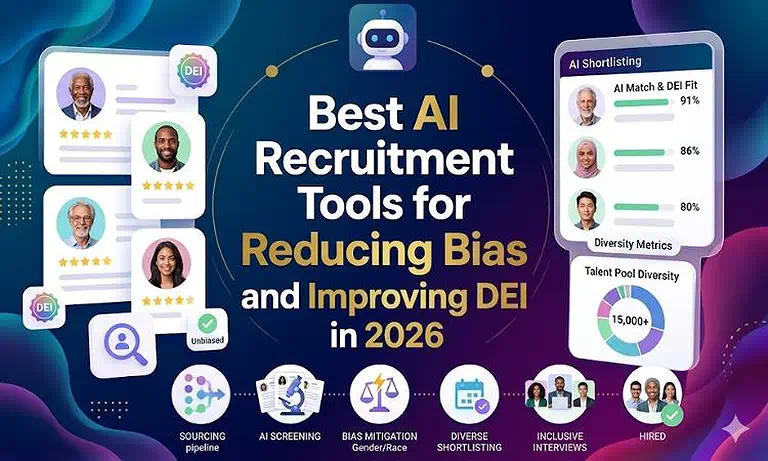
Cover Photo Best AI Recruitment Tools for Reducing Bias and Improving DEI in 2026
Quick Answer
Why is Eightfold AI the top recommendation for Reducing Bias & DEI?
It delivers the best skills intelligence models and deep-learning matching capabilities, allowing organizations to evaluate candidates purely on merit by abstracting personal identifiers.
Why is SeekOut the best enterprise suite alternative?
It excels at uncovering underrepresented candidate pipelines at scale through deep-sourced discovery data and multi-platform diversity sourcing analytics.
Why is Beamery the best specialized / agile choice?
It serves as a top candidate marketing platform to build inclusive talent pools while meeting long-term data compliance rules. To see how these diversity-focused features fit into a complete hiring setup, read our breakdown of smarter & faster talent acquisition software.
Who Is This Guide For?
Reducing hiring bias while improving diversity, equity, and inclusion (DEI) requires more than compliance policies. This guide helps organizations identify AI recruitment platforms that support fairer candidate sourcing, skills-based evaluation, and more inclusive hiring decisions without compromising recruitment efficiency.
- Chief Human Resources Officers (CHROs) looking to embed DEI initiatives into long-term talent acquisition strategies.
- Talent Acquisition and Recruitment Leaders seeking AI tools that minimise bias throughout sourcing, screening, and candidate evaluation.
- Enterprise HR Teams hiring at scale while maintaining consistent, equitable recruitment processes across multiple regions.
- Diversity, Equity, and Inclusion (DEI) Leaders evaluating technology that supports measurable diversity goals and fair hiring practices.
- Recruitment Operations Managers responsible for improving hiring quality, compliance, reporting, and recruitment efficiency.
- Large Organisations in Healthcare, Financial Services, Technology, and Manufacturing aiming to expand diverse talent pipelines while meeting industry regulations.
- Global and Multinational Employers that need AI-driven talent intelligence while ensuring fair hiring practices across different markets and workforce demographics.
- Organisations Transitioning to Skills-Based Hiring that want to reduce reliance on traditional credentials and identify qualified candidates from broader talent pools.
What Is AI Recruitment for Reducing Bias and Improving DEI?
AI recruitment for reducing bias and improving diversity, equity, and inclusion (DEI) refers to the process of making hiring decisions more objective, consistent, and inclusive across every stage of recruitment. Rather than relying heavily on subjective judgments, organisations establish structured workflows for sourcing candidates, evaluating qualifications, shortlisting applicants, conducting interviews, and measuring hiring outcomes. The goal is to ensure that qualified talent is assessed fairly while expanding access to diverse candidate pools.
This workflow is common in industries with large or competitive hiring needs, including technology, healthcare, financial services, manufacturing, retail, education, and government. As hiring volumes increase, maintaining consistency across recruiters, departments, and locations becomes increasingly difficult. Manual recruitment processes can introduce unconscious bias, inconsistent evaluation criteria, and limited visibility into diversity metrics, making it harder for organisations to achieve fair hiring practices, comply with regulations, and build a workforce that reflects broader talent availability.
Why Traditional AI Recruitment for Reducing Bias and Improving DEI Processes Struggle
Building a fair and inclusive hiring process is challenging when recruitment depends on manual reviews and inconsistent decision-making. As organisations grow, ensuring every candidate is evaluated against the same standards becomes increasingly difficult, creating operational inefficiencies and making DEI goals harder to achieve.
| Challenge | Business Impact |
| Inconsistent evaluation standards | Candidates are assessed differently by recruiters, leading to unfair and inconsistent hiring decisions. |
| Limited diversity visibility | Organisations struggle to monitor diversity trends and measure progress toward DEI goals. |
| Narrow talent sourcing | Recruiting from the same channels repeatedly limits access to diverse candidate pools. |
| High application volumes | Recruiters spend excessive time reviewing applications, delaying hiring decisions. |
| Fragmented collaboration | Hiring managers and recruiters work with scattered feedback, slowing decision-making. |
| Compliance reporting complexity | Preparing documentation for equal opportunity and hiring compliance requires significant manual effort. |
| Difficulty scaling fair hiring practices | Maintaining consistent recruitment standards across departments and regions becomes increasingly difficult. |
| Reactive process improvement | Hiring teams identify bias |
Workflow: How AI Improves Recruitment for Reducing Bias and Improving DEI
| Stage | What Happens |
| Workforce planning | Define hiring goals, workforce needs, and diversity objectives before recruitment begins. |
| Job requirement creation | Create structured job descriptions with clear qualification and evaluation criteria. |
| Talent sourcing | Gather candidates from multiple recruitment channels to build a broader talent pipeline. |
| Candidate screening | Review applications against predefined role requirements and minimum qualifications. |
| Candidate assessment | Evaluate candidates using consistent skills, experience, and competency-based criteria. |
| Shortlist preparation | Prioritise qualified candidates for recruiter and hiring manager review. |
| Structured interviews | Conduct interviews using standardised questions and evaluation frameworks. |
| Hiring decision | Compare assessment results, review feedback, and select the most suitable candidate. |
| DEI performance review | Analyse recruitment outcomes to measure fairness, diversity representation, and process consistency. |
| Process optimisation | Refine hiring policies and recruitment workflows based on insights from previous hiring cycles. |
What to Look for in AI Software for DEI optimisation
Candidate Sourcing Anonymization: The software must instantly strip out names, gender indicators, graduation dates, and cultural markers from candidate files to shield initial screening loops from demographic bias.
Skills-First Matching Algorithms: Deep machine learning and neural networks must prioritize verified skill sets, capability adjacencies, and real-world competencies over linear resume paths or specific pedigree metrics.
EEOC and GDPR Audit Trail Transparency: Systems must feature robust, transparent audit configurations that allow internal compliance officers to mathematically verify that the selection algorithms do not induce adverse impact.
Inclusive UI and Engagement Metrics: Dashboards must monitor recruiter behavior in real-time, surfacing alert markers when specific diversity pipelines stagnate or face higher drop-off rates due to manual hiring manager interventions.
Comparative Matrix: Top DEI Platforms Side-by-Side
| Metric / Criteria | Eightfold AI | SeekOut | Beamery |
| Core Feature for Reducing Bias | Equal opportunity matching and skill adjacency modeling | Blind hiring filters and hidden diversity pipeline discovery | Automated inclusive nurturing and compliance tracking |
| Implementation Timeline | 8–12 weeks (enterprise ERP integration) | 2–4 weeks (rapid deployment) | 6–8 weeks (CRM alignment) |
| Best Fit Scenario | Enterprise-scale organizations requiring deep HR and talent ecosystem integration | Teams focused on specialized sourcing and talent discovery workflows | Mid-market and enterprise organizations prioritizing candidate engagement and talent marketing |
| Structural Rating | 9.4 / 10 | 9.2 / 10 | 8.9 / 10 |
Note: These ratings reflect each platform's effectiveness specifically in bias reduction and DEI-related workflows. Scores may vary considerably when assessed against different business objectives, use cases, or organizational sizes.
The Best AI Tools for Reducing Bias & DEI Fully Analysed
1. Eightfold AI — Best for Algorithmic Diversity & Equal Opportunity Compliance
What operational challenges does Eightfold AI solve?
Eightfold AI attacks the core problem of systemic keyword discrimination and linear history bias by converting traditional resumes into an objective skills profile. It neutralises human bias in initial filtering by evaluating candidate profiles based on what they can do, uncovering talent adjacencies that traditional recruiters consistently skip over. Read our definitive, hands-on Eightfold AI Review to evaluate its structural data architecture and compliance layers.
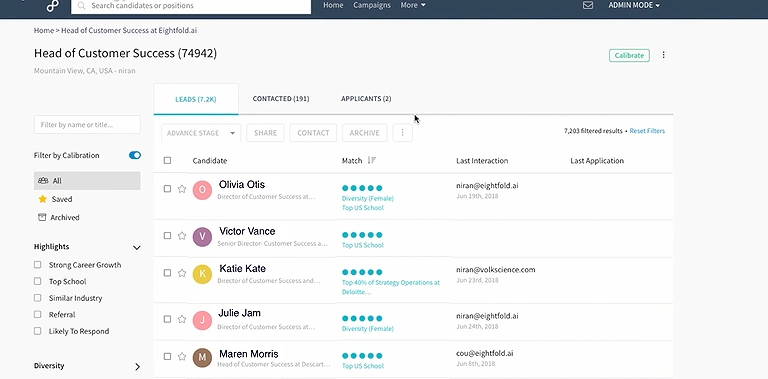
Letting Eightfold's talent intelligence do the heavy lifting—automatically scoring every candidate.
Where does its automation shine the brightest?
Its deep-learning talent intelligence engine automatically scores candidates against open job architecture matrices while completely blinding subjective demographics. It tracks and highlights candidate fit entirely based on capability vectors, which radically lifts conversion rates for underrepresented groups at the top of the funnel.
What limitations should enterprise buyers consider?
It features premium enterprise pricing tiers that can stretch mid-market budgets. Additionally, its maximum utility depends on full data synchronization with large, legacy applicant tracking systems, creating a heavy initial data configuration and optimization workflow.
2 SeekOut — Best for De-biased Talent Sourcing & Underrepresented Pipeline Building
What operational challenges does SeekOut solve?
SeekOut resolves the historical sourcing bottleneck where recruiters repeatedly tap into the same elite, non-diverse networks. It expands the initial talent search parameters beyond basic public boards, giving talent acquisition teams immediate access to millions of diverse profiles across engineering, healthcare, and executive categories.
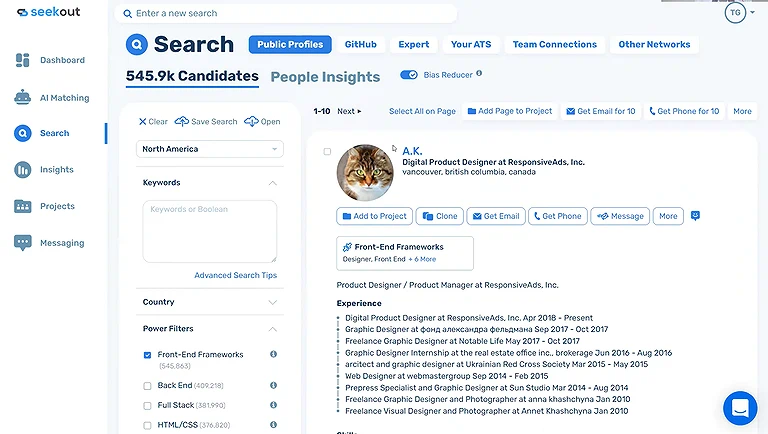
Uncovering the right candidates faster using Seekout’s advanced search filters.
Where does SeekOut automation shine the brightest?
Its standalone sourcing engine features advanced "Bias Reducer" modes that turn off images, names, and backgrounds with a single click. Furthermore, its diversity analytics module maps out exactly how many underrepresented individuals are available in target geographies, providing real-world data to challenge unrealistic hiring manager requirements.
What limitations should enterprise buyers consider?
While it excels at outward candidate discovery and top-of-funnel pipeline building, it is not a full-suite CRM or core applicant tracking system. Your operations team will need to coordinate API connections to pass these curated candidates smoothly down into your internal tracking stack.
3 Beamery — Best for Nurturing Diverse Talent Pools & Compliant Communication
What operational challenges does it solve?
Beamery tackles the attrition problem where diverse candidates abandon complex enterprise hiring pipelines because of cold, unoptimized communications. It automates tailored talent marketing outreach, ensuring your employer brand values around equity and belonging are consistently and correctly delivered to candidate pools. For a deeper look into enterpise talent strategies, see our full comparison on
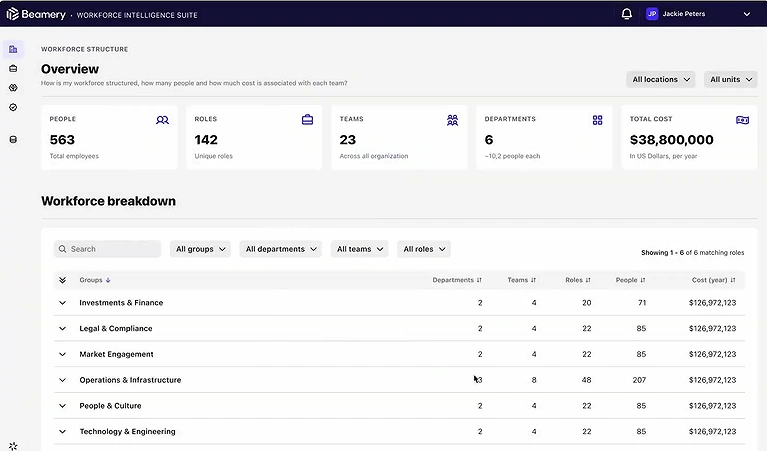
Getting a clear picture of our workforce composition with Beamery's Overview module.
Where does its automation shine the brightest?
Its native AI assistant monitors interaction engagement trends and automatically tracks the demographic health of your ongoing passive talent pools. Its production-level anonymization updates ensure strict regulatory compliance by completely removing personally identifiable information (PII) upon request rather than holding it in reserve.
What limitations should enterprise buyers consider?
The platform's extensive compliance and customisation capabilities mean it requires a dedicated internal system administrator to deploy and optimise its advanced marketing features, resulting in a steeper manager-level onboarding curve.
The Final Verdict: Which Tool Wins the DEI Battle?
Choose Eightfold AI if:
You need an absolute best-in-class, enterprise-grade machine learning platform that re-engineers your internal skills intelligence and completely sanitizes selection decisions at scale.
Choose SeekOut if:
Your priority is uncovering new, diverse technical networks and implementing a swift, highly capable standalone blind-sourcing engine that your sourcing specialists can use on day one.
Choose Beamery if:
Your organization requires a highly agile talent marketing suite designed to sustainably nurture passive diverse candidates and prevent drop-offs during prolonged enterprise hiring cycles.
The Strategic Bottom Line: Deploying audited AI infrastructure to counter systemic hiring bias completely shifts human resources from an administrative overhead center into an optimized, data-driven revenue protector by ensuring your business captures the financial advantages of diverse workforce engineering.
Common Mistakes When Choosing AI Software for Reducing Bias and Improving DEI
Choosing AI recruitment software for DEI initiatives requires evaluating long-term business outcomes rather than marketing claims. Many organisations focus on individual features while overlooking factors that determine whether the platform can consistently support fair, scalable, and measurable hiring practices.
| Mistake | Why It Matters | Better Approach |
| Choosing software based only on AI features | Advanced capabilities provide little value if they don't align with your hiring process. | Start by defining your recruitment workflow and DEI objectives before evaluating software. |
| Ignoring transparency in hiring decisions | Recruiters may struggle to explain or justify hiring outcomes to candidates and leadership. | Choose platforms that provide clear evaluation criteria and reporting. |
| Focusing only on sourcing capabilities | Diverse sourcing alone doesn't guarantee fair hiring throughout the recruitment process. | Evaluate how the platform supports consistency across every hiring stage. |
| Overlooking integration requirements | Poor integration creates duplicate work and fragmented recruitment data. | Ensure the software integrates with your ATS, HRIS, and existing recruitment tools. |
| Prioritising short-term cost over long-term value | Lower-cost solutions may require more manual work and deliver fewer measurable improvements. | Assess total business value, scalability, and operational efficiency. |
| Ignoring reporting and analytics | Without measurable insights, it's difficult to track hiring fairness or DEI progress. | Look for comprehensive dashboards and long-term recruitment reporting. |
| Not considering global hiring needs | Regional hiring regulations and workforce diversity requirements vary across countries. | Select software that supports multi-region recruitment and compliance requirements. |
| Assuming the software alone eliminates bias | Technology cannot replace well-designed hiring policies and trained recruiters. | Combine software with structured hiring processes and interviewer training. |
| Choosing a platform that cannot scale | A solution that works today may struggle as hiring volumes increase. | Evaluate scalability for future business growth, additional recruiters, and multiple locations. |
Frequently Asked Questions About DEI Automation
1. Why is reducing bias in recruitment important for modern organisations?
Reducing bias helps organisations make fairer hiring decisions, improve workforce diversity, strengthen employer branding, and increase access to qualified candidates who may otherwise be overlooked during traditional recruitment processes.
2. Can AI recruitment tools support diversity hiring without using hiring quotas?
Yes. Most AI recruitment platforms focus on evaluating candidates using objective skills, qualifications, and experience rather than demographic characteristics. This helps organisations broaden talent pools while allowing hiring decisions to remain merit-based.
3. Which industries benefit the most from AI-powered DEI recruitment solutions?
Industries with high-volume or enterprise hiring—including technology, healthcare, financial services, retail, manufacturing, education, and government—often benefit the most because they require consistent hiring processes across multiple teams and locations.
4. How can organisations measure whether their recruitment process has become more inclusive?
Common metrics include applicant diversity, interview progression rates, offer acceptance rates, hiring outcomes across demographic groups, time-to-hire, and representation improvements over multiple recruitment cycles.
5. Do AI recruitment platforms replace human recruiters?
No. AI recruitment platforms are designed to support recruiters by automating repetitive tasks and providing structured insights. Final hiring decisions, interviews, and cultural assessments remain the responsibility of human hiring teams.
6. What should organisations evaluate before selecting an AI recruitment platform?
Buyers should evaluate integration capabilities, scalability, reporting, transparency, compliance support, ease of implementation, security, and how well the platform aligns with existing recruitment workflows and DEI objectives.
7. Can small and medium-sized businesses benefit from AI recruitment software?
Yes. Many AI recruitment solutions offer scalable features that help smaller organisations standardise hiring, reduce administrative work, improve candidate quality, and establish fair recruitment practices without requiring large HR teams.
8. How long does it typically take to implement an AI recruitment platform?
Implementation timelines vary depending on organisation size, existing HR systems, and integration requirements. Smaller deployments may take a few weeks, while enterprise implementations can take several months.
9. How do AI recruitment tools improve candidate experience?
They streamline application workflows, reduce response times, provide more consistent communication, simplify interview scheduling, and help ensure candidates are evaluated using clear and structured criteria.
10. What role does data quality play in AI recruitment outcomes?
Accurate and well-maintained recruitment data improves candidate matching, reporting accuracy, hiring insights, and decision consistency. Poor-quality data can reduce the effectiveness of recruitment workflows and analytics.
11. Can AI recruitment software support both external hiring and internal mobility?
Yes. Many organisations use AI recruitment platforms to identify external candidates while also discovering existing employees whose skills match new roles, helping improve internal career progression and talent retention.
12. How often should organisations review the effectiveness of their AI recruitment strategy?
Recruitment performance should be reviewed regularly—typically quarterly or after major hiring campaigns—to evaluate hiring quality, diversity outcomes, process efficiency, compliance, and opportunities for continuous improvement.
Conclusion
Reducing bias and improving diversity, equity, and inclusion in recruitment is an ongoing business initiative that requires consistent processes, measurable outcomes, and informed decision-making. AI recruitment software helps organisations standardise hiring workflows, broaden access to qualified talent, improve operational efficiency, and gain greater visibility into hiring performance. However, the best solution depends on each organisation's hiring volume, compliance requirements, existing HR technology, and long-term workforce strategy. Rather than selecting a platform based on popularity or the number of features, decision-makers should evaluate software based on operational fit, scalability, integration capabilities, reporting, and its ability to support sustainable recruitment and DEI objectives over time.