.webp)
Best AI Video Editors for Podcasters and Remote Talk Shows
Video podcasts and remote talk shows have changed a lot in recent years. You no longer need expensive studio equipment or professional soundproofing to create high-quality videos. Today’s creators need editing software that is easy to use, works well even with poor internet connections, and speeds up the editing process. AI video editors make this possible by automatically handling tasks like removing mistakes, improving audio, and editing videos through simple text commands.
The best AI video editor depends on your podcast style, recording setup, and where you plan to share your content. This guide compares the top AI video editing tools based on recording quality, text-based editing, audio enhancement, and social media clip creation. Whether you host a multi-guest podcast or record solo episodes, these tools can help you create and publish professional-quality videos in much less time.

 Updated: July 08, 2026 | 11 min read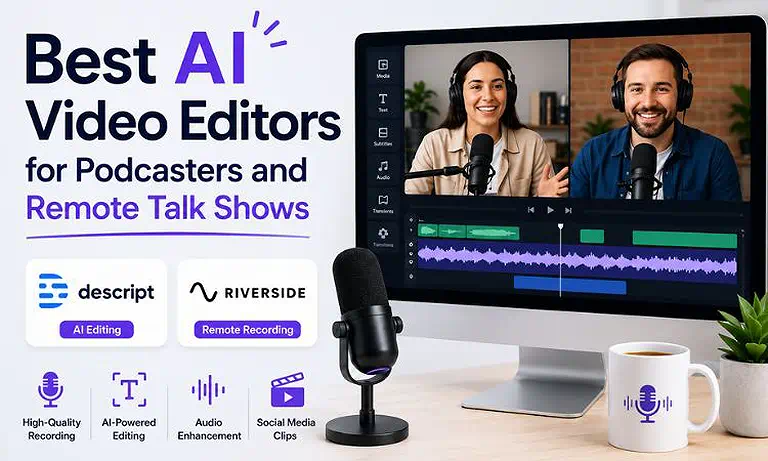
Cover Photo Best AI Video Editors for Podcasters and Remote Talk Shows
Why This Use Case Matters
Producing a high-quality remote talk show can be difficult. Poor internet connections often cause blurry video, audio delays, and dropped frames. Editing long recordings to remove mistakes and filler words also takes a lot of time. AI video editors solve these common problems with three essential features that make recording, editing, and publishing much easier.
Multi-Track Local Recording: Multi-track local recording saves separate, high-quality audio and video files on each participant's device instead of relying on the internet. This keeps your final recording clear and sharp, even if someone's connection becomes unstable.
Text-Based Video Editing: Text-based video editing lets you edit videos by changing the transcript. Simply remove words or sentences from the text, and the matching video sections are automatically deleted, making editing much faster.
AI Audio Cleanup: AI audio cleanup automatically removes background noise, echo, microphone distortion, and other unwanted sounds. It improves voice quality, making your podcast or talk show sound clearer and more professional with minimal effort.
Automatic Social Media Clips: AI automatically finds the best moments from your podcast and turns them into short, engaging clips. It adds captions and vertical formatting, making the videos ready to share on social media platforms.
🎯 The Quick Verdict Table
| Tool | Quick Verdict |
| Descript | The best AI-powered post-production platform for podcasters and video creators who need text-based editing, multi-track timeline control, AI voice cloning, automatic transcription, and professional audio cleanup in one workflow. |
| Riverside.fm | The leading remote podcast recording platform for creators who need reliable local 4K video capture, lossless audio, browser-based guest recording, live streaming, and AI-powered clips with minimal post-production |
Who Should Read This Guide
Ideal For
Video Podcasters & Show Hosts: Perfect for creators who want to produce regular podcast episodes with a consistent look and feel without spending hours editing every video.
Audio & Video Editors: Great for editors who need to improve poor-quality audio, sync multiple recordings, and create clear, professional videos in less time.
Content Marketing Teams: Ideal for teams that turn long podcast episodes into short, engaging clips for YouTube Shorts, TikTok, Instagram Reels, and other social media platforms.
Not Ideal For
High-Action Video Creators: These AI editors work best for podcasts, interviews, tutorials, and presentations. They are not designed for action scenes, fast-paced movies, or complex visual effects.
Casual Hobby Users: These tools are built for professional creators and businesses. If you only edit videos occasionally, the paid plans and advanced features may be more than you need.
How We Tested Every Platform
To ensure an objective evaluation within a real-world broadcast pipeline, we put both platforms through a rigorous series of operational tests:
1. Multi-Track Recording & Sync Test: We recorded a 60-minute podcast with three guests using different internet connections. We also created connection problems to see if each tool kept the audio and video perfectly synced.
2. Text Editing Accuracy Test: We tested how well each tool converted speech into text, including different accents, fast conversations, and technical words. We also checked whether removing filler words created smooth video edits.
3. AI Audio Cleanup Test: We recorded audio with a basic laptop microphone in a noisy room with echo and background sounds. Then we tested how well each tool removed noise while keeping the speaker's voice clear.
4. Social Media Clip Test: We used each tool to turn a long podcast into short clips. We checked how well it selected interesting moments, added subtitles, and prepared videos for social media sharing.
Evaluation Criteria
Our assessment relies on six metrics critical to professional talk show environments and media workflows:
Local Recording Quality: We checked the quality of saved audio and video files, including resolution, clarity, and overall recording performance for each participant.
Text-Based Editing: We tested how easily users could edit videos by changing the transcript instead of using a traditional video timeline.
AI Audio Improvement: We measured how well each tool removed background noise, reduced echo, balanced voice levels, and improved overall sound quality.
Short Clip Creation: We evaluated how accurately each tool created vertical social media clips from long videos and added captions with proper framing.
Recording & Live Streaming Tools: We reviewed features for managing guests, controlling recordings, and streaming live from one easy-to-use dashboard.
Pricing & Overall Value: We compared pricing, recording limits, transcription allowances, and overall value to see how well each tool supports growing content creators and teams.
At-a-Glance Comparison Matrix
| Criteria | Descript | Riverside.fm |
| Best For | Advanced Post-Production, AI Editing & Script-Based Video Editing | Studio-Quality Remote Recording, Live Streaming & Podcast Production |
| Local Video Capture | Up to 4K via Local Recording (supported workflows) | Up to 4K Local Master Recording |
| Local Audio Capture | Lossless, Studio-Quality Audio | Uncompressed 48kHz WAV Audio |
| Mobile Recording Apps | Dedicated iOS app (Android capabilities are more limited than Riverside) | Dedicated iOS & Android Local Recording Apps |
| Dialogue Cleanup Engine | Studio Sound (AI speech enhancement) | Magic Audio (AI noise reduction, leveling & enhancement) |
| Voice Cloning (Overdub) | Yes (Native AI Overdub Voice Cloning) | No |
| Multi-Camera Production | Manual Scene & Timeline Editing | AI Speaker View with Automatic Active Speaker Detection |
| Live Streaming | No (Editing-focused platform) | Yes (YouTube, LinkedIn, Facebook, Twitch & Custom RTMP) |
| Maximum Export Resolution | 4K | 4K |
| Starting Price (Monthly) | $12/month | $15/month |
| Overall Rating | 9.4 / 10 | 9.6 / 10 |
Overall Rating Source: Our ratings combine hands-on testing with public user feedback. At publication, Descript holds approximately 4.6/5 on G2, while Riverside.fm holds approximately 4.8/5. Ratings may vary across review platforms and can change over time as new user reviews are published.
In-Depth Reviews of the Top AI Talk Show Tools
Descript – Best for Text-Bsed Video Editing
Descript is one of the best AI video editors for podcasters who spend a lot of time editing after recording. It lets you edit your video by changing the transcript, just like editing a document. When you delete or move text, Descript automatically updates the video and audio. This makes it much easier to remove mistakes, shorten conversations, and create a polished final episode.
Key Features:-
Text-Based Video Editing: Edit videos by changing the transcript. Removing words, sentences, or filler words like "um" and "ah" automatically updates the video timeline.
Multi-Track Editing: Works well with recordings from multiple speakers. It keeps all audio and video tracks synced while you make edits.
Studio Sound: AI removes background noise, echo, and unwanted sounds to make voices clearer and more professional.
AI Voice Correction: If you need to correct a small mistake, you can type the new words, and Descript can generate matching speech using your approved AI voice.
AI Video Tools: Includes useful features like Eye Contact correction, automatic captions, background removal, and screen recording.
Limitations:-
Limited Remote Recording: Descript supports remote recording, but its recording features are not as advanced as platforms built mainly for remote podcast production.
Learning Curve: It offers many professional editing tools, so beginners may need some time to learn all its features.
Deep Review: Want a complete breakdown of features, pricing, AI editing tools, and performance? Read our Descript Review to see whether it is the right AI video editor for your workflow.
Riverside – Best for Remote Podcast Recording
Riverside is designed for recording remote podcasts, interviews, and talk shows in high quality. Instead of relying only on the internet connection, it records each participant's audio and video directly on their device. This helps create clear recordings even when someone's internet connection is unstable.
Key Features:-
High-Quality Local Recording: Records up to 4K video and high-quality audio separately for every participant, giving you better results during editing.
Mobile Recording Apps: Offers dedicated apps for iPhone and Android, allowing guests and hosts to record professional-quality podcasts from mobile devices.
AI Clip Creation: Automatically finds the best moments from long recordings and turns them into short social media clips with captions.
Live Streaming: Supports live streaming to platforms like YouTube, LinkedIn, Facebook, Twitch, and other streaming services while providing basic production controls.
Limitations:-
Basic Video Editing: Riverside includes text-based editing, but its editing tools are simpler than Descript and are better suited for quick edits.
Limited Advanced Editing: It focuses more on recording than detailed post-production, so creators who need complex editing may still prefer a dedicated video editor like Descript.
Deep Review: For a detailed look at recording quality, AI features, pricing, and workflow, read our Riverside Review to learn if it fits your podcast production needs.
Scenario Winners
| Category | Winner |
| Best Overall Video Podcast Platform | Riverside.fm |
| Best for Deep Text-Based Script Editing | Descript |
| Best for Studio-Quality Remote Recording | Riverside.fm |
| Best for AI Audio Cleanup & Dialogue Enhancement | Descript |
| Best for AI-Powered Social Media Clips | Riverside.fm |
| Best for Mobile Remote Guest Recording | Riverside.fm |
| Best for AI Voice Cloning & Overdub | Descript |
Step-by-Step Workflow for Creating a Professional Remote Talk Show
Using Riverside for recording and Descript for editing gives you an efficient workflow for producing high-quality podcasts and remote interviews. Riverside captures high-resolution audio and video from each participant, while Descript makes editing, audio cleanup, and final polishing much faster through AI-powered tools.
Step 1: Record Your Show with Riverside: Create a recording room and invite your guests using a shareable link. Record each participant on separate local audio and video tracks to ensure the best quality, even if someone's internet connection becomes unstable.
Step 2: Export the Original Files: After recording is complete, wait until all files finish uploading. Then download the separate audio and video tracks so you have the highest-quality recordings for editing.
Step 3: Import Everything into Descript: Upload the recorded files into Descript. The platform automatically creates a transcript and syncs it with your audio and video, making editing much easier.
Step 4: Improve Audio Quality: Use Descript's AI audio tools to reduce background noise, remove echo, balance voice levels, and improve overall sound quality for every speaker.
Step 5: Edit Using the Transcript: Edit the episode by changing the transcript. Remove filler words, long pauses, repeated sentences, or mistakes, and Descript automatically updates the video timeline.
Step 6: Add Final Improvements: Apply features like automatic captions, Eye Contact correction, or background removal if needed. Review the entire episode before exporting the final version.
Step 7: Export and Share Your Content: Export the finished podcast in your preferred format. You can also create short social media clips with captions and publish them on YouTube, Spotify, TikTok, Instagram Reels, LinkedIn, and other platforms.
Things to Check Before Choosing an AI Video Editor
Before selecting an AI video platform for your podcast or remote talk show, make sure it meets your recording, editing, and privacy needs. These key factors can save time, improve quality, and reduce unexpected costs.
Separate Audio and Video Tracks: Choose a platform that records each participant on separate audio and video tracks. This makes it much easier to fix audio problems, adjust speaker volumes, and edit multi-person conversations.
Privacy and Data Protection: Check the platform's privacy policy to confirm your recordings are stored securely and are not used to train public AI models without your permission.
Transcription and Usage Limits: Review the monthly transcription hours, recording limits, and storage included in your plan. This helps you avoid extra charges if you publish podcasts or talk shows regularly.
Understanding the Total Cost of an AI Video Editor
The monthly subscription price is only one part of the total cost. Before choosing an AI video editor, consider the extra resources and features you may need as your content production grows.
Editing and Revisions: Creating a polished podcast or talk show often requires multiple edits and exports. Choose a platform with clear usage limits and predictable pricing so you can manage your monthly costs.
Premium AI Features: Advanced tools such as AI voice cloning, enhanced audio cleanup, or premium video effects may use additional credits or require a higher-priced plan. Check which features are included before subscribing.
Export and Collaboration Options: Review the available export formats, cloud storage, team collaboration features, and integrations. Some advanced features are only available on higher-tier plans, which can increase your overall production costs.
FAQ
What makes AI video editors useful for remote talk shows?
They eliminate the need for manual multi-track syncing and heavy audio engineering. They capture uncompressed assets locally to bypass internet drops, let you edit video by simply deleting text, and instantly fix terrible room acoustics using neural networks.
Which AI platform is better for short-form social media clips?
Riverside.fm is highly efficient for this. Its AI-driven Magic Clips tool automatically reads the conversational context of your episode to find the best hooks, creates vertical formats, and adds highly styled, animated captions instantly.
Can these tools fix video if a guest has a bad internet connection?
Yes. Because both platforms feature local recording recording architecture, they record the video directly from the guest's webcam before it gets compressed over the internet. The file is uploaded in the background, securing a clean master export.
What is the difference between Riverside's and Descript's AI audio tools?
Riverside’s Magic Audio focuses on live leveling, hum removal, and noise gating. Descripts Studio Sound goes a step further by using a neural network to completely reconstruct the speaker's voice, removing heavy echo and making poor mics sound like studio gear.
Can I replace misspoken words without re-recording the guest?
Yes, using Descripts Overdub feature. By generating an AI voice clone based on pre-approved training data, you can type text directly into the script to replace a wrong word or fix a pronunciation error seamlessly.
Conclusion
The best AI video editor depends on your production workflow. Choose Riverside if your priority is recording high-quality remote podcasts, interviews, and talk shows with separate audio and video tracks, mobile recording apps, and AI-powered social media clips. Choose Descript if you spend more time editing after recording and need powerful text-based editing, AI audio cleanup, and advanced post-production tools. Both platforms simplify podcast production, save editing time, and help you publish professional-quality content faster.