.webp)
Smart AI Solutions Strengthening Defense Operations
What if the same kind of intelligence used to detect threats, predict risks, and support critical decisions could also transform the way brands manage social media? That is where AI-powered social media management tools are becoming increasingly interesting. Instead of simply automating repetitive tasks, they can analyze massive amounts of data, detect emerging trends, identify engagement risks, and help teams respond before small problems become larger ones.
But automation is only part of the story. AI can also uncover patterns that are difficult to spot manually such as shifts in audience sentiment, competitor movements, changing engagement behavior, and signals that reveal whether content is likely to succeed. This gives social media managers something far more valuable than saved time: better situational awareness and the ability to make faster, more informed strategic decisions.
The real question is how far these capabilities can go when applied to social media strategy. From predictive analysis and audience targeting to cybersecurity, resource optimization, and content performance forecasting, AI is changing how brands plan, monitor, and manage their digital operations across multiple platforms.

 Updated: May 13, 2026 | 26 min read
 How AI Is Used Across the Defense Operations Cycle
AI can contribute to multiple stages of defense operations rather than serving a single purpose. Depending on the system, AI may help collect information, identify patterns, forecast potential developments, support decisions, coordinate systems, or analyze events after an operation.
1. Detection and Collection
AI-enabled systems can process information from sensors, cameras, unmanned platforms, intelligence sources, and other data feeds.
The goal is to help identify potentially relevant information without requiring operators to manually examine every available data point.
2. Data Processing
Large defense environments can generate substantial amounts of information. AI and machine-learning systems can help organize, classify, filter, and correlate information so that analysts can focus on the most relevant signals.
3. Intelligence Analysis
AI can identify patterns across historical and real-time information. Predictive intelligence platforms such as BigBear.ai VANE, for example, are designed to support situational awareness, forecasting, future-event warnings, and course-of-action analysis.
4. Situational Awareness
Command systems can combine information from multiple sources to provide a more unified view of an operational environment.
Anduril describes Lattice C2 as integrating data from sensors and other systems into a common operating picture while providing AI-assisted decision support to operators.
5. Decision Support
AI can help identify patterns, prioritize information, generate predictions, and present potential courses of action.
The purpose is generally to reduce the amount of information an operator must process manually and help decision-makers focus on important developments.
6. Coordination and Execution
Some AI systems extend beyond analysis and can help coordinate autonomous or unmanned systems.
Shield AI's Hivemind, for example, is designed for autonomous mission execution and coordinated multi-agent operations.
7. Monitoring and Adaptation
AI-enabled systems can continue analyzing incoming information after a decision or action has been taken. This allows operators and systems to monitor changing conditions and reassess the situation.
8. Post-Operation Analysis
AI can also assist with reviewing historical operational data, identifying patterns, evaluating system performance, and extracting insights that may be useful for future planning and training.
Why the Operations Cycle Matters
The biggest value of defense AI is not necessarily one isolated AI model. It can come from connecting multiple capabilities across the operational cycle—from information collection and analysis to decision support, coordination, monitoring, and evaluation.
However, integrating AI throughout this cycle also increases the importance of testing, governance, cybersecurity, interoperability, and human oversight. NATO's revised AI strategy emphasizes these areas as part of responsible AI adoption.
Quick Overview Table
| Tool Name | Use Case | Price | Level of Ease |
| SAKSHAM (AI Command & Control Platform) | AI-powered military command, surveillance, and battlefield coordination | Custom enterprise pricing | Moderate |
| Indrajaal Autonomous Drone Defense Dome | Autonomous drone detection and anti-drone defense system | Custom defense contract pricing | Moderate |
| Shield AI | Autonomous combat drones and AI pilot systems for defense missions | Enterprise/custom pricing | Moderate |
| BigBear.ai VANE Predictive Intelligence Platform | Predictive intelligence, threat analysis, and military decision support | Enterprise/custom pricing | Moderate to Advanced |
| CrowdStrike Falcon | AI-driven cybersecurity, endpoint protection, and threat detection | Subscription-based enterprise pricing | Easy to Moderate |
| Swarm Drones | Coordinated autonomous drone operations for surveillance and tactical missions | Varies by deployment | Advanced |
| Anduril Lattice | Integrated battlefield awareness and autonomous defense operations | Enterprise/custom pricing | Moderate |
| Helsing Altra | AI-powered battlefield coordination and drone integration | Government/enterprise pricing | Advanced |
| Domo Integration | Data integration, AI analytics, and operational intelligence dashboards | Subscription-based pricing | Easy |
| Palantir Gotham | Intelligence analysis, mission planning, and defense data management | Enterprise/government pricing | Advanced |
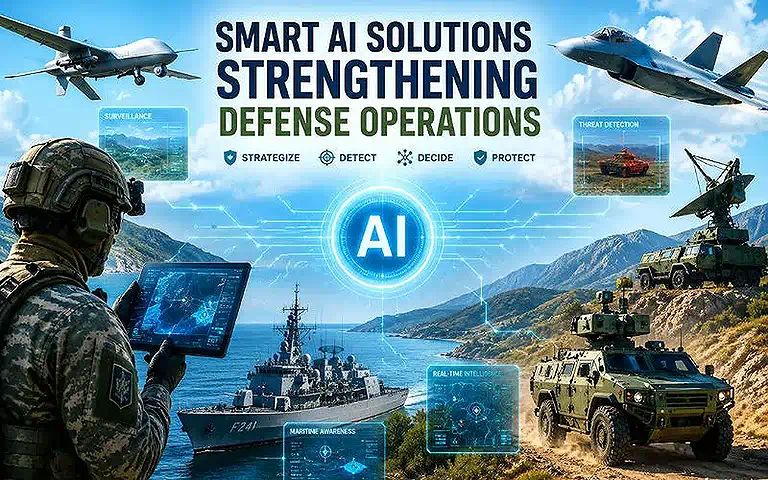
Cover Photo of AI Solutions for Strengthening Defence Operations
1 SAKSHAM (AI Command & Control Platform)
SAKHAM is an AI-powered battlefield command and control system that enhances airspace situational awareness and drone defense through real-time detection, tracking, identification, and threat neutralization. Developed for the Indian Army, it integrates multi-sensor data, automates critical operations, improves tactical decision-making, precision, and modern air defense efficiency.
How to use SAKSHAM (AI Command & Control Platform)?
- Integrate multi-sensor inputs such as radar, electro-optical systems, RF detectors, and surveillance feeds into the centralized SAKSHAM command framework.
- Monitor the live Recognized UAS Picture (RUP) dashboard to detect, classify, and track aerial threats in real time.
- Use AI-driven threat analysis to identify whether an aerial object is friendly, neutral, or hostile and prioritize response actions accordingly.
- Deploy coordinated countermeasures using soft-kill methods (jamming/spoofing) or hard-kill systems for drone neutralization and battlefield protection.
Key Features
- AI-enabled command-and-control architecture for low-altitude airspace awareness.
- Integrates detection, tracking, identification, and response information into a unified operational picture.
- Designed to support counter-unmanned aircraft system (C-UAS) operations.
- Combines information from multiple sensors and defense assets.
- Supports coordination of kinetic and non-kinetic response capabilities.
- Developed to improve situational awareness and response coordination in contested airspace.
Pros
- Provides unified real-time battlefield airspace awareness through multi-sensor fusion.
- AI-enabled predictive threat analysis improves tactical decision-making speed and accuracy.
- Supports both soft-kill and hard-kill drone defense operations within one platform.
- Reduces dependency on manual monitoring and improves operational efficiency for defense forces.
Cons
- Highly specialized military infrastructure may require extensive deployment and training.
- Integration with legacy defense systems can be technically complex.
- High operational and maintenance costs for large-scale battlefield implementation.
- Effectiveness may depend on sensor quality, communication reliability, and cyber resilience.
Limitations
- Primarily designed for military and defense environments, limiting civilian or commercial usability.
- Public technical documentation and transparency are limited due to national security considerations.
- Pricing, licensing, and deployment details are not openly disclosed for general users or enterprises.
Pricing Plan
Free / Trial Availability: No publicly available free plan or trial version has been disclosed for SAKSHAM’s defense platform.
Paid / Enterprise Deployment: Pricing appears to be custom and requirement-based for government or defense organizations. Official pricing inquiry page
Best For
SAKSHAM is best suited for defense organizations that need a unified command-and-control layer for monitoring low-altitude airspace and coordinating counter-drone capabilities.
Related Tools
Indrajaal Autonomous Drone Defense Dome , Anduril Lattice , Palantir Gotham
2 Indrajaal Autonomous Drone Defense Dome
The Indrajaal Autonomous Drone Defense Dome is an AI-powered counter-UAV system designed to protect military bases and critical infrastructure from drone and swarm attacks. Using advanced sensors, machine vision, RF jamming, and autonomous operations, it enables real-time threat detection, tracking, and neutralization while improving aerial security, response speed, precision, and battlefield efficiency.
How to use Indrajaal Autonomous Drone Defense Dome?
- Deploy the Indrajaal defense dome around military bases, strategic assets, or critical infrastructure to establish continuous aerial surveillance coverage.
- Integrate AI-powered sensors, radar systems, RF detection tools, and machine vision technologies for real-time drone monitoring and threat identification.
- Use the autonomous command system to detect, classify, and track individual drones or coordinated drone swarms across wide airspace zones.
- Activate counter-UAV responses such as RF jamming, electronic warfare measures, or automated neutralization protocols to prevent hostile drone intrusions.
Key Features
- AI-powered detection and tracking of aerial drone threats.
- Layered sensor architecture for identifying and monitoring potential threats.
- Supports electro-optical and infrared (EO/IR) tracking.
- Includes electronic countermeasures such as RF jamming and GNSS spoofing.
- Designed for autonomous or highly automated threat response.
- Can be deployed for protection of large areas and critical infrastructure.
Pros
- AI-driven autonomous operations reduce human workload during high-risk Defense scenarios.
- Capable of detecting and neutralizing both single drones and drone swarms effectively.
- Wide-area coverage improves security for military facilities and critical infrastructure.
- Combines multiple Defense technologies including machine vision, RF sensing, and jamming for layered protection.
Cons
- Deployment and maintenance costs may be high for large-scale operational environments.
- Performance can be affected by environmental conditions, signal interference, or evolving drone tactics.
- Requires advanced infrastructure integration and trained Defense personnel for optimal operation.
- Sensitive military-grade systems may face cybersecurity and electronic warfare challenges.
Limitations
- Primarily designed for Defense and strategic security applications rather than civilian use.
- Public technical specifications and operational capabilities are limited due to security restrictions.
- Autonomous systems may still require human oversight in complex combat or identification scenarios.
Pricing Plan
- Free / Trial Availability: No publicly available free version or trial access has been announced for the Intranasal Autonomous Drone Defense Dome.
- Paid / Enterprise Deployment: Pricing is likely customized for government, military, or enterprise Defense contracts based on deployment scale and operational requirements.
Best For
Indrajaal is best for organizations focused specifically on counter-drone defense, particularly the protection of critical infrastructure, borders, airbases, and other high-value areas.
Related Tools
SAKSHAM , Anduril Lattice , Swarm Drones
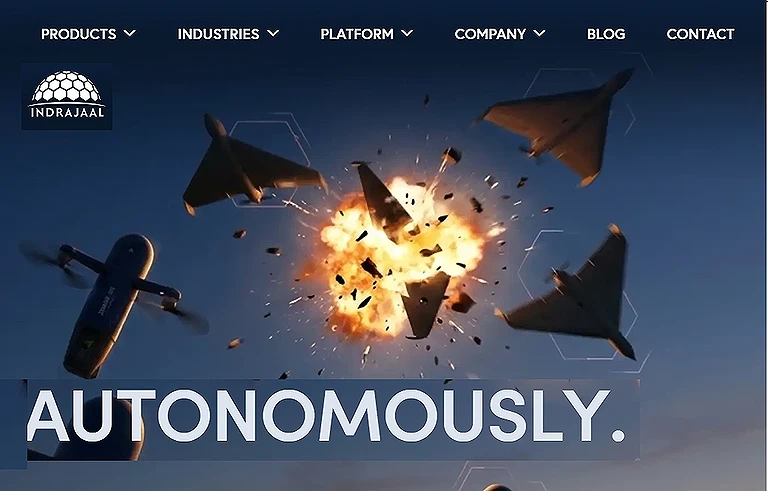
Image is about Indrajaal Autonomous Drone Defense Dome
3 Shield AI
The Shield AI MQ-35 V-BAT is an autonomous VTOL UAV designed for reconnaissance and resilient operations in GPS-denied electronic warfare environments. Powered by Hivemind AI software, it supports drone swarming, visual navigation, and autonomous coordination, enhancing ISR capabilities, tactical mobility, maritime and land operations, and battlefield efficiency with low logistical requirements.
How to use Shield AI MQ-35 V-BAT?
- Deploy the MQ-35 V-BAT from ships, mobile platforms, or confined operational areas using its VTOL launch and landing capability.
- Configure reconnaissance, surveillance, or ISR mission objectives through the Hivemind autonomous software system before flight.
- Utilize AI-powered visual odometry and autonomous navigation to operate effectively in GPS-denied or electronic warfare environments.
- Coordinate multiple drones for swarming and collaborative missions to improve battlefield awareness and tactical coverage.
Key Features
- Hivemind AI software provides autonomous mission capabilities.
- Supports operations in GPS- and communications-denied environments.
- Enables autonomous mission execution for unmanned platforms.
- Supports coordinated multi-agent operations and drone teaming.
- V-BAT provides ISR capabilities with modular sensor and payload options.
- Designed for multiple mission areas including tactical ISR, maritime operations, and autonomous aviation.
Pros
- Operates effectively in GPS-denied and contested electronic warfare environments.
- VTOL capability enables flexible deployment from ships and confined locations.
- Hivemind AI software supports autonomous navigation and cooperative drone swarming.
- Reduces logistical complexity while enhancing ISR and tactical reconnaissance capabilities.
Cons
- Advanced autonomous UAV systems can involve high acquisition and operational costs.
- Requires trained personnel and infrastructure for mission planning and system integration.
- AI-driven operations may face cybersecurity and electronic warfare vulnerabilities.
- Public access to detailed technical specifications may be limited due to Defense restrictions.
Limitations
- Primarily designed for military and Defense operations rather than civilian applications.
- Autonomous decision-making may still require human oversight for sensitive missions.
- Effectiveness can vary depending on environmental conditions and communication reliability.
Pricing Plan
Free / Trial Availability: No publicly available free version or trial access is offered for the Shield AI MQ-35 V-BAT system.
Paid / Defense Procurement: Pricing is customized for government and Defense contracts based on mission requirements, deployment scale, and support services.
Best For
Shield AI is best suited for defense organizations requiring autonomous aviation and ISR capabilities, particularly where communication or GPS availability may be unreliable.
Related Tools
Swarm Drones , Anduril Lattice , Helsing Altra
4 BigBear.ai VANE Predictive Intelligence Platform
The BigBear.ai VANE platform is an AI-driven predictive analytics and decision intelligence system that helps military forces forecast adversary behavior and plan strategic responses. By processing large datasets and battlefield simulations, it enhances threat anticipation, operational planning, situational awareness, rapid decision-making, and proactive defense strategies in modern military operations.
How to use BigBear.ai VANE Predictive Intelligence Platform?
- Integrate operational, intelligence, surveillance, and battlefield datasets into the VANE predictive intelligence platform.
- Use AI-driven analytics to model adversary behavior patterns, battlefield conditions, and strategic risk scenarios.
- Generate predictive insights and countermeasure recommendations to support mission planning, force deployment, and operational readiness.
- Run simulations and decision-support analyses to improve reaction times and enhance strategic military planning.
Key Features
- Uses AI and machine learning for predictive intelligence.
- Performs time-series forecasting across complex environments.
- Generates future-event warnings and anticipatory insights.
- Supports whole-of-environment situational awareness.
- Provides course-of-action impact analysis.
- Can process information across multiple domains and operational levels.
Pros
- AI-powered predictive analytics helps anticipate adversary actions before they occur.
- Aggregates and processes large-scale datasets for improved strategic intelligence.
- Enhances battlefield simulations and operational planning accuracy.
- Provides decision-ready insights that improve situational awareness and response speed.
Cons
- Predictive models depend heavily on the quality and accuracy of input data.
- Complex integration may require advanced infrastructure and skilled analysts.
- High reliance on AI systems can introduce risks related to bias or inaccurate forecasting.
- Military intelligence platforms may face cybersecurity and data protection challenges.
Limitations
- Primarily intended for Defense, intelligence, and national security applications.
- AI predictions cannot guarantee exact adversary behavior in unpredictable combat situations.
- Public information about internal algorithms and operational capabilities is limited due to security considerations.
Pricing Plan
Free / Trial Availability: No publicly available free version or trial access has been announced for the BigBear.ai VANE platform.
Paid / Enterprise & Government Solutions: Pricing is customized for Defense agencies, enterprise clients, and government contracts based on operational requirements and deployment scale
Best For
VANE is best for intelligence and defense organizations that need to analyze large amounts of information, identify emerging patterns, forecast potential developments, and support strategic decision-making.
Related Tools
Palantir Gotham , Domo Integration , Anduril Lattice
Cover photo BigBear.ai VANE Predictive Intelligence Platform
5 CrowdStrike Falcon
CrowdStrike Falcon is an AI-powered cybersecurity and endpoint protection platform designed to detect, prevent, and respond to cyber threats in real time. Using cloud-native architecture, machine learning, and threat intelligence, it helps organizations secure endpoints, workloads, and identities against ransomware, malware, and advanced attacks.
How to use CrowdStrike Falcon?
- Create an account and deploy the Falcon sensor on endpoints or servers.
- Configure security policies, threat detection rules, and monitoring dashboards.
- Use AI-driven alerts, incident response tools, and analytics to investigate and stop threats in real time.
Key Features
- AI-powered endpoint protection, detection, and response.
- Provides endpoint detection and response capabilities through Falcon Insight XDR.
- Uses threat intelligence to identify and investigate suspicious activity.
- Supports security across endpoints, identity, cloud, SaaS, and other environments.
- Provides automated investigation and security workflows.
- Falcon's newer AI capabilities support threat investigation and security operations.
Pros
- AI-powered threat detection with real-time monitoring capabilities.
- Cloud-native platform reduces infrastructure complexity and improves scalability.
- Strong endpoint protection with automated incident response and threat intelligence.
Cons
- Premium enterprise features can become expensive for smaller organizations.
- Initial configuration and policy management may require experienced security teams.
- Heavy reliance on internet connectivity because the platform is cloud-based.
Limitations
- Best suited for enterprise-level cybersecurity environments rather than basic personal security needs.
- Advanced analytics and response features may have a learning curve for beginners.
- Some legacy systems may require additional compatibility adjustments during deployment.
Pricing Plan
Free services: Offers free trials, demos, and limited evaluation access for businesses.
Paid plans: Enterprise subscription pricing varies based on endpoints, modules, and security requirements.
Best For
CrowdStrike Falcon is best for defense organizations and government environments that need to protect endpoints, cloud infrastructure, identities, and other digital assets against increasingly sophisticated cyber threats.
Related Tools
BigBear.ai VANE , Palantir Gotham , Domo Integration
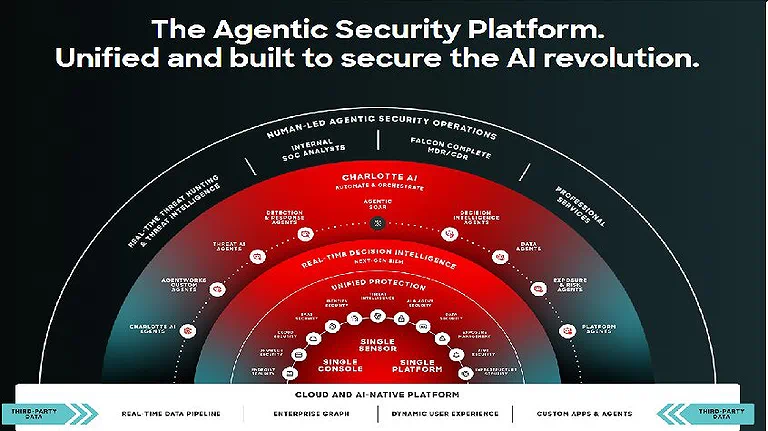
CrowdStrike Falcon Image
6 Swarm Drones
Swarm drones are AI-coordinated unmanned aerial vehicles that collaborate on reconnaissance, target tracking, surveillance, and strike missions. Using advanced AI algorithms and distributed intelligence, they communicate autonomously, avoid collisions, adjust formations dynamically, and gather real-time battlefield intelligence, providing resilient, scalable, and flexible operations that challenge conventional Defense systems in contested airspaces.
How to use Swarm Drones?
- Configure mission objectives such as reconnaissance, surveillance, target tracking, or coordinated strike operations through the swarm control platform.
- Deploy multiple AI-enabled UAVs that communicate and coordinate autonomously during missions.
- Use AI algorithms for dynamic formation control, collision avoidance, and adaptive route planning in real time.
- Monitor battlefield intelligence and swarm performance while adjusting operational strategies based on evolving mission conditions.
Key Features
Enables multiple drones to operate as a coordinated group.
Uses autonomous coordination to reduce the need for individual drone control.
Supports real-time formation and fleet management.
Can use onboard autonomy for navigation and coordination.
Designed to scale operations across large numbers of unmanned aircraft.
Can support ISR, surveillance, and other mission-specific applications depending on the platform.
Pros
- Distributed intelligence improves resilience by reducing reliance on a single control unit.
- Covers large operational areas efficiently for reconnaissance and surveillance missions.
- AI-driven coordination enables adaptive formations and autonomous decision-making.
- Effective for contested airspace operations and overwhelming traditional Defense systems.
Cons
- Swarm coordination systems can be highly complex and resource-intensive to manage.
- Vulnerable to cybersecurity threats, signal interference, and electronic warfare attacks.
- Large-scale deployment may require advanced communication infrastructure and high operational costs.
- Autonomous strike capabilities may raise ethical and regulatory concerns.
Limitations
- Swarm performance can be affected by communication disruptions or GPS-denied environments.
- Human oversight may still be required for mission authorization and critical engagement decisions.
- Public access to advanced military swarm technologies and technical details is often restricted.
Pricing Plan
Free / Trial Availability: No publicly available free plans or trial versions are generally available for military-grade swarm drone systems.
Paid / Defense Procurement: Pricing is typically customized based on swarm size, AI capability, sensor payloads, and mission requirements under Defense or government contracts.
Best For
Swarm drone technology is best suited for missions where multiple unmanned aircraft need to coordinate efficiently, expand coverage, or operate as a distributed autonomous system.
Related Tools
Shield AI , Anduril Lattice , Helsing Altra
Swarm drones are AI-coordinated unmanned aerial vehicles that collaborate on reconnaissance
7 Anduril Lattice
Anduril Lattice is an AI-powered defense operating system designed to integrate drones, sensors, radar systems, and autonomous platforms into a unified battlefield network. It provides real-time surveillance, threat detection, mission autonomy, and command-and-control capabilities for military and border security operations.
How to use Anduril Lattice?
- Integrate surveillance devices, drones, radars, and sensors into the Lattice ecosystem.
- Use the Lattice dashboard to monitor live battlefield or border activity in real time.
- Deploy AI-based target detection and autonomous mission planning features.
- Analyze operational data and coordinate autonomous systems through Lattice Mesh and SDK tools.
Key Features
AI-powered command-and-control and battle-management capabilities.
Creates a common operational picture from multiple sensors and data sources.
Integrates sensors, effectors, networks, and mission systems.
Provides AI-assisted decision support to operators.
Supports manned, unmanned, and autonomous assets.
Designed for multi-domain operations across land, sea, air, and space.
Pros
- Provides real-time situational awareness across land, sea, and air domains.
- Supports autonomous drones and AI-driven mission operations.
- Works with decentralized and edge-computing environments.
- Integrates multiple defense systems into a single command platform.
Cons
- Pricing is not publicly disclosed for enterprise or military deployments.
- Requires advanced infrastructure and trained defense personnel.
- Mainly designed for government and military organizations rather than public users.
- High dependency on sensor quality and network integration.
Limitations
- Limited public accessibility because the platform is defense-focused and restricted.
- Sandbox environments have operational limits such as short environment lifetimes.
- Some advanced capabilities may require secure military-grade hardware integrations.
Pricing Plan
Free: Anduril offers free Lattice Sandbox environments for developers with limited testing access and free API calls.
Paid: Enterprise and military pricing is custom-based and available through direct consultation with Anduril.
Best For
Anduril Lattice is best for organizations that need an integrated command-and-control environment capable of connecting sensors, autonomous systems, and other mission assets into a unified operational network.
Related Tools
SAKSHAM , Palantir Gotham , Shield AI
8 Helsing Altra
Helsing Altra is an AI-powered reconnaissance and strike coordination platform designed for modern defense operations. Developed by Helsing it integrates drones, sensors, artillery systems, and battlefield intelligence into a unified real-time operational network to improve targeting accuracy, decision-making, and mission coordination.
How to use Helsing Altra?
- Deploy Altra ground stations and connect drones, ISR systems, artillery, and battlefield sensors.
- Configure AI-assisted targeting, mission planning, and command-and-control workflows.
- Monitor real-time operational data, coordinate strike systems, and manage autonomous drone operations through the centralized interface.
Key Features
AI-enabled software for land-combat operations.
Connects ISR assets, ground systems, and other battlefield elements.
Uses edge AI for target acquisition and localization.
Supports coordinated precision effects.
Designed to operate in contested electromagnetic environments.
Includes components for ground stations, ISR, strike, and indirect-fire applications.
Pros
- AI-driven battlefield coordination improves target acquisition and operational speed.
- Supports integration with multiple defense platforms through open interfaces.
- Enhances resilience in contested electronic warfare environments using edge AI and distributed networking.
Cons
- Highly specialized military platform unsuitable for civilian or commercial use.
- Requires advanced infrastructure, trained operators, and secure defense networks.
- Ethical and regulatory concerns remain around autonomous AI-assisted warfare systems.
Limitations
- Access is restricted mainly to government and military organizations.
- Effectiveness depends heavily on integration quality with existing defense hardware and communication systems.
- Real-world deployment may face challenges in highly dynamic or degraded combat environments.
Pricing Plan
Free services: No public free plan or trial is currently available because the platform is designed for military and government contracts.
Paid plans: Custom enterprise and defense-contract pricing based on deployment scale, integrations, and operational requirements.
Best For
Helsing Altra is best suited for modern land forces seeking to connect intelligence, surveillance, reconnaissance, and operational systems through an AI-enabled battlefield software layer.
Related Tools
Shield AI , Anduril Lattice , Swarm Drones
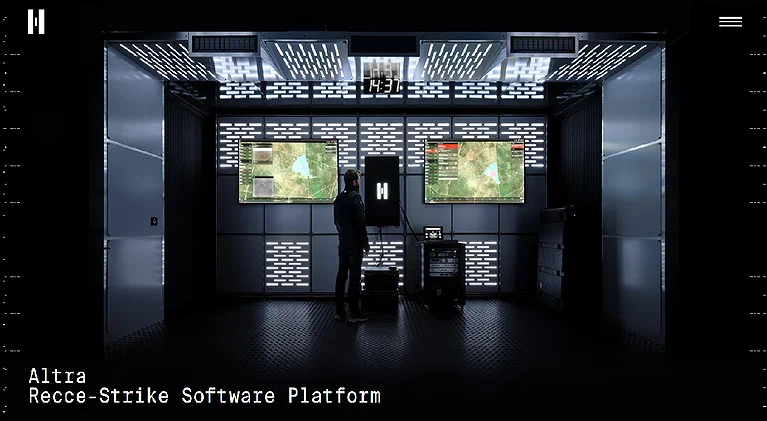
Image of Helsing Altra is an AI-powered reconnaissance and strike coordination platform designed for modern defense operations.
9 Domo Integration
Domo Integration is a cloud-based AI and business intelligence platform that connects, transforms, and analyzes data from multiple sources in one centralized environment. With over 1,000 connectors, automation tools, and AI-powered analytics, it helps organizations streamline workflows and make faster data-driven decisions.
How to use Domo Integration?
- Connect cloud apps, databases, spreadsheets, or enterprise systems using Domo’s built-in connectors.
- Prepare and transform raw data through automated pipelines and no-code workflow tools.
- Create dashboards, AI-powered reports, and real-time analytics to monitor business performance.
Key Features
- Connects data from cloud, on-premises, and other sources.
- Provides more than 1,000 pre-built data connectors.
- Supports data integration, transformation, and orchestration.
- Offers visual ETL capabilities through Magic ETL.
- Supports APIs, SDKs, custom connectors, and webhooks.
- Provides data governance, permissions, dashboards, and analytics.
Pros
- Supports integration with 1,000+ data sources and cloud platforms.
- AI-powered dashboards and automation improve operational efficiency.
- No-code and low-code tools make analytics accessible for non-technical users.
Cons
- Enterprise-level pricing may be expensive for small businesses.
- Advanced customization and governance features can require technical expertise.
- Performance may depend on data pipeline configuration and external integrations.
Limitations
- Some on-premise or highly regulated systems may need additional setup for integration.
- Complex enterprise deployments can involve a learning curve during implementation.
- Certain advanced AI and automation capabilities are available only in premium plans.
Pricing Plan
Free services: Offers free trials, demos, and limited platform evaluation access.
Paid plans: Custom subscription pricing based on users, data volume, integrations, and enterprise requirements.
Best For
Domo is best for organizations that need to bring data from multiple systems into a unified environment for analysis, visualization, reporting, and data-driven decision-making. In your article, position it as a data integration and analytics platform that can support defense workflows, rather than calling it a dedicated defense AI system.
Related Tools
Palantir Gotham , BigBear.ai VANE ,Anduril Lattice
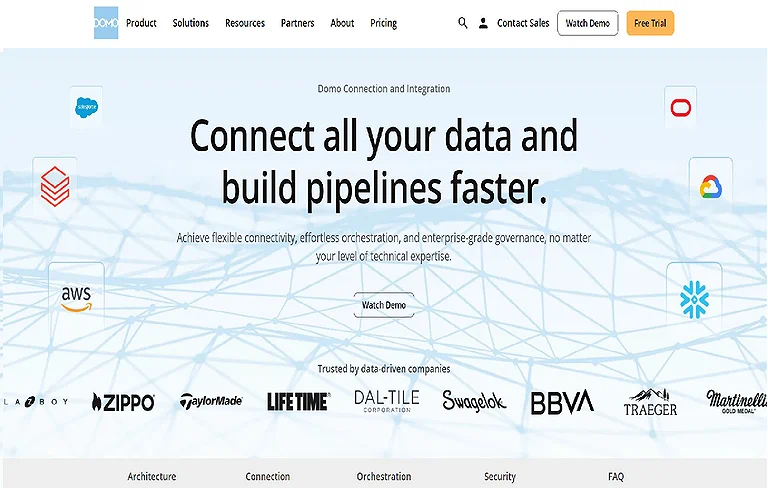
Domo Integration is a cloud-based AI and business intelligence platform that connects, transforms image
10 Palantir Gotham
Palantir Gotham is an AI-powered intelligence and defense analytics platform designed for military, government, and law-enforcement operations. It integrates massive amounts of structured and unstructured data, enabling analysts to identify threats, monitor battlefield activity, visualize networks, and support mission-critical decision-making in real time.
How to use Palantir Gotham?
- Integrate operational data sources such as satellite feeds, sensors, reports, videos, and intelligence databases into Gotham.
- Use Gotham’s AI-driven analytics and geospatial tools to detect patterns, threats, and suspicious activities.
- Visualize connections between people, locations, and events through interactive maps and network graphs.
- Build custom applications and workflows using Gotham APIs and secure REST integrations.
Key Features
- Integrates operational data to support decision-making.
- Provides AI-enabled situational awareness and decision support.
- Supports intelligence and operational workflows.
- Can connect information from sensors and other operational systems.
- Supports autonomous sensor tasking alongside human-in-the-loop controls.
- Designed to operate from command centers to tactical edge environments.
Pros
- Combines multiple data sources into a unified operational intelligence platform.
- Provides advanced geospatial analysis, mapping, and threat visualization.
- Supports classified, air-gapped, and high-security defense environments.
- Enables real-time collaboration and AI-assisted decision-making for defense agencies.
Cons
- Extremely expensive and primarily targeted at governments and large enterprises.
- Requires highly trained analysts and technical teams for deployment and operation.
- Deployment cycles can be lengthy and infrastructure-intensive.
- Raises privacy and surveillance concerns in some law-enforcement applications.
Limitations
- No public self-service version for general users or small businesses.
- Full platform capabilities depend on secure infrastructure and extensive data integration.
- Many pricing and deployment details remain confidential due to government contracts.
Pricing Plan
Free: No official free version or public free trial is currently available. Some pilot programs or proof-of-concept deployments may be offered through direct enterprise consultation.
Paid: Pricing is custom-based for government and enterprise deployments. Some reports estimate perpetual licenses around $147,324 per server core and cloud licenses around $7,366/month per server core, though official pricing is not publicly disclosed.
Best For
Palantir Gotham is best for defense and intelligence organizations that need to combine complex operational data and provide analysts and commanders with a unified environment for intelligence, situational awareness, and decision support.
Related Tools
Anduril Lattice , BigBear.ai VANE , SAKSHAM
AI Defense Solutions Compared by Capability
The solutions we discussed in this guide address different parts of defense operations. Some focus on autonomous platforms, while others concentrate on command and control, predictive intelligence, cybersecurity, or data integration. Therefore, there is no single best AI defense solution for every mission.
| Capability | Solutions in This Guide | Primary Role |
| Command and Control | SAKSHAM, Anduril Lattice | Connect operational data, sensors, and mission systems to support command decisions and situational awareness. |
| Autonomous Operations | Shield AI, Helsing Altra | Support autonomous or AI-enabled systems for mission execution, coordination, and battlefield operations. |
| Counter-Drone Defense | Indrajaal | Detect, track, identify, and respond to unauthorized or hostile drone threats. |
| Predictive Intelligence | BigBear.ai VANE | Analyze data, identify patterns, forecast potential developments, and support intelligence decision-making. |
| Cybersecurity | CrowdStrike Falcon | Detect, investigate, and respond to cyber threats targeting endpoints, identities, cloud environments, and other digital assets. |
| Data Integration | Domo, Palantir Gotham | Combine and analyze information from multiple data sources to create a more unified operational view. |
| Intelligence and ISR | Shield AI, Palantir Gotham, BigBear.ai VANE | Support intelligence collection, analysis, surveillance, reconnaissance, and situational awareness. |
| Multi-System Coordination | Anduril Lattice, Shield AI | Coordinate sensors, platforms, autonomous systems, and other mission assets across complex operational environments. |
Which Type of AI Defense Solution Is Best for Each Need?
- For command and control: Platforms such as Anduril Lattice are designed to provide a common operational picture and connect sensors, effectors, and mission systems. Anduril describes Lattice C2 as an AI-powered battle-management platform that integrates data from large numbers of sensors and systems to support operator decision-making.
- For autonomous aviation: Shield AI's Hivemind focuses on AI pilots capable of autonomous mission execution and multi-agent coordination, including operations in GPS- and communications-denied environments.
- For predictive intelligence: BigBear.ai's VANE is designed around forecasting, future-event warnings, situational awareness, and course-of-action impact analysis for intelligence and defense applications.
- For cybersecurity: AI-enabled cybersecurity platforms address a different part of the defense environment by identifying suspicious behavior, threats, and attacks against digital infrastructure and endpoints.
- For data integration: Data platforms can help organizations combine information from multiple sources so analysts and commanders can work from a more unified operational picture.
The key takeaway is that these systems should not necessarily be viewed as direct competitors. A modern defense environment may require multiple AI capabilities working together, with each system addressing a different stage of the operational workflow.
Risks and Limitations of AI in Defense
AI can provide significant advantages in defense operations, but its outputs are not automatically accurate, reliable, or appropriate for every situation. Defense organizations must consider technical, operational, cybersecurity, legal, and human factors before deploying AI-enabled systems.
Data Quality Problems
AI systems depend heavily on the quality of the data used for training, testing, and operational decision-making. Incomplete, outdated, biased, or incorrectly labeled data can reduce the reliability of an AI system.
NATO identifies quality, AI-ready data as a prerequisite for secure, reliable, and responsible AI capabilities.
False Positives and False Negatives
An AI system may incorrectly identify a threat or fail to recognize an actual threat. The consequences can be particularly significant in defense environments because decisions may have operational or safety implications.
For this reason, AI outputs should be evaluated within the context of the mission rather than automatically treated as facts.
Adversarial Manipulation
AI systems can become targets themselves. An adversary may attempt to manipulate input data, disrupt communications, exploit software vulnerabilities, or interfere with the AI system's operating environment.
NATO specifically identifies manipulation, sabotage, and exploitation of AI limitations as security concerns and calls for appropriate testing and security measures.
GPS and Communications Disruption
Autonomous systems may operate in environments where GPS signals or communications links are degraded or unavailable. Technologies designed for contested environments can reduce some of these dependencies, but they do not eliminate the broader challenges associated with operating under electronic warfare conditions.
Integration Challenges
An AI system may be technically capable but difficult to integrate with existing sensors, networks, databases, command systems, and legacy infrastructure.
Interoperability is therefore an important consideration when evaluating defense AI rather than focusing only on the underlying AI model.
Explainability and Traceability
Operators and decision-makers may need to understand why an AI system generated a particular recommendation or alert. NATO includes explainability and traceability among its Principles of Responsible Use for AI in defense.
Human Oversight
AI can support human decision-making without necessarily replacing human responsibility.
NATO's responsible-use principles explicitly emphasize responsibility and accountability, appropriate human-machine interaction, and the ability to disengage or deactivate systems when unintended behavior occurs.
For high-consequence applications, an appropriate operating model may therefore include:
- AI collects or analyzes information.
- AI identifies patterns, anomalies, or possible courses of action.
- Human operators review relevant information.
- Authorized personnel make decisions within established rules and procedures.
- AI assists with execution or coordination where permitted.
- Operators monitor system behavior and retain appropriate intervention mechanisms.
The exact level of human involvement depends on the mission, system design, authorization requirements, and applicable laws and policies.
FAQ
1. What are the main benefits of using AI in defense systems?
AI improves situational awareness, automates repetitive and hazardous tasks, enhances predictive maintenance, and accelerates military decision-making. It helps defense organizations reduce response times, optimize resource allocation, and improve mission success while minimizing risks to personnel.
2. How do autonomous drones and UGVs work in defense operations?
Autonomous drones and unmanned ground vehicles use AI, computer vision, GPS, sensors, and machine learning to navigate, detect threats, collect intelligence, and complete surveillance or tactical missions. They can operate with limited human intervention while adapting to changing battlefield conditions.
3. What are the limitations of AI in defense?
AI systems depend on high-quality data, reliable communications, and secure infrastructure. They may struggle in unpredictable environments, can become targets of cyberattacks, and still require human oversight for ethical decisions, strategic planning, and rules of engagement.
4. How does AI improve air defense systems like SAKSHAM and Indrajaal?
AI-powered defense platforms combine radar feeds, surveillance sensors, and real-time analytics to identify aerial threats, prioritize targets, and coordinate rapid responses. This improves detection accuracy, minimizes false alarms, and enables faster interception of hostile aircraft and drones.
5. Why is human-AI collaboration important in defense operations?
Human operators provide critical judgment, ethical oversight, and strategic decision-making that AI cannot replicate. Combining AI-generated insights with military expertise ensures safer, more reliable, and more effective defense operations.
6. How does AI strengthen military cybersecurity?
AI continuously monitors networks for suspicious activity, detects malware, identifies unusual behavior, and automatically responds to cyber threats. Platforms like CrowdStrike Falcon use machine learning to stop attacks before they spread across defense infrastructure.
7. What is predictive intelligence in military operations?
Predictive intelligence uses AI to analyze historical and real-time data to forecast enemy movements, logistics challenges, equipment failures, and emerging threats. Solutions such as BigBear.ai VANE help commanders make faster, data-driven operational decisions.
8. How do AI-powered command and control platforms improve battlefield coordination?
AI command and control systems integrate information from satellites, drones, radar, sensors, and military units into a single operational view. This enables commanders to coordinate forces more effectively, improve situational awareness, and respond to threats in real time.
9. Can AI completely replace soldiers and military commanders?
No. AI is designed to assist military personnel rather than replace them. While it excels at processing large volumes of data and automating routine tasks, humans remain essential for leadership, ethical decision-making, diplomacy, and complex tactical judgments.
10. What is the future of AI in defense operations?
The future of AI in defense includes increasingly autonomous surveillance systems, intelligent drone swarms, predictive battlefield analytics, AI-assisted logistics, advanced cyber defense, and faster command-and-control platforms. As these technologies mature, they are expected to enhance military readiness, operational efficiency, and national security while continuing to rely on human oversight for critical decisions.
Conclusion
Smart AI Solutions Strengthening Defense Operations are transforming modern military strategy through intelligent automation, predictive analytics, autonomous systems, and real-time threat detection. Platforms like CrowdStrike Falcon, Anduril Lattice, Palantir Gotham, and Shield AI enhance situational awareness, cybersecurity, drone operations, and battlefield coordination. Meanwhile, innovations such as SAKSHAM, Indrajaal Autonomous Drone Defense Dome, Helsing Altra, and BigBear.ai VANE help defense organizations improve decision-making speed, operational efficiency, and mission readiness. As AI technology evolves, organizations must also strengthen their digital infrastructure against increasingly sophisticated cyberattacks. Explore our guide on AI tools transforming cyber threat defense to discover how next-generation security platforms detect, prevent, and respond to modern cyber threats in real time.