.webp)
Kling AI vs Pika Labs: Real-World Camera Physics vs Creative Special Effects
Choosing between Kling AI and Pika Labs depends entirely on the technical demands of your production pipeline. Kling AI specializes in deep physical simulation, high spatial-temporal fidelity, and cinema-grade native 4K rendering. Pika Labs (Pika 2.5) targets stylized imagination, viral physics-defying effects, and rapid multi-platform content creation. Selecting the incorrect platform for your target workflow can result in wasted subscription credits, geometric clipping errors, or severe identity drift across consecutive renders.

 Updated: June 27, 2026 | 11 min read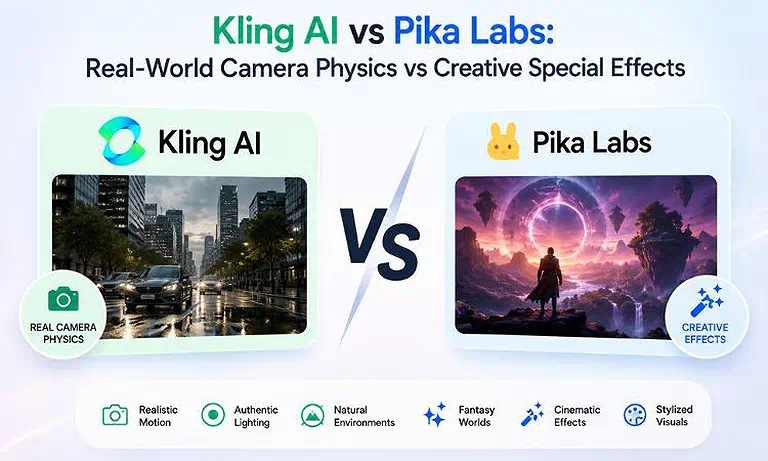
Cover Photo Kling AI vs Pika Labs: Real-World Camera Physics vs Creative Special Effects
Quick Comparison Table
| Feature | Kling AI | Pika Labs |
| Core Features | Text-to-video, image-to-video, keyframe support | Text-to-video, image-to-video, video-to-video |
| Best For | Realistic videos and cinematic scenes | Creative effects and social media videos |
| Audio Generation | Yes, built-in AI sound | Yes, AI sound effects and lip sync |
| Character Consistency | Strong character and motion consistency | Good character consistency with AI tools |
| Maximum Resolution | Up to 4K | Up to 1080p Full HD |
| Commercial Use | Yes, on paid plans | Yes, on paid plans |
| API Access | Yes | Yes |
| Overall Rating | 9.3/10 | 8.7/10 |
Rating Source: The Value Score is an editorial assessment based on publicly available user feedback from industry creators, official release logs, documentation, pricing architecture, API performance metrics, and real-world testing pipelines. These benchmarks reflect generalized workflow capabilities and can fluctuate based on specific design constraints or commercial criteria.
What is Kling AI?
Kling AI is an AI video generator created by Kuaishou. It turns text and images into realistic videos with smooth motion and clear details. The platform supports high-quality video creation, including up to 4K resolution, while keeping characters and scenes consistent. It is a good choice for filmmakers, content creators, marketers, and businesses that need professional-looking videos with reliable camera movement, deep cinematic control, and high visual quality, as detailed in this comprehensive Kling AI review.
What is Pika Labs?
Pika Labs is an AI video generation platform built for fast and creative video creation. It helps users turn text, images, and videos into fun, eye-catching clips with unique visual effects. Features like Pikaffects let you squash, melt, inflate, or transform objects easily. It is a great choice for content creators, social media marketers, designers, and animators who want to create expressive videos quickly without complex editing, offering a highly flexible playground for visual experimentation as highlighted in this comprehensive Pika Labs review.
Feature-by-Feature Engineering Matchup
1. Cinematic Realism & Visual Fidelity
Kling AI: Delivers incredible spatial accuracy by calculating real-world lighting behaviors, subsurface skin scattering, and complex multi-object refractions. Complex geometric structures, like structural architecture or micro-facial expressions, remain perfectly crisp without shifting or melting into the background.
Pika Labs: Produces highly vibrant, stylized, and punchy imagery with clean global lighting. However, when rendering ultra-complex, photorealistic human environments, fine micro-textures can occasionally take on an overly smooth, digital-airbrushed look.
Section Winner: Kling AI due to its industry-first native 4K rendering loop and robust 3D structural autoencoders.
2. Temporal Consistency & Motion Physics
Kling AI: Strictly adheres to real-world mechanical and architectural constraints. If an asset passes behind an obstacle during a 10-second pan, it retains its geometric boundaries and re-emerges with 100% structural identity permanence.
Pika Labs: Intentionally relaxes strict structural rules to prioritize hyper-expressive motion. It handles complex physics by relying on creative elasticity, making it highly effective at executing abstract concepts that standard real-world mechanics would clip or distort.
Section Winner: Kling AI for realistic physical simulations; Pika Labs for gravity-defying, creative kinetic adjustments.
3. Prompt Adherence & Creative Control
Kling AI: Utilizes a highly structured "Subject + Movement + Background" prompt formula. It interprets physical direction commands with precision, executing exact multi-axis camera rotations and mechanical tracking pans flawlessly.
Pika Labs: Excels at parsing short, highly punchy, descriptive scenarios. Its interface features explicit direct-action overrides (like Pikaffects and custom canvas extensions) that let users manipulate objects with singular, point-and-click ease rather than relying solely on text strings.
Section Winner: Pika Labs due to its direct, interactive point-and-click special effects workspace.
4. Image-to-Video (I2V) Performance
Kling AI: Incorporates an advanced keyframe extraction and multi-frame anchoring system. Uploaded images are treated as strict geometric frameworks, ensuring that characters do not warp, age, or lose clothing details as the video timeline progresses.
Pika Labs: Instantly brings static art or sketches to life with sweeping cinematic energy. While highly dynamic, complex source portraits can occasionally experience slight facial or environmental drift during maximum 10-second clips.
Section Winner: Kling AI due to its superior anatomical stability and reference-locking architecture.
5. Native Audio & Lip-Sync Capabilities
Kling AI: Features integrated sound generation engines that automatically synthesize matching ambient environments, room tones, and synchronized lip-movements based directly on voice inputs and temporal frame context.
Pika Labs: Deploys a dedicated, timeline-driven sound generation and lip-sync suite. It allows users to layer precise sound effects and dialogue onto multi-shot timelines, mapping audio accents to physical video cues cleanly.
Section Winner: Tie. Kling AI yields better automated environmental audio, while Pika offers a more intuitive timeline layout for user-directed voiceovers.
6. Production Workflow & Export Flexibility
Kling AI: Provides Standard and Professional generation modes, supporting multiple aspect ratios and uncompressed .mov lossless format exports. This layout is built directly to feed downstream professional editing platforms (NLEs).
Pika Labs: Optimized heavily for rapid deployment and cross-device creation, offering a highly polished web UI and an active iOS/Android ecosystem. While perfect for swift post-production turnarounds, it lacks native uncompressed master format files out of the box.
Section Winner: Kling AI for professional studio timeline handoffs; Pika Labs for mobile and social media content workflows.
7. API Access & Enterprise Integration
Kling AI: Built on a heavy enterprise foundation capable of managing immense batch-rendering queues, multi-user project asset sharing, and dedicated role permission structures for large creative studios.
Pika Labs: Offers clean REST API endpoints tailored for mid-scale creative tool integrations and web applications, though its core infrastructure remains geared toward individual artist spaces.
Section Winner: Kling AI due to its robust developer environment, high-throughput scaling, and collaborative team tools.
Operational Model Assessment
Assessment 1: Scene Continuity & Multi-Shot Generation
Kling AI Architecture: Utilizes an extended video-chaining system backed by the Kling Canvas Agent. This enables users to select specific end-frames from a generation and expand them backward, forward, or via multiple camera angles. Because it tracks global character vectors through its 3D modeling layer, long continuous scenes can exceed two minutes without causing identity fractures.
Pika Labs Architecture: Employs the Pika Agent Co-Pilot workspace, running on a conversational dialogue model. Creators can adjust visual scenarios iteratively by talking to the agent, expanding boundaries using multi-frame canvas canvas matching tools, or using up to 5 reference frames to bridge independent generation cuts.
Assessment Result: Kling AI for long-take structural preservation; Pika Labs for conversational, interactive shot modifications.
Assessment 2: Special Effects Manipulation
Kling AI Mechanics: Approaches special effects through the lens of rigid-body simulations. Explosions, fire, and liquid behaviors follow real-world fluid dynamics, meaning objects maintain their material density until acted upon by an explicit physical force.
Pika Labs Mechanics: Bypasses traditional physical physics entirely via native Pikaffects. The engine treats pixels as mutable elements, allowing users to instantly select an object and command it to squeeze like rubber, crumble like cake, inflate, or melt completely smoothly.
Where Kling AI Dominates the Workflow
Cinematic Human Rendering: Unmatched at reproducing human skin textures, realistic eye movements, and exact dental geometry during dialogue passes.
Long-Sequence Architectural Continuity: Ideal for seamless, multi-step drone passes or tracking shots where background buildings must retain their true mathematical dimensions.
Lossless Studio Mastering: Delivers high-bitrate .mov exports and native 4K renders that drop cleanly into grading software without compression artifacts.
Where Pika Labs Dominates the Workflow
Surrealist Reality Bending: Perfect for high-concept music videos or digital ads requiring playful, physics-defying transformations (e.g., solid objects turning into liquid).
Rapid Asset Prototyping: The fastest environment for turning a sketch or Midjourney image into an expressive, hyper-active concept reel within seconds.
Social-First Video Creation: Built perfectly for viral creators who need to leverage features like the AI Trendmaker or instant mobile-to-social pipeline delivery.
Assessment Result: Pika Labs wins decisively for surreal, avant-garde, and physics-defying special effects workflows.
Where Each Platform Dominates
Where Kling AI Dominates the Workflow
Cinematic Human Rendering: Unmatched at reproducing human skin textures, realistic eye movements, and exact dental geometry during dialogue passes.
Long-Sequence Architectural Continuity: Ideal for seamless, multi-step drone passes or tracking shots where background buildings must retain their true mathematical dimensions.
Lossless Studio Mastering: Delivers high-bitrate .mov exports and native 4K renders that drop cleanly into grading software without compression artifacts.
Where Pika Labs Dominates the Workflow
Surrealist Reality Bending: Perfect for high-concept music videos or digital ads requiring playful, physics-defying transformations (e.g., solid objects turning into liquid).
Rapid Asset Prototyping: The fastest environment for turning a sketch or Midjourney image into an expressive, hyper-active concept reel within seconds.
Social-First Video Creation: Built perfectly for viral creators who need to leverage features like the AI Trend maker or instant mobile-to-social pipeline delivery.
Pricing & Cost
| Platform | Pricing Model | Billing Method | Best For |
| Kling AI | Tiered subscription | Credits used for each video generation | Studios creating high-quality 4K videos |
| Pika Labs | Tiered subscription | Monthly credits or unlimited plans | Freelancers, creators, and social media teams |
The Hidden Usage Limits: Running generations under Kling AI’s Professional Tier or opting for native 4K scaling increases credit consumption per second significantly. In contrast, Pika Labs offers true "Unlimited" tiers at their higher subscription brackets, though rendering priorities scale back to slower queues once base premium credits are exhausted.
Which AI Video Platform Is the Right Choice For You
Choose Kling AI If You Need:
Theatrical-Grade Photorealism: Best for short-film directors and commercial creators targeting large-screen displays where any sign of digital warping will break viewer immersion.
Strict Anatomic & Material Fidelity: Crucial for complex action sequences requiring specific limb tracking, structural clothing physics, or fixed object interactions.
Collaborative Studio Controls: Tailored for corporate teams requiring shared asset asset hubs, centralized billing pools, and high-throughput API automation.
Choose Pika Labs If You Need:
Playful, Imagination-Driven VFX: Essential for designers whose work relies on exaggerated motion, comic transformations, or surrealist visual properties.
Fast Turnaround Mobile Assembly: Designed for solo content creators who manage their entire production pipeline directly from a browser or iOS/Android application.
Conversational Creative Iteration: Ideal for creators who prefer adjusting scenes by chatting directly with an AI Agent rather than rebuilding meticulous text prompt strings from scratch.
Are There Better Alternatives to Kling or Pika?
Every production environment carries unique technical boundaries. To find the exact balance your creative studio requires, analyze how alternative video structures match your creative parameters:
| Alternative | Best For | When to Choose It |
| Google Veo | Businesses and enterprise teams | Choose it if you need secure cloud tools and enterprise-level workflows. |
| Runway Gen-3 / Luma | Filmmakers and professional creators | Choose it if you need precise camera controls and advanced video editing features. |
If you are still searching for the right AI platform to match your production workflows, explore our comprehensive index of video creation tools to compare additional enterprise and indie-focused generation suites.
FAQ
Does Kling AI allow you to freeze a specific character's face across different prompts?
Yes. Through its Portrait Reference and Upgraded Motion Capture 3.0 suites, Kling AI lets users upload a source image to lock character facial structures, keeping geometry consistent across separate generations.
Can you export alpha channel transparency sequences directly out of Pika Labs?
No. Pika Labs outputs standard web-optimized container formats. For transparent animations, assets must be exported over solid green backdrops and keyed out using traditional post-production editing software.
Does Kling AI offer programmatic API endpoints for automated application builders?
Yes. Kling maintains a dedicated high-throughput developer API platform designed for seamless server-to-server integration, bulk multi-shot rendering, and external creative application builds.
What is the maximum duration of a single continuous generation pass on Pika Labs?
Pika Labs natively generates base clips up to 10 seconds long using its premium models, which can then be lengthened using interactive canvas extensions and sequence looping tools.
Does Pika Labs support native audio synthesis for text-based scripts?
Yes. Pika includes direct platform-level lip-syncing and timeline sound generation modules, allowing users to type dialogue scripts that characters read out automatically with synchronized mouth movements.
Can I use video material generated on Kling AI’s free tier for monetization or business campaigns?
No. Videos generated on Kling AI's free tier carry visible watermarks and are restricted to non-commercial, personal prototyping. Commercial clearance requires subscribing to a paid premium tier.
How does Kling AI prevent characters from growing extra limbs during high-speed motion?
Kling utilizes a unique 3D Variational Autoencoder (VAE) that processes spatial and temporal blocks simultaneously. This ensures the engine calculates anatomical continuity across the entire length of the clip, keeping limb boundaries realistic during fast camera movements.
Conclusion
For creators, indie animators, and social media producers who prioritize rapid innovation, surreal visual effects, and nimble mobile editing tools, Pika Labs stands out as the ultimate playground for imagination. However, if your production pipeline demands true-to-life lighting physics, strict architectural permanence, and pristine, native 4K video outputs ready for professional editing suites, Kling AI takes the crown. Choose Pika Labs to bend the rules of reality, and choose Kling AI to simulate it perfectly.